Airfix 1/72 Vulcan B.2
|
KIT #: |
09003 |
|
PRICE: |
€30.00 in 2005 |
|
DECALS: |
Three options |
|
REVIEWER: |
Spiros Pendedekas |
|
NOTES: |
Original tooling |
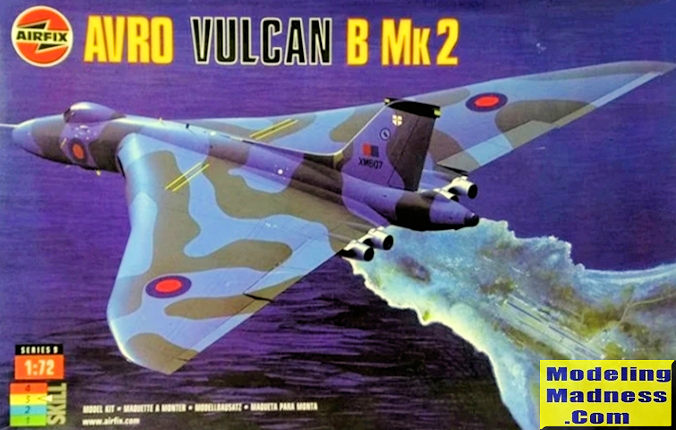
The Avro Vulcan was the second of Britain's famous V-bombers,
developed during the early years of the Cold War to provide the Royal Air
Force with a high-speed, high-altitude strategic nuclear strike capability.
Designed by Avro under the direction of Roy Chadwick and his team, the
Vulcan's enormous tailless delta wing gave it a futuristic appearance unlike
any other bomber of its era. The first prototype flew in August 1952, and
the B.1 entered RAF service in 1956.
The improved B.2 followed in the early 1960s, featuring a larger and
stronger wing, more powerful Rolls-Royce Olympus engines and substantially
improved avionics and electronic equipment. The Vulcan became a major
component of Britain's nuclear deterrent, initially carrying free-fall
nuclear weapons and later the Blue Steel stand-off missile. As Soviet air
defenses became increasingly capable, however, the Vulcan's operational role
gradually shifted toward lower-level operations and conventional strike
missions.
The Vulcan achieved perhaps its greatest fame during the 1982
Falklands War. In Operation Black Buck, Vulcans flew extraordinarily
long-range missions from Ascension Island to attack Argentine positions at
Port Stanley. The raids required an elaborate chain of Victor tanker
aircraft to refuel the bombers in flight and remain among the most
remarkable long-distance bombing missions ever undertaken.
Following the Falklands War, the Vulcan's operational career was finally
drawing to a close. The last aircraft left RAF service in 1984, bringing an
end to the career of one of Britain's most distinctive Cold War aircraft.
Yet the Vulcan's extraordinary appearance and unmistakable howl ensured that
it would remain one of the most beloved British military aircraft ever
built.
 The Airfix 1/72 Avro Vulcan B.Mk.2 first appeared in 1983 and, for
its time, represented a remarkable achievement in large-scale
injection-molded aircraft modeling. Even today, it is easy to understand why
the kit became such a long-lived favorite. Its enormous size, imposing delta
planform and relatively simple overall architecture allowed Airfix to
capture the unmistakable character of the Vulcan in a way that was, for many
years, unmatched. Airfix itself has described the original tooling as a
triumph of the plastic-injection technology available at the time.
The Airfix 1/72 Avro Vulcan B.Mk.2 first appeared in 1983 and, for
its time, represented a remarkable achievement in large-scale
injection-molded aircraft modeling. Even today, it is easy to understand why
the kit became such a long-lived favorite. Its enormous size, imposing delta
planform and relatively simple overall architecture allowed Airfix to
capture the unmistakable character of the Vulcan in a way that was, for many
years, unmatched. Airfix itself has described the original tooling as a
triumph of the plastic-injection technology available at the time.
The particular example previewed here, was purchased by me around
2005 from one of my usual beloved hobby shops in Athens, at the then quite
normal price of approximately €30. It came in the large, classic Airfix box
of the period, with its impressive box art immediately conveying the sheer
presence of Britain's mighty delta bomber.
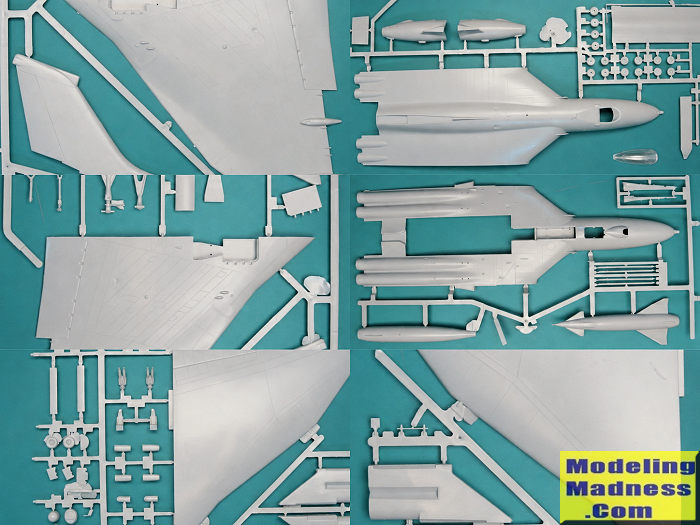
Upon opening the box, I was greeted with not more than 101
light-gray styrene parts, arranged on six sprues. One additional part is
included separately, representing a modified bomb-bay floor designed to
accommodate the Blue Steel stand-off missile.
The molding is definitely old-style, with raised panel lines,
somewhat soft detail, and quite a bit of flash here and there that should be
removed carefully during parts preparation. Nevertheless, the overall shapes
of the major components look convincing and accurate, and the characteristic
lines of the Vulcan are captured well.
The cockpit is extremely basic, containing only two rudimentary
seats, two control yokes, an instrument panel where a decal is to be affixed
and the rear bulkhead. There is nothing particularly special here, although
this is hardly a serious criticism in practice, as very little, if anything,
will be visible through the cockpit transparencies once the fuselage is
assembled.
The landing gear is also very much on the simplified side. The wheel
wells and gear doors have virtually no internal detail. The landing gear
itself is barely acceptable by today's standards—just a step away from
looking toy-like, although fortunately it does not quite cross that line.
Some additional detailing would certainly improve this area considerably.
A Blue Steel missile is included and can be carried beneath the
aircraft by replacing the standard bomb-bay doors with the specially
provided modified piece. The Blue Steel is an interesting inclusion.
Although its operational history was relatively brief, its presence provides
the modeller with the option of representing the Vulcan in its strategic
nuclear strike configuration.
The transparencies are reasonably well done and should provide an
adequate representation of the Vulcan's distinctive cockpit glazing. The
instructions are also adequate and follow the traditional Airfix/Heller
style of the period. Coming in the form of a 12-page A4 booklet, they
include a short history of the aircraft, while construction is divided into
16 clear, concise and easily followable steps, with some color callouts
given throughout. Apart from some missing color callouts, for a kit of this
vintage the instructions are sufficient to guide the modeller through the
build.
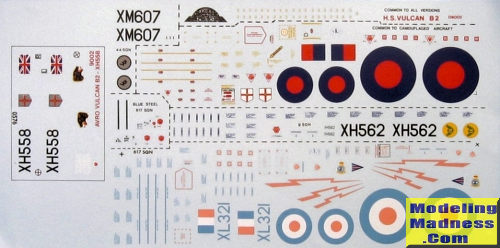 Four marking schemes are provided, although there is an interesting
caveat concerning the fourth option:
Four marking schemes are provided, although there is an interesting
caveat concerning the fourth option:
- No. 44 Squadron, XM607 — RAF Waddington, August 1982, in the
familiar Dark Green/Dark Sea Grey camouflage with Light Grey undersurfaces.
- No. 617 Squadron, XL321 — RAF Scampton, 1963, in overall Gloss
White.
- No. 9 Squadron, XH562 — RAF Waddington, 1977, in Dark Green/Dark
Sea Grey camouflage with Light Grey undersurfaces.
- XH558, the famous Vulcan that eventually became the world's last
flying example, appearing in the later releases with its distinctive
wraparound Dark Green and Dark Sea Grey camouflage.
Colors are given in Humbrol codes, so have your conversion charts
handy.
The decals are quite well printed and reasonably well registered.
They are certainly not perfect and show some of the registration limitations
characteristic of Airfix and Heller decals from this period, but there is
nothing particularly alarming. With careful application, they should work
adequately and provide an acceptable finish to the model.
It is important to note that XH558 was not included in the original
releases of the tooling. At some point during the kit's long production
history, the XH558 markings were added to the decal sheet. This can actually
be identified quite easily by examining the sheet, where the additional
markings specific to XH558 are printed on an obviously extra area created on
the sheet. Consequently, anyone purchasing one of these older kits today
should check the actual decal sheet carefully before buying. Depending on
the particular boxing, the XH558 markings may be present—or they may not.
Construction begins with the cockpit and air intakes, which are
trapped between the two fuselage halves. The instructions call for 30 grams
of nose weight, but I would recommend around 50 grams to ensure that the
Vulcan sits properly.
The fin, tail surfaces and large delta wings are then assembled and
attached to the fuselage, followed by the landing gear. If the Blue Steel
missile is selected, it is assembled separately and the appropriate bomb-bay
floor for the version being built is fitted underneath the fuselage. The
entry hatch can be displayed open or closed, with a crew ladder provided for
the former option. Various antennas and other underside details are then
added, followed by the transparencies.
On paper, the construction looks straightforward and uncomplicated.
In practice, however, several fit problems have been reported. Particular
attention is required around the air intakes, where achieving a smooth
transition between the parts can be difficult. The fuselage fit and the
attachment of the large wings and tail have also been reported to require
some care. Thus, while the construction sequence itself is simple, achieving
a clean result will require careful dry-fitting, patience, filling and
adjustment.
Airfix eventually gave us in 2020 what most Vulcan enthusiasts had
been waiting for: a completely new-tool 1/72 Vulcan B.Mk.2. The new kit is,
without question, the definitive choice for anyone looking for a modern,
highly detailed and impressive representation of Britain's famous delta
bomber. It features recessed panel lines, excellent engineering and an
exceptional level of detail, with the bomb bay being particularly
impressive. It is certainly not a simple kit, but if a modeller wants the
best possible modern 1/72 Vulcan, this is the one to choose.
That inevitably leaves this old tooling in second place. The fact
that Airfix eventually replaced such a long-lived kit with a completely new
tooling says quite a lot about how far modeling technology had progressed.
By today's standards, the old Vulcan is rather average in detail, the raised
panel lines and soft molding reveal its age, and the fit can present the
modeller with some significant challenges.
Yet it would be wrong to call it a bad kit. The basic shape is good,
the parts count is relatively low and the construction is conceptually
straightforward. The principal difficulty is not complexity but achieving a
good fit, particularly around the intakes and the major fuselage and wing
joints. With patience, careful preparation and some filling and sanding, the
old Airfix Vulcan can still become a very impressive model.
There is also something rather charming about its simplicity. This
was a kit designed in the early 1980s, at a time when producing such a large
aircraft in injection-molded plastic was itself a considerable achievement.
It may lack the sophistication of its modern successor, but it captures the
essential character and imposing presence of the Vulcan remarkably well.
As for the old tooling's current value, examples can still be found,
and prices in the region of €30–50 are certainly not extraordinary for a
discontinued kit of this size and vintage. They are reasonable rather than
inflated prices. However, as the tooling becomes increasingly scarce and the
new Vulcan takes its place as the mainstream choice, the old kit will
naturally become more interesting to collectors and enthusiasts. It would
therefore not be surprising if prices gradually increased in the future.
So, where does that leave the old Airfix Vulcan? The new Vulcan is
the one to build; the old Vulcan is the one to appreciate., and, why not,
build it as well. It is not the most detailed, nor the easiest, nor the most
sophisticated Vulcan available today. But it has good bones, an imposing
presence and, above all, character. For those of us who remember when this
was the Vulcan to have in 1/72 scale, that counts for quite a lot.
Happy Modeling!
Spiros Pendedekas
September 2026
Copyright ModelingMadness.com. All rights reserved.
No reproduction in part or in whole without express permission.
If you would like your product reviewed fairly and fairly quickly, please
contact
the editor
or see other details in the
Note to
Contributors.
Back to the Main Page
Back to the Review
Index Page
Back to the Previews Index Page
 The Airfix 1/72 Avro Vulcan B.Mk.2 first appeared in 1983 and, for
its time, represented a remarkable achievement in large-scale
injection-molded aircraft modeling. Even today, it is easy to understand why
the kit became such a long-lived favorite. Its enormous size, imposing delta
planform and relatively simple overall architecture allowed Airfix to
capture the unmistakable character of the Vulcan in a way that was, for many
years, unmatched. Airfix itself has described the original tooling as a
triumph of the plastic-injection technology available at the time.
The Airfix 1/72 Avro Vulcan B.Mk.2 first appeared in 1983 and, for
its time, represented a remarkable achievement in large-scale
injection-molded aircraft modeling. Even today, it is easy to understand why
the kit became such a long-lived favorite. Its enormous size, imposing delta
planform and relatively simple overall architecture allowed Airfix to
capture the unmistakable character of the Vulcan in a way that was, for many
years, unmatched. Airfix itself has described the original tooling as a
triumph of the plastic-injection technology available at the time.