| KIT #: | 6033 |
| PRICE: | 50 Euros when new |
| DECALS: | One option |
| REVIEWER: | Spiros Pendedekas |
| NOTES: | Short run multimedia kit |
| HISTORY |
In the years immediately following the Second World War, French aircraft manufacturers were eager to regain their place in the rapidly developing jet age. Among the interesting projects to emerge was the Sud-Est SE.2410 Grognard, designed by SNCASE (Sud-Est) as a jet-powered ground-attack aircraft. Its appearance was certainly unconventional, with a compact fuselage housing two Rolls-Royce Nene engines installed one above the other and fed through a dorsal intake. The cockpit was positioned well forward in the nose, giving the aircraft a distinctive and rather unusual appearance. The name Grognard, meaning “Grumbler,” was a reference to the veteran soldiers of Napoleon's Old Guard.
The first prototype, the SE.2410, made its maiden flight in April 1950. Testing revealed a number of problems and led to several modifications, eventually resulting in the substantially revised SE.2415 Grognard II. This version featured a lengthened fuselage, a raise cockpit beneath a bubble canopy and a revised wing. Further aerodynamic refinements were made during the test programme. The proposed operational aircraft was intended for the look ground-attack role and was to carry 30 mm cannon, rockets and bombs.
The Grognard also participated in France's early experiments with guided weapons and became the first French aircraft to fire an air-to-air missile, the Matra T-10. Unfortunately, the project was overtaken by changing requirements within the French Air Force, which increasingly favored more versatile designs. The Grognard programme was eventually abandoned in favor of aircraft such as the Sud-Ouest Vautour. Thus, the Grognard remained an intriguing experimental aircraft, remembered today as one of the more unusual products of France's early jet age.
| THE KIT |
 The
early 2000s were the great years for Fonderie Miniature. The French limited-run
company decided to provide us with some spectacular kits of subjects that had
never been modeled before and, in some cases, probably never will be again. One
of them was the subject of this preview, the SE.2415 Grognard in 1/48 scale,
issued around 2003.
The
early 2000s were the great years for Fonderie Miniature. The French limited-run
company decided to provide us with some spectacular kits of subjects that had
never been modeled before and, in some cases, probably never will be again. One
of them was the subject of this preview, the SE.2415 Grognard in 1/48 scale,
issued around 2003.
I was fortunate enough to find one around 2004, when I was in France on a Hellenic Air Force mission. During one of my visits to the beloved, almost fairy-tale-like Maurice Verden Hobby Shop in Bordeaux, I spotted it on the shelves. The price was the typical €50 or so for these kits at the time, and I immediately grabbed it. How could I possibly resist?
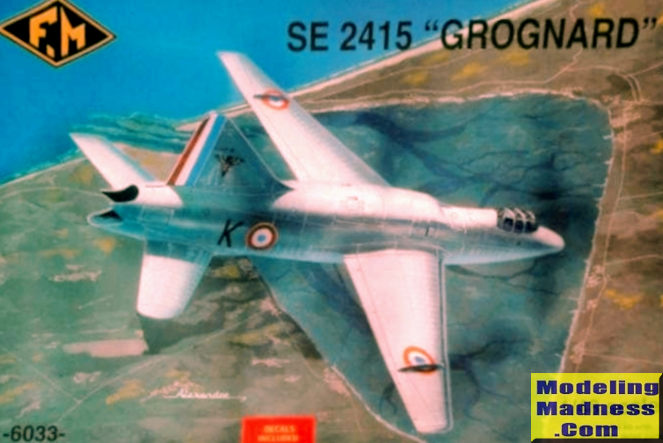
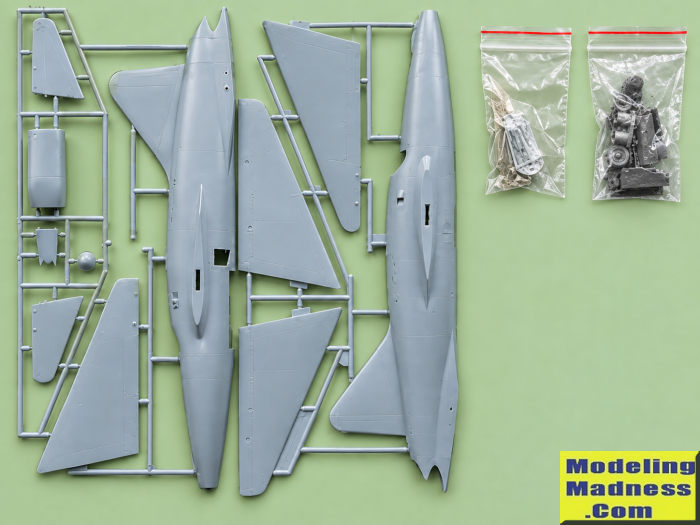
The kit comes in the usual medium-sized, top-opening Fonderie Miniature box, of good quality and featuring dramatic box art showing a Grognard gracefully flying. Upon opening it, I was greeted by two light-gray styrene sprues, a bag of resin parts, a bag of white-metal parts and two vacform canopies.
The molding of the styrene parts is typical of Fonderie Miniature at the time: low-pressure injection, with generally correct shapes and beautifully rendered panel lines. The surface, however, is somewhat pebbly and will definitely require some cleanup and preparation if a decent finish is to be achieved—particularly important for a model that will eventually wear a natural-metal finish. The styrene parts cover the main airframe components, including the fuselage, aerodynamic surfaces and nose.
The resin parts include the cockpit tub, instrument panel, ejection seat, wheel wells, wheels and the distinctive twin exhausts. They are beautifully cast, with crisp detail and very little to complain about. The cockpit in particular is a highlight, with a nicely reproduced instrument panel and beautifully molded-on raised detail on the side consoles. The ejection seat is also very well done.
The landing-gear bays feature excellent molded detail and should look very convincing once installed. The landing gear itself is supplied in white metal, allowing the modeler to portray the gear in considerable detail. As expected with white-metal parts, however, some careful cleanup will be required before assembly. The resin wheels are beautifully cast and should add considerably to the finished model. The distinctive twin exhausts are also supplied in resin and are very nicely rendered.
Finally, two vacform canopies are provided. They are quite well done for vacform parts, but, as always, they will require careful cutting, thinning and preparation before they can be fitted.
The instructions are very much in the usual Fonderie Miniature tradition. They consist of an A4 sheet, printed on both sides in black and white, containing relatively brief sketches showing how the various components are supposed to come together, along with reasonably detailed decal-placement information.
This is definitely a kit aimed at the experienced modeler. Careful study of the drawings is required to understand how the parts are intended to fit, and some details have to be interpreted from the schematics. For much of the construction, the modeler is essentially on his own. Albeit challenging, that is not necessarily a bad thing—although it certainly isn't the most convenient approach—and an experienced builder should be able to work things out without too much trouble.
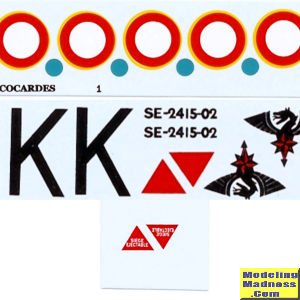 Only one
scheme is provided, representing the NMF prototype Grognard. The decals come in
three separate pieces, with some of them presumably originating from other
Fonderie Miniature projects. They are beautifully printed, and my experience
with Fonderie Miniature decals has been very positive. With careful application,
they should work very nicely and add considerably to the finished model.
Only one
scheme is provided, representing the NMF prototype Grognard. The decals come in
three separate pieces, with some of them presumably originating from other
Fonderie Miniature projects. They are beautifully printed, and my experience
with Fonderie Miniature decals has been very positive. With careful application,
they should work very nicely and add considerably to the finished model.
Construction should begin with the cockpit, and this is one area where it pays to spend as much time as you like. The cockpit is quite elaborate, and the work invested here will definitely show on the finished model. With its resin components, raised console detail and nicely reproduced instrument panel, it should become one of the main points of attraction of the completed Grognard.
The landing-gear bays are then dealt with, with the main gear structures needing to be secured from inside the fuselage. The cockpit, exhaust assemblies and the somewhat tricky intake arrangement behind the cockpit must then be trapped between the fuselage halves. This is one of the areas where careful planning and repeated test-fitting will pay dividends.
The wings follow, being assembled from two main pieces, with the distinctive small aerodynamic fillets then attached. The stabilators come next, followed by the nose. No ballast requirement is mentioned in the instructions. I am not certain that additional weight is actually necessary, but this is something worth checking before closing the fuselage and deciding for yourself whether some insurance is appropriate.
The landing gear follows, and finally the vacform canopy has to be carefully cut out and fitted. Although the completed model may look like a relatively uncomplicated aircraft, the construction is considerably more involved than its appearance suggests. The combination of injection-molded plastic, resin, white metal and vacform parts means that everything has to come together accurately.
This is therefore not a kit to rush. Test-fit three times before reaching for the glue would be very good advice here. Trimming, adjusting and fitting the different materials will take time, but that is simply part of the Fonderie Miniature experience.
| CONCLUSIONS |
There is no getting around the fact that the Grognard is a difficult kit. It is not a shake-and-bake model, and the combination of short-run plastic, resin, white metal and vacform parts demands patience, careful preparation and plenty of test-fitting. But there is also something rather special about it.
Fonderie Miniature gave us the opportunity to build an aircraft that would almost certainly never have appeared as a conventional mainstream 1/48 injection-molded kit. That alone makes the Grognard worthwhile. The unusual subject, good resin detail, attractive decals and characterful shape all come together to offer the experienced modeler something genuinely different.
These kits are becoming increasingly difficult to find today, so if you happen to come across a Grognard, it may be tempting to put it safely away in the stash and admire it from time to time. Resist that temptation. Build it. It deserves to become a model rather than remain a rare kit in a box. It will demand some patience, certainly, but once finished, it will give you something that very few other models can: a little piece of France's fascinating early jet history sitting on your shelf.
Happy Modeling!
October 2026
Copyright ModelingMadness.com. All rights reserved. No reproduction in part or in whole without express permission from the editor.
If you would like your product reviewed fairly and fairly quickly, please contact the editor or see other details in the Note to Contributors.