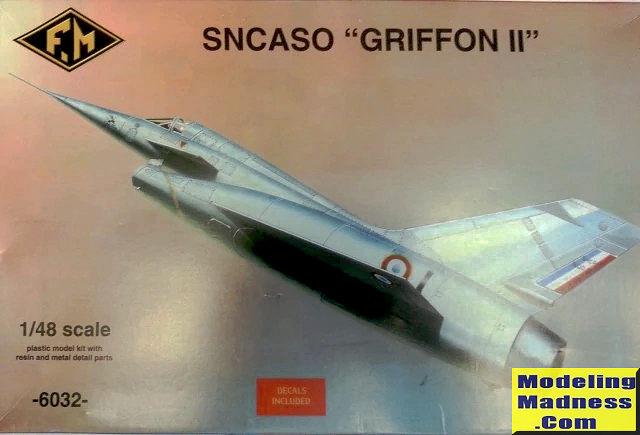
Fonderie Minitaure 1/48 Griffon II
| KIT #: | 6032-45 |
| PRICE: | 50 Euros when new |
| DECALS: | One option |
| REVIEWER: | Spiros Pendedekas |
| NOTES: | Short-run multimedia kit |
| HISTORY |
In the years immediately following the Second World War, French aviation entered one of its most fascinating periods. The country was determined to recover its position at the forefront of aviation technology, while the arrival of supersonic flight presented engineers with an entirely new set of problems. Conventional turbojets were rapidly approaching their practical limits, and designers began investigating increasingly unconventional solutions to propel aircraft beyond the sound barrier and into the realm of Mach 2. Among the most spectacular of these experiments was the Nord 1500 Griffon.
The Griffon was an extraordinary answer to the problem of high-speed flight. Instead of relying solely on a conventional turbojet, the aircraft combined a turbojet with a ramjet, the latter becoming increasingly effective as speed increased. The first Griffon prototype, the Griffon I, flew in 1955 and served primarily as a test bed. Its successor, the Griffon II, made its first flight on 23 January 1957, incorporating the definitive propulsion arrangement and the characteristic enormous annular intake. The aircraft's combination of delta wing, small foreplanes, long fuselage and massive intake gave it an appearance that seemed to have arrived directly from the future.
The Griffon was not merely spectacular to look at. In the hands of French test pilot André Turcat, the Griffon II became a genuinely formidable research aircraft. On 5 October 1959, it reached approximately Mach 2.19, or around 2,330 km/h, demonstrating the enormous potential of the ramjet concept. The aircraft also established a world speed record over a 100-kilometre closed circuit, making it one of the most remarkable French experimental aircraft of the era.
Ultimately, however, the Griffon was a victim of changing technology. The French Air Force chose the considerably more conventional Dassault Mirage III for its future interceptor requirement, while the Griffon's unusual propulsion system proved too specialized for an operational fighter. The sole Griffon II continued its research career until 1961. Today, it survives at the Musée de l'Air et de l'Espace at Le Bourget, a fascinating reminder of the brief period when aviation engineers were prepared to explore almost any idea in the relentless pursuit of speed.
| THE KIT |
 It
was in 2003 that Fonderie Miniature decided to tackle this spectacular yet truly
esoteric subject in 1/48 scale. Even today, a 1/48 Griffon II is an unusual
proposition; at the time, it was an even more adventurous choice. Surprisingly,
Fonderie Miniature was not the first company to attempt the aircraft in this
scale. During the 1990s, the SCP Phoenix Company had apparently produced a 1/48
kit consisting principally of resin with some white-metal components, although
information about that earlier release is rather scarce.
It
was in 2003 that Fonderie Miniature decided to tackle this spectacular yet truly
esoteric subject in 1/48 scale. Even today, a 1/48 Griffon II is an unusual
proposition; at the time, it was an even more adventurous choice. Surprisingly,
Fonderie Miniature was not the first company to attempt the aircraft in this
scale. During the 1990s, the SCP Phoenix Company had apparently produced a 1/48
kit consisting principally of resin with some white-metal components, although
information about that earlier release is rather scarce.
Fonderie Miniature went a step further, however, and produced a genuine short-run multimedia kit. My example was purchased in France around 2005, while I was there on a Hellenic Air Force mission. During a visit to the beloved Maurice Verdeun shop in Bordeaux, I happened to see a copy sitting on the shelves. The combination of the subject's obscurity, its limited availability and, naturally, my weakness for unusual and esoteric aircraft was simply too much to resist. The futuristic shape of the Griffon made the decision even easier. I grabbed it immediately.
The kit comes in a medium-sized, top-opening box of reasonably good quality, decorated with artwork depicting the Griffon climbing dramatically into the sky. Opening the box reveals exactly the sort of contents one would expect from a limited-run multimedia kit of this period.
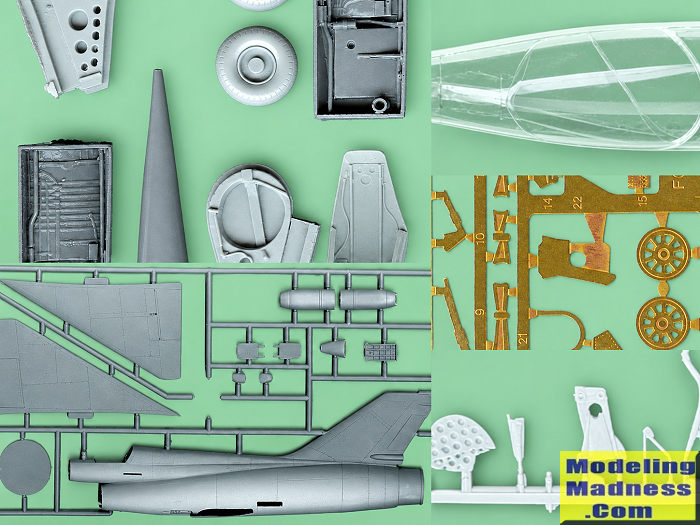
The injection-molded plastic parts are light gray and number approximately 18 pieces, arranged over two sprues. These are supplemented by a bag containing nine nicely cast resin parts in two shades of gray, another containing 17 white-metal components, and a photo-etched fret. It is therefore a genuine multimedia package, with plastic, resin, white metal and photo-etched brass all contributing to the finished model.
The styrene parts form the basic airframe, including the fuselage halves, wings and canards, together with the compressor face and other major components. For a short-run kit of this nature, the injection molding is good. The parts are produced by low-pressure injection, with the molding being generally clean and the engraved panel lines quite nicely represented. The surfaces are somewhat pebbly, however, and some sanding and preparation will therefore be necessary. Flash is not particularly troublesome, which is a pleasant surprise considering the limited-run nature of the kit.
The resin parts provide several important components, including the cockpit tub, the distinctive nose, the landing-gear bays, the impressive main landing-gear doors and the three wheels. The resin parts are among the best features of the kit. They are very cleanly cast, with good definition and minimal, if any, cleanup required.
The white-metal parts include the nose gear door, the gear legs, the seat, the instrument panel and several smaller components. They are well cast, needing the usual cleanup typical of white-metal parts.
The nicely done photo-etched fret completes the package with a useful selection of finer details. It includes the instrument panel face, wheel and landing-gear details, various linkages and other small components.
The cockpit is very elaborate and, with some patience, can produce an impressive result straight from the box. The various resin, metal and photo-etched components complement one another well. This is definitely an area where the modeler should take his time. Careful preparation, painting and assembly of the small components will pay dividends.
The landing gear is similarly well catered for. The resin and PE components complement the white-metal parts nicely, producing a sufficiently detailed and convincing representation of the Griffon's rather unusual undercarriage. Naturally, some cleaning, straightening and test-fitting of the metal components should be expected.
The intake and exhaust arrangements are adequately represented. The real aircraft's propulsion system was considerably more complicated, of course, particularly around the enormous ramjet installation at the rear, but what Fonderie Miniature provides is more than sufficient to create a convincing finished model.
Two vacform canopies are supplied and are nicely produced. As with any vacform canopy, however, they require rather more care than conventional injection-molded transparencies. The experienced modeler should have little difficulty with them, but this is certainly another indication that this is not a kit intended for beginners.
The instructions are very much in keeping with Fonderie Miniature's Mystical Experience philosophy. They contain, more or less, all the information required to build the model, but they do so in a rather spartan fashion. The experienced modeler will probably understand what is intended, but considerable time should be spent studying the diagrams and working out precisely how the various components fit together.
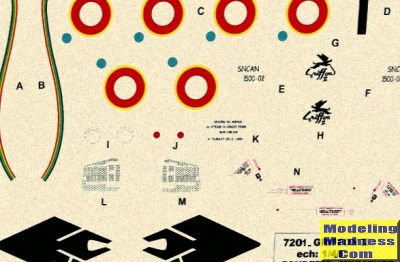 Only one scheme is provided, which is entirely understandable given that only
one Griffon II was constructed. The decals are beautifully printed and, based on
my previous experience with Fonderie Miniature products, are of excellent
quality.
Only one scheme is provided, which is entirely understandable given that only
one Griffon II was constructed. The decals are beautifully printed and, based on
my previous experience with Fonderie Miniature products, are of excellent
quality.
There is, however, one important consideration for anyone purchasing this kit today. These decals are now around two decades old. They may still perform perfectly well, but their age should be kept in mind. Some testing on a spare surface, preferably after coating them with liquid decal film, would be sensible before committing the decals to the model.
The basic construction sequence is fairly straightforward in concept. The cockpit is assembled first and then trapped between the fuselage halves, together with the compressor and rear bulkhead. Once the main fuselage assembly is completed, the wings, canards and other major aerodynamic surfaces can be added, followed by the distinctive nose.
The resin nose is substantial and provides a considerable amount of weight at the front of the model. Having built the kit, I can tell you that no additional nose weight is actually required, as the weight of the resin nose itself is sufficient to keep the finished Griffon safely on its nose gear.
The landing gear and its associated details are next. This is where patience becomes particularly important. The white-metal parts will require cleanup, careful test-fitting and, in some cases, trimming before they can be assembled satisfactorily. The resin and photo-etched components likewise require preparation before installation. The canopy and various small bits conclude the build.
This is not a kit to rush. A methodical approach, plenty of dry-fitting and a willingness to modify or clean up parts before committing them to glue will make the whole experience considerably more enjoyable.
| CONCLUSIONS |
There is something particularly appealing about a kit like this. Fonderie Miniature decided to tackle the Nord 1500 Griffon II—a single experimental aircraft, produced in only one example, with an exotic propulsion system and a shape that still looks futuristic more than half a century after its first flight.
Yes, this is a difficult kit, and among the more demanding short-run multimedia models. The parts require preparation, the resin and white metal need careful handling, the photo-etch demands patience, the instructions require close study, and the vacuum-formed canopy adds another challenge. But these are all part of the character of a kit like this.
The plastic molding is quite good for a limited-run product, while the resin components are nicely cast, the white-metal parts are useful, and the photo-etched fret provides a good selection of additional detail. The cockpit is particularly rewarding, and the combination of materials allows a very convincing representation of this extraordinary aircraft to be achieved straight from the box.
Most importantly, Fonderie Miniature gave us something that one would hardly expect to find in 1/48 scale. They took an obscure, almost forgotten experimental aircraft and turned it into a model that enthusiasts could actually build. I suspect that this is exactly why I found it impossible to leave that box sitting on the shelf in Bordeaux back in 2005.
The kit was issued more than twenty years ago and has naturally become increasingly difficult to find. When examples do appear, prices can be surprisingly high, particularly given the rarity of the subject. At the same time, I have not seen many built examples, suggesting that quite a few of these kits may still be waiting in modelers' stashes. Finding one may require patience, but it should not be impossible.
If what you want is a 1/48 Nord 1500 Griffon II, this remains the kit. There are certainly no abundance of alternatives waiting on the shelves. It is a project for the experienced modeler who enjoys unusual subjects and does not mind cleaning up parts, studying instructions, test-fitting assemblies and solving the occasional problem along the way. The reward is an imposing, futuristic and genuinely unusual model of one of the most adventurous aircraft of the early supersonic age.
Every kit deserves to be built, and every subject deserves to be represented in miniature. Having built the kit, I would genuinely love to see more examples of this Griffon completed. I have always had a particular affection for rare, unusual and slightly esoteric subjects, and this is exactly the kind of model that deserves the attention of a modeler who shares that enthusiasm.
Fonderie Miniature certainly gave the modeler a few challenges along the way, but those are easily forgiven for what they ultimately gave us: the opportunity to build the Griffon. And for such a rare, spectacular and wonderfully unusual aircraft, simply having a Griffon in 1/48 scale is something rather special indeed.
Happy Modeling!
October 2026
Copyright ModelingMadness.com. All rights reserved. No reproduction in part or in whole without express permission.
If you would like your product reviewed fairly and fairly quickly, please contact the editor or see other details in the Note to Contributors.