| KIT #: | 05002 |
| PRICE: | 30 Euros |
| DECALS: | Two options |
| REVIEWER: | Spiros Pendedekas |
| NOTES: | What if build. |
| HISTORY |
THE LOST RAF BRISTOL SUPERFREIGHTER
Some aircraft become famous because history remembers them. Others become legends because history forgot them.
There are aircraft whose entire lives can be traced through official records. Their construction dates, serial numbers, test flights, modifications, accidents, squadrons and eventual disposal are all carefully documented, leaving historians with little room for speculation. But aviation history also has its shadows: aircraft that briefly entered a world of experimentation, secret trials and unusual assignments, only to disappear again before their stories could be properly recorded. Their existence survives in fragments—a faded photograph, an incomplete engineering document, a handwritten note or perhaps the recollection of someone who once stood beside the aircraft. The Bristol Superfreighter described here belongs to that second, far more intriguing category. For a brief period she appeared to be destined for a completely different life, and there were those who later wondered whether she had carried something considerably more important than ordinary cargo behind her great forward doors.
In the early 1950s, Britain was passing through one of the most fascinating transitions in aviation history. The great piston-engine aircraft of the Second World War were gradually giving way to jets and turboprops, while military planners were trying to determine what the next generation of transport aircraft should look like. Speed was increasingly important, but so were range, reliability, economy and the ability to transport heavy or awkward loads. The Bristol Type 170 Superfreighter was hardly a new design by then, but she possessed qualities that remained extremely valuable. Rugged, spacious and remarkably practical, she could carry vehicles and bulky equipment through her enormous forward cargo doors, operate from relatively basic airfields and tolerate the sort of treatment that would have made more sophisticated aircraft uncomfortable. She was not beautiful in the conventional sense, but she looked like an aircraft built for one purpose: to get the job done.
It was therefore not
unreasonable for the Royal Air Force to investigate whether the
Superfreighter could have a future in military transportation. One aircraft
was selected for an unusual evaluation program, and what followed
transformed the machine from an ordinary civilian transport into something
altogether more intriguing. The aircraft was taken into the workshops, where
her standard configuration was modified and experimental equipment
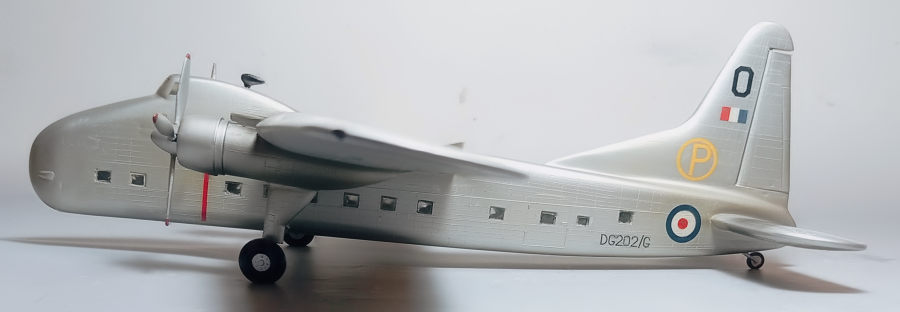
installed. Most noticeably, she was repainted completely in High Speed
Silver, giving her a distinctly military appearance, and RAF insignia w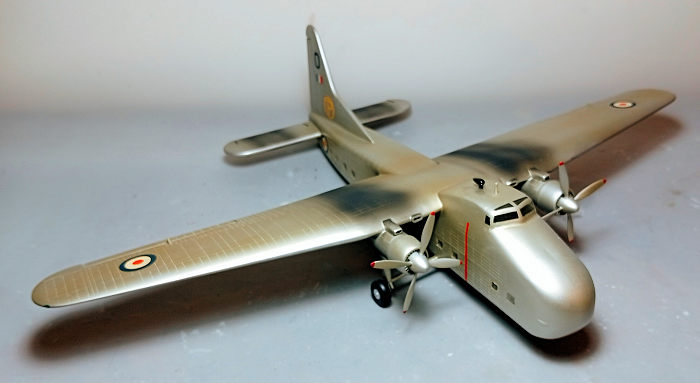 as
applied. Then came the markings that would eventually make the aircraft so
difficult to identify. On the aft fuselage appeared the serial DG202/G,
while the fin carried a yellow P enclosed within a yellow circle, with a
large black O positioned above it. A small emblem below the cockpit's port
side resembled a modified Sabena logo—but its meaning remains a mystery. Was
it an operator’s mark, a service insignia, or something else entirely? No
answer has emerged, leaving this tiny detail to deepen the Super Freighter’s
intrigue.
as
applied. Then came the markings that would eventually make the aircraft so
difficult to identify. On the aft fuselage appeared the serial DG202/G,
while the fin carried a yellow P enclosed within a yellow circle, with a
large black O positioned above it. A small emblem below the cockpit's port
side resembled a modified Sabena logo—but its meaning remains a mystery. Was
it an operator’s mark, a service insignia, or something else entirely? No
answer has emerged, leaving this tiny detail to deepen the Super Freighter’s
intrigue.
To anyone standing beside the aircraft, the markings looked convincing enough, almost official in their appearance, yet there was something subtly strange about the combination. The serial appeared to belong to an RAF experimental machine, but it did not fit comfortably into the records, while the unusual fin markings seemed to provide clues without ever quite explaining what the aircraft actually was.
The most significant modification, however, was hidden beneath the engine cowlings. The Superfreighter's normal powerplants were replaced by experimental heavy-fuel diesel engines, an ambitious attempt to investigate whether diesel technology could provide better fuel economy, endurance and operational flexibility for large transport aircraft. The installation was watched closely by Bristol's engineers, and the early trials were conducted with considerable interest. The engines were certainly not quiet or refined. On cold mornings, long before the airfield was fully awake, mechanics would bring the aircraft to life while mist still covered the grass. The great propellers would begin turning slowly as the starters engaged, the engines coughing and shuddering before finally catching with a deep mechanical rumble. Almost immediately, thick gray smoke would begin pouring from the exhausts, drifting across the ramp and hanging over the airfield. The ground crews soon gave the aircraft an unofficial nickname that never appeared in any technical report: the Smoking Giant.
Despite their peculiar behavior, the engines began to demonstrate promising qualities. Once airborne, the Superfreighter settled into a steady rhythm, and the test crews found that the aircraft retained the dependable handling characteristics for which the type was known. Heavy loads were carried, vehicles were driven through the forward doors, and engineering equipment was moved in and out of the spacious fuselage as the trials progressed. For Bristol, the program began to look increasingly worthwhile. There was even quiet optimism that the RAF might eventually adopt some form of military Superfreighter, particularly if the experimental powerplants could demonstrate a worthwhile advantage in endurance and operating costs. The aircraft's High Speed Silver finish, RAF markings and unusual engines seemed to suggest the beginning of a new chapter for a design that had already spent years working in the civilian world.
As the evaluation continued, however, the nature of some of the flights began to change. At first everything appeared routine, with the aircraft operating according to the normal procedures of a test program. Gradually, though, the Superfreighter began appearing on the airfield at unusual hours. On some mornings she was prepared before sunrise, when the airfield was still dark and covered in low mist. Cargo was loaded behind closed doors, and only a small number of personnel were permitted near the aircraft. There were no photographers, few observers and apparently little interest in allowing outsiders to see what was taking place.
The aircraft would start her smoky diesel engines, taxi away into the darkness and disappear into the morning sky. Several hours later she would return, and the official entry in the logbook was apparently little more than routine transport evaluation. Nothing unusual and nothing worth remembering.
 People remembered
anyway. Ground personnel noticed that the aircraft occasionally returned
with cargo that had not been seen being loaded, while rumors circulated that
she was transporting experimental military equipment between secure
establishments. Others suggested that the trials involved rapid deployment
equipment or new methods of moving military vehicles and supplies. There
were even whispers that the Superfreighter was being used for missions that
had little connection with her stated evaluation role. Nobody could prove
any of it, and nobody seemed particularly interested in trying. In those
days, men working around experimental aircraft understood that there were
questions which were better left unanswered.
People remembered
anyway. Ground personnel noticed that the aircraft occasionally returned
with cargo that had not been seen being loaded, while rumors circulated that
she was transporting experimental military equipment between secure
establishments. Others suggested that the trials involved rapid deployment
equipment or new methods of moving military vehicles and supplies. There
were even whispers that the Superfreighter was being used for missions that
had little connection with her stated evaluation role. Nobody could prove
any of it, and nobody seemed particularly interested in trying. In those
days, men working around experimental aircraft understood that there were
questions which were better left unanswered.
One particular flight became the subject of quiet speculation for years afterward. It took place shortly before dawn, with the airfield covered in thick mist. The Superfreighter had been prepared during the night, and only a small number of men were working around the aircraft while the rest of the station remained largely unaware of what was happening. The cargo doors were closed, the experimental engines were started and the familiar cloud of gray diesel smoke spread across the ramp. One mechanic later recalled watching the aircraft taxi toward the runway, its silver fuselage gradually disappearing into the mist until only the lights and faint outline of the fin could be seen. The yellow P appeared briefly through the darkness, with the black O above it, before the Superfreighter finally disappeared into the morning sky.
She did not return that day, nor did she return the following day. For three days the aircraft was apparently absent, with no explanation offered to ordinary ground personnel and no obvious indication of where she had gone. Then, just before sunset on the fourth day, the Smoking Giant returned and landed as though nothing unusual had happened. The engines were shut down, the crew climbed down and the aircraft was quietly pushed back onto the ramp, but her cargo doors remained closed for some time. Whatever had happened during those missing days was never openly discussed, and the official record once again remained reassuringly dull.
There was, however, another part of the story that would only emerge many years later, when investigators began asking questions about the aircraft's movements. The airfield used during at least part of the evaluation program had been located near a small rural community, and several villagers remembered unusual activity during the autumn of 1954. Their memories were understandably imperfect by the time anyone came to ask them about it, but several recalled hearing large aircraft operating at strange hours, particularly before dawn. One farmer remembered seeing a large silver aircraft sitting beyond the airfield perimeter on a misty morning, surrounded by military vehicles. Another villager recalled being awakened during the night of 14 October 1954 by what she described as a deep mechanical rumbling followed by a metallic noise. She could see nothing through the darkness, but the following morning she noticed several military trucks traveling along a normally unused farm road toward the airfield.
The most intriguing testimony came from an elderly farmer who claimed that he had seen men unloading something from the aircraft that morning. He remembered the machine as large, silver and extremely noisy, but what stayed in his memory was not the aircraft itself but the cargo. According to him, several men were struggling to move a long, bulky object covered completely by a dark canvas sheet. It was being transported on a small wheeled trolley, and for a few seconds the canvas slipped as the men maneuvered it. The farmer claimed that he caught a glimpse of something metallic underneath, perhaps a series of pipes or cylinders, although he admitted that the glimpse lasted only a moment. Another villager recalled that the covered object was subsequently moved into a small building near the far end of the airfield, after which military personnel prevented anyone from approaching the area.
The stories naturally became more elaborate with time. One villager believed the object was an experimental engine, another insisted that it was some kind of radar equipment, while someone else claimed that it was an aircraft component being transported for secret testing. The most extraordinary version suggested that the object itself was a small experimental aircraft that had been carried inside the Superfreighter. There was never any evidence to support that claim, and most investigators dismissed it as the natural exaggeration that occurs when old memories are mixed with decades of speculation. Yet the elderly farmer who had supposedly seen the object remained remarkably consistent in one detail. When shown the photograph of the Superfreighter years later, he immediately identified the canvas-covered object beside the aircraft and insisted that whatever had been hidden underneath it was the reason for the secrecy surrounding the operation.
The RAF eventually decided not to proceed with a Superfreighter transport program. The reasons were understandable: aviation technology was advancing rapidly, new transport concepts were emerging and military priorities were changing. The Superfreighter had not failed the evaluation; if anything, she had demonstrated that an older and relatively simple aircraft could still perform useful work. But usefulness was no longer enough. The future belonged to faster and more sophisticated machines. The experimental diesel engines were removed, standard Bristol Hercules engines were restored, and the aircraft's military identity gradually disappeared. The High Speed Silver finish was covered, the RAF insignia vanished, DG202/G disappeared beneath civilian markings, and the yellow P and black O were lost beneath new paint. The Smoking Giant returned to civilian configuration and, outwardly at least, the strange military chapter of her life was over.
The Superfreighter resumed civilian service, carrying passengers and freight around Europe. Families boarded her, businessmen traveled in her cabin and vehicles continued to pass through her enormous forward doors. To the passengers she was simply another working transport aircraft, perhaps unusual in appearance but otherwise unremarkable. Whatever secrets had been carried inside her during those strange RAF evaluation flights were now buried beneath civilian paint and the passage of time. Nobody suspected anything until one afternoon in the mid-1960s, when a passenger found something beneath a cabin window ledge.
It was a small piece of paper, yellowed with age and folded twice. At first he assumed it was an old maintenance note or something accidentally left behind by a previous passenger, but curiosity persuaded him to unfold it. At the top was a date: 14 October 1954. Beneath it were the words DG202/G — HOLD 3, followed by a hurriedly written instruction: DO NOT ENTER. In the lower corner was a small circle containing a handwritten P. The passenger handed the paper to a member of the cabin crew, who initially laughed and assumed it was simply some forgotten piece of engineering paperwork. But when he saw the date, his expression changed. The note was more than ten years old, yet the aircraft had undergone several maintenance periods and changes of ownership since then. It should not have been there.
 The note eventually
reached the airline's maintenance department, where several engineers
examined it and searched the aircraft's records for DG202/G. Nothing
appeared. A second search produced the same result. Eventually an older
engineer was brought in, and after studying the paper for some time he asked
where it had been found. When he was told that it had been hidden beneath
the cabin window ledge, he became visibly uncomfortable and quietly admitted
that the aircraft had once had another life. That admission was enough to
begin a formal investigation.
The note eventually
reached the airline's maintenance department, where several engineers
examined it and searched the aircraft's records for DG202/G. Nothing
appeared. A second search produced the same result. Eventually an older
engineer was brought in, and after studying the paper for some time he asked
where it had been found. When he was told that it had been hidden beneath
the cabin window ledge, he became visibly uncomfortable and quietly admitted
that the aircraft had once had another life. That admission was enough to
begin a formal investigation.
Old Bristol documents were examined, RAF records were searched and the aircraft's history was reconstructed as far as possible. Slowly, fragments began to emerge. There really had been a Superfreighter in High Speed Silver. There really had been strange RAF markings. There really had been an aircraft carrying the designation DG202/G. Yet almost nothing could be found explaining exactly what she had done. Some documents referred vaguely to an experimental engine installation, others mentioned a special transport evaluation, and several dates did not agree. Most troubling of all, some pages appeared to be missing. One old loading document contained a reference to Hold 3, but did not explain what had been stored there. Another described the contents simply as RESTRICTED.
The investigators eventually located several retired Bristol employees. One remembered the aircraft clearly and could describe the diesel engines in considerable detail. Another remembered the smoke and the strange markings. But when questions turned to the mysterious flights, memories became evasive. One elderly engineer finally admitted that he remembered the Superfreighter leaving before dawn but claimed not to know what she was carrying. When the investigator pressed him, pointing out that he must have known something, the old engineer remained silent for several seconds before finally saying, "I knew enough not to ask." It was the closest anyone came to confirming that there had been more to the program than the surviving documents suggested.
Then another photograph appeared.
It had been found in a private collection and was badly faded, but the Superfreighter was unmistakable. She stood on an airfield in High Speed Silver, carrying DG202/G, the yellow P and the black O. Behind her, partly obscured by haze, stood another aircraft surrounded by several men. One appeared to be pointing toward the Superfreighter's cargo doors, while between the two aircraft was a large object covered by a canvas sheet. When the photograph was enlarged, the investigators could just make out three characters on the canvas.
H-3.
The room fell silent as the meaning became apparent.
Hold 3.
The same words written on the piece of paper discovered years later inside the civilian aircraft.
The investigators examined the photograph again, and eventually someone noticed a small yellow circle beneath the Superfreighter's fuselage, almost hidden in shadow. Inside it was a P. The photograph carried a date, and when it was read aloud there was no longer any doubt that the different pieces belonged to the same story.
14 October 1954.
The same date as the mysterious note.
The investigation intensified. The villagers' recollections were reexamined, and although none of their stories could be independently verified, several details appeared to overlap. The military vehicles, the early-morning aircraft, the covered object and the unusual noises were all mentioned by more than one person. Most intriguingly, one witness insisted that the canvas-covered object had been moved into a building after being unloaded and that military personnel had remained around the building for several nights. Another recalled hearing an unfamiliar mechanical noise coming from the building after the Superfreighter had departed, describing it as something between an electric motor and a large engine attempting to start. Whether those memories were accurate or merely the product of years of speculation was impossible to determine, but they provided investigators with one tantalizing possibility: perhaps whatever had been inside Hold 3 had remained at the airfield after the aircraft left.
One final piece of
evidence seemed to support the theory. The original photograph was examined
once more, this time under magnification, and a faint pencil annotation was
discovered near the bottom edge. The writing was barely legible, but enough
could be made out to read Return after 17/10. The date was three days after
the Superfreighter had disappeared and one day before she returned. Beside
the annotation was a partial reference that appeared to begin with DG—,
although the rest had been obscured by age and damage. It was not proof of
anything, but it was enough to make the inve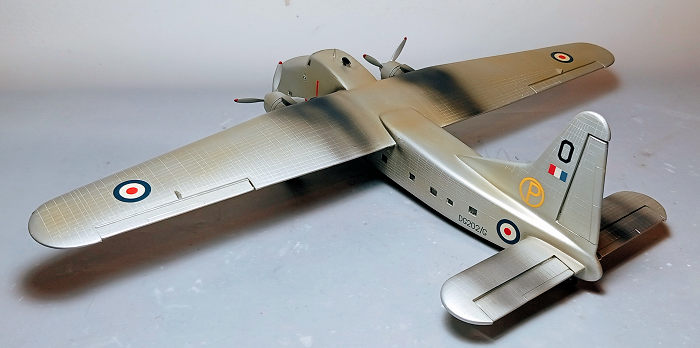 stigators wonder whether the
aircraft's mysterious absence had been connected directly to the object
marked H-3.
stigators wonder whether the
aircraft's mysterious absence had been connected directly to the object
marked H-3.
The investigation eventually reached the limits imposed by time. The surviving documents were incomplete, witnesses contradicted one another, and many of the people who might have known the truth were either dead or unwilling to speak. The little piece of paper was placed in an archive, the photograph returned to its private owner and the official inquiry quietly came to an end. No one could establish what had been carried inside Hold 3, why the aircraft had disappeared for several days, or why so much effort seemed to have been made to conceal the identity of DG202/G.
Yet the mystery refuses to disappear completely. Every few years another fragment seems to surface: a photograph, a number written in the margin of an old document, a recollection from someone who remembers seeing a silver transport aircraft near a military airfield, or a reference to a restricted cargo that nobody can identify. None of these fragments proves that the Superfreighter was involved in anything extraordinary, but taken together they form a story that is difficult to dismiss entirely. Somewhere between fact and memory, the Smoking Giant seems to have carried a secret that was never meant to survive.
Perhaps the simplest explanation is also the correct one: the aircraft was involved in an obscure experimental transport program, the records were poorly preserved, the markings were temporary and the mysterious cargo was nothing more than an experimental piece of equipment. Perhaps the villagers saw an engine, a radar installation or some other perfectly conventional piece of military hardware beneath the canvas, and the passage of time transformed an ordinary operation into something much more mysterious. Yet there remains that little piece of paper, hidden where nobody should have found it, bearing the exact date of the strange operation and the same DG202/G — HOLD 3 designation that appears in the surviving photograph.
Perhaps, somewhere, there is still another photograph showing what stood beneath the canvas. Perhaps an old Bristol engineer left behind a notebook that was never discovered. Perhaps the missing pages of the loading records are still sitting in a forgotten archive, waiting for someone curious enough to look through them. And perhaps, if that evidence is ever found, the mystery of the Smoking Giant will finally be solved.
Until then, the Bristol Superfreighter remains suspended in that fascinating space between history and legend: a rugged transport aircraft that briefly wore RAF colors, carried the mysterious serial DG202/G, disappeared into the mist on an unexplained assignment and later returned to civilian life carrying a secret that may have remained hidden inside her for more than a decade. The yellow P on the fin, the great black O, the experimental diesel engines, the villagers' stories, the canvas-covered object marked H-3, and finally the tiny piece of paper hidden behind a cabin window ledge all seem to point toward the same unanswered question.
Whatever happened on 14 October 1954, someone clearly wanted it forgotten.
Perhaps that is why the story is so compelling. The Superfreighter was never supposed to become a legend; she was simply a working aircraft, built to carry people, vehicles and cargo. Yet for a short and mysterious period she seems to have stepped into another world, one of secret evaluations, unexplained flights and guarded conversations, before quietly returning to civilian service as though nothing had happened. Decades later, all that remains is a handful of clues and the uneasy feeling that the investigators came tantalizingly close to something they were never quite meant to see.
The photograph remains.
The paper remains.
The markings remain in memory.
Somewhere, perhaps, Hold 3 still has an answer.
We simply have not found it yet.
| THE KIT |
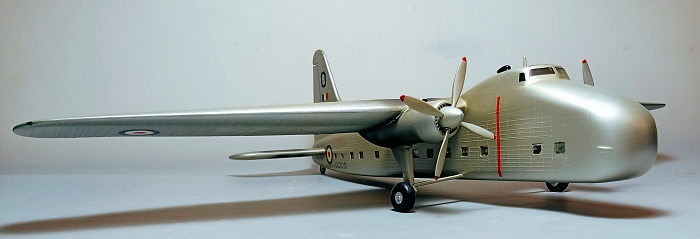 Airfix introduced
its brand-new Bristol Superfreighter kit in 1959, bringing one of Britain's
most distinctive post-war transport aircraft to modelers around the world.
At a time when most manufacturers concentrated on fighters and bombers,
producing an unusual civilian transport was a courageous decision, and one
that has since become part of Airfix history.
Airfix introduced
its brand-new Bristol Superfreighter kit in 1959, bringing one of Britain's
most distinctive post-war transport aircraft to modelers around the world.
At a time when most manufacturers concentrated on fighters and bombers,
producing an unusual civilian transport was a courageous decision, and one
that has since become part of Airfix history.
For its time, the tooling was first class. The engineering and mold quality were highly advanced for the late 1950s, and the tooling has proved remarkably durable, being reboxed numerous times over the decades with virtually no changes to the plastic parts. Only decals and packaging varied between releases, with the kit most recently returning in 2024 as part of Airfix's Vintage Classics range.
The example reviewed here is the 1996 reissue, released during the period when Airfix and Heller were closely associated. The kit joined my collection around 2005, purchased from one of my beloved hobby shops in Athens at what seemed even then a very fair price. Looking back, it feels less like buying another kit and more like preserving a small piece of modeling history.
For a more in-depth view of the kit's contents, you may look no further than the ever-growing MM archives, where this venerable Airfix classic has already received the detailed treatment it deserves.
I had built this kit many years ago, and it had been sitting quietly among my models ever since. Inspired by my friend Dr. Frank Spahr and his fascinating Super Freighter project, I decided to dig mine out, refurbish and update it, and give it a new lease of life. This time, however, I wanted to go a step further and present the aircraft with a fictional what-if history of its own.
| CONSTRUCTION |
Construction began with the installation of the 26 fuselage windows from the inside of the fuselage halves. Loyal to my lifetime habits, I did not make a perfect job of this operation. A few of the windows ended up slightly marred by glue, and some did not sit absolutely perfectly against the surrounding window ledges. There was little I could realistically do without risking further damage, so I decided to leave them as they were. Fortunately, the small windows and the dark interior make these imperfections far less noticeable once the model is completed.
I then assembled the
six-piece cockpit and trapped it between the fuselage halves. The
instructions call for an entirely black cockpit, which I happily followed,
hoping that practically nothing would be visible through the relatively
small windows anyway. Nevertheless, I used the supplied instrument-panel
decal, even though it would ultimately be almost invisible, and added a
little dry brushing simply to introduce some highlights and prevent the
cockpit from becoming a completely featureless black ho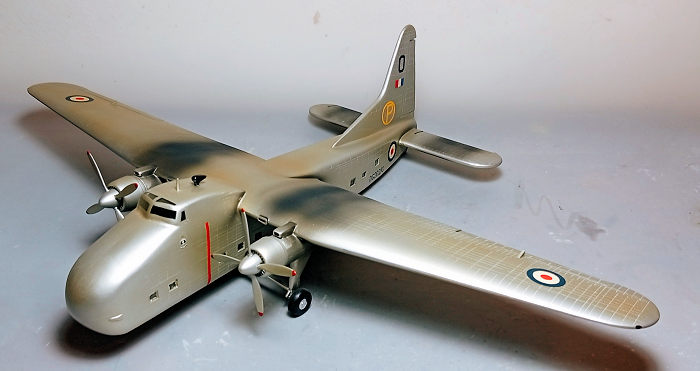 le. I used the same
black color for the fuselage and cargo interior, with the intention of
blanking everything out behind the windows, which proved to be more or less
the case.
le. I used the same
black color for the fuselage and cargo interior, with the intention of
blanking everything out behind the windows, which proved to be more or less
the case.
The wings were next assembled and attached, followed by the tailplanes and fin. Although most of the aerodynamic surfaces are designed to be movable, I elected to leave them in their neutral positions, preferring a more homogeneous appearance. For the same reason, I decided to display the large forward cargo doors closed, joining them together and attaching them in the closed position. This gave the completed model a much cleaner and more uniform appearance.
The engines came next. Each pair of cowlings was assembled around the engine, with the propeller shafts trapped between the relevant components, and the completed subassemblies were then attached to the wings. I followed this with the landing gear, assembling each main strut and attaching it to its respective engine nacelle. The additional strengthening strut was then installed, giving the model a surprisingly good degree of rigidity.
Believe it or not, this more or less concluded the basic assembly. The construction was considerably less complex than I had initially expected and proved to be a very pleasant experience. Fit was relatively good overall, with the expected issues associated with a 1959 tooling, particularly around the wing joints and the nacelle-to-wing connections. The forward cargo doors required some additional attention, as several gaps were apparent when they were installed closed; this was hardly surprising because the original kit was designed around movable doors rather than an absolutely tight closed-door fit.
After filling and sanding the various areas that needed attention, the Superfreighter was finally ready for the paint shop.
| COLORS & MARKINGS |
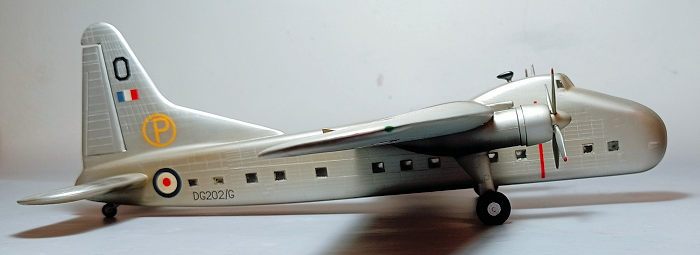 For this particular
build, I decided to step away completely from the two civilian markings
supplied in the box and create my own what-if prototype RAF evaluation
aircraft, inspired, naturally, by the mysterious machine described in the
story above. As a prototype, there was no hesitation whatsoever about
painting the entire aircraft silver, and for this I reached for my trusty
Humbrol 11 enamel, while my stocks last. The result was a distinctive High
Speed Silver appearance that suited the character of the aircraft
beautifully.
For this particular
build, I decided to step away completely from the two civilian markings
supplied in the box and create my own what-if prototype RAF evaluation
aircraft, inspired, naturally, by the mysterious machine described in the
story above. As a prototype, there was no hesitation whatsoever about
painting the entire aircraft silver, and for this I reached for my trusty
Humbrol 11 enamel, while my stocks last. The result was a distinctive High
Speed Silver appearance that suited the character of the aircraft
beautifully.
I did not use the kit decals at all. Instead, I raided my decal dungeon for suitable markings to represent the imagined RAF evaluation machine. The decals had no difficulty adhering to the smooth silver surface, and a coat of Future was applied to seal everything securely and provide the appropriate base for the final finish.
| CONSTRUCTION CONTINUES |
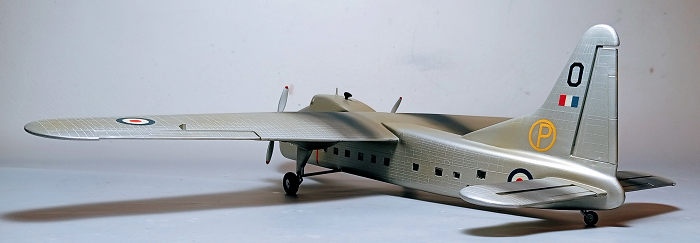 The final details
were relatively straightforward. The wheels were assembled and installed,
with black tires and silver rims, the DF loop antenna was painted black and
attached, while the forward antenna mast was painted silver and added to the
model as well. The canopy was then attached, although blending it smoothly
into the surrounding fuselage required a little patience and some additional
attention. Eventually, however, everything came together satisfactorily, and
the canopy framing was painted silver - where I also did an average job.
The final details
were relatively straightforward. The wheels were assembled and installed,
with black tires and silver rims, the DF loop antenna was painted black and
attached, while the forward antenna mast was painted silver and added to the
model as well. The canopy was then attached, although blending it smoothly
into the surrounding fuselage required a little patience and some additional
attention. Eventually, however, everything came together satisfactorily, and
the canopy framing was painted silver - where I also did an average job.
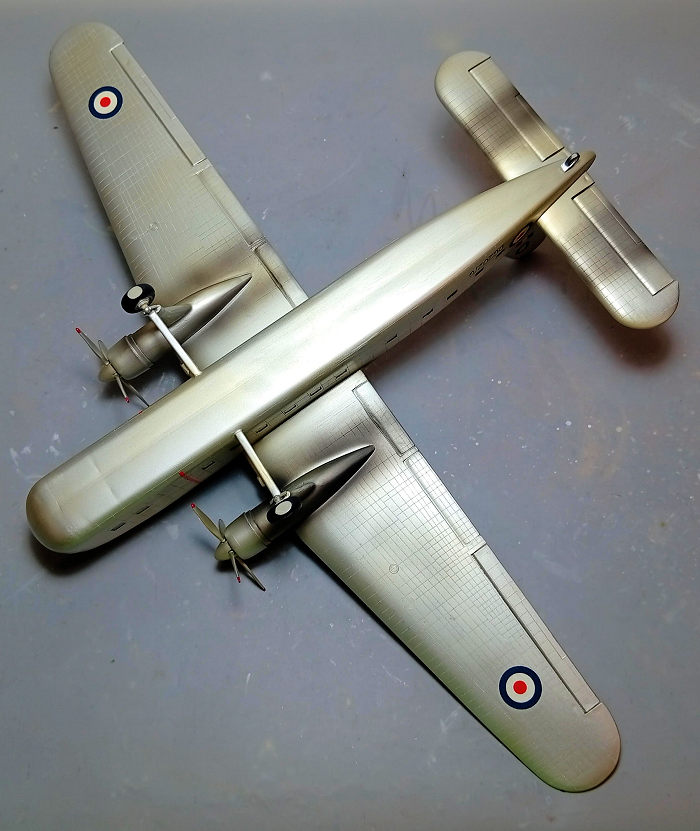
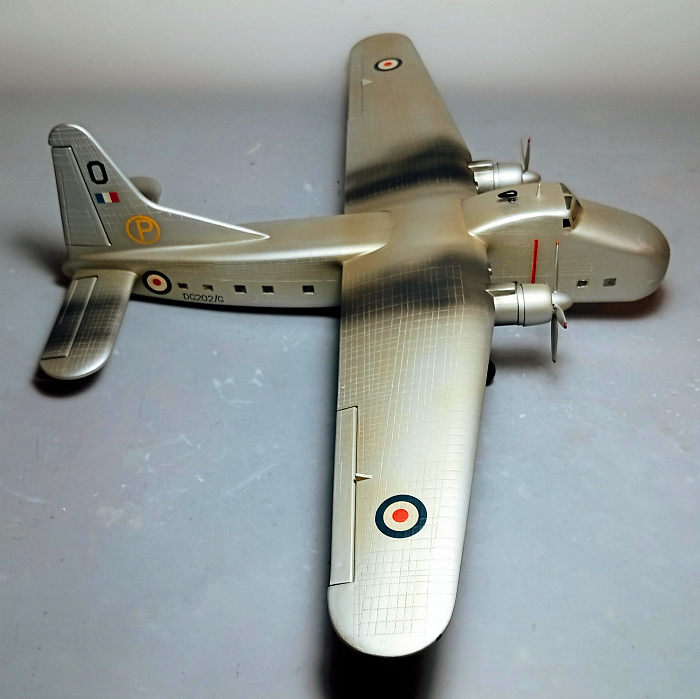
Since this was supposed to represent a prototype, I decided not to weather it excessively. There was, however, one rather large exception. Because my fictional aircraft was powered by experimental diesel engines, I decided to go completely overboard and have some fun with the exhaust staining. Heavy stains were applied above and below the wings around the engine nacelles, extending somewhat toward the tailplanes. It was deliberately excessive, but I think it gives the aircraft a distinctive appearance and fits nicely with the fictional history of the Smoking Giant and her experimental powerplants.
A final satin coat brought everything together and gave the model its final finish. The wingtip lights were represented with small applications of clear red and green paint, completing the model and finally bringing the mysterious Superfreighter to life.
| CONCLUSIONS |
There is no doubt that this is an old-tool kit, and it should never be judged against today's highly sophisticated releases. It lacks the finely engraved surface detail, elaborate interiors and precision engineering that modern modelers have come to expect. But that is not really the point of this kit. The Airfix Bristol Superfreighter belongs to another era of modeling, and that is precisely where much of its charm lies.
For me, building this particular kit was a wonderful walk down memory lane. Here is a tooling that first appeared in 1959, yet has survived for more than six decades and continues to offer modelers the opportunity to build one of Britain's most unusual post-war transports. The raised rivets, simple cockpit, basic interior and uncomplicated engineering all belong unmistakably to the golden age of Airfix, when opening a box often meant discovering something wonderfully unexpected.
This is perhaps what makes the Superfreighter so special. Airfix chose to produce an aircraft that few other manufacturers would probably have considered, and that decision has allowed this fascinating machine to remain available to generations of enthusiasts. The subject itself is unusual, the model has character, and the build is relaxing rather than demanding. Yes, there are imperfections, and I certainly contributed a few of my own, particularly around those troublesome windows, but none of them diminishes the pleasure of building the model.
The mold has stood the test of time remarkably well. The raised rivets possess undeniable nostalgic charm, the molding remains respectable for its age, the cockpit is perfectly adequate, the clear parts are good, the engines and propellers are nicely represented, the instructions are clear and the decals in this particular 1996 release are surprisingly comprehensive. Most importantly, the engineering remains straightforward enough to make the kit an enjoyable project rather than a battle with an elderly tooling.
In the end, this is a model to enjoy for what it is: a genuine classic from the golden age of Airfix. It may not possess the finesse of a modern tooling, but it offers something equally valuable—character, nostalgia and the opportunity to build one of Britain's most distinctive post-war transport aircraft. For me, transforming this venerable civilian transport into the mysterious silver RAF prototype DG202/G made the experience even more enjoyable, because the old Airfix kit became the physical embodiment of a story that perhaps never happened, but somehow feels as though it might have.
Perhaps that is the greatest pleasure of scale modeling. We do not merely build aircraft; sometimes, we give forgotten aircraft a life of their own.
Happy Modeling!
15 September 2026
Copyright ModelingMadness.com. All rights reserved. No
reproduction in part or in whole without express permission from the editor.
If you would like your product reviewed fairly and fairly quickly, please
contact the editor or see other details in the
Note to
Contributors.