| KIT #: | 09002 |
| PRICE: | 30.00 Euros when new |
| DECALS: | Four options |
| REVIEWER: | Spiros Pendedekas |
| NOTES: | Older tooling |
| HISTORY |
Few aircraft have acquired the emotional following of the Avro Vulcan. More than just a machine, the Vulcan has become one of the most recognizable symbols of Britain's Cold War aviation heritage, and for generations of enthusiasts it remains the Vulcan.
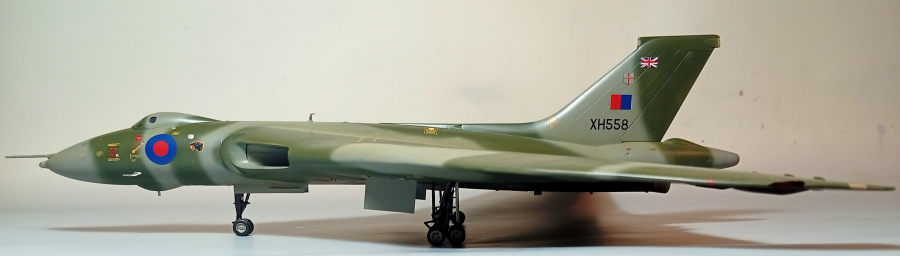
Among all the surviving examples, XH558 holds a particularly special place. The twelfth Vulcan B.Mk.2 built, XH558 made her maiden flight at Avro's Woodford works on 25 May 1960 and was delivered to the Royal Air Force on 1 July of that year. She initially served as a conventional bomber before being converted to the SR.2 maritime reconnaissance configuration and later to the K.2 tanker configuration.
Her RAF career eventually took another turn when she was returned to B.Mk.2 configuration and selected for the RAF Vulcan Display Flight. She made her display debut in 1986 and subsequently became the world's only flying Vulcan after the withdrawal of the other RAF display aircraft.
For several years XH558 became a familiar and unforgettable sight at British airshows. Anyone who saw her display will remember the experience: the enormous delta wing appearing in the distance, the unmistakable howl of four Rolls-Royce Olympus engines and then that huge aircraft sweeping overhead with a presence that seemed completely disproportionate to its age.
 The RAF
finally disbanded the Vulcan Display Flight after the 1992 season, and XH558
made what was expected to be her final flight in March 1993, leaving RAF
Waddington for Bruntingthorpe. But this was not to be the end of her story.
The RAF
finally disbanded the Vulcan Display Flight after the 1992 season, and XH558
made what was expected to be her final flight in March 1993, leaving RAF
Waddington for Bruntingthorpe. But this was not to be the end of her story.
After years of preservation, fundraising and an extraordinary amount of work by dedicated volunteers and engineers, the seemingly impossible happened. On 18 October 2007, XH558 returned to the sky.
From 2008 until 2015 she once again became one of the world's most famous airshow aircraft. Crowds gathered wherever she appeared, eager to see and, above all, hear the last flying Vulcan. The aircraft that had once represented Britain's nuclear deterrent was now doing something very different: carrying the memory of an era of British aviation to a new generation.
Sadly, the return to flight could not last forever. Age, increasing maintenance requirements and the difficulty of obtaining specialist technical support eventually brought her flying career to an end. On 28 October 2015, after more than 55 years since her first flight, XH558 made her final journey through the air.
Today she remains preserved at Doncaster Sheffield Airport. Although she will not fly again, the aircraft continues to be maintained, and efforts are being made to provide her with a permanent, protected home where she can be conserved and used for education and heritage activities.
There is something rather fitting about XH558's present role. She has already lived several lives: bomber, reconnaissance aircraft, tanker, display aircraft, preservation project and finally the Spirit of Great Britain. She has survived retirement, changing priorities and the passage of more than six decades. Most importantly, she has survived in the memories of the people who saw her fly.
There is something almost magical about a Vulcan in the air. On the ground, XH558 is an enormous and somewhat austere Cold War machine, all sharp edges, huge delta wing and four massive engines. In the sky, however, she becomes something else entirely. The sound arrives first, followed by that enormous delta shape moving with surprising grace. For a few moments, the decades disappear.
XH558 may never fly again, but she still has a future. Instead of carrying bombs or fuel, she now carries memories. Instead of demonstrating Britain's military power, she demonstrates what persistence, engineering skill and affection for aviation can achieve.
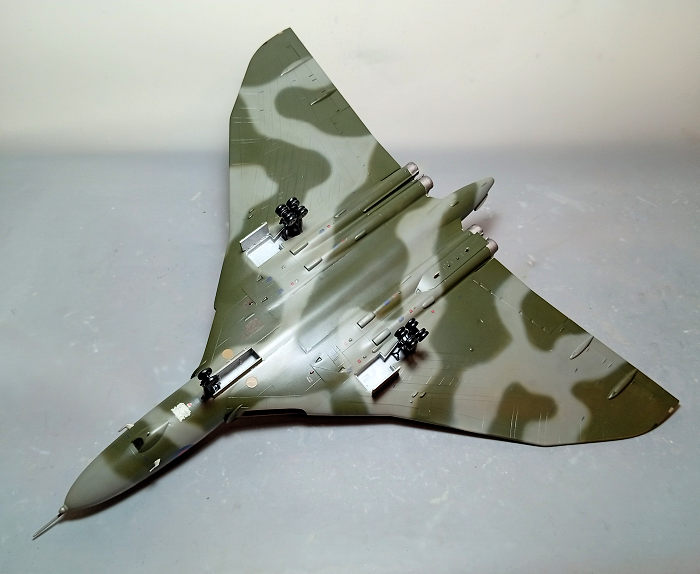
One particularly distinctive feature of the later Vulcan was its wraparound camouflage. As RAF Vulcans changed from high-altitude operations to low-level penetration, the traditional pale underside became increasingly unsuitable. The aircraft could be surprisingly conspicuous from below when banking at low level, particularly against the terrain. The later wraparound camouflage therefore extended the Dark Sea Grey and Dark Green pattern over the undersides, reducing the contrast between the aircraft and its surroundings and helping conceal its silhouette during low-level operations.
It is a particularly appropriate finish for a machine that, despite its enormous size, was expected to fly fast and low and use the terrain as part of its protection.
| THE KIT |
 This is the
older tooling of Airfix's 1/72 Vulcan B.Mk.2, a great kit when it first appeared
and one that has been superseded by the newer, superlative, also by Airfix
offering.
This is the
older tooling of Airfix's 1/72 Vulcan B.Mk.2, a great kit when it first appeared
and one that has been superseded by the newer, superlative, also by Airfix
offering.
For its time, this older tooling offered a good level of detail and solid engineering, especially considering the sheer size of the subject. It was an impressive model then, and it remains one today.
Of course, the newer Airfix Vulcan has raised the bar considerably in terms of detail, accuracy and engineering. But that should not diminish the qualities of this older kit. It is still a good kit, albeit simpler and challenging to put together.
Should you wish to have a look at its contents, you may check its dedicated preview in the ever-growing MM archives
| CONSTRUCTION |
Following the instructions, I first assembled the cockpit and the two pairs of intakes. All cockpit parts were painted black, save the seat cushions that were painted olive drab. I used the kit supplied decal for the instrument panel, while I added seat belts from masking tape. That was more than enough, since practically nothing can be seen through the small canopy windows. The intakes were painted white, with the compressor faces painted silver.
I added some extra shims, apart from the ones provided, from the inside of the lower fuselage half to help ensure a secure fit for the single-piece bomb bay door, which was then attached.
 The two
fuselage halves were next brought together, trapping the cockpit and intakes
between them. The instructions called for 30 grams of nose weight, but I really
did not want to take any chances with such a large model, so I secured a good 50
grams of fishing weights at the nose with cyanoacrylate.
The two
fuselage halves were next brought together, trapping the cockpit and intakes
between them. The instructions called for 30 grams of nose weight, but I really
did not want to take any chances with such a large model, so I secured a good 50
grams of fishing weights at the nose with cyanoacrylate.
The wings, fin and tail were assembled separately and then attached to the main fuselage. With these major components in place, the basic Vulcan was already taking shape.
A bunch of smaller parts were then added on the undersides, before proceeding to filling and sanding. The model required quite some work in this respect, as several of the major joints needed attention.
Despite its size and some fit issues, the construction proved surprisingly straightforward, and I was quite pleased with how quickly this enormous aircraft had come together. Once the major joints had received their first treatment, I gave the model another complete filling and sanding session.
It was now time to take the big bird to the paint shop.
| COLORS & MARKINGS |
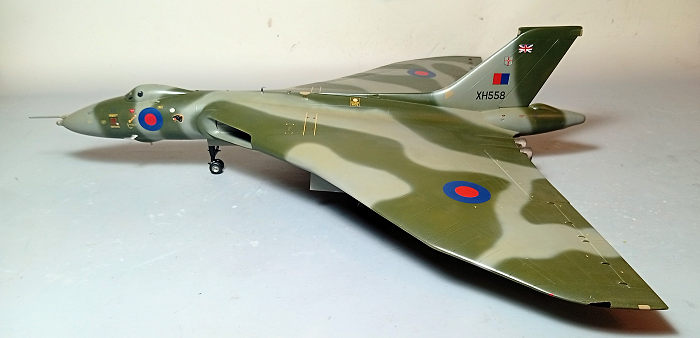 I
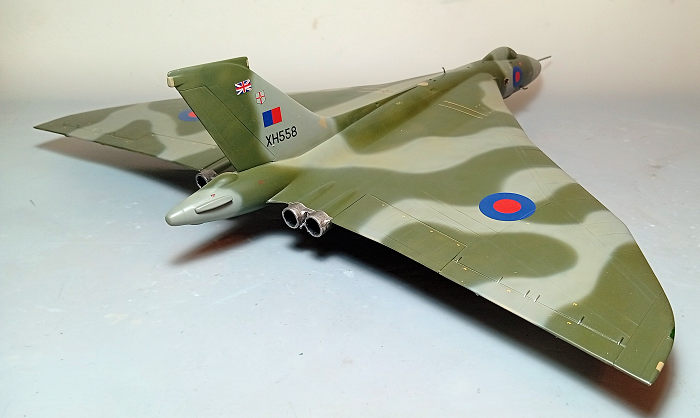
painted the camouflage using Humbrol 163 and 164 for the green and grey
shades respectively. The camouflage pattern was freehanded with relatively
tight demarcation lines. Admittedly, the real aircraft's demarcations were
considerably tighter, and I am aware that my interpretation is not
realistic, but I then deemed the looks "dynamic" and pressed on.
I
painted the camouflage using Humbrol 163 and 164 for the green and grey
shades respectively. The camouflage pattern was freehanded with relatively
tight demarcation lines. Admittedly, the real aircraft's demarcations were
considerably tighter, and I am aware that my interpretation is not
realistic, but I then deemed the looks "dynamic" and pressed on.
The rather simplistic exhausts were painted gunmetal, with their interiors painted black. This helped make the simplified exhaust arrangement considerably less noticeable. A few dielectric areas were painted "linen".
Once the camouflage was complete, I gave the model a coat of Future to prepare the surface for the decals.
I used the kit decals, which behaved quite satisfactorily. They were certainly not perfect and there were occasional minor registration problems, but overall they performed well and gave the Vulcan the characteristic appearance I was looking for. A coat of Future sealed them.
| FINAL CONSTRUCTION |
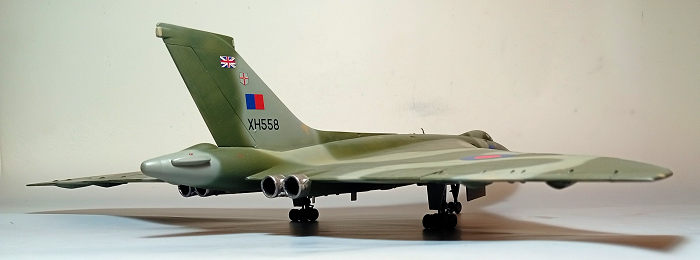 The
landing gear was assembled and attached in position. The gear legs and tires
were painted black, the wheel rims silver, while the totally flat gear bays
and door innards were painted white.
The
landing gear was assembled and attached in position. The gear legs and tires
were painted black, the wheel rims silver, while the totally flat gear bays
and door innards were painted white.
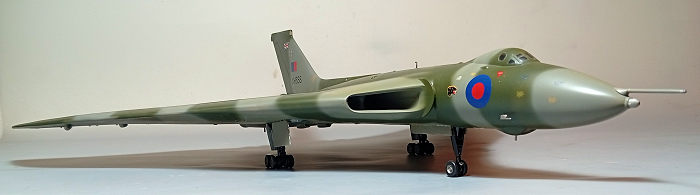
Getting all eighteen wheels properly aligned and, importantly, making sure that all actually touched the ground was not particularly easy. The unusual multi-wheel undercarriage leaves rather little room for error, and a wheel sitting even slightly out of alignment can make the finished model look awkward. With a little persuasion, adjustment and patience, however, a solid result was obtained, with the Vulcan sitting properly on all of its wheels.
I deliberately decided not to apply any weathering. XH558 was maintained in pristine condition during her display career, and I felt that a clean finish was therefore the appropriate choice for this particular model. A satin coat provided the final hue.
For the wingtip lights, I used small blobs of red and green clear paint. And with that, the big bird — the Vulcan, the Delta Lady — was complete.
| CONCLUSIONS |
Airfix eventually gave us, in 2020, a completely new-tool 1/72 Vulcan B.Mk.2. The new kit is a superb modern interpretation of Britain's famous delta bomber, with recessed panel lines, excellent engineering and an impressive level of detail, including a fully detailed bomb bay. That inevitably leaves this older tooling in second place, but being superseded does not make a kit bad.
This old Airfix Vulcan remains a good kit. It has an accurate basic shape, a satisfying amount of detail and, above all, produces an impressive model. The engineering is very much of its period, so some filling and sanding should be expected, particularly around the major fuselage, wing and intake assemblies. I would recommend it to modellers who enjoy taking a little extra care rather than to anyone looking for a completely effortless build.
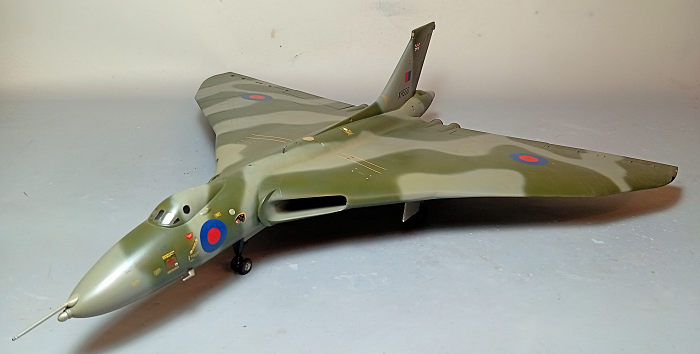 There
is still something satisfying about tackling a kit like this. When it first
appeared, producing a 1/72 Vulcan of this size in injection-molded plastic
was quite an achievement. Today we have better detail and more sophisticated
engineering, but that does not erase the history of this kit or the pleasure
of building it.
There
is still something satisfying about tackling a kit like this. When it first
appeared, producing a 1/72 Vulcan of this size in injection-molded plastic
was quite an achievement. Today we have better detail and more sophisticated
engineering, but that does not erase the history of this kit or the pleasure
of building it.
This old Vulcan had been sitting in my collection for a few years, waiting patiently for its turn. When I finally took it from the closet and started putting the big pieces together, I was reminded that we can become so concerned with having the newest and most accurate kit that we forget to build the ones we already own. This one deserves to be built.
It is still a nice kit, it can still be found at a decent price, and it still produces a very impressive Vulcan. Yes, the newer Airfix offering is a more modern and sophisticated proposition. But if you find one of these older kits at a reasonable price, why not tackle it?
Give it a little care, patience and filler where it needs it, and then enjoy the sight of a huge Vulcan sitting on your shelf.
For me, that is what this old Airfix kit is all about. It may no longer be the latest Vulcan on the block, but it still has character, presence and plenty of life left in it.
Ultimately, isn't that what our hobby is supposed to be about?
Happy Modeling!
Spiros Pendedekas
April 2022 Copyright
ModelingMadness.com. All rights reserved. No reproduction in part or in whole
without express permission. If you would like your product reviewed fairly and fairly quickly, please
contact
the editor or see other details in the
Note to
Contributors.