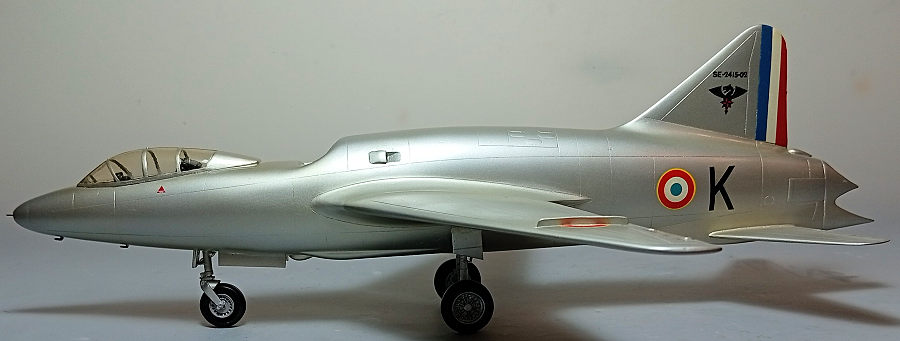
Fonderie Miniature 1/48 SE.2415 Grognard
| KIT #: | 6033 |
| PRICE: | 50 Euros when new |
| DECALS: | One option |
| REVIEWER: | Spiros Pendedekas |
| NOTES: |
Short run multimedia kit |
| HISTORY |
THE LAST FLIGHT OF TOMORROW
Southern France, February 1951
The morning was still young when the engineer stepped out onto the airfield. A thin veil of mist lingered above the grass, and the cold carried the familiar smell of oil, fuel, and damp concrete. Beyond the hangars, the sky was slowly brightening, revealing the pale outline of the hills in the distance. It was the kind of morning on which the world seemed to be holding its breath.
There she stood.
The SE.2415 Grognard was waiting beside the runway, an extraordinary collection of metal, rivets, pipes, and carefully calculated angles. She did not possess the graceful lines of the fighters that filled the dreams of young boys, nor the reassuring familiarity of the aircraft that had carried France through the darkest years of the war. Her shape was unusual, almost stubbornly so, with a broad, unconventional fuselage and a silhouette that seemed to challenge the very idea of what a jet aircraft ought to look like. Yet the engineer felt a quiet affection for her. He had seen the drawings on the tables, the arguments in the design offices, the endless calculations, and the long evenings when a promising idea had seemed to collapse beneath the weight of a new problem. He knew how much hope had gone into this machine.
To the outside world, the Grognard might have appeared strange. To the men who had created her, she was a possibility.
France was still finding its feet in the years after the war. The old world had been shattered, and the new one was being assembled piece by piece. Across the country, engineers and designers were trying to recover lost ground, determined that French aviation would not remain a spectator in the jet age. There was urgency in their work, but also something more profound: the conviction that a nation could rebuild not only its factories and its airfields, but also its confidence in the future.
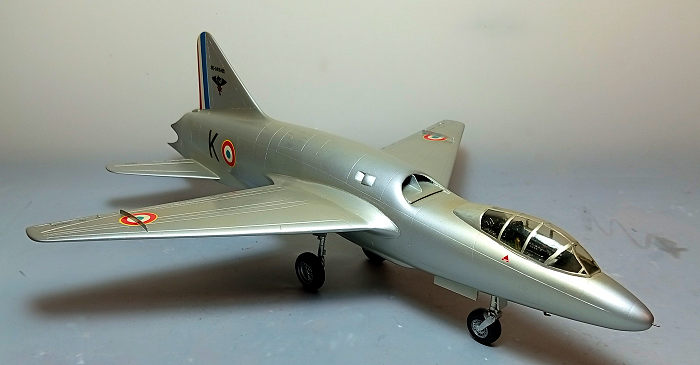 The
Grognard belonged to that restless time. She was an ambitious attempt to create
a new kind of ground-attack aircraft, a machine intended to explore
possibilities that conventional designs could not easily offer. Her twin
Hispano-Suiza-built Nene turbojets promised the power of the new age, while her
unconventional configuration reflected the questions that still troubled even
the most experienced aeronautical minds. Nothing about the design had been
accepted simply because it was familiar. Everything had to be examined, tested,
and, when necessary, reconsidered.
A few metres away, the pilot was listening to the final briefing. He was a quiet man, accustomed to the peculiar mixture of confidence and uncertainty that accompanied experimental flying. He knew that the aircraft had already revealed difficulties during its development. He also knew that the engineers were learning, flight by flight, how to understand and improve the machine. No experimental aircraft ever offered complete reassurance. There were always unanswered questions waiting somewhere beyond the end of the runway.
He walked towards the Grognard and paused beside the fuselage. For a moment, he rested his gloved hand against the cold metal. It was an insignificant gesture, one that nobody would have recorded in an official report, but he found comfort in it. He had learned to respect the machines he flew. They were never merely objects. They were the work of hundreds of people, each of whom had contributed a small piece of knowledge, patience, and hope.
The ground crew completed their checks. A mechanic raised his hand, exchanged a brief word with a colleague, and stepped clear. The engines began to turn, and the airfield was suddenly filled with a rising mechanical howl. The sound echoed against the hangars and rolled across the open ground, drowning the quiet morning. The Grognard trembled as the engines gathered strength, and a faint shimmer appeared behind the exhausts.
Inside the cockpit, the pilot settled into his seat. The familiar world narrowed to instruments, switches, and the view ahead. He took a breath, checked his surroundings, and prepared to begin the flight.
Then the aircraft moved.
At first, the acceleration seemed almost reluctant, as though the great machine needed a moment to gather its resolve. Then the runway markings began to pass faster beneath her nose. The vibration of the engines reached through the structure, the airframe came alive around the pilot, and the hangars slipped away behind him. The nose rose. For one suspended instant, the wheels seemed unwilling to surrender their hold on the earth.
Then the Grognard was flying.
Below her, the airfield began to shrink. The roads, fields, and buildings of southern France unfolded beneath the morning light, while the horizon widened into a pale blue distance. The pilot made his initial checks, listening to the aircraft, feeling her responses through the controls, and watching the instruments for the smallest indication that something was not quite right. He had no desire to prove himself a hero. He wanted to bring the aircraft home with the knowledge that would make the next flight safer, and the one after that better still.
 That was
the quiet courage of experimental aviation. It was not always found in
spectacular manoeuvres or record-breaking speeds. More often, it lived in
concentration, discipline, and the willingness to return to the same problem
tomorrow, even when today's answers had been disappointing.
The flight continued. Somewhere behind the cockpit, the two engines pushed their streams of hot exhaust into the morning air. Ahead lay a future that remained uncertain, but for those few precious minutes the Grognard occupied her own small place in it. She was no longer a collection of drawings or a collection of parts assembled in a hangar. She was an aircraft, carrying a human being through the sky, and every second aloft added another line to the story of French aeronautical engineering.
Eventually, the pilot turned towards the airfield. The runway appeared in the distance, a narrow strip of grey against the earth. He descended carefully, bringing the aircraft back towards the world from which she had risen. The wheels met the runway, the aircraft rolled forward, and the engines gradually fell silent.
For a moment, nobody moved.
Then the ground crew began walking towards her. The pilot climbed down, removed his helmet, and exchanged a few words with the waiting engineers. There would be observations to record, measurements to examine, and questions to discuss. There would be another round of calculations, another inspection, and perhaps another flight. The work was far from finished.
None of them could have known exactly what the future would bring. The Grognard would continue to contribute to France's experimental aviation efforts, including weapons trials, but changing military requirements and competing designs would eventually bring the programme to an end. The aircraft would never become the familiar presence in the skies that its designers might once have imagined.
Yet it would be wrong to measure its story only by what it failed to become.
For a brief period in the early 1950s, the Grognard represented the determination of a generation unwilling to accept that the future belonged to somebody else. It carried the hopes of engineers who dared to think differently, mechanics who turned unfamiliar drawings into tangible reality, and pilots who climbed aboard machines whose possibilities were still being discovered. Their work did not disappear simply because the aircraft did not enter production. Every experiment added something to the great, unfinished conversation between human imagination and the sky.
Years later, the hangars would change, the airfield would grow quiet, and the prototype would pass from the world of flight into the pages of aviation history. Photographs would preserve her unusual silhouette, and the occasional enthusiast would stop to look at her, wondering what it must have been like to stand beside such a remarkable machine.
Perhaps that is the fate of some aircraft. They do not live on through squadrons, famous battles, or generations of pilots. They live on through the questions they asked, the people who believed in them, and the memories they leave behind.
Somewhere, many decades later, another pair of hands would begin assembling a miniature Grognard at a modeller's workbench. Piece by piece, the strange shape would emerge from the plastic and metal, its contours gradually becoming familiar beneath the modeller's fingers. The real aircraft might have vanished from the skies, but the fascination it inspired would remain.
The engines would never roar again. The runway would never fall away beneath its wheels. But in the quiet world of scale modelling, the Grognard could take flight once more.
Perhaps that is enough.
For some machines, the final flight is not the end of the story. It is simply the moment when somebody, somewhere, decides that they are worth remembering.
| THE KIT |
 Fonderie
Miniature has given us some fantastic subjects over the years, often covering
highly esoteric aircraft that would otherwise have little chance of appearing in
mainstream kit manufacturers' catalogues. The SE.2415 Grognard is a perfect
example of this approach, offering us the opportunity to add a truly unusual
French experimental aircraft to our collections in 1/48 scale.
I bought this kit in 2004, during a visit to France, from the wonderful Maurice Verdeun hobby shop in Bordeaux. Its rarity and, above all, its fascinating subject immediately caught my attention. It was exactly the sort of aircraft that I found irresistible, and I could hardly wait to get started. Before long, construction was underway, and, somehow, I eventually managed to bring the project to some sort of completion. More recently, I decided that the model deserved a little refurbishment, giving me the perfect opportunity to revisit this old build and share the experience with our beloved Modeling Madness readers.
If you would like to take a closer look at the kit's contents before following me through the construction process, you can find my preview in our ever-growing MM archives.
| CONSTRUCTION |
I began by tackling the rather elaborate cockpit, which combines resin, photo-etched and white metal components to reproduce the aircraft's busy flight deck. There is quite a lot to work with here, including a white metal film camera installed to record the flights. The cockpit rewards patience and careful handling. Even for a short-run multimedia kit, the level of detail is particularly impressive.
I painted the cockpit interior black, including the seat frame, while the seat itself received light olive-green cushions. The supplied seat belts were painted an off-white shade to provide a little contrast against the darker surroundings. I then brought out the raised details with a gentle silver dry-brushing treatment, while various knobs and switches were picked out in white, red, and yellow.
The cockpit is, quite simply, beautifully rendered straight out of the box. The resin components capture the fine details very well, and the photo-etched and white metal parts add another welcome layer of finesse. The more time you devote to this area, the more the finished result will reward you, particularly once everything is viewed through the large vacformed canopy. Given the unusual nature of the Grognard, the cockpit is an especially appealing part of the model, and it is well worth taking your time to get it right.
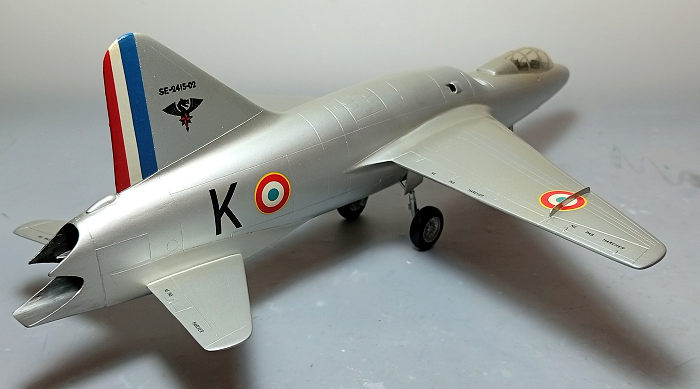
With the cockpit completed, I turned my attention to the fuselage. The landing gear bays were first attached to the relevant interior sections, after which I trapped the cockpit assembly and the distinctive twin exhausts between the fuselage halves. The unusual split air intake also had to be installed at this stage, and getting it reasonably aligned required a fair amount of patience.
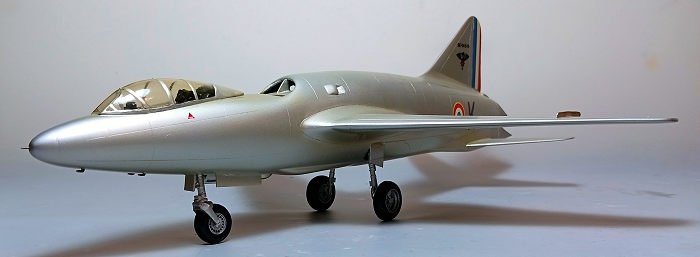 Initially,
I was prepared to trust the weight of the resin cockpit to keep the model
sitting properly on its landing gear. However, the additional weight of the
resin exhausts made me reconsider my decision. To be on the safe side, I added
approximately 30 grams of fishing weights to the nose. Whether this was strictly
necessary or not, I preferred not to take any chances with the balance of the
finished model! The nose dome was then attached, completing the forward section
of the fuselage.
The wings and tailplanes were assembled and attached next, gradually transforming the collection of limited-run parts into the unmistakable silhouette of the Grognard. At this point, the basic airframe was in place, although there was still considerable work ahead before the model could be considered ready for painting.
As expected from a short-run multimedia kit of this nature, achieving a satisfactory fit proved challenging. Practically every major component required careful preparation, and the quality of the joints varied from reasonably acceptable to decidedly troublesome. Bringing everything together into a convincing, homogeneous airframe demanded patience, repeated test-fitting, and a considerable amount of filling and sanding.
I initially treated the seams with liquified styrene, followed by conventional filler. This was only the beginning, however, as numerous rounds of filling and sanding were required to eliminate the remaining imperfections. The surface itself presented another challenge. As I mentioned in my preview, the molded finish was rather pebbly, something that would be particularly noticeable under the natural-metal finish I had planned for the model.
Consequently, I sanded the entire airframe, beginning with coarser abrasive and gradually working towards finer grades. I paid particular attention to achieving a uniform finish across the fuselage, wings, and other exposed surfaces. With a natural-metal aircraft, surface preparation is everything; even relatively minor imperfections can become painfully obvious once the silver paint goes on.
Only after completing the initial sanding and correcting the major surface imperfections did I carefully attach the distinctive fillets on the upper wing surfaces. These were blended into the surrounding structure, and the final sanding was then carried out using progressively finer abrasives, finishing with 2000-grit paper. This final preparation helped smooth the airframe and produce a more uniform surface for the forthcoming natural-metal finish.
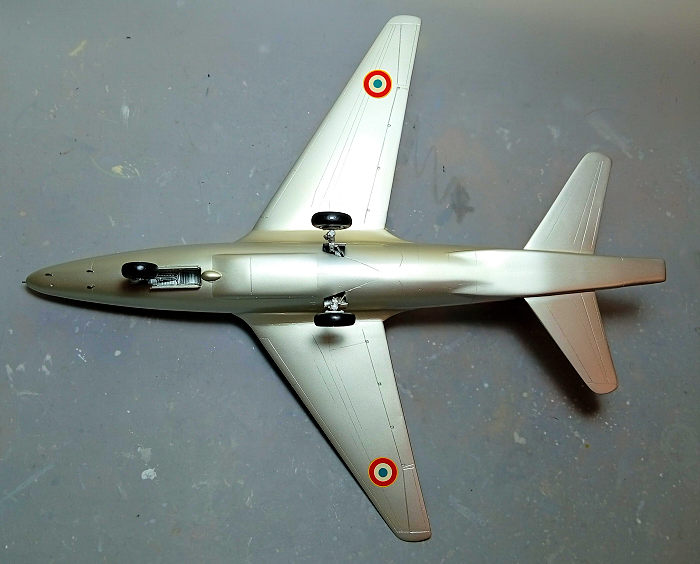
Since the landing gear legs, bays and gear door innards would also receive the same silver finish, I decided to attach them before painting, leaving the wheels off for later installation. This allowed me to paint the relevant components together and maintain a consistent finish across the model. At last, after all the filling, sanding, test-fitting, and surface preparation, the Grognard was ready for the paint shop!
| COLORS & MARKINGS |
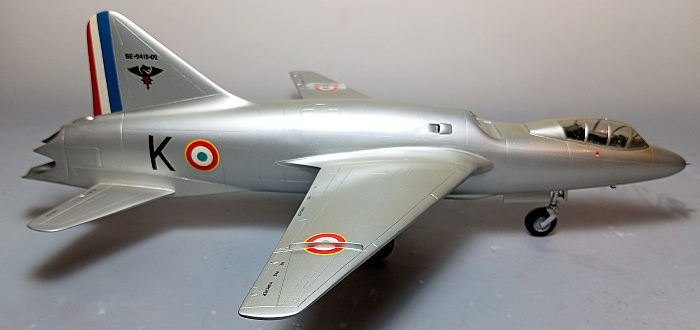 For the
natural-metal finish, I used Humbrol 11 Silver, applying an even coat over the
prepared airframe. The paint dried to a pleasing silver shade, which I
subsequently buffed lightly to give the surface a little more depth and shine.
It was a straightforward approach, but one that suited the prototype well and
gave the model the clean metallic appearance I wanted.
With the silver finish completed, the exhaust area was painted Testors Burned Metal and the model was ready for its decals.
I used the kit-supplied markings, which behaved beautifully during application. I have never had any problems with Fonderie Miniature decals, and these were no exception. They settled down nicely over the surface and conformed well to the various details of the aircraft. A more or less suitable leftover decal from my fungeon was used to represent the fin flash. Once everything was dry, I applied a coat of Future to seal the decals and prepare the model for its final finish.
| FINAL CONSTRUCTION |
The finishing touches were relatively straightforward after the considerable effort required to prepare the airframe. The beautifully rendered wheels received silver-painted rims and black tyres before being attached to the landing gear. With the wheels in place, the Grognard finally stood proudly on her own feet, and I could begin to appreciate the rather imposing appearance of this unusual aircraft in 1/48 scale.
Since the model represents an experimental prototype, I decided against applying
weathering. I wanted to preserve the clean appearance of the natural-metal
finish rather than introduce effects that would distract from the aircraft's
unusual lines. A c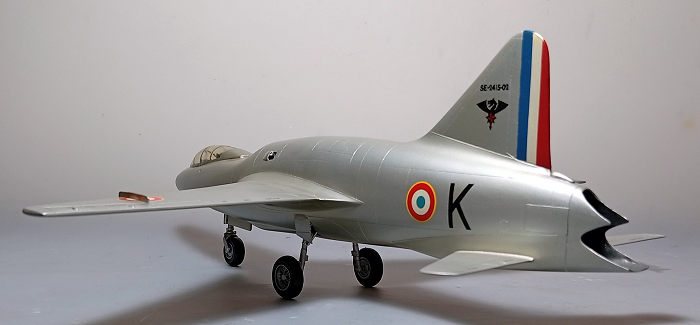 oat
of satin clear finish was therefore applied over the completed model, giving the
silver surface the final sheen I had in mind.
The vacformed canopy required some care. I carefully cut it from its backing sheet, working slowly to avoid damaging the transparent material. The frame lines were reasonably well defined and were hand-painted before the canopy was attached to the cockpit. This was a delicate operation, but well worth the effort, as the canopy allows the beautifully detailed cockpit to remain visible.
A few remaining details, including the small pitot probe at the nose and the pitot probes underneath the aircraft, were carefully installed to complete the model.
With that, the Grognard was finally finished! After all the challenges of assembly, filling, sanding, and finishing, it was immensely satisfying to see the completed aircraft sitting on the workbench. Its unusual configuration, natural-metal finish, and distinctive proportions made it a striking addition to the collection, and one that certainly stood apart from the more familiar aircraft usually found on our shelves.
| CONCLUSIONS |
Let us make one thing clear from the outset: this is a difficult kit to build. I would hesitate to recommend it to the average modeller, particularly anyone looking for a straightforward project. The Fonderie Miniature Grognard demands serious attention, careful preparation, and a fair amount of determination. Practically every major component needs work to achieve a reasonable fit, while the seams and the rather pebbly surface require extensive filling and sanding. This is especially important for an acceptable natural metal finish, as even minor imperfections can become painfully obvious beneath the silver paint. Bringing everything together into a convincing, homogeneous airframe takes patience, perseverance, and quite a bit of effort.
Having said that, Fonderie Miniature deserves considerable credit for giving us this remarkable subject in 1/48 scale. Honestly, this is an aircraft I would never have expected to find in kit form, in any scale, let alone with such an interesting selection of multimedia components. The Grognard is one of those fascinating experimental machines that occupy a special corner of aviation history, far removed from the familiar aircraft that dominate most manufacturers' catalogues. Its beautifully detailed cockpit, resin exhausts, and other carefully rendered components provide all the ingredients for an impressive model, provided the modeller is prepared to work for the result.
This is precisely where companies such as Fonderie Miniature have made such a valuable contribution to our hobby. By tackling highly esoteric and often overlooked aircraft, they have allowed us to explore fascinating corners of aviation history that mainstream manufacturers might never consider. For this alone, they deserve our congratulations. The engineering may be demanding, but the opportunity to add such an unusual and distinctive aircraft to our collections is something I genuinely appreciate.
Finding one today may not be easy. These kits have become increasingly uncommon, and their prices on the second-hand market can be unpredictable. As I mentioned in my Griffon review, completed Grognards are rarely seen at modelling shows or in online galleries. Perhaps many unbuilt kits are still waiting patiently in modellers' stashes, awaiting the day their owners finally decide to tackle them. If you are determined to find one, it is worth keeping an eye on the second-hand market, although I would not want to speculate on what price you might have to pay.
For me, this project was about more than simply completing another model. I bought the kit in France in 2004, drawn immediately to its rarity and the fascinating aircraft it represented. I could hardly wait to start building it, and although the project proved challenging, I eventually managed to bring it to completion. Returning to the model years later for some refurbishment has given me the opportunity to revisit that original enthusiasm and share the experience with our beloved Modeling Madness readers.
Ultimately, I am glad I built it. The Grognard may not be the easiest model in my collection, but it has a presence all its own. Standing proudly on its landing gear, with its natural-metal finish highlighting its unusual lines, it is a striking reminder that our hobby is not just about the latest kits or the most famous aircraft. Sometimes, the greatest pleasure comes from discovering an obscure prototype, accepting the challenges of a less-than-perfect kit, and bringing a forgotten machine back to life in miniature.
My congratulations to Fonderie Miniature for having the courage to produce such an unusual subject. This is certainly not a kit for everyone, but for the dedicated modeler who appreciates experimental aviation and is willing to invest the necessary time and effort, it offers the opportunity to build something truly special. For me, the satisfaction of seeing this extraordinary French prototype finally completed made the whole experience worthwhile.
Happy Modeling!
9 November 2026
Copyright ModelingMadness.com. All rights reserved. No reproduction in part or in whole without express permission.
If you would like your product reviewed fairly and fairly quickly, please contact the editor or see other details in the Note to Contributors.