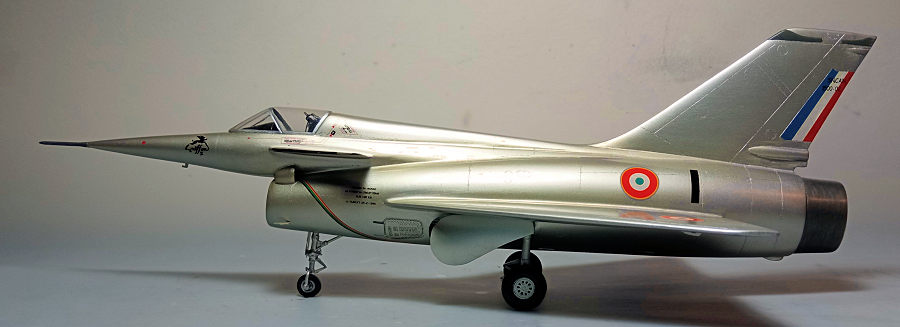
Fonderie Miniature 1/48 Nord 1500 Griffon II
| KIT #: | 6032 |
| PRICE: | 50.00 Euros when new |
| DECALS: | One option |
| REVIEWER: | Spiros Pendedekas |
| NOTES: | Short run multimedia kit. |
| HISTORY |
There was a time, in the years immediately after the Second World War, when the future of the fighter aircraft seemed almost limitless. Jet propulsion had opened the door to speeds that had been unimaginable only a few years earlier, while engineers were already looking beyond the first generation of turbojet fighters toward the elusive world of Mach 2. For France, rebuilding its aviation industry also meant proving that it could once again stand at the forefront of high-speed aircraft design.
Among the many fascinating French experimental projects of the period was the Nord 1500 Griffon. Its story began with the search for a lightweight supersonic interceptor capable of extraordinary speed and rapid acceleration. Nord Aviation embarked on a remarkably ambitious design. The answer was not simply another conventional fighter. Instead, the Griffon would combine two very different forms of propulsion in one extraordinary machine: a conventional turbojet for takeoff and acceleration, and a ramjet for the high-speed flight that followed.
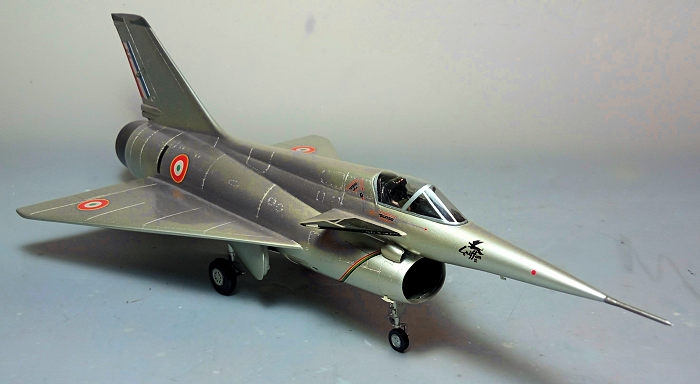 The
principle was ingenious. A ramjet has no compressor or turbine and cannot
produce useful thrust from a standing start; it needs the aircraft to already be
moving rapidly through the air. The Griffon's turbojet would therefore get the
aircraft airborne and accelerate it to the point where the ramjet could take
over much of the work. In an era when engineers were still learning how to make
jet aircraft fly safely at transonic and supersonic speeds, this was a bold
solution—and one that gave the Griffon an unmistakable appearance.
The aircraft itself looked as though it had arrived from the future. Its long, tubular fuselage, sharply swept delta wings, tall fin and small foreplanes around the cockpit gave it a distinctive, almost predatory character. The huge forward intake dominated the underside of the nose, feeding the unusual propulsion system buried inside the fuselage. There was little of the familiar about the Griffon. It was less a conventional fighter than a flying laboratory built around one question: just how fast could a relatively small aircraft go?
Two prototypes were constructed for research purposes. The first, the Nord 1500-01 Griffon I, was deliberately more conservative. It was powered only by an afterburning SNECMA Atar turbojet, allowing the designers and test pilots to investigate the aerodynamics, handling qualities and systems of the new airframe before introducing the considerably more demanding ramjet installation.
On September 20, 1955, the Griffon I made its first flight. Although it lacked the ramjet, it still demonstrated the potential of the basic design, eventually reaching approximately Mach 1.3. But the real adventure was still waiting.
That aircraft was followed by the Griffon II, the Nord 1500-02. Equipped with an Atar turbojet together with the Nord Aviation ramjet, it made its first flight on January 23, 1957. Once the ramjet was brought into operation, the Griffon became something altogether different. It was no longer simply an experimental jet aircraft; it was a high-speed research machine exploring territory where very few aircraft had ventured before, and it proved remarkably successful.
 The
Griffon II eventually reached Mach 2.19, or approximately 2,330 km/h,
demonstrating that the unusual turbojet-ramjet combination could deliver
spectacular performance. In 1959, André Turcat also established a world speed
record over a closed course, further demonstrating the remarkable capabilities
of the aircraft.
Yet the Griffon was also beginning to reveal the price of such speed. At Mach 2 and beyond, the air itself became an enemy. Friction and compression generated enormous temperatures, and the materials available to designers were not yet as capable as those that would become commonplace in later high-speed aircraft. Kinetic heating became an important limitation, while the ramjet, although highly effective at high speed, presented its own difficulties, particularly in controlling its operation.
The Griffon had demonstrated that its unusual propulsion concept worked. But demonstrating what was possible was not the same thing as producing a prctical fighter. By the end of the 1950s, other French designs were offering a more straightforward path to an operational supersonic fighter. The Dassault Mirage III, in particular, offered impressive performance without the extraordinary complexity of the Griffon's turbo-ramjet arrangement. There would therefore be no production Griffon, and the proposed development of a "Super Griffon" never came to fruition, so the Griffon remained what it had always been at heart: an explorer.
It was built to ask questions rather than to equip squadrons, to push technology rather than to serve in combat. Only two Griffons were constructed, but the second prototype achieved something far more valuable than production numbers could suggest. It demonstrated what French aeronautical engineering could accomplish at the dawn of the supersonic age.
The Griffon II eventually made its final flight in 1961. Fortunately, its story did not end there. The surviving Nord 1500-02 was preserved and today occupies a place in the collection of the Musée de l'Air et de l'Espace at Le Bourget, where this extraordinary machine can still be seen.
Standing today beside the Griffon, it is difficult not to feel a little of the optimism of the 1950s—the belief that the next great breakthrough might be just one flight away. Its career was short, its production run consisted of a single surviving prototype, and it never became the fighter its designers originally imagined. But for a brief moment, the Griffon went where very few aircraft had gone before, riding a remarkable combination of turbojet and ramjet power into the supersonic frontier. It may never have entered service, but the Griffon certainly earned its name.
| THE KIT |
It was the year 2003 when Fonderie Miniature decided to tackle one of the most spectacular—and certainly one of the more unusual—French experimental aircraft in 1/48 scale: the Nord 1500 Griffon II. For a subject as exotic as this, a mainstream injection-molded kit was unlikely to appear, so the Griffon found its way into the hands of a company well known for taking on subjects that the larger manufacturers tended to overlook.
 The kit is
a typical Fonderie Miniature short-run multimedia offering of its time. Inside
the box is a combination of low pressure injection-molded plastic parts, resin
components, white metal parts and a PE fret. The stytene molding is distinctly
short-run, with softer detail and less precision than we have come to expect
from modern mainstream kits, and the modeler will need to approach the project
with a little patience—and perhaps a little courage.
But there is something wonderfully appealing about the whole idea. Here is an aircraft that looks as though it came straight from the imagination of a science-fiction artist, yet actually flew at more than twice the speed of sound. And Fonderie Miniature was willing to give us the opportunity to put one on our shelves in 1/48 scale.
At around €50 when purchased in 2005, the kit was certainly not inexpensive, yet for the enthusiast interested in unusual aviation subjects, there was really very little else available. The Griffon was exactly the sort of aircraft that made a short-run kit worthwhile: rare, historically fascinating and visually spectacular.
So, with the box opened, the multimedia parts spread across the workbench, and the instruction sheet in hand, there was only one question left. Could this rather mysterious collection of parts actually be persuaded to become a Griffon?
| CONSTRUCTION |
I first tackled the cockpit, attaching the white-metal
instrument-panel frame, followed by the PE instrument and side consoles faces.
Various other small cockpit details, mainly supplied in white metal, were added
at this stage. The basic cockpit color was black, while the raised details were
dry-brushed with silver. A few knobs and switches were picked out with tiny
touches of red, white, and yellow paint applied with a toothpick. Nothing
elaborate, but enough to bring some life to this rather small and nicely
busy area.
The white metal seat received the same basic black color and dark green cushions. I added an ejection handle made from stretched sprue and seat belts made from masking tape.
I then attached the main landing-gear bays to the insides of the fuselage halves. The completed cockpit and the nose landing-gear bay were subsequently trapped between the fuselage halves, together with the compressor frame and the rear frame containing the ramjet exhaust.
The wings were next assembled and attached, followed by the canards. Finally, the distinctive nose section was secured in place with cyanoacrylate glue. With this, the basic assembly was completed.
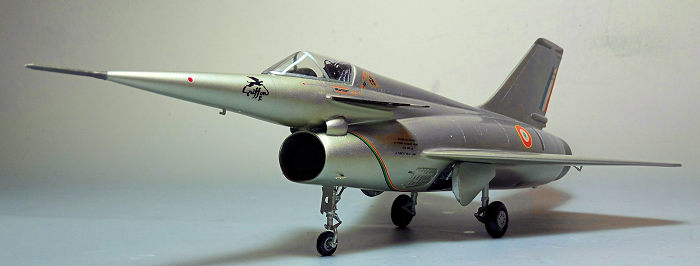 It might
sound quite simple and straightforward—and, in a way, it was straightforward.
However, it was certainly not simple. Virtually every part required trimming and
repeated test-fitting, with a fair amount of trial and error before everything
would fit reasonably well. Taking the time to trim, test, adjust, and try again
before committing the parts to glue paid dividends, and I eventually ended up
with a reasonably well-assembled model.
The model then underwent quite a few sessions of filling and sanding to remove all the pebbling from the external surfaces and eliminate the various gaps. It was not a quick process, but it gradually transformed the rather rough-looking assembly into something that finally resembled the sleek experimental aircraft it was supposed to be. Before moving to the paint shop, there was one more little adventure.
Since all landing-gear parts were to be painted silver like the aircraft, I attached the main landing-gear legs and was ready to tackle the nose landing gear, but I simply could not find it anywhere, no matter how long I searched. The landing-gear leg was nowhere to be found. After a few moments of mild horror, I took the bold decision to use a leftover nose-gear leg from a Eurofighter Typhoon. It had a similar general layout, and after trimming away some of the excess detail and modifying it slightly, I managed to make it look reasonably close to the original Griffon unit. I have to say that it looks convincing, and certainly it was a much better solution than having no nose landing gear at all! After this little adventure, it was time to take the sleek fighter to the paint shop.
| COLORS & MARKINGS |
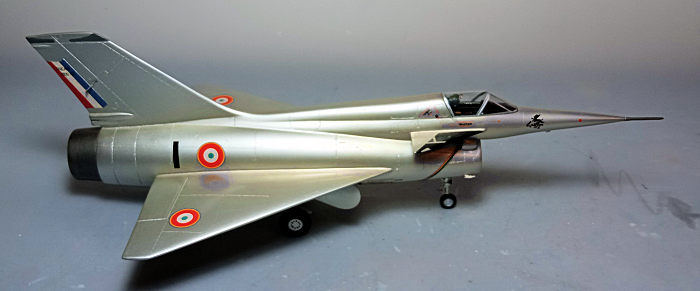 I used
Humbrol 11 and sprayed the complete model, which dried to a lovely shiny silver
finish. The intakes and compressor disc were also painted silver, while the
exhaust innards were painted with Testors Burnt Metal. The outer exhaust area
was painted with Testors Burnt Metal at this stage as well.
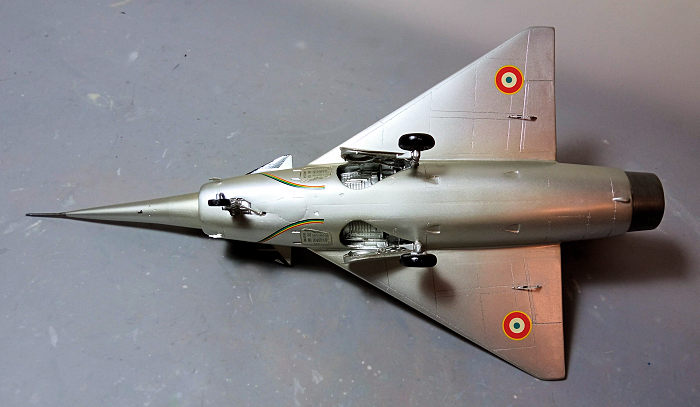
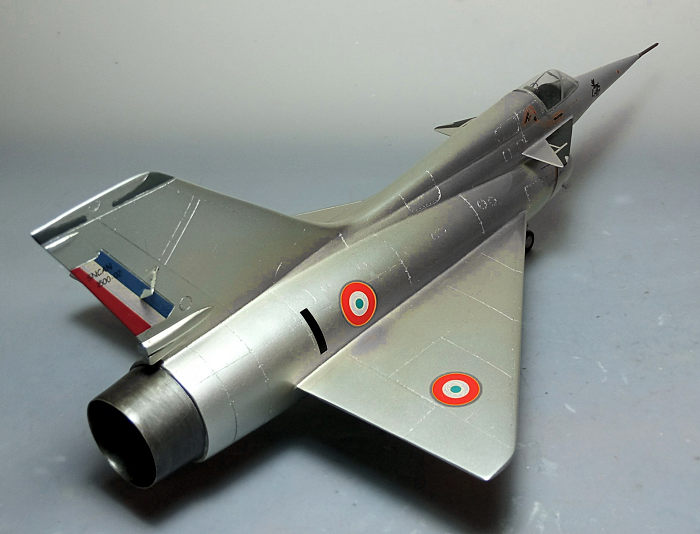
The red/white/blue fin flash was hand painted, as were the two dielectric areas on the fin top, and with that, the Griffon was ready for its decals.
I used the kit decals, which behaved beautifully. They detached quite easily from the backing paper and attached securely to the model without any drama. Their good quality added considerably to the appearance of the finished aircraft. After the rather elaborate and sometimes challenging construction process, applying the decals was almost a stress-relieving exercise. Painting and decaling were, in fact, a breeze and proved to be a very pleasant part of the build.
| FINAL BITS |
The main wheels received their photo-etched external hubs and were then attached to the landing gear. The wheel rims were painted silver, while the tires were painted black. The nose wheel was treated similarly and attached in position, with the Griffon standing securely on its feet, with no tail-sitting problem whatsoever.
I decided not to apply any weathering to the aircraft. This was, after all, a prototype, and the real Griffon was maintained in a relatively clean condition during its flying career. Instead, I simply applied a coat of gloss clear, giving the model the final sheen appropriate to this remarkable machine.
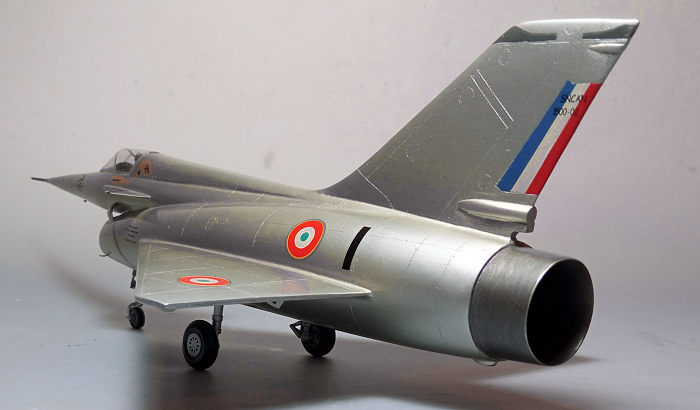 The canopy
was carefully cut from its fret, with the excess material carefully removed
before trimming it to fit. Its relatively well-defined frames were picked out in
silver, and the canopy was attached in position. The fit was good after some
trimming, which is simply part of the process when dealing with vacuform
canopies.
Various small pieces were added toward the end of the build, including the pitot tube and the photo-etched pitot tubes around the cockpit. Being PE, the latter are inevitably rather two-dimensional, but once installed they are not particularly obvious, and I can certainly live with them.
I couldn't spot any wingtip lights on the real mavhine, so I didn't add any. With these last details in place, the Griffon was finally ready to leave the workbench. It had been sitting quietly in my showcase for a few years until it was recently refurbished, given a few extra touches, and offered a new life.
| CONCLUSIONS |
The FM 1/48 Nord 1500 Griffon II is a challenging kit, but also a very rewarding one. There is no pretending that it is an easy build. The short-run molding, pebbly surface, gaps, multimedia construction and constant need for trimming and test-fitting demand patience throughout. With a little perseverance, all those idiosyncrasies can eventually be overcome.
The build is not so much difficult because of any single major obstacle, but because the kit presents a steady succession of smaller challenges. Parts often need to be cleaned up, adjusted and checked repeatedly before they will fit properly. The instructions also require a certain amount of interpretation, so it pays to study the parts and plan each stage before committing to glue. Taking the time to dry-fit assemblies and correct problems early will make the later stages considerably less stressful.
This is where Fonderie Miniature deserves appreciation. The company chose to give us subjects that the larger manufacturers were unlikely to touch, and the Griffon is a wonderful example. It is an unusual, fascinating aircraft, and having the opportunity to build it in 1/48 scale is something to appreciate. The kit may not offer the convenience of a modern, highly engineered release, but it does provide the raw materials needed to create a model of an aircraft that would otherwise be absent from many collections.
Despite its quirks, the kit can become a lovely model. Once finished, the sleek lines of the Griffon really come alive, and the rather intimidating collection of plastic, resin, white metal and photo-etched parts is transformed into one of the most unusual aircraft on the shelf. The finished model also has a presence that is difficult to capture in photographs: it is distinctive, imposing and immediately invites questions from anyone unfamiliar with the type.
Finding the kit today is probably the hardest part. They are scarce, and when one does appear, it is not always offered at a particularly friendly price. It may therefore be tempting to keep one safely in the collection as a rare Fonderie Miniature kit and simply admire the box. Given the kit's age and reputation, that is an understandable reaction. I would resist that temptation.
If you are fortunate enough to find one, build it. Every kit deserves its chance to become a model, and this one certainly deserves to be given that chance. It may ask a little more from the modeler than a modern mainstream kit, but the reward is a very distinctive Griffon in 1/48 scale—and, for such an extraordinary aircraft, that makes the effort worthwhile. The process may involve more filling, sanding, adjustment and improvisation than usual, but those tasks are part of the character of the kit rather than reasons to avoid it.
For all its little idiosyncrasies, it is simply nice to have a kit like this. It represents the kind of subject that keeps the hobby interesting: obscure, technically fascinating and unlikely to be produced by the major manufacturers. The Nord 1500 Griffon II may not be the easiest model on the bench, but it is memorable, rewarding and well worth the effort.
Happy Modeling!
15 October 2026
Copyright ModelingMadness.com. All rights reserved. No
reproduction in part or in whole without express permission.
If you would like your product reviewed fairly and fairly
quickly, please
contact
the editor
or see other details in the
Note to
Contributors.