| KIT #: | 32-002 |
| PRICE: | $165.00 |
| DECALS: | Seven options |
| REVIEWER: | Tom Cleaver |
| NOTES: |
| HISTORY |
Had the Hawker Sea Fury arrived on the scene one year earlier than it did, its place in history would not be assured by its technical excellence but rather by the outstanding combat record it would have undoubtedly achieved with the British Pacific Fleet in the final struggles of 1945. As it is, the Sea Fury - designed for air superiority - is known for shooting down only one opponent, a MiG 15 on August 2, 1952, originally credited to Lt. Peter "Hoagy" Carmichael of 802 Squadron, but now recognized as having been downed by Carmieal’s wingman, St-Lieutenant Brian “Smoo” Ellis. Given that, in the intervening five years between its appearance in squadron strength and that day in 1952' technological development had rendered the Sea Fury obsolete, its victory over the MiG-15 is even more remarkable. Regardless, the Sea Fury is the penultimate result of Sir Sidney Camm's philosophy of piston engine fighter design.
The Sea Fury began life in 1942 with a request by the Air Ministry that Hawker Aircraft design a long range fighter for operations in the Far East. While a radial engine version of the Tempest was under development at the time, it was thought that the relatively high wing loading of the Tempest would be ill suited for combat with the lightly loaded Japanese fighters, and thus the Sea Fury started out as the "Tempest Light Fighter (Centaurus)."
In early 1943, the designers were directed to adapt the fighter for shipboard operation as well as the land based role.
 The first
RAF prototype flew in September 1944, while the first navalized prototype flew
in February 1945. Tests revealed a need for an increase in vertical fin and
rudder size to counter the swing on take off, while the rigid engine mounts
created difficulty until they were replaced with dynafocal base mounts which
completely eliminated the vibration at lower speeds that had hampered the
airplane's ability to land aboard ship.
The first
RAF prototype flew in September 1944, while the first navalized prototype flew
in February 1945. Tests revealed a need for an increase in vertical fin and
rudder size to counter the swing on take off, while the rigid engine mounts
created difficulty until they were replaced with dynafocal base mounts which
completely eliminated the vibration at lower speeds that had hampered the
airplane's ability to land aboard ship.
While the Royal Navy was testing both the Meteor and the Vampire and had ordered the Supermarine Attacker, there was sufficient doubt about the ability of jets to operate off carriers that while the RAF canceled the land based Fury in the face of the arrival of the new jets - the Royal Navy continued to develop the Sea Fury as a shipboard interceptor and later as a fighter bomber. With carrier compatibility trials completed in 1947, 807 Squadron was the first to convert to the aircraft, followed by 802, 803 and 805 Squadrons between August 1947 and February 1948. The initial Sea Fury Mk.X was quickly replaced by the F.B.11, which could carry underwing drop tanks, bombs and rockets; squadrons began to equip with it in May 1948.
The Sea Fury's introduction to combat came in the fall of 1950 when 807 Squadron, operating from HMS "Theseus," joined Task Force 95, the Korean blockade force. Operating jointly with Firefly F.R.IV and V strike aircraft, FAA Sea Furies flew from HMS "Triumph," "Theseus," "Glory," and "Ocean," as well as with the RAN from HMAS "Sydney" until the end of the war in July 1953.
In typical operations, the carrier was "on line" for 11 days - four days of operations followed by 3 days of replenishment followed by a final 4 days of operations; at least two missions per day were flown by each operational aircraft aboard. These were missions in support of ground troops, or against rail and road transport to choke off supplies to the Chinese and North Koreans. As 802 Squadron pilot Peter Carmichael remembered, “Our biggest worry was flak. It kept you worried the whole time. Some of it was radar-controlled, and some used tracer. Most AA weapons were very well concealed, sometimes in houses in the villages. False targets were used as flak traps and their fire discipline was excellent.”
HMS "Ocean" came on line in May, 1952, with 802 Squadron equipped with Sea Furies. The carrier and its group would set records during this tour. 802 Squadron was launched with 1,000-lb bombs, twice the load carried by other Sea Furies in the light wind conditions found in the East China Sea, and several daily-launch records would be set.
By July and August,
enemy jet incursions over North Korea to intercept UN fighter bomber sorties
began to increase. On August 9, 1952, eight MiG 15s hit Ocean’s mixed strike
force of Sea Furies and Fireflies. Combat was sharp, with one Firefly destroyed
by a MiG's heavy cannon fire, but one of the MiGs lost speed
 as it
maneuvered around for a second attack. With throttles “through the gate” to
chase this slower MiG, the Sea Furies managed to hit both it and its wingman who
came back for support. One of the two crashed, and Lt. Peter "Hoagy" Carmichael,
Blue Section leader, was credited with the kill, the only victory by a piston
engine fighter over a jet in the war. The following day saw 8 more MiGs come
after the Sea Furies, who were able to save themselves by dint of using their
superior maneuverability at what was a low speed for the jets, pulling tight
high-G maneuvers and taking advantage of cloud cover. One MiG was claimed
damaged.
as it
maneuvered around for a second attack. With throttles “through the gate” to
chase this slower MiG, the Sea Furies managed to hit both it and its wingman who
came back for support. One of the two crashed, and Lt. Peter "Hoagy" Carmichael,
Blue Section leader, was credited with the kill, the only victory by a piston
engine fighter over a jet in the war. The following day saw 8 more MiGs come
after the Sea Furies, who were able to save themselves by dint of using their
superior maneuverability at what was a low speed for the jets, pulling tight
high-G maneuvers and taking advantage of cloud cover. One MiG was claimed
damaged.
Herer’s Carmichael’s account:
“We had been in the area for about 20 minutes when Sub Lt Carl Haines called out "MiGs 4 o'clock". I turned the formation to meet the attack and saw eight MiGs coming straight at us. Lt Toby Davies and Sub Lt 'Smoo' Ellis broke away from the flight to fend for themselves as four of the MiGs decided to look after them. We,as usual, were flying at about 4000 feet. Suddenly a MiG came down behind me: I turned towards him and, as he flew past me, I noticed he had his air brakes out. He made the mistake of trying to dog-fight with us. I put my gyro sight on him and started to fire. At this point he realised he was in trouble and put his dive brakes in and started to accelerate like mad. I held him quite easily and my bullets started to hammer him. He started to roll over on his back and crashed into the ground with no attempt to bail out.”
Here is the 802 Squadron report of the August 9 combat:
“Lieutenant Carmichael, Lieutenant Davis and Sub-Lieutenants Haines and Ellis started the ball rolling this morning by flying the first AR of the patrol. By 0600 they had entered the area and had commenced their Hanchon and Pyongyang to Chinnampo rail search. By 0630 they had reconnoitered as far south as Chinji-ri, a small village about 15 miles north of Chinnampo. As they meandered down the line, checking the bridge state as they went, they suddenly saw eight jet bogies to the north. Almost immediately the bogies were identified as MiGs - and were closing. By this time drop tanks were fluttering earthwards and the flight had assumed proper battle formation and No.4 - Sub Lieutenant Ellis - had noticed a shower of red tracer streaming past both sides of his fuselage. He cried "Break" over the R/T and the flight commenced a "Scissors". It was soon apparent that four MiGs were after each section of two Furies but by continuing their break turns our aircraft presented practically impossible targets to the enemy who made no attempt to bracket.
“On one occasion a MiG
came head-on to Lieutenant Carmichael and Sub Lieutenant Haines - they both
fired - it broke away and proceeded to go head-on to Lieutenant Davies and Sub
Lieutenant Ellis - they both fired and registered hits. On another occasion a
MiG pulled up in front of Ellis with its air brakes out and he was amused to
find the range closing. He gave a long burst and noticed
 hits on
the enemy's wings. The aircraft then proceeded northwards and a reduced speed
with two other MiGs in company. Meanwhile the flight, still in its battle
formation, managed a dozen or so more firing passes at the MiGs head-on. The dog
fight lasted 4-5 minutes and then the MiGs disappeared as quickly as they had
arrived - as they departed an aircraft was seen to crash into a hillside and
blow up. At first Lieutenant Carmichael thought it was one of his flight and
ordered a tell-off. However when No.4 came up "loud and clear" it was realised
that the Royal Navy had shot down its first communist aircraft. Lieutenant
Carmichael as flight leader is being credited with its destruction officially
but the rest of the flight are claiming their quarter as well.”
hits on
the enemy's wings. The aircraft then proceeded northwards and a reduced speed
with two other MiGs in company. Meanwhile the flight, still in its battle
formation, managed a dozen or so more firing passes at the MiGs head-on. The dog
fight lasted 4-5 minutes and then the MiGs disappeared as quickly as they had
arrived - as they departed an aircraft was seen to crash into a hillside and
blow up. At first Lieutenant Carmichael thought it was one of his flight and
ordered a tell-off. However when No.4 came up "loud and clear" it was realised
that the Royal Navy had shot down its first communist aircraft. Lieutenant
Carmichael as flight leader is being credited with its destruction officially
but the rest of the flight are claiming their quarter as well.”
Here’s Brian “Schmoo” Ellis’ account of the combat:
“We crossed the coast on a deserted stretch near Chungsan at about six o’clock. There was no sign of activity. The Communist air defence forces seemed to still be asleep. That was no anti-aircraft fire; all seemed quiet.”
“We should have realised there were enemy fighters in the local area. Within minutes it had all changed. It was Carl who spotted them first. He called ‘MiGs four o-clock high.’”
“I was the nearest to the fast approaching enemy, so I called the break. With a well-practiced manoeuvre, we crossed over – the right pair taking the lead - and turned towards the enemy, at the same time opened the throttle to its highest power setting, in a climbing turn.
“My four 20 mm cannon were set to fire and I braced into the turn, pulling hard. As I did so, I saw a MiG get around behind me as if he wanted to dogfight. Big mistake; a jet can’t dogfight a Sea Fury.
“The MiG came in from behind and realised that he had too much energy; he was going too fast. He put out his air brakes to slow but in doing so loss momentum and dropped into my gyro gunsight. I fired and even as he accelerated away, I kept firing. I had no time to watch him go down as there was still a fight underway.”
Reading the two accounts, it is clear that Ellis hit the MiG first and that it was in process of going down when Carmichael - thinking it had tried to attack him - took his shots as it flew past. Given that Ellis fired from six o’clock with extended bursts of fire, while Carmichael was probably at seven o’clock to a bit past eight o’clock and fired only one burst, the preponderance of evidence in the descriptions gave the edge to Ellis. The FAA officially changed its record to recognize Ellis as the “MiG-killer” in 2019.
| THE KIT |
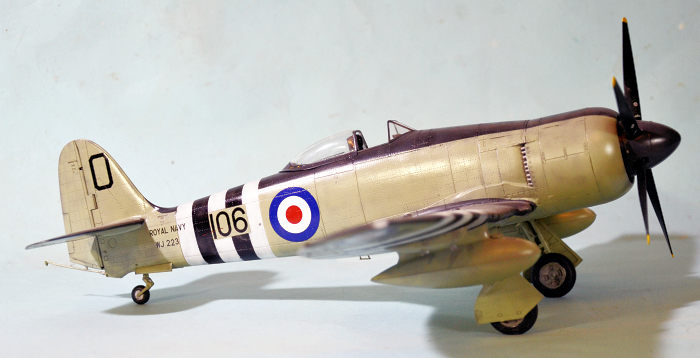 This Sea
Fury FB 11 is the second 1/32 kit to come from DBMK, a new model company in the
UK - their first being a DeHavilland Hornet F.3. Will Packard - who started the
company - has an ambitious kit release list, which includes a 1/48 Supermarine
Scimitar and a 1/48 North American F-86H which should be the next releases,
hopefully toward the end of this year.
This Sea
Fury FB 11 is the second 1/32 kit to come from DBMK, a new model company in the
UK - their first being a DeHavilland Hornet F.3. Will Packard - who started the
company - has an ambitious kit release list, which includes a 1/48 Supermarine
Scimitar and a 1/48 North American F-86H which should be the next releases,
hopefully toward the end of this year.
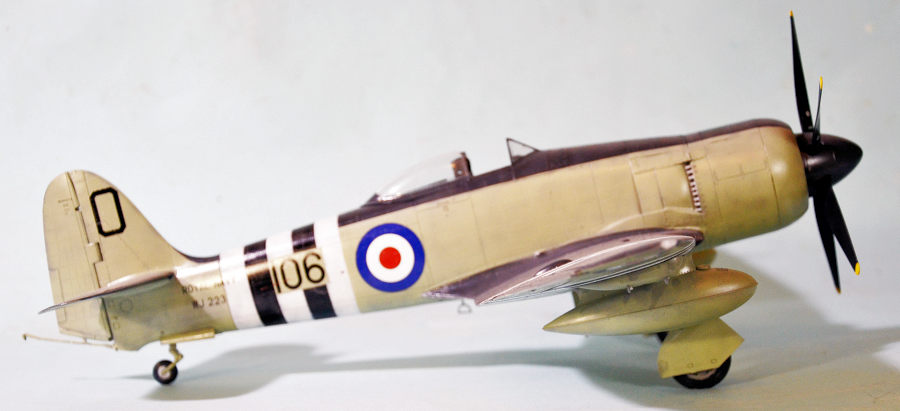
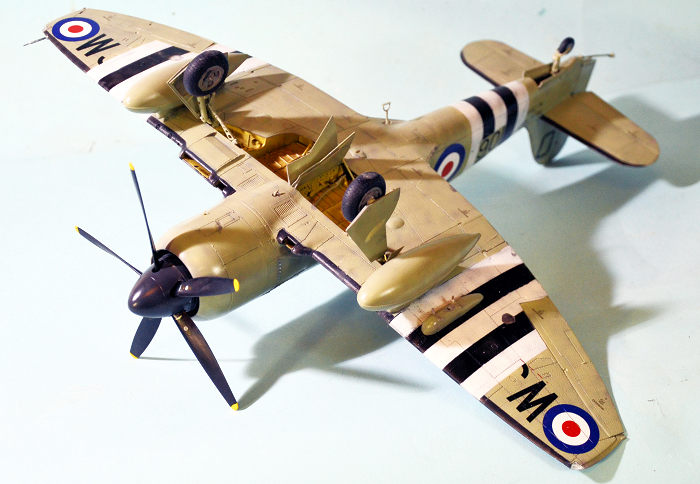
The kit design and production quality is beyond first rate. This is easily the best, most detailed, most accurate Sea Fury in any scale. I’ve been around 1:1 Sea Furies “up close and personal,” and the surface detailing is “spot on.” The cockpit is as detailed as the one I sat in. The wheel wells display all the various piping inside that has never appeared before on any Sea Fury kit. Decals are by Cartograf and are excellent. (The sheet doesn’t have any 802 Squadron aircraft, and I am very fortunate I never throw away decals, since I managed to spill some Tamiya Extra Thin on the decals for the airplane I intended. Fortunately I had the leftovers from the Fisher Sea Fury and was able to do markings for “Schmoo” Ellis’ airplane.)
| CONSTRUCTION |
This kit is very detailed - there are 338 plastic and 117 P.E. brass parts! - it is the definition of “challenging.” So do yourself the favor of reading - and following - the instructions. They really aren’t “somebody’s opinion.” Do that, and you’ll be on the road to success.
One point overall: most of the structural parts are large, and the plastic they’re made from is thin. Be very careful in getting proper alignment when you start gluing things together - one small oopsie can lead to a cascade of bigger and bigger outright catastrophes if you miss this point.
There is a lot of p-e used for all the various levers and switches in the cockpit. Given the cockpit is all black, do not get upset if any of the p.e. goes flying off to the Department of Lost. You won’t see them if they were there.
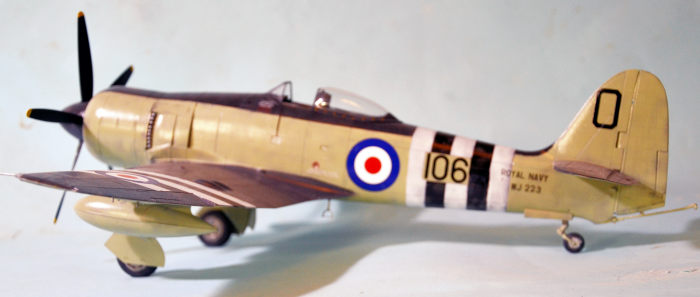 When it
came time to assemble the wings, I did differ from the instructions on how to
bring the inner and outer wing sections together in a good strong bond. I
attached all the sections of the interior of the wing stub, then glued the
connection spars into position inside the upper wing half, then glued that to
the lower center section. After doing that for both wings, I took the upper
outer wing part and glued it strongly to the spar, and also glued the wing edges
together from the inside. That avoided any glue running anywhere on the nice
surface detail, and got the wing parts nice and secure. I then glued the lower
wing halves to the respective upper halves. BE SURE TO REMEMBER to open the
locating holes in the lower wing parts for attachment of the drop tanks, bomb
rack or rockets (Sea Furies carried rockets or bombs but not both together in
Korea) BEFORE you proceed to attach everything. (Yes, I learned that the hard
way, fortunately before the glue had set up n the right inner lower wing.)
When it
came time to assemble the wings, I did differ from the instructions on how to
bring the inner and outer wing sections together in a good strong bond. I
attached all the sections of the interior of the wing stub, then glued the
connection spars into position inside the upper wing half, then glued that to
the lower center section. After doing that for both wings, I took the upper
outer wing part and glued it strongly to the spar, and also glued the wing edges
together from the inside. That avoided any glue running anywhere on the nice
surface detail, and got the wing parts nice and secure. I then glued the lower
wing halves to the respective upper halves. BE SURE TO REMEMBER to open the
locating holes in the lower wing parts for attachment of the drop tanks, bomb
rack or rockets (Sea Furies carried rockets or bombs but not both together in
Korea) BEFORE you proceed to attach everything. (Yes, I learned that the hard
way, fortunately before the glue had set up n the right inner lower wing.)
When you assemble the highly detailed main gear wheel well, take your time and be careful. Many of these parts are “scale thickness” which makes them fragile cutting them free of the sprue and them moving them arund for proper attachment.
Once you have the fuselage halves together, the most difficult part of the assembly (in my experience) is getting the engine face, the upper and lower cowling, and the upper deck glued in position properly. This is where if you failed to get the fuselage halves properly aligned when you assembled them that you find yourself at the great big “Oh, Fudge!” moment. You will likely use a stronger term.
When the wing and fuselage subassemblies are all properly glued together and fully set up, mating the two subassemblies is easy. Be sure to get proper alignment of the upper inner wing to the fuselage and hold things in position until you get an initial “grab.”
The rest of the assembly is easy. Attach the control surfaces and the horizontal stabs, and your ready to move on to...
| COLORS & MARKINGS |
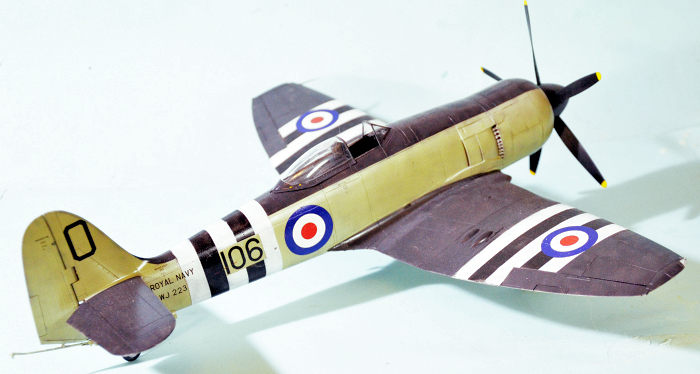
I used Mr. Color C-333 Extra Dark Sea Grey (semigloss) and Mr. Color C-368 Sky BS361C/210 for the exterior camouflage paint. I sued Mr. Color C-352 Chromate Yellow, with a dollop of Mr. Color C-113 RLM04 Yellow, to get what could pass as “Hawker Yellow” for the interior of the wheel wells. I used Mr. Color C-156 Super White and Tamiya LP5 Semoigloss Black for the ID stripes.
The inside of the gear doors and the gear legs are also painted Sky with the rest of the lower surfaces; wheel hubs are silver; hoses in the wheel well are Rubber Black.
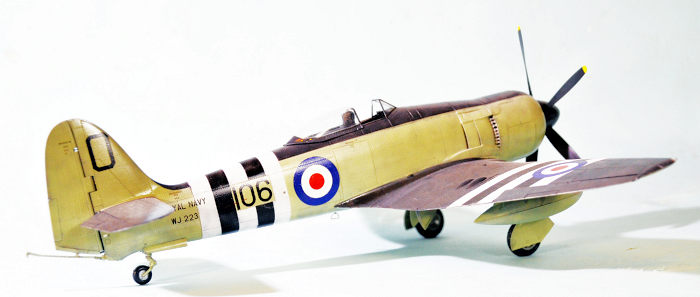 After first
preshading all the panel lines, I also painted the areas where the black and
white ID stripes are in black; after the paint was dry, I masked off the black
stripes and painted the other areas white - doing this over black allowed for a
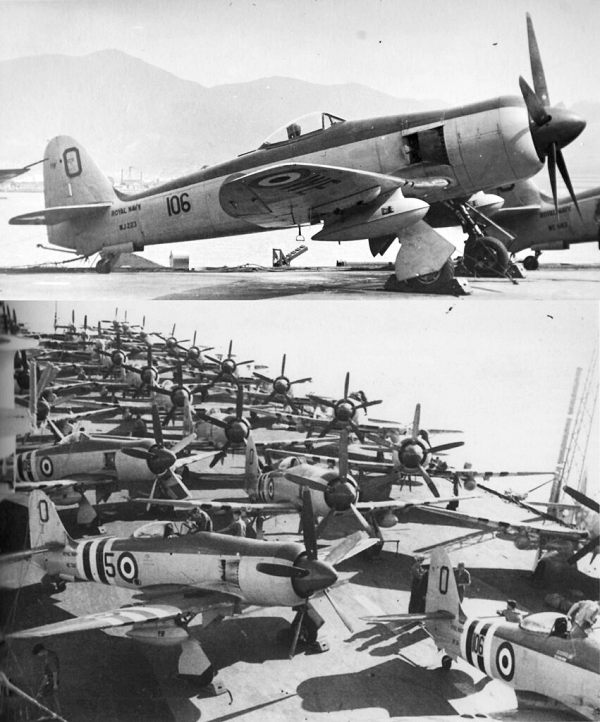
“distressed” finish, which according to photos is the way these stripes appeared
after a few tours in the East China Sea.
After first
preshading all the panel lines, I also painted the areas where the black and
white ID stripes are in black; after the paint was dry, I masked off the black
stripes and painted the other areas white - doing this over black allowed for a
“distressed” finish, which according to photos is the way these stripes appeared
after a few tours in the East China Sea.
I then applied the Extra Dark Sea Grey and masked it off. Sky was applied last. I then unmasked everything and was glad to see all had been done right.
I first gave the model an overall coat of Tamiya Clear Gloss lacquer.
As stated at the beginning, I managed to mess up the very nice kit decal sheet by spilling Tamiya Extra Thin on that part of the sheet that had the black letter markings for my choice of airplane. Luckily, I had leftover decals from the Fisher Sea Fury and was able to piece together markings for Sub Lt Brian “Schmoo” Ellis’s Sea Fury. I used the kit national insignia and stencils.
Once the decals were all set up (some needed to be sliced and flooded with decal solvent to make sure it all snugged down), I gave the model an overall coat of Mr. Color Gx-112 Super Clear UV Cut, which resulted in a less-glossy overall finish. I assembled the main gear and tailwheel and attached it in position. I then attached the drop tanks and the bomb racks, and assembled the spinner and prop. Lasty, I attached the canopy in the open position.
| CONCLUSIONS |
Like I said, the best Sea Fury out there. Yes, it’s expensive, but like they say in my other business, “every penny’s on the screen.” The resulting model is well worth the cost to acquire it and the time to assemble it. Recommended for experienced intermediate modelers and beyond. This is a great initial effort from a new company.
Review kit courtesy of DBMK. Get yours at DBMK (All income goes to future development and production of their impressive product line.)
Tom
Cleaver 30 July
2026 Copyright ModelingMadness.com. All rights reserved. No
reproduction in part or in whole without express permission. If you would like your product reviewed fairly and fairly quickly, please
contact
the editor or see other details in the
Note to
Contributors.