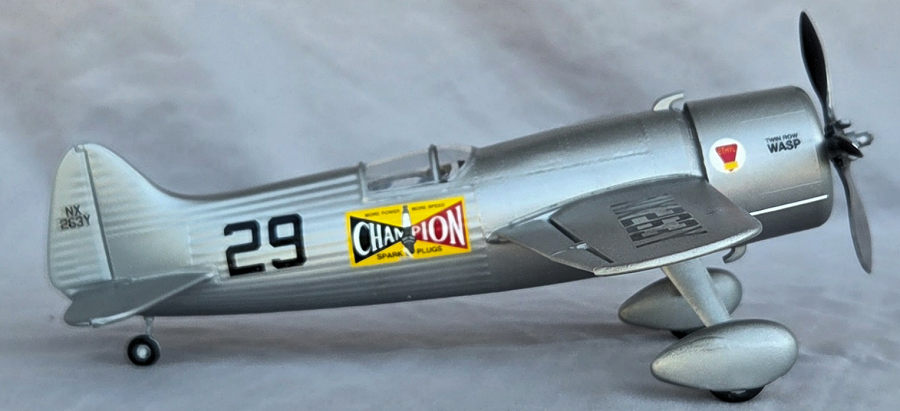
| KIT #: | 70562 |
| PRICE: | $22.00 |
| DECALS: | One option |
| REVIEWER: | John Summerford |
| NOTES: | Engine from Williams Bros. |
| HISTORY |
In 1936, Col. Roscoe Turner, an old timer in the race game, felt the need of a new racing mount. Colonel Turner, Nevada National Guard, had been a famous name in race history since 1924. Along with his robin's egg blue uniform, whipcord breeches, military cap, gold wings with RT in bold letters, he also had Gilmore, his pet lion.
Gilmore accompanied Roscoe on most of his cross-country record-breaking flights and his name, along with the flashy uniform, became synonymous with Colonel Turner. Roscoe had set many records with his Lockheed Vega, Air Express, and Wedell Williams but the Wedell was getting outclassed and in 1936 Turner contracted with Lawrence W. Brown Aircraft Company to build him a new racing aircraft. The racer was designed by Turner himself and engineered by Howard Barlow of the University of Minnesota. The ship was built at the Brown factory in California and completed in mid-year 1936. It was a full cantilever mid-wing monoplane, fixed gear and powered by a Twin Wasp Sr., 1830 cu. in. 1000 hp engine. The wingspan of the original racer was approximately 22 ft. and quite narrow in chord. The fuselage was constructed of chrome-moly tubing with spruce and fabric fairing.
 The two
solid wing spars were of 14 ply laminated spruce; ribs were reinforced plywood
and the leading-edge metal covered. The fuselage was covered with metal from the
engine cowl to the cockpit and from this point rearward Irish linen was used for
covering. There was also a strip along the bottom of the fuselage that was metal
covered to protect this portion from flying stones during take-off and landings.
The rudder faired smoothly into the tail cone of the fuselage, giving an
uninterrupted airflow line.
The two
solid wing spars were of 14 ply laminated spruce; ribs were reinforced plywood
and the leading-edge metal covered. The fuselage was covered with metal from the
engine cowl to the cockpit and from this point rearward Irish linen was used for
covering. There was also a strip along the bottom of the fuselage that was metal
covered to protect this portion from flying stones during take-off and landings.
The rudder faired smoothly into the tail cone of the fuselage, giving an
uninterrupted airflow line.
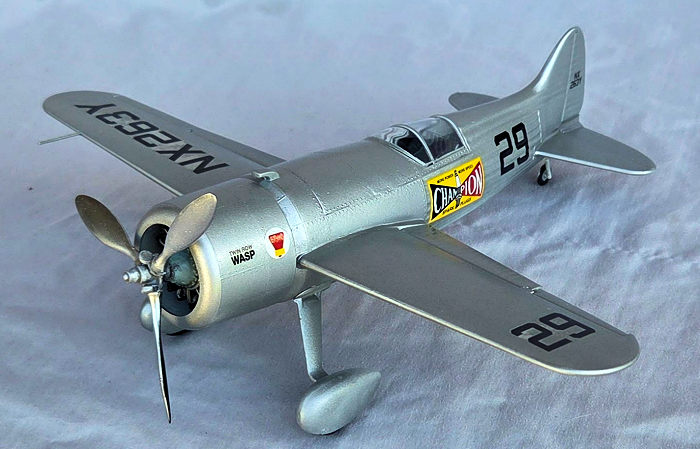
The stabilizers were constructed of wood and the elevators and rudder were steel tubing. All were fabric covered. The paint scheme was a silver gray, license number R263Y and race number 29. The wheels were un-spatted but were thin and equipped with full side caps. Turner tested the aircraft and decided it was too heavy for the narrow wing. The racer was never flown with the narrow wing but was taken apart and shipped to the Laird factory at Chicago. Turner then redesigned the wing and Matty Laird rebuilt the racer in his factory.
During the redesigning Turner had approximately 3 ft. added to each wing, the chord width increased, and the engine set back 6 in. The final specifications of the Turner Racer were: wingspan 25 ft., length 23 ft. 4 in., height 10 ft., wing area 95 sq. ft. empty weight 3300 lbs., gross weight 4923 lbs., wing loading 51.8 lbs. and a power loading of 4.92 lbs. It carried 215 gallons of fuel and had an oil capacity of 15 gallons. Manually controlled wing flaps decreased the landing speed.
The racer was sponsored in 1937 by Ring Free Oil and arrived at the Nationals wearing the name "Ring Free Meteor", a star, and race number 29 on its flanks. The name Laird in a diamond appeared on the vertical stabilizer.
 Roscoe and
the "Meteor" got off to a bad start as he was forced out of the Bendix when a
welding explosion ruptured the oil tank of the racer. However, he was very
fortunate that the plane was not completely destroyed. En route to the races he
flew through a hailstorm, causing considerable damage to the leading edge of the
wing. He repaired the damage and entered the Thompson Trophy Race and was
running second behind Steve Wittman and his D-12 "Bonzo" when Wittman developed
trouble on the 17th lap and Turner slid into the lead.
Roscoe and
the "Meteor" got off to a bad start as he was forced out of the Bendix when a
welding explosion ruptured the oil tank of the racer. However, he was very
fortunate that the plane was not completely destroyed. En route to the races he
flew through a hailstorm, causing considerable damage to the leading edge of the
wing. He repaired the damage and entered the Thompson Trophy Race and was
running second behind Steve Wittman and his D-12 "Bonzo" when Wittman developed
trouble on the 17th lap and Turner slid into the lead.
He held the lead until the final lap and on one of the final pylons, blinded by the sun, felt that he had cut the pylon so he returned and re-circled it. At this point he was passed by Earl Ortman in the Keith Rider R-3 and Rudy Kling in the sleek Folkerts SK-3. Turner and the "Meteor" finished third in the Thompson with a speed of 253.802 mph.
Roscoe roared into the 1938 National Air Races with his silver Meteor and a determination to win the Thompson Trophy. During the early part of the year, he experienced problems in cooling and lubrication but these bugs had been worked out and the Wasp was full of vitamins. Only minor changes had been made on the racer itself. One was the wheel pants covering the gear. The racer's new sponsor was the Pump Engineering Service Corporation of Cleveland. The name "Ring Free" had been removed and "Pesco Special" replaced it. Many stories have been circulated about some of the pilots planning to box Turner and the "Pesco" so he could not win the race and that his answer was, "I'll chew their fuselage apart with this big fan of mine and then bail out". However, none of these stories have ever been proven true.
The ships lined up for-the Thompson and as the flag dropped the "Pesco Special" sprang forward as the big Wasp screamed under full throttle. At 100 mph the racer appeared alive, aware of her controls, and at 125 mph Turner lifted her into the air.
On the first lap the "Pesco
Special" was running second behind Earl Ortman in the R-3. The Twin Wasp Sr.
SBG-177 that had been built and delivered in 1936 was rated at 1000 hp at 2600
rpms and a maximum manifold pressure at takeoff of 40.3 in. HG. Turner was
turning the Wasp slightly over the 2600 rpm mark and pulling 47 in. HG. (6.7 in.
over maximum). He held this all during the 300-mile grind, co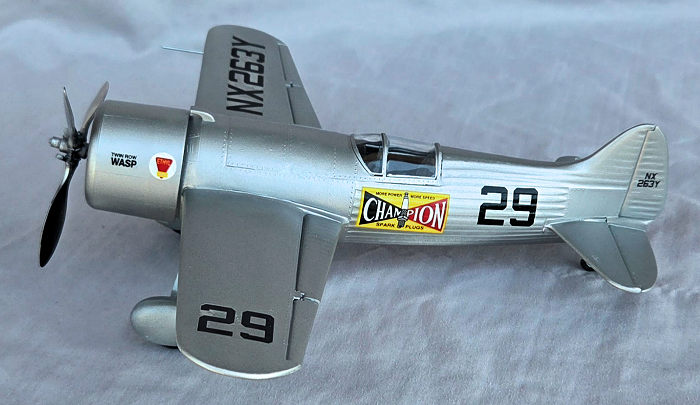 nsuming
185 gallons of fuel (under 2 miles to the gallon) and with no damage to the
engine. Pulling this power and flying a wide race so as not to cut a pylon,
Turner streaked ahead of Ortman and went on to win the Thompson with a speed of
283.416 mph, turning one lap at 293 mph. With this win he became the only
two-time winner of the Thompson Trophy Race.
nsuming
185 gallons of fuel (under 2 miles to the gallon) and with no damage to the
engine. Pulling this power and flying a wide race so as not to cut a pylon,
Turner streaked ahead of Ortman and went on to win the Thompson with a speed of
283.416 mph, turning one lap at 293 mph. With this win he became the only
two-time winner of the Thompson Trophy Race.
Turner and his powerful Racer was back in 1939. No changes had been made in the ship, except the sponsor. Champion Spark Plugs now sponsored.
The speedster and their insignia appeared on the fuselage and the racer was now known as the "Miss Champion". Turner considered Ortman and Wittman top competitors for the Thompson Race but figured Ortman was too young and would not plan all the angles for the long race, so Wittman would be the man to beat. Roscoe was slow getting off the ground in the start of the Thompson and was setting in fourth spot. Then it happened again, on the second lap he cut a pylon and had to go back and re-circle it. He now trailed the entire field but he pushed the hay to all the extra horses in the nose, streaking by the other racers one at a time, and pulled into the lead. He went on to win with a speed of 282.5 mph and became the first and only three-time winner of the Thompson Trophy Race.
After the race Colonel Turner stated that he and the "Miss Champion" were retiring from the race game. The racer can be seen next to Boeing’s Dash 80 (707 prototype) at the National Air and Space Museum’s Udvar-Hazy Center.
| THE KIT |
This example has a copyright dated 2007. Lindberg previously released it in 1992 with new parts. Scale Mates indicates that the kit was originally released in 1959 by Pyro. 34 white styrene and two clear parts plus a very undersized pilot figure are in the box. Instructions are broken down into eight steps and printed on an 11 by 17-inch sheet.
| CONSTRUCTION |
I found myself exhaling a deep breath, with cheeks puffed out, as I pondered what improvements to include to bring the model into the 21st century. Before gluing anything together, the prominent ridges representing the fabric skin on the fuselage halves and control surfaces were sanded down. Ejector pin marks were also removed and this was an opportunity to thin the edges of the flying surfaces. This took about two hours.
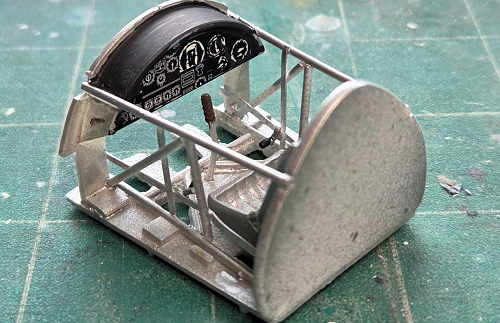 Moving to
the fictitious cockpit, the combined seat and rear bulkhead piece was discarded
and new bulkhead cut from sheet styrene. A more appropriate seat was sourced
from the parts bin. Material was ground away from the floor piece to better
represent the framework and the instrument panel piece added. Side frames were
built up with styrene rod and strip stock. Just enough detail was included to
make it look busy. The subassembly was painted with rattle-can silver along with
the fuselage interior. The kit instrument decal was applied before the cockpit
was glued in place.
Moving to
the fictitious cockpit, the combined seat and rear bulkhead piece was discarded
and new bulkhead cut from sheet styrene. A more appropriate seat was sourced
from the parts bin. Material was ground away from the floor piece to better
represent the framework and the instrument panel piece added. Side frames were
built up with styrene rod and strip stock. Just enough detail was included to
make it look busy. The subassembly was painted with rattle-can silver along with
the fuselage interior. The kit instrument decal was applied before the cockpit
was glued in place.
A two-part, upper and lower, stabilizer fits from the inside of the fuselage sides and insures near perfect alignment. The rudder is also trapped by the fin when the fuselage sides get mated. The tail wheel is also trapped but was left for later.
Two tabs are molded in the part that represents the sheet metal top of the fuselage. I think they are to help with alignment, but they create more problems than they solve. They were clipped off and resulting gaps filled with shims. Rivet detail was lost and I was not able to make a straight seam. The windshield and canopy were installed and masked.
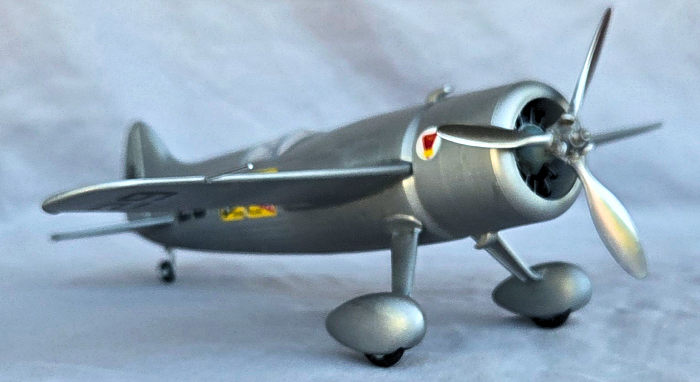
A single part, lacking in detail, represents the engine and it slots into the cowl. When I returned to the hobby in the mid 80’s, there were a lot of kits that dealt with radial engines in this manner and Williams Brothers sold after-market engine kits. I bought multiples of Wasps, Hornets, Whirlwinds, and Cyclones and still have a handful in the stash.
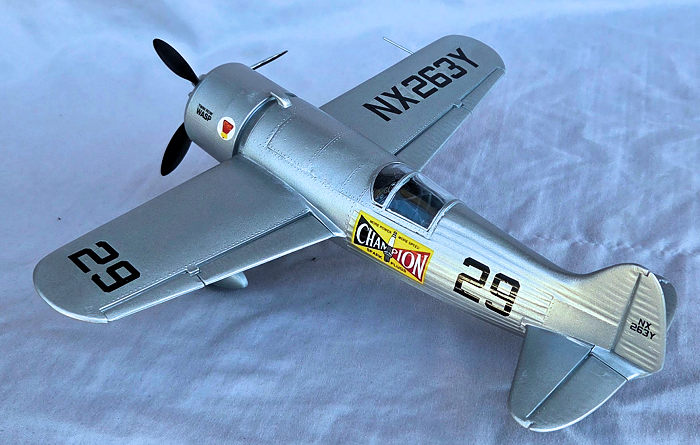 So, I
grabbed a Wasp, assembled it, and tested the fit in the cowl. Either the cowl is
too large, or the engine too small, or something in between, but the gap was
appalling. Strip stock was wrapped around the rear bank of cylinders a couple of
turns and the engine guide rails inside the cowl ground away to allow the new
engine to fit in the correct location. Once that was painted and installed, the
cowl was glued to the fuselage.
So, I
grabbed a Wasp, assembled it, and tested the fit in the cowl. Either the cowl is
too large, or the engine too small, or something in between, but the gap was
appalling. Strip stock was wrapped around the rear bank of cylinders a couple of
turns and the engine guide rails inside the cowl ground away to allow the new
engine to fit in the correct location. Once that was painted and installed, the
cowl was glued to the fuselage.
Propeller blade counterweights are lacking on the prop piece. A set was punched from a die using .060 styrene and glued to the hub. The cord of the blades was trimmed before the prop was painted and set aside.
Assembling the wings was straight forward, the flap and aileron hinges are trapped by the upper and lower halves. A mounting hole for the pitot was drilled in the right wing. The wings fit into deep sockets that, again ensure easy alignment. Gaps were easily handled.
Gaps in the wheel spats also needed filling and sanding before gluing the landing gear to the fuselage.
| COLORS & MARKINGS |
A coat of Krylon Fusion line of metallic primer and paint from a rattle can was sprayed on. It dries to the touch in 20 minutes. Waiting a bit longer than that, some seams were touched up and a second coat applied. Decals were put in place 24 hours later. They behaved well.
Masking was removed from the engine and clear parts. The tail wheel was added. A pitot was cut from a paper clip and secured by cyano. The last part was the prop.
| CONCLUSIONS |
This kit is a product of its time. Because of the minimal cockpit and engine detail plus very overstated fabric covering, it cannot become a great model. It assembles reasonably well and needs the usual filling and sanding of the seams. If one desires to build a model over a weekend OOB, this is a good kit for such an effort. It occurs to me that a 3-D printed upper fuselage piece with recessed panel lines would help a lot. That leads me to wonder if a new cockpit and engine should be printed too. But then then, why stop there?
In this scale, it’s the only kit available. Dekno released both 48th and 72nd scale resin kits.
9 June 2026
Copyright ModelingMadness.com. All rights reserved. No reproduction in part or in whole without express permission.
If you would like your product reviewed fairly and fairly quickly, please contact the editor or see other details in the Note to Contributors.