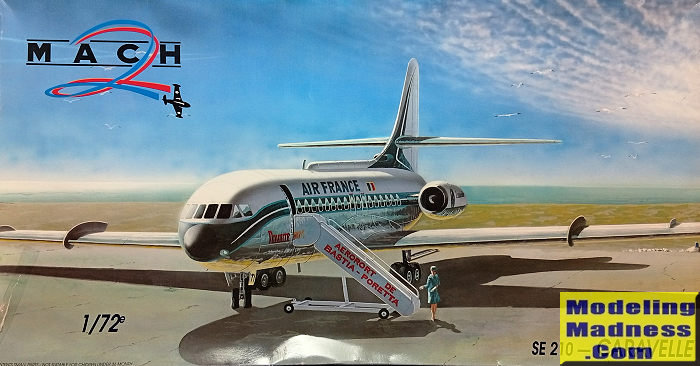
Mach 2 1/72 SE 210 Caravelle
| KIT #: | GP023 |
| PRICE: | £23.00 |
| DECALS: | Five options |
| REVIEWER: | Spiros Pendedekas |
| NOTES: | Short Run |
| HISTORY |
The Sud-Est SE.210 Caravelle was one of the aircraft that helped define the beginning of the jet age in European commercial aviation. Developed in France during the early 1950s by SNCASE (Société Nationale de Constructions Aéronautiques du Sud-Est), the design was intended primarily for short- and medium-haul routes, where a relatively small, fast jet airliner could offer a substantial improvement over the piston-engine aircraft then in widespread service. The prototype made its first flight on May 27, 1955, from Toulouse-Blagnac, introducing an aircraft whose clean lines and distinctive rear-mounted engines would soon become one of the most recognizable silhouettes of the early jet era.
The Caravelle was notable not simply because it was a jet, but because of the way its configuration combined efficiency, passenger capacity, and relatively quiet operation. Its two Rolls-Royce Avon engines were mounted at the rear of the fuselage, leaving the wings aerodynamically clean and giving the aircraft its characteristic appearance. This configuration would prove highly influential, with later aircraft such as the Douglas DC-9 and Boeing 727 adopting similar rear-engine layouts. The Caravelle also incorporated several advanced features for its time, including hydraulically assisted flight controls and all-weather landing capability.
The first production aircraft entered service with Air France in April 1959, and the Caravelle quickly found customers well beyond France. Airlines in Europe, the Americas, Africa, and elsewhere adopted various versions of the aircraft, while its combination of good performance and relatively modest size made it particularly suitable for regional and medium-range operations. In 1957, SNCASE became part of the newly created Sud Aviation, and production continued under the new company's name as the Caravelle evolved through a succession of versions with improved engines, greater capacity, and increased range.
Over the course of its production life, the Caravelle was built in 282 examples across eight variants, a respectable achievement for a pioneering European jetliner. It remained in airline service for decades and was also operated by charter companies, smaller carriers, and military and government organizations in various roles. More importantly, the SE.210 established French industry as a serious participant in the rapidly developing postwar commercial jet market and provided valuable experience that would later contribute to much larger European projects, including Concorde and eventually Airbus.
Today, the Caravelle remains one of those aircraft whose importance goes beyond its production numbers. Elegant, technically innovative, and unmistakably a product of the optimistic early jet age, it represents an important stage in the transition from propeller-driven airliners to the modern world of commercial aviation.
| THE KIT |
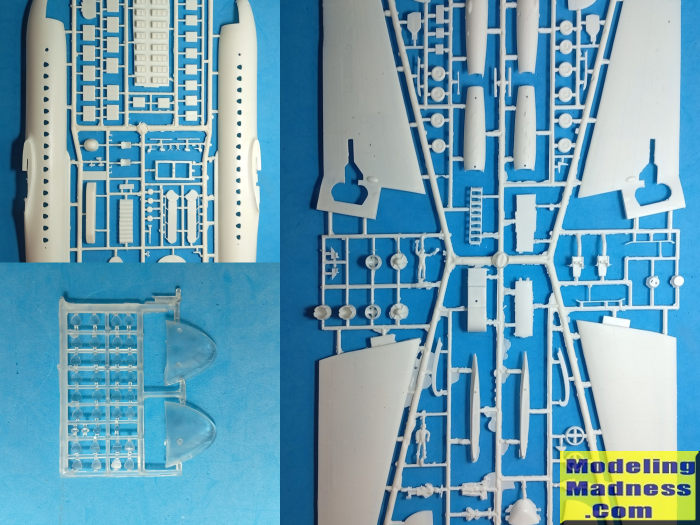 The
Caravelle has never been particularly popular in 1/72 scale, and I suspect
it never will be—although hope dies last! Apart from this Mach 2 edition,
originally released in 1999, there no other choice for anyone wishing to
build this elegant early jetliner in the larger scale. In that respect, Mach
2 deserves some credit for tackling such an esoteric subject. The kit was
never reissued, which means that it is not particularly easy to find
nowadays. My example was purchased from a French shop in Bordeaux, France,
around 2005, while I was on an Hellenic Air Force mission and still on
active duty, at a price of approximately €70. Considering the subject,
scale, and limited production, that seemed at the time a logical and
sensible price. Thinking this may be the last time I see this kit in a shop,
I immediately grabbed it.
The kit comes in a very large, top-opening box. The lower part is quite strong, although the top is somewhat flimsy. It carries attractive box art by aviation artist Alexandre Boudon, depicting an Air France Caravelle sitting elegantly at the airport. Upon opening the box, I was greeted by approximately 150 white styrene parts, arranged on two massive sprues. As one might expect from a Mach 2 kit of this period, the molding requires some work. There is quite a lot of flash throughout the parts, and the molding itself is not particularly sharp. Surprisingly, some of the smaller components are relatively free of flash, but most of the larger parts will require careful cleanup before assembly.
The panel lines are engraved and appear to be located in the correct places, which is certainly welcome on an aircraft with the relatively clean surfaces of the Caravelle. The external surfaces, however, have a distinctly pebbly texture and will definitely require some sanding and preparation if a smooth, presentable finish is to be achieved. Thus, before any actual assembly begins, the kit demands a fair amount of basic modeling work—flash removal, sanding, and surface preparation.
The interior is reasonably well catered for, and I would say quite well considering the nature of the kit. The cockpit includes an instrument panel, control yokes, seats, and bulkheads, while the passenger cabin is also furnished with rows of seats, so this is certainly not an empty shell. The landing gear is similarly reasonably detailed, with the wheel wells and associated components being quite adequate for the scale. A boarding ladder is also provided, together with two crew figures. This means that the modeller can leave the entry door open if desired, although doing so may require some additional work to beef up the interior and make the most of what can be seen through the opening. Fortunately, what is provided is already a good starting point.
The engines and aerodynamic surfaces are also quite well done. They are not over-elaborated, but the level of detail is perfectly acceptable, with the engine intakes and exhausts represented adequately. The transparent parts are injeed, but they are somewhat foggy and will benefit from careful polishing and cleaning before installation. Two different canopy styles are provided to accommodate the different Caravelle versions represented by the kit.
The instructions are, as with all Mach 2 instructions, a mystical experience by themselves! They consist essentially of a single A4 sheet printed on both sides, with around 13 rows or steps showing various sub-assemblies. These are not really connected to each other as a conventional construction sequence, but instead cover individual areas of the model, such as the interior, engines, landing gear, and other components. They do contain a good amount of the information required to build the model, but the presentation is very Spartan and leaves considerable room for interpretation. A lot of research and careful study of the drawings is therefore required from the modeller to understand exactly how the various components are supposed to go together.
Some color references are provided, but additional research is definitely advisable to establish the correct colors and shades, as well as to clarify certain assembly details. In fact, research is very much part of the experience with this kit. The experienced modeller, with some good internet research, patience, and a little trial and error, should eventually be able to figure things out.
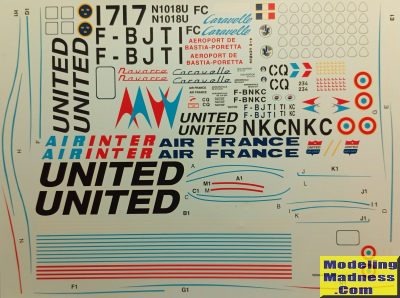 Five
marking options are provided, covering several different operators and
versions of the Caravelle. These include an Air France example, F-BJTI, from
1962; an Air Inter aircraft, F-BNKC, from 1967; a Sud Aviation SE.210
Caravelle VI-R of the French Air Force Flight Test Centre, 234 CQ, from
1978; a United Airlines aircraft, N1018U, from 1969; and finally a Swedish
Air Force Sud Tp85 Caravelle III, 172 FC.
The decals are nicely printed. They appear to be in good condition and should respond well to careful application. Once again, however, the painting and decaling instructions are rather sketchy, so some additional research is strongly recommended, particularly for the exact placement of the markings and the appropriate colors. This is very much a kit where the modeller needs to do some homework.
My interpretation of the intended construction sequence would be to start with the interior, assembling the cockpit and passenger cabin and spending as much time as desired on this area, particularly if the entry door is to be displayed open. The completed interior can then be trapped between the fuselage halves, where the side windows must have been attached beforehand. I would also recommend checking the balance of the model at this stage. No nose weight is mentioned in the instructions, and I cannot say with certainty that it is absolutely necessary, but my feeling is that adding some weight in the nose would be prudent. The nose landing gear should also be positioned and trapped between the fuselage halves before the fuselage is closed.
The main landing gear can then be assembled, wits wells trapped between the wing halves. The wings can subsequently be attached to the fuselage, followed by the remaining aerodynamic surfaces. The boarding ladder can then be added, together with the supplied crew figures if the modeller wishes to use them, and finally the canopy and other transparent parts. This is, of course, my own generic interpretation of the construcnce, but it seems to be the most logical way of approaching the model.
The build itself is definitely going to be a complex undertaking. A considerable amount of effort will be required simply to clean the parts properly, remove the flash, improve the external surfaces, and interpret the rather basic instructions. Nevertheless, I believe that the project is perfectly feasible for the experienced modeller for whom this kit is clearly intended. It is not a kit that can simply be taken from the box and assembled in a relaxing weekend, but with patience and careful preparation, there is a very good model hiding in there.
| CONCLUSIONS |
This is clearly a very challenging kit. Although purely done in styrene, it is limited-run in almost every respect—you really cannot get much more limited-run than this! The molding presents considerable flash and is not particularly sharp, while the external surfaces will require quite a bit of sanding to achieve a smooth and convincing finish. On the positive side, the panel lines are engraved and appear correctly positioned, while the overall level of detail is actually quite acceptable, and I would even call it good for the scale and the nature of the kit.
The transparencies are reasonably molded, although somewhat foggy and therefore in need of polishing and careful preparation. The interior is well represented, with a cockpit and passenger cabin that provide a good basis for a detailed model, while the landing gear, engines, and aerodynamic surfaces are all adequately represented. The decals are also nicely printed and appear to be in good condition.
The instructions, however, are very spartan, and considerable interpretation and research will be required from the modeller. This is definitely not a kit for the average modeller, and certainly not one for somebody looking for an easy out-of-the-box build. In reality, it is a project for an experienced modeller who is prepared to spend considerable time cleaning, sanding, researching, test-fitting, and occasionally figuring things out for himself.
But if one decides to tackle this kit, there is the potential for a fantastic result. And that is not the whole story. Mach 2 has to be congratulated for bringing a subject like the Caravelle to the modeling world in 1/72 scale—a subject that we would probably never, ever have dreamed of seeing produced in injected styrene otherwise. Yes, it is crude in places, demanding in others, and certainly requires more work than most modern kits. But at the end of all that work, it is still a 1/72 Caravelle, and that alone makes it rather special.
So, with all the above caveats, this is a kit that can still be built into a wonderful model. It asks a lot from the modeller, but it also gives something back: the opportunity to build an aircraft that has been seriously neglected in our scale. And for that reason alone, this old Mach 2 Caravelle deserves a place on the workbench of the adventurous and experienced modeler.
Happy Modeling!
October 2026 Copyright ModelingMadness.com. All rights
reserved. No reproduction in part or in whole without express permission from
the editor. If you would like your product reviewed fairly and fairly quickly, please contact the editor or see other details in the
Note to
Contributors. Back to the Main Page
Back to the Review
Index Page
Back to the Previews Index Page