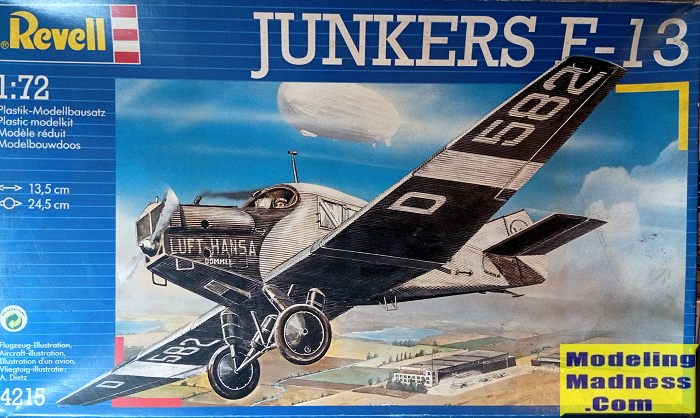
Revell 1/72 Junkers F.13
| KIT #: | 4215 |
| PRICE: | 8 Euros 20 years ago |
| DECALS: | Two options |
| REVIEWER: | Spiros Pendedekas |
| NOTES: | Landplane version |
| HISTORY |
The Junkers F.13 was one of the most revolutionary aircraft designs of the immediate post-World War I era and is widely regarded as the world’s first all-metal passenger aircraft. Designed by Hugo Junkers and his chief designer Otto Reuter, it first flew on June 25, 1919, at Dessau. At a time when most aircraft were still constructed from wood, fabric, and wire bracing, the F.13 featured a completely metal structure with Junkers’ distinctive corrugated duralumin skin and a clean, cantilever low-wing monoplane layout.
The aircraft was designed specifically for the emerging civil aviation market. Its enclosed cabin could accommodate four passengers in considerably greater comfort than the open cockpits and cramped cabins typical of contemporary aircraft, while the pilots occupied an open cockpit above and ahead of the passenger compartment. The rugged all-metal construction also made the F.13 well suited to operation in widely differing climates and from primitive airfields. Different versions could be fitted with wheels, floats, or skis, making the aircraft remarkably versatile for its time.
The F.13 went on to achieve considerable international success, serving with airlines, air-mail operators and private owners across Europe, the Americas and elsewhere. More than 300 examples were produced between 1919 and the early 1930s, with the type becoming an important foundation for Junkers' growing presence in commercial aviation. Its combination of all-metal construction, reliability, passenger comfort and long-term durability established a design philosophy that would influence a whole generation of Junkers transport aircraft.
| THE KIT |
 In
1992, Revell decided to introduce a new mold of the iconic Junkers F.13,
followed two years later, in 1994, by a seaplane edition that included an extra
sprue containing the necessary parts. From 2006 onward, the kit was issued with
all the sprues in the box, allowing the modeler to build either the landplane or
seaplane version. Further releases appeared in 2008 with different decals, as a
Model Set, and finally in 2020 as both a standalone kit and a Model Set, the
latter including basic paints, a brush, and glue. The tooling also appears to
have been released by Classic Plane with the addition of some extra parts
catering to some less mainstream versions. The kit previewed here is the
original 1992 landplane edition.
In
1992, Revell decided to introduce a new mold of the iconic Junkers F.13,
followed two years later, in 1994, by a seaplane edition that included an extra
sprue containing the necessary parts. From 2006 onward, the kit was issued with
all the sprues in the box, allowing the modeler to build either the landplane or
seaplane version. Further releases appeared in 2008 with different decals, as a
Model Set, and finally in 2020 as both a standalone kit and a Model Set, the
latter including basic paints, a brush, and glue. The tooling also appears to
have been released by Classic Plane with the addition of some extra parts
catering to some less mainstream versions. The kit previewed here is the
original 1992 landplane edition.
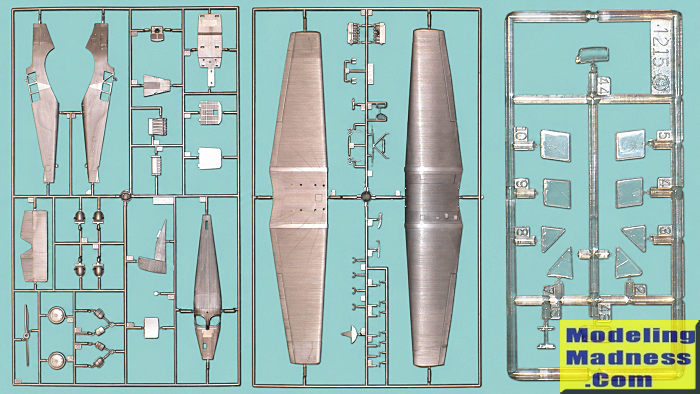
The model comes in a relatively small, slightly flimsy and beaten by time, top-opening blue Revell box featuring beautiful artwork by Axel Dietz, depicting a Lufthansa F.13 gracefully flying overhead. Inside, I found 47 silver-gray styrene parts, very neatly arranged on two equally sized sprues. Molding is excellent, with no flash, just a few mold separation lines, easily cleaned. One of the first things that immediately strikes the modeler is the beautifully reproduced corrugated metal surface. This is one of the defining characteristics of the F.13, and Revell has rendered it particularly well for this scale. Care will nevertheless be needed during assembly to avoid damaging these delicate surfaces.
The open cockpit is relatively well done. It is not overly elaborate, but neither is it excessively simplistic, especially considering the scale. It includes two seats, control yokes, foot pedals, front engine firewall, rear bulkhead, and an instrument panel to which a decal is applied. The cockpit is perfectly acceptable straight from the box, although its open nature means that virtually everything will remain visible on the finished model. A modeler wishing to add further realism could easily spend a couple of hours adding switches, wiring and other small details. As supplied, however, it is quite convincing and certainly adequate for a 1/72 kit originating in the early 1990s.
The passenger cabin is also nicely represented. The bulkhead aft of the cockpit features molded-on curtains, while the seats are sufficiently convincing, particularly when viewed through the cabin windows. The landing gear is nicely reproduced. The engine is provided with a good shape, and, although much of it will be almost invisible once the fuselage is closed, it must still be installed correctly to provide the proper mounting position for the well shaped exhaust - I would spend a couple of minutes drilling out the end of the exhaust to give it a more convincing hollow appearance.
Various small external fittings are provided around the airframe, and these are generally crisp and well molded. The transparent parts are particularly nice, being crystal clear and free of distortion.
The instructions are typical Revell fare from the early 1990s and come as a four-page A4 booklet. Construction is presented in fourteen clear and concise steps, with full color callouts throughout. The instructions are straightforward and should present no problems to the average modeler. The colors are given in Revell codes, as well as in generic form.
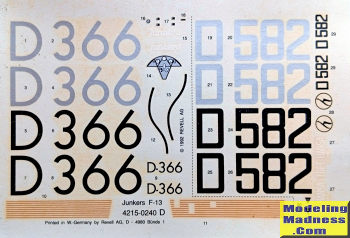 Two schemes
are provided, both representing aircraft operated by Deutsche Luft Hansa AG,
including D-582 and D-366.
Two schemes
are provided, both representing aircraft operated by Deutsche Luft Hansa AG,
including D-582 and D-366.
The original decals in this particular 1992 release were absolutely beautifully printed for their time, save the excessive carrier film, but they are now well beyond their useful life. On my example, the decals have visibly cracked on the sheet and should be considered unusable.
Anyone purchasing this early edition should therefore be prepared to source replacement decals elsewhere. This is an important point to bear in mind when looking for one of these older releases. Naturally, the decals supplied with the much later reissues are a different matter and should be perfectly usable, so the condition of the decals is primarily a concern for collectors and modelers purchasing the original edition.
Construction begins with the interior and the engine, both of which are installed on a nicely molded one-piece floor. The cabin windows are fitted from inside the fuselage halves, after which the completed interior assembly is trapped between the left and right fuselage sections. The upper fuselage section is then added, followed by the engine front and bottom covers and the remaining major components. The wings, tailplanes, landing gear and various smaller external fittings complete the construction.
The build itself is relatively easy and should be well within the capabilities of the average modeler. While there is nothing particularly complicated in the engineering, and the relatively low parts count helps make this a pleasant and uncomplicated project, attention is required when fitting the cockpit and interior assembly between the fuselage sections, as everything needs to sit correctly before the fuselage can be closed. Even more care should be taken when gluing the fuselage and other components together so that the beautifully reproduced corrugations remain properly aligned, so they will not be damaged by excessive sanding or filling.
These points should not, however, discourage anyone with average modeling experience. With careful dry-fitting and a little patience, the kit should go together without drama. The main challenge is not the complexity of the construction but rather protecting the excellent surface detail while assembling the airframe. In other words, this is a relatively easy kit to build, but one that rewards a careful rather than hurried approach.
| CONCLUSIONS |
This is a really wonderful kit, especially when one considers that its origins go all the way back to 1992. It is remarkable that, during what was becoming something of a golden era for Revell, the company chose to tackle subjects such as the Junkers F.13 that many modelers would never have expected to see produced in injection-molded plastic.
The molding remains excellent, and the beautifully reproduced corrugated surfaces are undoubtedly the star of the show. Interior detail is also quite good, although I would not have minded a little more detail in the cockpit, particularly because it is completely open and therefore highly visible. Fortunately, this also provides the enthusiastic modeler with an excellent opportunity to add some extra detail without having to work through a tiny enclosed cockpit.
The transparencies are excellent, the engine and landing gear are sufficiently represented, and the smaller external details are nicely molded. The instructions are clear and followable, while the overall construction is straightforward and relatively easy. The interior assembly requires some attention when being fitted between the fuselage sections, while the corrugated surfaces demand care during assembly and cleanup. Nothing here should be beyond the experience of the average modeler, though, and there are no major constructional traps to worry about.
Out of the box, the kit can produce a very attractive Junkers F.13 with relatively little difficulty. It is a fine example of Revell's willingness during that period to produce interesting and less-mainstream subjects, and the company deserves considerable credit for giving modelers an F.13 in this scale.
If you are looking for one today, the later releases have the additional advantage of including the seaplane parts, giving you the choice between the landplane and floatplane configurations. They are therefore particularly attractive if you want maximum versatility from the kit. This older edition can still be found at relatively reasonable prices, but pay close attention to the decals. If you buy the original 1992 release, assume that the decals will need replacing.
Whichever version you choose, the Revell Junkers F.13 remains a kit well worth building. It is an unusual and historically important subject, beautifully captured by Revell's excellent tooling, and it can still be turned into a very handsome model more than three decades after the mold first appeared.
Happy Modeling!
September 2026
Copyright ModelingMadness.com. All rights reserved. No reproduction in part or in whole without express permission.
If you would like your product reviewed fairly and fairly quickly, please contact the editor or see other details in the Note to Contributors.