Airfix 1/72 Superfreighter Mk.32
|
KIT #: |
05002 |
|
PRICE: |
30 Euros
|
|
DECALS: |
Two options |
|
REVIEWER: |
Spiros Pendedekas |
|
NOTES: |
1959 tooling |
The Bristol Superfreighter was one of the most distinctive and
fascinating British transport aircraft of the post-war era. Developed as an
enlarged and improved version of the successful Bristol Freighter, it was
designed to meet the growing demand for a more capable cargo aircraft,
offering increased capacity while retaining the ruggedness, reliability and
practicality of its predecessor. With its characteristic nose-opening cargo
door, high-wing configuration and powerful Bristol Hercules engines, the
Superfreighter was a unique combination of strength and versatility,
perfectly suited to the demanding world of post-war air transport.
Entering service during a period of rapid change in aviation
history, the Bristol Superfreighter represented the final generation of
large piston-powered freighters before the arrival of the jet age. Although
it never became a widespread commercial success, it found its place with
several operators around the world, quietly performing its duties by
carrying freight, vehicles and passengers across Europe and beyond. Today,
it is remembered with affection by aviation enthusiasts as a symbol of a
more adventurous era, when practical, characterful aircraft played an
essential role in connecting people and places. The Superfreighter may not
have achieved legendary status like some of its contemporaries, but its
distinctive appearance and remarkable story have ensured that it remains a
truly memorable chapter in aviation history.
 It
was in 1959 that Airfix introduced its brand-new Bristol Superfreighter kit,
bringing one of Britain's most distinctive post-war transport aircraft to
the workbenches of modelers around the world. At a time when most
manufacturers concentrated on fighters and bombers, Airfix took the bold
decision to produce an unusual civilian transport aircraft whose commercial
success could never have been guaranteed. It was a courageous choice, and
one that has since become part of Airfix history.
It
was in 1959 that Airfix introduced its brand-new Bristol Superfreighter kit,
bringing one of Britain's most distinctive post-war transport aircraft to
the workbenches of modelers around the world. At a time when most
manufacturers concentrated on fighters and bombers, Airfix took the bold
decision to produce an unusual civilian transport aircraft whose commercial
success could never have been guaranteed. It was a courageous choice, and
one that has since become part of Airfix history.
For its time, the tooling was first class. The engineering and mold
quality were highly advanced for the late 1950s, demonstrating the ambition
of Airfix during its golden years. The Bristol Superfreighter may never have
been a glamorous aircraft, but it was undoubtedly an iconic one, and Airfix
deserves great credit for bringing such a unique subject to the market.
Those were truly different days in the modelling world.
The original mold proved remarkably durable, being reboxed another
nine times over the decades with virtually no changes to the plastic parts.
Only the decals and packaging varied between releases. The latest appearance
came in 2024, when Airfix reissued the kit in its popular Vintage Classics
range, complete with the original 1959 artwork, allowing a new generation of
modelers to enjoy this historic tooling.
The example reviewed here is the 1996 reissue, released during the
period when Airfix and Heller were closely associated. This particular kit
joined my collection around 2005, having been purchased from one of my
beloved hobby shops in Athens at what seemed, even then, to be a very fair
price. Looking back today, it feels less like buying another kit and more
like preserving a small piece of modelling history.
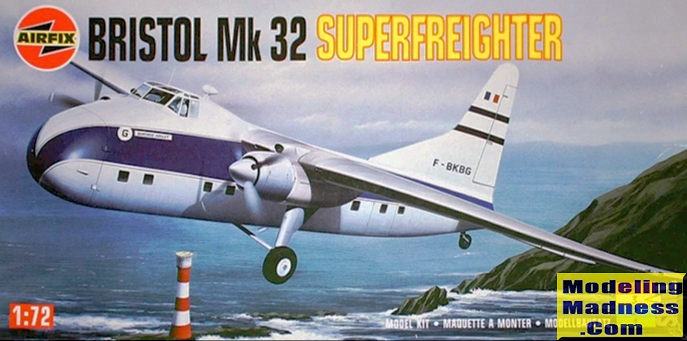
The kit comes in a medium-sized, side-opening cardboard box of
typical Airfix/Heller quality for the period. A highlight is undoubtedly the
beautiful artwork by aviation artist Gavin MacLeod, depicting the Compagnie
Air Transport aircraft "Quatorze Juillet" gracefully flying along the
coastline. It is one of those classic Airfix illustrations that immediately
captures the imagination and invites the modeler to lift the lid.
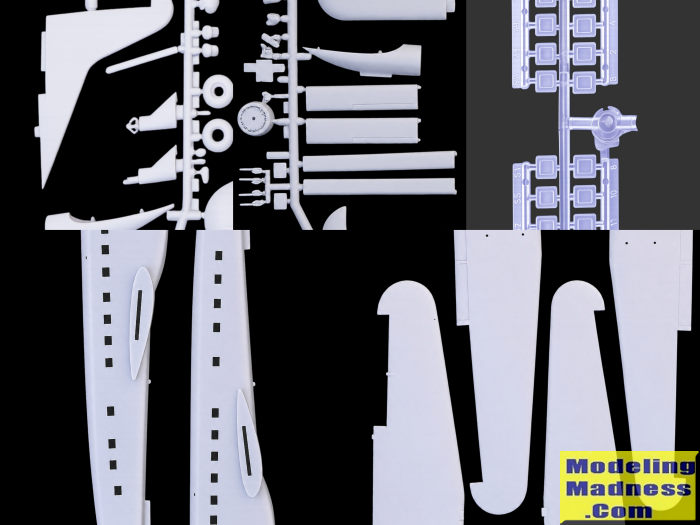
Inside the box are approximately 80 light green styrene parts. The
two fuselage halves are provided as separate major components, the four wing
halves are joined in pairs, while the remaining parts are arranged in two
sprues. Molding is unmistakably from the late 1950s, featuring extensive
raised rivet detail, and, while such surface detail may seem dated by modern
standards, many of us still appreciate its distinctive character.
Personally, I find it full of charm, as it instantly recalls the golden age
of plastic modelling. Yes, some flash is present, together with a few sink
marks and ejector-pin marks, but none appear particularly difficult to
tackle. Considering the age of the tooling, these imperfections are mostly
expected, sort of being simply part of building a classic kit.
Cockpit is adequate for a model of this vintage. It contains two
basic seats, control yokes, an instrument panel with a decal, and two pilot
figures typical of the period. Although simple, the cockpit provides enough
detail for what can actually be seen through the relatively small cockpit
windows once the model is complete. The engines are nicely represented,
capture the appearance of the Bristol Hercules originals convincingly and
the same can be said for the props. Landing gear is also well done, being
simplistic as it is in reality.
One of the Superfreighter's most distinctive features, the large
forward cargo doors, may be displayed either open or closed. The cargo
compartment itself is totally empty, reflecting the kit design philosophy of
the late 1950s when interior detail was rarely a priority. Nevertheless,
Airfix includes the characteristic loading ramps, allowing the modeler to
create a much more dynamic display. Adding a suitable 1/72 scale vehicle
together with a few figures inside would produce an attractive loading scene
while naturally disguising the otherwise empty interior.
 Transparencies
are nicely molded and clear. Instructions follow the familiar Airfix/Heller
style of the 1990s, consisting of an eight-page black-and-white A4 booklet,
containing a brief history of the type, while the construction is spread in
20 clear and concise assembly steps with color callouts for the cockpit
area.
Transparencies
are nicely molded and clear. Instructions follow the familiar Airfix/Heller
style of the 1990s, consisting of an eight-page black-and-white A4 booklet,
containing a brief history of the type, while the construction is spread in
20 clear and concise assembly steps with color callouts for the cockpit
area.
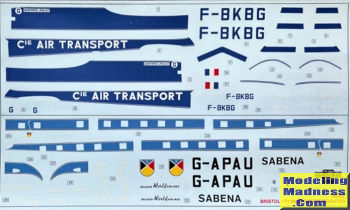
Two attractive marking options are included:
- Sabena (1923–2001) – G-APAU, Oostende, 1960.
- Compagnie Air Transport (CAT, 1946–1970) – F-BKBG "Quatorze
Juillet", Le Touquet, 1962.
The decals are a particularly pleasant surprise for an Airfix/Heller
kit of the 1990s, being sharply printed, perfectly registered and appearing
to have aged remarkably well. While decal quality was not always one of
Airfix (and Heller) strongest points during earlier decades, this 1996
release features decals that should perform very well.
Instructions want you to first tackle the cockpit, after which the
windows are installed from inside the fuselage halves before everything is
enclosed. The wings, tail planes and fin follow, while separate control
surfaces allow the ailerons, elevators and rudder to be positioned.
Attention then turns to the large forward cargo doors, which can be
displayed open or closed, followed by the loading ramps. The landing gear is
next, simple but sturdy, followed by the engines and propellers, with
construction concluding with the canopy and DF loop aerial. Overall, the
engineering appears logical and uncomplicated, promising a seemingly
straightforward and enjoyable build.
There is no doubt that this is an old-tool kit, and it should never
be judged against today's highly sophisticated releases. It lacks the fine
engraved detail and elaborate interiors that modern modelers have come to
expect. Yet that is not the point of this kit.
What makes the Bristol Superfreighter so special is its subject.
Airfix chose to produce an aircraft that few other manufacturers would even
have considered, and that decision has allowed this fascinating transport to
remain available to generations of enthusiasts. More than sixty years later,
it is still one of the most distinctive civil transport aircraft ever to
appear in an Airfix catalog.
The mold has stood the test of time remarkably well. The raised
rivets possess undeniable nostalgic charm, molding remains respectable for
its age, cockpit is perfectly adequate, clear parts are well done, engines
and propellers are nicely represented, instructions are clear, and the
decals are surprisingly well printed. Assembly promises to be relaxing
rather than demanding, making the kit suitable for almost anyone with a
little modelling experience.
Ultimately, this is a model to enjoy for what it is: a genuine
classic from the golden age of Airfix. It may not possess the finesse of a
modern tooling, but it offers something just as valuable - character,
nostalgia and the opportunity to build one of Britain's most unusual
post-war transport aircraft. Even today, it remains the only mainstream
injection-molded Superfreighter in 1/72 scale, making it an essential
addition not only for lovers of classic Airfix kits, but also for civil
aviation enthusiasts and anyone wishing to take a rewarding walk down memory
lane.
Happy Modeling!
Spiros Pendedekas
July 2026
Copyright ModelingMadness.com. All rights reserved. No
reproduction in part or in whole without express permission.
If you would like your product reviewed fairly and
fairly quickly, please
contact
the editor
or see other details in the
Note to
Contributors.
Back to the Main Page
Back to the Review
Index Page
Back to the Previews Index Page
 It
was in 1959 that Airfix introduced its brand-new Bristol Superfreighter kit,
bringing one of Britain's most distinctive post-war transport aircraft to
the workbenches of modelers around the world. At a time when most
manufacturers concentrated on fighters and bombers, Airfix took the bold
decision to produce an unusual civilian transport aircraft whose commercial
success could never have been guaranteed. It was a courageous choice, and
one that has since become part of Airfix history.
It
was in 1959 that Airfix introduced its brand-new Bristol Superfreighter kit,
bringing one of Britain's most distinctive post-war transport aircraft to
the workbenches of modelers around the world. At a time when most
manufacturers concentrated on fighters and bombers, Airfix took the bold
decision to produce an unusual civilian transport aircraft whose commercial
success could never have been guaranteed. It was a courageous choice, and
one that has since become part of Airfix history.