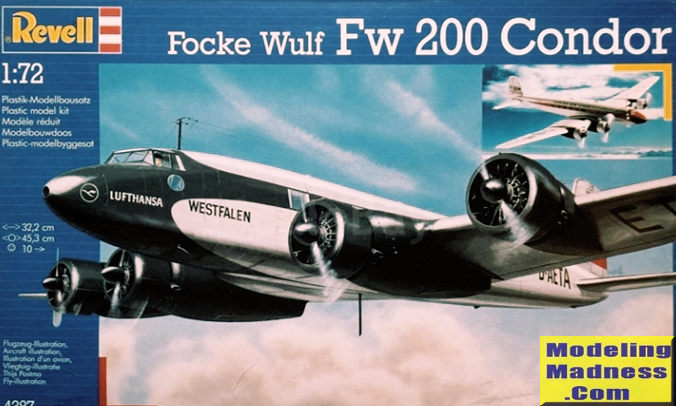
| KIT #: | 04387 |
| PRICE: | €8 when new |
| DECALS: | Two options |
| REVIEWER: | Spiros Pendedekas |
| NOTES: | Civilian early version |
| HISTORY |
The Focke-Wulf Fw 200 Condor was developed in the mid-1930s as a long-range airliner for Deutsche Lufthansa. Designed under the direction of Kurt Tank, it was an advanced aircraft for its time, featuring an all-metal structure, retractable landing gear and four radial engines. The prototype first flew in July 1937, and the Condor quickly demonstrated its impressive long-range capabilities. In August 1938, a specially prepared Fw 200 made a nonstop flight from Berlin to New York in less than 25 hours, demonstrating the aircraft's potential as a long-distance passenger and transport aircraft.
The early Fw 200A was among the first production versions and was intended primarily for civil service. Several aircraft were operated by Lufthansa, while others were exported to foreign airlines. One of the best-known was OY-DEM Jutlandia, operated by Det Danske Luftfartselskab (Danish Air Lines) in 1938. Another famous aircraft was D-AETA Westfalen, operated by Deutsche Luft Hansa. These early Condors were elegant long-range airliners, quite different from the heavily armed military aircraft that would later make the type famous during World War II.
The Condor's peaceful career was relatively short-lived. With the outbreak of war, surviving civil aircraft were impressed into transport and other military duties, while the design evolved into the Fw 200C and later versions used by the Luftwaffe for long-range maritime reconnaissance and anti-shipping operations.
The exact number of those early machines built is unknown: some sources state six, some seven (most likely correct), and a few even ten examples. Despite the low number built, the early civilian Condors nevertheless represent a fascinating and often overlooked chapter in the aircraft's story.
| THE KIT |
Revell introduced its new-tool 1/72 Fw 200A Condor in 1991, initially in two versions: a military transporter and a civilian airliner. A second civilian boxing followed in 1992, but remarkably, the kit has never been reissued since. That long absence has made the surviving examples increasingly interesting to both modelers and collectors.
 My
own example has a little story behind it. Around 2002, I found it sealed and
forgotten on a shelf in one of my hometown's beloved toy and hobby shops,
carrying the almost unbelievable price of €8. Although I had no particular
interest in civilian aircraft at the time, there was no hesitation whatsoever—I
grabbed it. And I am very glad I did, because I have built this kit in the past
and really enjoyed it.
My
own example has a little story behind it. Around 2002, I found it sealed and
forgotten on a shelf in one of my hometown's beloved toy and hobby shops,
carrying the almost unbelievable price of €8. Although I had no particular
interest in civilian aircraft at the time, there was no hesitation whatsoever—I
grabbed it. And I am very glad I did, because I have built this kit in the past
and really enjoyed it.
The kit comes in Revell's familiar blue box. The medium-sized top-opening box itself is somewhat flimsy, but it features attractive artwork by artist Thijs Postma, depicting a Lufthansa Condor gracefully flying through the sky.
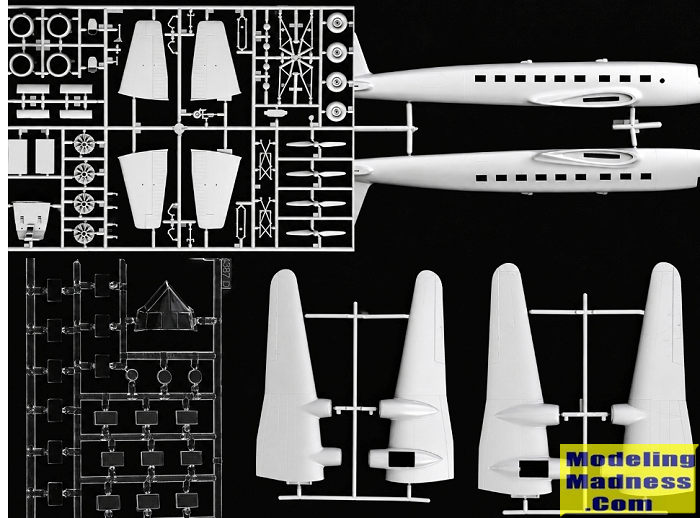
Opening the box was a pleasant surprise, because I had not realized that this was a completely new-tool kit. Inside were 62 white styrene parts, neatly arranged on four sprues. One sprue contains the fuselage halves, two carry the wings, while the fourth contains everything else. Molding is clean and crisp, with virtually no flash. The panel lines are finely recessed, and the overall shapes look very convincing, at least to my eye.
This is clearly a kit designed to be built rather than over-engineered. The exterior is particularly well represented, while the interior is considerably more basic. The cockpit contains two reasonably represented seats, a rear bulkhead, control yokes and an instrument panel, with an instrument decal to be fitted. It is not elaborate, but the small cockpit windows will hide much of it anyway.
The passenger cabin is where the kit's simplicity becomes most obvious. There is no real cabin interior and not even a floor is provided. In my original review, written when I built the kit a few years ago, I placed rather more emphasis on this omission and expressed some concern about the absolute lack of interior detail. Looking at the kit again today, however, I think I was perhaps a little too hard on it. The omission is certainly noticeable, especially because this is a civilian airliner, but in practical terms very little can actually be seen through the relatively small passenger windows. There are also no doors designed to be posed open.
So, yes, the missing cabin interior is a weakness, and an AMS modeler will certainly want to address it. But for the average builder, it is hardly a deal-breaker. The exterior is the part that really matters here, and that is very nicely done. In retrospect, I certainly would not consider the lack of an interior a reason for Revell not to reissue this otherwise excellent kit.
The landing gear is another particularly attractive feature. The Condor's distinctive landing gear is very nicely represented, with convincing shapes and detail. The engines are equally well done; only their front faces are provided, but these look quite convincing once installed. The early Condor's two-bladed propellers are also beautifully rendered.
The transparencies deserve special praise. They are beautifully molded, thin and crystal clear, and should make a real difference to the appearance of the finished model. The instructions are typical of Revell during the early 1990s: simple, clear and concise, with a useful color chart and 19 straightforward construction steps.
Two historically interesting schemes are included:
- Focke-Wulf Fw 200 K-1 (A-0) Condor, OY-DEM, "Jutlandia", Det Danske Luftfartselskab A/S (Danish Air Lines), 1938
- Focke-Wulf Fw 200 V3 Condor, D-AETA, "Westfalen", Deutsche Luft Hansa AG
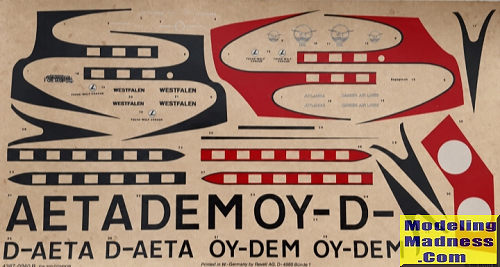 The decals
are typical of Revell's early-1990s production: sharply printed, with excellent
color density and superb register, and a nice matte finish. They looked
excellent when new, but unfortunately, the backing paper tended to yellow and
the decals could become brittle rather quickly. Later Revell sheets improved
considerably in durability while retaining their excellent printing and
registration. My example is now unusable, but fortunately, a little research has
revealed suitable aftermarket alternatives, including markings for these
particular aircraft.
The decals
are typical of Revell's early-1990s production: sharply printed, with excellent
color density and superb register, and a nice matte finish. They looked
excellent when new, but unfortunately, the backing paper tended to yellow and
the decals could become brittle rather quickly. Later Revell sheets improved
considerably in durability while retaining their excellent printing and
registration. My example is now unusable, but fortunately, a little research has
revealed suitable aftermarket alternatives, including markings for these
particular aircraft.
Construction is pleasantly straightforward. The instructions first call for all the cabin windows to be installed from the inside of the fuselage. The cockpit is then assembled and trapped between the fuselage halves, together with the rear wheel.
The instructions would have the builder assemble the landing gear and attach it to its boxed-in wheel bay before fitting the bay between the wing halves. However, I think the wheel bays can be trapped between the wing halves first, leaving the delicate landing gear to be installed later, perhaps with a tiny bit of tweaking. This avoids unnecessary handling and reduces the possibility of damaging the gear during construction. I built mine this way in the past and encountered no real problems.
The assembled wings are then attached to the fuselage, followed by the tail planes. The engines are fitted into their nacelles, which are attached to the wings, followed by the propellers, the various small external components, including antennas and other details, and, finally, the canopy.
That is essentially it. Considering that this is a large four-engine propeller aircraft, the construction is remarkably uncomplicated. Revell clearly made the wise decision not to over-engineer the kit. The result is a build that is much less intimidating than a four-engine aircraft might initially suggest—and my own experience confirms that it is a genuinely pleasant one.
| CONCLUSIONS |
This is a really nice kit, and I remain genuinely surprised that Revell has not reissued it since 1992. Perhaps that long absence is one reason why we so rarely see one built today. It is an unusual, iconic and very attractive subject, and Revell captured the character of the civilian/transporter Condor extremely well in this tooling.
The finely recessed panel lines, convincing shapes, excellent exterior detail, beautifully clear transparencies and relatively low parts count all work in its favor. The landing gear and engines are well represented, while the construction is straightforward and enjoyable.
There is, of course, that missing passenger cabin. In my original review, after building the kit, I made rather a point of criticizing the complete absence of interior detail. Having looked at it again with fresh eyes, I would put the matter into better perspective. It is a shortcoming, but not a serious one. The small windows reveal very little, no doors are intended to be opened, and the superb exterior representation is ultimately far more important.
I can say that with some affection, because I have built this kit myself and really enjoyed it. Sometimes a kit simply gets the balance right. It does not try to impress you with hundreds of unnecessary parts or complicated engineering. It gives you a fascinating subject, good shapes, enough detail, straightforward construction and the simple pleasure of watching a large and elegant aircraft emerge from the box.
The original decals are now mostly unusable, but aftermarket replacements are available. The real problem is finding the kit itself. As of 2026, prices for surviving examples can be surprisingly high, simply because of their rarity.
So, Revell, if anyone is listening: bring the Early Condor back! A new release, perhaps combining the different versions, would be very welcome indeed. Add your usual excellent decal sheet and accompany it with a sensible price, and you will likely have a winner! The tooling deserves another chance, and I am sure there are plenty of modelers who would happily give this beautiful early Condor a new home.
Until then, this remains one of those wonderful Revell kits that has quietly disappeared into collector's territory without ever really deserving to. I was lucky enough to find mine for €8, and even luckier to have built it and enjoyed it so much. It is an honest, straightforward and attractive kit of a fascinating aircraft—and sometimes that is more than enough.
So, congratulations to Revell for this one. Now, how about letting the Early Condor fly again?
Happy Modeling!
September 2026
Copyright ModelingMadness.com. All rights reserved. No reproduction in part or in whole without express permission.
If you would like your product reviewed fairly and fairly quickly, please contact the editor or see other details in the Note to Contributors.