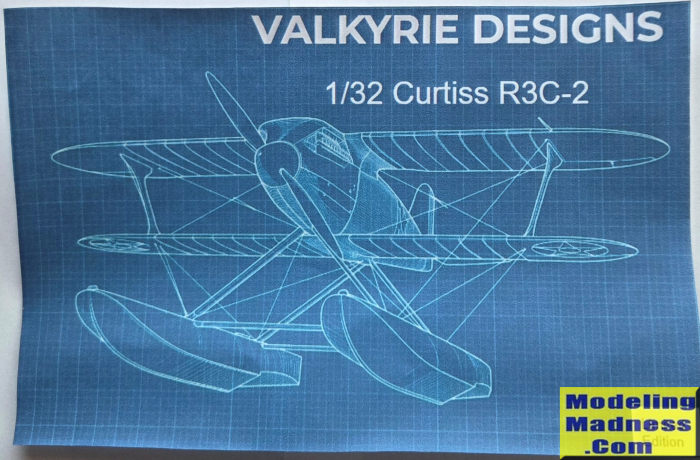
Valkyrie 1/32 Curtiss RC3-2
| KIT #: | 00001 |
| PRICE: | $150.00 |
| DECALS: | One set of masks |
| REVIEWER: | John Summerford |
| NOTES: | 3D printed |
| HISTORY |
Following the First World War, Curtiss Aeroplane & Motor Co. Inc. resumed construction of racing aircraft, primarily as test beds for new airframe designs, engines and propellers. The first post-war, purpose-built racer was produced for Texas oil millionaire S. E. J. Cox. for the 1920 James Gordon Bennett race, held in France. The succeeding planes were purchased by the US Army and Navy as “fighter” designs. The military racers competed in the Bennett, Pulitzer Trophy, and Schneider Trophy races through 1926; however, they only gained a second place in the Schneider that year and Curtiss discontinued the program.
The R3C-1 and R3C-2 were the peak of development for Curtiss. The difference between the two was that the -1s were landplanes and -2s were the same airframes but converted to floats. Two of the three R3C-1s built in 1925 were entered in the Pulitzer race held on October 12 and finished first and second. All three competed in the Schneider race on the 26th. The two Navy entrants dropped out while the Army entrant, piloted by Jimmy Doolittle, won by a record-breaking straightaway speed of 245.7 mph (335.4km/h).
| THE KIT |
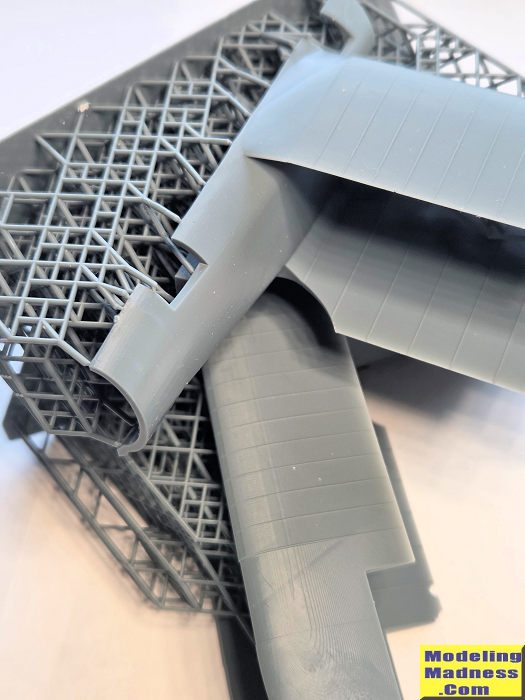 Inside the
shipping package is a combination of bubble wrap and packing peanuts. The major
prints float in the packing and the smaller pieces are in zip-top bags with a
hand-written label of the parts within. The parts are printed in gray resin with
great detail in the radiators and exhausts. The struts are printed as one piece
with large mating surfaces for the floats and fuselage, making alignment easy.
Also, the wings and their struts are printed attached to the fuselage halves.
This example has a small notch in the trailing edge of an upper wing but should
be easy to repair. If not, I have been assured that a replacement part can be
sent.
Inside the
shipping package is a combination of bubble wrap and packing peanuts. The major
prints float in the packing and the smaller pieces are in zip-top bags with a
hand-written label of the parts within. The parts are printed in gray resin with
great detail in the radiators and exhausts. The struts are printed as one piece
with large mating surfaces for the floats and fuselage, making alignment easy.
Also, the wings and their struts are printed attached to the fuselage halves.
This example has a small notch in the trailing edge of an upper wing but should
be easy to repair. If not, I have been assured that a replacement part can be
sent.
Total parts count, including a Jimmy Doolittle figure, is 19. Of note is the lack of rudder pedals (which probably cannot be seen anyway) and control stick in the cockpit. Instrument faces are not included, nor clear windshield panes. Painting masks are included for the markings, or one could source decals, if so desired.
There are no instructions and the label found inside the box can serve as a rigging diagram. Rigging material is not included.
| CONCLUSIONS |
Valkyrie Designs is a front for a hobbyist who has taken his dabbling in 3-D printing to the next level and produced a kit. According to the social media site, the kit went through several iterations and I stumbled upon the release announcement a couple of weeks after it was made. Since I am a huge admirer (like, geeky level) of Jimmy Doolittle, I ordered a copy right away. We had a spirited email exchange during the printing process regarding future projects and I received my package a week later.
I am confident the parts fit well and minimal cleanup is required. Rigging is probably the most difficult task. (As usual) I noticed that dimples for the rigging anchor points are not present and I suggested that they be included.
Rigging and the lack of instructions dictate that some experience is required to assemble the kit. VERY helpful information can be found on the National Air and Space Museum’s website at
https://airandspace.si.edu/collection-objects/curtiss-r3c-2/nasm_A19280002000
A webpage for Valkyrie Designs may be in the offing, but in the meantime, an order can be placed at: https://www.facebook.com/profile.php?id=100078668206240
August 2026
Copyright ModelingMadness.com. All rights reserved. No reproduction in part or in whole without express permission.
If you would like your product reviewed fairly and fairly quickly, please contact the editor or see other details in the Note to Contributors.