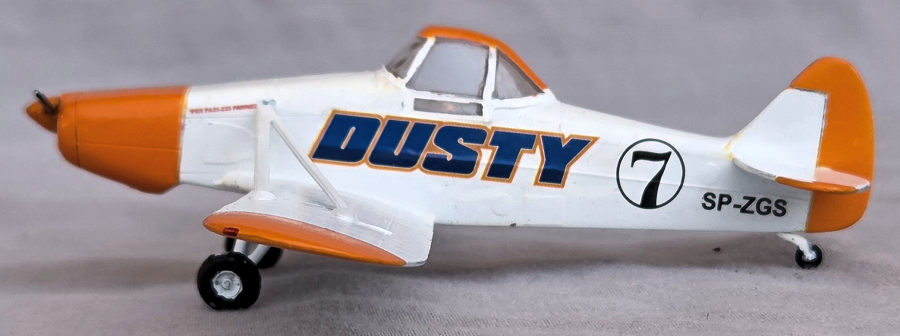
KoPro 1/72 Piper Pawnee
| KIT #: | 472 |
| PRICE: | $20.00 |
| DECALS: | Three options |
| REVIEWER: | John Summerford |
| NOTES: |
| HISTORY |
With major contributions from NASA and Wikipedia
The Piper PA-25 Pawnee was an aircraft evolution of a design that aviation engineer Fred Weick created while on staff with Texas A&M University after World War II.
Prior to joining the university, Weick started his aviation career in 1922 with the U.S. Air Mail Service as a draftsman and implementer of facilities, such as emergency landing fields. In 1923, he joined the Yackey Aircraft Company, responsible for everything from refueling airplanes to selling rides to passengers. While employed at Yackey, he applied for a junior aeronautical engineer position in government service and went to work for the Navy’s Bureau of Aeronautics, in Washington, D.C., where he became its first civilian assistant for propeller research. The offices and technical library of the NACA were within walking distance of his Navy office, and he spent considerable time studying reports and interacting with NACA personnel. While at the Bureau of Aeronautics, he began a textbook on propeller design that was to become a classic.
 As a Navy engineer, he interacted with nearby managers
of the NACA and recommended that the NACA construct a special wind tunnel for
testing full-scale propellers, and that the tunnel should have a test-section
diameter of about 20 feet — four times the size of Langley’s largest existing
tunnel. When NACA management asked if he would be interested in becoming the
designer and head of such a facility, he enthusiastically accepted the
opportunity.
As a Navy engineer, he interacted with nearby managers
of the NACA and recommended that the NACA construct a special wind tunnel for
testing full-scale propellers, and that the tunnel should have a test-section
diameter of about 20 feet — four times the size of Langley’s largest existing
tunnel. When NACA management asked if he would be interested in becoming the
designer and head of such a facility, he enthusiastically accepted the
opportunity.
He joined the NACA Langley Memorial Aeronautical Laboratory in 1925 and contributed to the of design the Langley Propeller Research Tunnel (PRT), the first wind tunnel devoted to full-scale propeller research. He was head of the PRT from 1925-1929.
After the technical value of the PRT was verified by initial propeller tests, Weick led the development of low-drag engine cowlings for air-cooled radial engines. The resulting technology significantly enhanced aircraft performance, while ensuring adequate engine cooling. This contribution was an important advancement in aviation and, in 1929, earned the NACA its first Collier Trophy.
Weick also initiated research on the effect of wing-mounted engine location on the performance of multi-engine airplanes. He personally conceived and planned a series of tests for the PRT, in which the vertical position of an NACA-cowled engine could be varied relative to the wing chord. The actual tests were run after Weick had moved to a new job; but the study had a huge impact on airplane designs, showing that the most efficient vertical location of the engines was in line with the wing chord. First applications of the results of the study were to the Boeing 247 and Douglas DC-2 airliners, and the Martin B-10 bomber. This NACA contribution was adapted by almost every designer of multi-engine aircraft and enabled airliners to become economically viable.
 Weick left NACA in 1929 to become chief engineer at
the Hamilton Aero Manufacturing Company where, among other duties, he conducted
propeller tests on Charles Lindbergh’s Sirius airplane, at Lindbergh’s request.
Weick left NACA in 1929 to become chief engineer at
the Hamilton Aero Manufacturing Company where, among other duties, he conducted
propeller tests on Charles Lindbergh’s Sirius airplane, at Lindbergh’s request.
The Great Depression forced Weick to rejoin NACA in 1930, working on aircraft for stability and control to identify methods to make aircraft incapable of spinning — avoiding the problem of spinning altogether.
He soon became the Assistant Chief of the Aerodynamics Division supervising research in a new 7-by 10-Foot Atmospheric Wind Tunnel. He and the staff directed their research toward high-lift devices and innovative aircraft control concepts that would permit lower speeds for landing, thereby increasing safety. The group approached their research with great enthusiasm, to the point of having a contest to design the most promising single-engine personal-owner-type configuration from a safety perspective. After technical evaluations by the group, Weick’s revolutionary design, called the W-1, was declared the winner. The W-1’s design incorporated a high parasol wing, an unorthodox auxiliary wing forward of the main wing, and a pusher-propeller. After free-flight model testing, Weick and a group of nine other Langley engineers built the full-scale experimental airplane in their spare time. This “home-built” W-1 was the first aircraft to employ a steerable tricycle landing gear. The W-1 airplane was flown in evaluation flights by NACA pilots.
Weick left the NACA again in 1936, and joined the Engineering and Research Corporation (ERCO) of Washington, D.C., as its chief designer. His Ercoupe airplane design demonstrated Weick’s passion for safety. He simplified turning the airplane by combining the controls for the rudder and the aileron surfaces into a single-steering, interconnected device that was easy for amateur pilots to use. Built first as a two-seater, and later a four-place model, the Ercoupe was the first personal-owner airplane to be certified as spin-proof. About half of the 6,000 Ercoupes built were still flying 50 years later.
Weick joined Texas A&M University in 1948. Although he had no background in the use of aircraft for agricultural purposes, he designed an aircraft dedicated to the needs of aerial applicators, dubbed the AG-1. Piper Aircraft approached him in 1953 to develop a follow up design but to use as many PA-18A and PA-22 components as possible.
 The resulting design, the AG-3, was smaller than the
AG-1 and had a steel tube fuselage which was fabric covered. The AG-3 was a
single-seat, low-wing monoplane with the wings braced to the fuselage with
struts. It had a conventional landing gear with a tailwheel and was powered by a
135 hp engine. The single seat was placed high in the fuselage to give the best
visibility and an 800 lb. capacity hopper was fitted in front of the cockpit.
The resulting design, the AG-3, was smaller than the
AG-1 and had a steel tube fuselage which was fabric covered. The AG-3 was a
single-seat, low-wing monoplane with the wings braced to the fuselage with
struts. It had a conventional landing gear with a tailwheel and was powered by a
135 hp engine. The single seat was placed high in the fuselage to give the best
visibility and an 800 lb. capacity hopper was fitted in front of the cockpit.
The AG-3 made its maiden flight in November 1954. The aircraft's flying tests were successful and, in 1957, Weick joined Piper as director and chief engineer of its development center and the AG-3 was renamed the PA-25 Pawnee. Two pre-production aircraft were built at Vero Beach, Florida, in 1957 and production started at Lock Haven, Pennsylvania, in May 1959.
In 1962, another prototype was built at Vero Beach with a 235 hp Lycoming O-540-B2B5 engine and production aircraft were produced at Lock Haven from 1962. In 1964, the Pawnee B was introduced with a larger hopper and improved dispersal gear. The Pawnee C of 1967 was fitted with oleo shock-absorbers and other improvements.
In 1974, the Pawnee D was introduced, with the fuel tanks moved from the fuselage to the wings; the 260 hp variant was also available with either a fixed pitch or constant-speed propeller. The final production aircraft was completed at Lock Haven on 22 March 1981, the last of 5,167 Pawnees.
Fred Weick died on July 8, 1993, in Vero Beach, Florida, at the age of 93.
| THE KIT |
A simple end-opening cardboard box holds a bagged single sprue of medium gray, soft styrene parts. Another single clear part for the cockpit is in a separate bag. Four different propellers are available. Total parts count is 34. Paint and marking diagrams are on the bottom of the box. History and assembly instruction are on both sides of a folded sheet.
| CONSTRUCTION |
Seven parts are glued together through five steps to create the cockpit subassembly. A four-part harness was scratch built and glued to the seat. The instrument panel is glued to the right fuselage half. It does not have any detail, so an instrument decal was sourced from the decal dungeon. The cockpit subassembly fits into the guides molded in the interior face of the fuselage side.
Gluing the rudder to the left fuselage half is called
before mating the halves together. In this case, that wa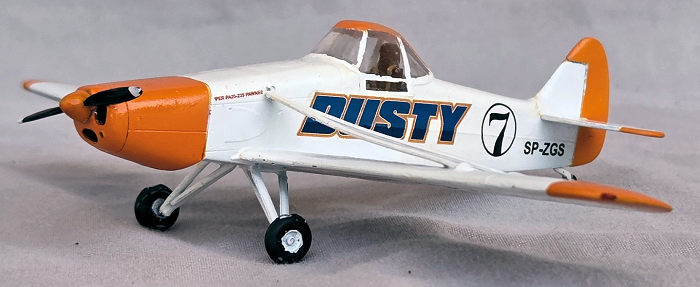 s done after the halves
were joined and the seams addressed. Filling and sanding took several sessions.
A dummy engine-front piece and cowl nose came next, followed by seam work.
Masking for the canopy was done before adding it to the fuselage.
s done after the halves
were joined and the seams addressed. Filling and sanding took several sessions.
A dummy engine-front piece and cowl nose came next, followed by seam work.
Masking for the canopy was done before adding it to the fuselage.
A choice of propeller is to be made in the next step, but that was left for final assembly, as was the tail wheel. It wasn’t until the right stabilizer/elevator was in place that I noticed that paint diagrams indicate wire bracing for the tail surfaces. A rigging diagram is absent from the instructions. If I had known that earlier, I would have drilled holes for the wires. Too late, so I didn’t bother with the rigging at all.
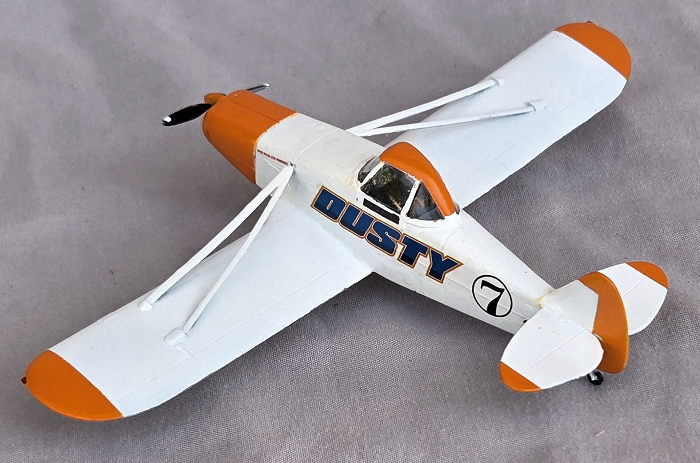
Some filing was needed to create a good fit in the wing to fuselage joints. The dihedral is well molded and the struts help in getting the angle correct, even if they are a bit fiddly to get in place as the glue cures. Attaching the wheel struts was a similar experience. The wheels were also left off for later. When the axles and nose openings were masked, it was ready for the paint booth.
| COLORS & MARKINGS |
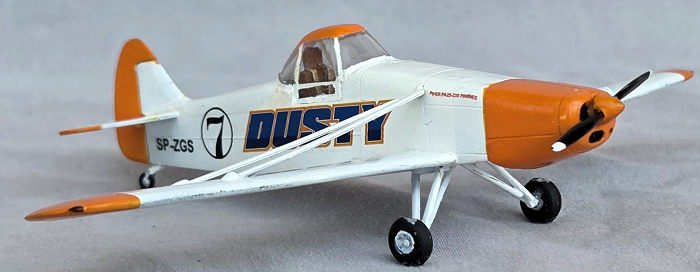
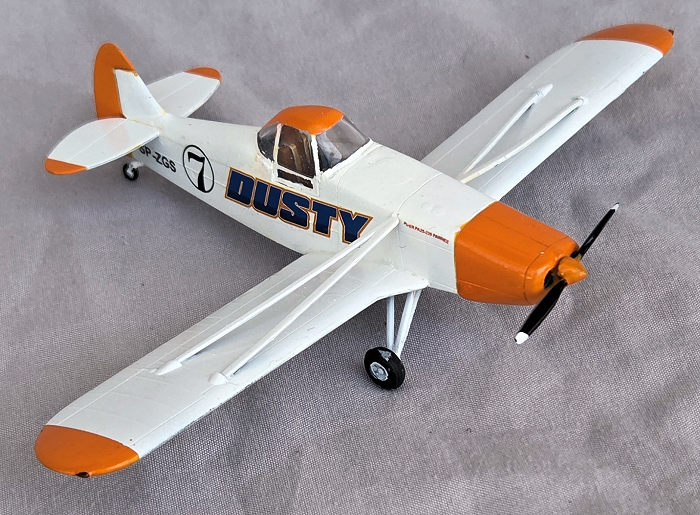
Disney’s movie Planes lead character was the inspiration of the first decal option. It represents a Pawnee based at the Poznan Airfield in Poland. I decided on adding some whimsy to my modeling shelf.
In preparation for the first spraying session, the
model was wiped with lint-free cloth soaked with rubbing alcohol. AK’s Xtreme
White (paint and primer) was used for the base coat. The white pigment is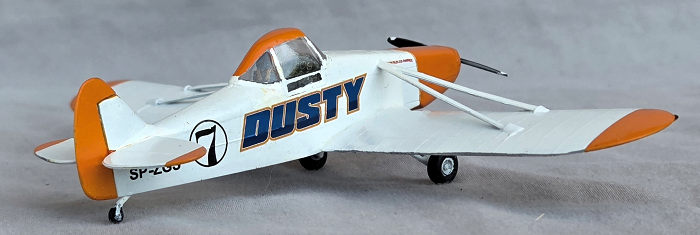 very
opaque, but I found the primer lacking adhesion. (I’ll return to my preferred
automotive primer.) Of course, more filling and sanding followed and a touch-up
coat was applied.
very
opaque, but I found the primer lacking adhesion. (I’ll return to my preferred
automotive primer.) Of course, more filling and sanding followed and a touch-up
coat was applied.
The model was masked for the orange areas, which was tricky with the wing struts. Yup, another coat of white was needed for touch-ups. Perhaps it might have been easier to apply the orange color first.
A gloss coat went down before decaling. The decals are very thin and have good density. A lot of water drops were used to maneuver them into place, then wicked away. They settled down nicely.
Masking at the nose and on the canopy was removed and a bit of windshield touch-up was done. Main wheels and tail wheel were installed, leaving the prop as the final piece.
| CONCLUSIONS |
If ever an opportunity to see a crop duster in action comes up, it’s worth taking the time to watch. It’s like seeing an acrobatic performance for free. It’s even more interesting when the pilot flies underneath power lines. Kudos to Kopro for releasing this kit.
Mold seams, particularly on the struts, need a lot of clean-up, but that is not unusual for a limited-run kit. The parts fit together pretty well. I think the manufacturing of limited-run kits is getting better. One should consider removing the molded hopper lid, which is bisected by the fuselage seam and install a separate piece. There also other opportunities to add more detail to the model.
22 June 2026
Copyright ModelingMadness.com. All rights reserved. No reproduction in part or in whole without express permission
If you would like your product reviewed fairly and fairly quickly, please contact the editor or see other details in the Note to Contributors.