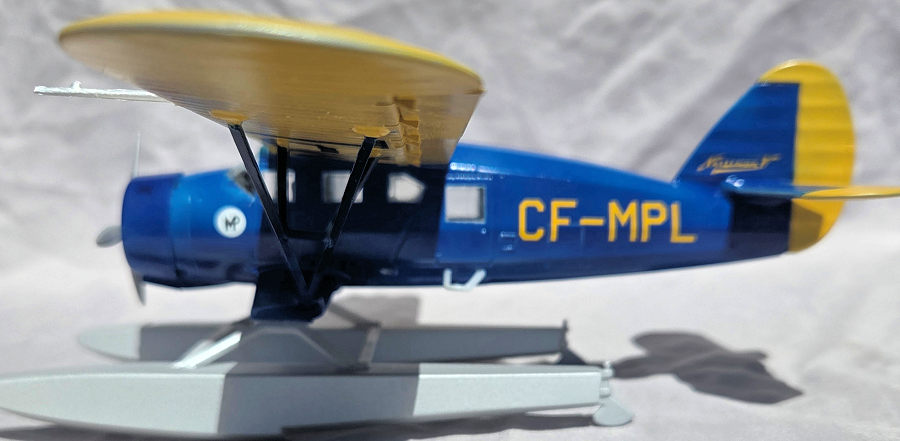
Modelcraft 1/48 Norseman Mk.V
| KIT #: | 48-002 |
| PRICE: | $35.00 'used' |
| DECALS: | Two optionse |
| REVIEWER: | John Summerford |
| NOTES: |
| HISTORY |
Wilderness Workhorse: Canada’s Rugged, Reliable Noorduyn Norseman Bush Plane
by Robert Guttman on Historynet.com
Designed and built in Canada for Canada, the Norseman was a simple and dependable airplane specifically intended to go places others couldn’t go and under conditions that would leave others grounded. The Norseman began doing that in 1935 and, to this day, a few are still doing it.
The Norseman’s creator, Robert Bernard Cornelius Noorduyn, was born in the Netherlands in 1893 to a Dutch father and British mother. Noorduyn was multilingual and the handicap of losing a leg as a child did not hinder his considerable peregrinations. He studied aeronautics in Germany in 1912 before moving to Britain in 1913. There he began his career during World War I, first working for Sopwith and then for British Aerial Transport under fellow Dutch aircraft designer Frederick “Frits” Koolhoven.
When B.A.T. folded after the war, Noorduyn moved back home to work for another Dutch aircraft designer, the legendary Anthony Fokker. In 1920 Fokker dispatched Noorduyn to the United States to run his new American subsidiary, the Atlantic Aircraft Corporation, in Teterboro, N.J. “Fokker kept a low profile in the U.S. because he’d been on the wrong side during the war,” Noorduyn later explained. “I’d been working for the Allies and he’d been working for the enemy. I was acceptable and he wasn’t.”
 While Fokker
was visiting the U.S. in 1925, Noorduyn helped draw up plans for a
single-engine, high-wing cabin monoplane transport, the Atlantic Aircraft Model
4. By 1926 Noorduyn had sold seven Fokker Universals (as they were known) in
Canada to serve as bush planes, where, he noted, they “exceeded their operators’
expectations.” In 1929 he went to work for Bellanca, with whom he designed two
more high-wing, single-engine cabin monoplanes, the Skyrocket and the
Pacemaker. Those aircraft also gained favor among Canadian bush pilots. Noorduyn
changed jobs again in 1932, this time to work on Harold F. Pitcairn’s new design
for an autogiro.
While Fokker
was visiting the U.S. in 1925, Noorduyn helped draw up plans for a
single-engine, high-wing cabin monoplane transport, the Atlantic Aircraft Model
4. By 1926 Noorduyn had sold seven Fokker Universals (as they were known) in
Canada to serve as bush planes, where, he noted, they “exceeded their operators’
expectations.” In 1929 he went to work for Bellanca, with whom he designed two
more high-wing, single-engine cabin monoplanes, the Skyrocket and the
Pacemaker. Those aircraft also gained favor among Canadian bush pilots. Noorduyn
changed jobs again in 1932, this time to work on Harold F. Pitcairn’s new design
for an autogiro.
In 1934 Noorduyn moved to Montreal to establish his own aircraft manufacturing company. Having already created several airplanes popular with bush fliers, he chose to cater to that demanding fraternity rather than try competing against the larger aircraft manufacturers for airline contracts. To that end Noorduyn made a point of inviting bush pilots to discuss their special requirements, as well as to examine his aircraft designs and mock-ups and suggest any improvements that should be made.
Noorduyn understood that bush flying was different from airline flying. While both required expert aviators, bush pilots had to be able to operate in remote areas for long periods under extreme weather conditions. In addition, the bush flier had to be part taxi driver, part truck driver, part ambulance driver, part porter, part navigator, part mechanic, part meteorologist and part wilderness survivalist. Bush planes had to be simple enough for pilots to maintain in the field with whatever equipment they had on hand, without access to airport facilities. The aircraft had to operate with equal facility on wheels, floats or skis to enable them to fly from rough airstrips, lakes and rivers or arctic snow and ice. They also needed to accommodate both passengers and all manner of cargo, with doors large enough to admit bulky items such as oil drums. A high-wing configuration was preferred to keep the wing clear of obstructions on the ground or alongside docks and to facilitate cargo handling. A bush plane also had to be affordable and efficient enough to make a profit.
Unlike commercial airliners, bush planes did not have to be particularly large or luxurious. In fact, single-engine aircraft were preferred because most multiengine types were too big, complex and expensive. A high cruising speed was not a priority; as one bush pilot put it, “You only have to be faster than a dog sled.” However, bush planes did require plenty of power in order to fly in and out of the small fields at the remote locations they serviced.
The prototype Norseman first flew on November 14, 1935, taking off on floats from the St. Lawrence River and immediately demonstrating good handling characteristics both on the water and in the air. Since the Curtiss-Wright Corporation provided much of Noorduyn’s financial backing, the prototype and first few Norsemen produced were powered by 420-hp Wright R-975 Whirlwind radial engines. That engine proved insufficiently powerful, however, and was soon replaced with a 550-hp Pratt & Whitney R-1340 Wasp, subsequent versions of which were increased to 600 hp. Although that upgrade increased the aircraft’s weight, thereby reducing cargo capacity by a small margin, bush pilots regarded that as an acceptable tradeoff against the improved takeoff and climb performance.
 The
fuselage was made of welded steel tube, faired with wooden stringers and covered
with fabric. The fabric-covered wings were constructed of wood with metal-framed
control surfaces. They also featured movable flaps to reduce takeoff and landing
speeds, a first on a Canadian-built airplane. The Norseman’s 170-cubic-foot
cabin could accommodate up to 10 people. A large fuselage door provided ready
access for either cargo or passengers and the comfortable cockpit had an
additional door on each side. The empennage was sufficiently large to not
require additional tail surfaces when the plane was fitted with floats.
The
fuselage was made of welded steel tube, faired with wooden stringers and covered
with fabric. The fabric-covered wings were constructed of wood with metal-framed
control surfaces. They also featured movable flaps to reduce takeoff and landing
speeds, a first on a Canadian-built airplane. The Norseman’s 170-cubic-foot
cabin could accommodate up to 10 people. A large fuselage door provided ready
access for either cargo or passengers and the comfortable cockpit had an
additional door on each side. The empennage was sufficiently large to not
require additional tail surfaces when the plane was fitted with floats.
Noorduyn sold only 17 Norsemen prior to World War II. Given the generally slow sales of new aircraft due to the Depression, that quantity was considered a success. Nevertheless, the onset of WWII greatly increased the demand for all aircraft, including an order for 94 Norseman from the Royal Canadian Air Force. Originally intended as trainers for navigators and radio operators, they subsequently proved invaluable for rescue and transport work.
The Norseman’s greatest single customer, however, was the United States. When the Army Air Corps was called upon to expedite deliveries of aircraft and war materiel to Britain via Greenland, General Henry H. “Hap” Arnold turned for advice to veteran Norwegian arctic pilot Bernt Balchen. The recently commissioned Colonel Balchen overcame Arnold’s strong “buy American” bias by explaining that the U.S. produced nothing comparable to the Norseman for supporting operations in rugged, remote regions such as Greenland and Alaska. As a result, the Norseman became one of the few foreign-built aircraft operated by the U.S. during the war. In fact, of the 904 Norsemen eventually produced, 749 were originally built for the Army Air Forces as C-64s and UC-64s (though the Norseman was technically too large to rate the latter “utility” designation).
Although far from the most glamorous aircraft in the AAF inventory, the C-64 served faithfully throughout the world—and not just in polar regions. Frank Davis, a typical C-64 pilot, recalled his experiences with the aircraft: “During WWII I flew several hundred hours in Norsemen in India and Burma, a combat area where we often used very short strips carved out of the jungle. Of the thousands of hours that our Norsemen flew, I can think of no incidents caused by plane failure. My personal problems came from a replacement engine from the States with four rebuilds—no longer eligible for Stateside flying, but OK for combat! It nearly cost me a few times (cutting out, but able to be restarted). We didn’t know what weight and balance was—we just stuffed them full of supplies, drums of gas, wounded soldiers, Jap prisoners, whatever, and hoped we cleared the trees. Getting over high mountains in hot weather was a problem, but with time, and sometimes a bit of flaps, we made it. The airplane certainly did its job, and I am grateful that our organization had the foresight to use them.”
The Norseman performed most of its work, as Thomas Hardy would have put it, “far from the madding crowd.” One of the few conspicuous events in its career was its unfortunate role as the aircraft in which big-band leader Glenn Miller disappeared while flying from Britain to France on December 15, 1944. What actually happened remains a mystery, but when his C-64A took off the weather was so bad that practically everything else was grounded. In 1987 a British fisherman raised the wreckage of an airplane similar to Miller’s from the bottom of the English Channel when it got caught in his nets, but he returned it to the sea. The International Group for Historic Aircraft Recovery (TIGHAR), famous for its longstanding search for Amelia Earhart’s airplane, has expressed interest in finding and recovering the wreck.
The only other blot on the Norseman’s escutcheon involved the death of 31-victory Canadian fighter ace George F. Beurling. After surviving WWII Beurling volunteered to fly for the new Israeli Air Force. On May 20, 1948, he was test-flying a Norseman prior to a delivery flight from Rome to Israel when it was destroyed by a midair fire and explosion. Again, the cause of the accident remains a mystery, although there have been strong suspicions that it was sabotage. Beurling was buried in Israel with full military honors.
 Beurling’s
Norseman was one of 17 purchased clandestinely in Canada for the newly
established state of Israel. The others were soon committed to combat. On May
10, 1948, days after arriving in the country, one of the Norseman was shot down,
or crashed, while carrying out a bombing mission (a role for which it had never
been intended) during the fighting to circumvent the Arab blockade of Jerusalem.
The aircraft’s engine was subsequently placed on the Israeli Air Force Memorial
erected at Har-Tayyasim, where it had been found.
Beurling’s
Norseman was one of 17 purchased clandestinely in Canada for the newly
established state of Israel. The others were soon committed to combat. On May
10, 1948, days after arriving in the country, one of the Norseman was shot down,
or crashed, while carrying out a bombing mission (a role for which it had never
been intended) during the fighting to circumvent the Arab blockade of Jerusalem.
The aircraft’s engine was subsequently placed on the Israeli Air Force Memorial
erected at Har-Tayyasim, where it had been found.
While most WWII aircraft were scrapped soon after hostilities ended, the Norseman’s career was only just beginning. Hundreds of C-64s and UC-64s came onto the surplus market, and as the Canadian wilderness experienced a postwar development boom, the demand for bush planes soared. Many surplus Norsemen were snapped up by Canadian operators, while others turned up everywhere a rugged utility transport was required. Appropriately, another notable user of the Norseman was Norway where, as in Canada, the airplane proved ideal for operations in the country’s far north. One Norwegian Norseman has been preserved as the only remaining flying example in Europe.
In 1946 Canadian Car and Foundry took over Noorduyn in hopes of continuing production with the Norseman Mark VII, which featured a lengthened fuselage and all-metal wings and tailplane, but only one prototype was built in 1951. Moreover, the ready supply of surplus C-64s greatly reduced the postwar demand for new-built Norsemen. The last of them was delivered in 1959, the same year Robert Noorduyn died.
The Norseman was not actually eclipsed until the 1947 advent of the all-metal de Havilland Beaver and the 1951 appearance of the similar but larger de Havilland Otter. The Beaver possessed a more advanced airframe than the Norseman, but it was of a similar size and used the same engine. Nevertheless, the Norseman remained in regular use for decades thereafter, and as of 2020 no fewer than 37 were still listed on the civil register in Canada. Although it was unfortunately cancelled that year due to the covid-19 pandemic, Canada hosts an annual Norseman Festival at Red Lake, Ontario. Closer to home, a meticulously restored UC-64 is preserved at the National Museum of the U.S. Air Force in Dayton, Ohio.
| THE KIT |
Modelcraft released the kit in 1995 with three sprues of non-colored styrene and one sprue of clear parts. There are options for a two-bladed propeller or three-bladed, plus wheels, floats, and skis. Total parts count is 77. Decal options are for the ill-fated Glen Miller aircraft and the other an aircraft operated by the Royal Canadian Mounted Police. Two sheets of 11 by 17 paper hold the paint and marking drawings, parts map, histories, and assembly illustrations.
| CONSTRUCTION |
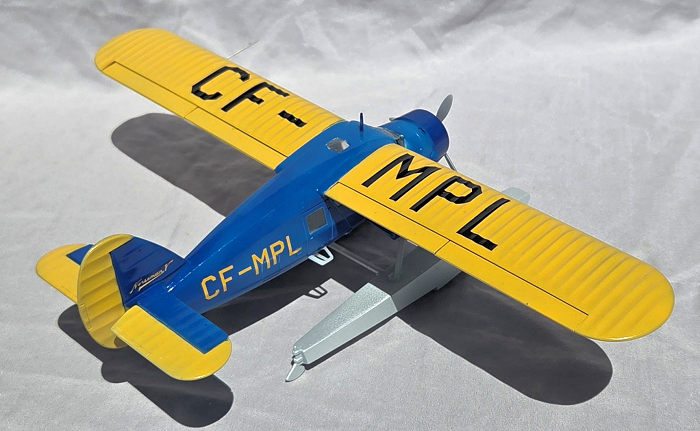
I wanted to build a float version, since the only Norseman that I have seen was on floats, so I chose the RCMP option. The color callouts list FS numbers, but the yellow decals don’t match those specs. To help decide if I should follow the decal color, or order a new set, I tested a snippet of decal for the Army plane. I didn’t find any problems and the saturation of the yellow was good. Fortunately, I have in my paint supply a bottle that closely matches the decal.
With that issue decided, work started on the interior, which is a rudimentary cockpit and rear bulkhead attached to the floor. Since it is so simple, the parts were assembled, then painted. The instructions do not provide color callouts, so gray primer doubled as the interior color. Card stock paper was used for seat harnesses. The yoke and instrument panel were painted black and the bezels highlighted with a swipe from a white color pencil.
Being inserted from the inside, the windows came next and their fit was adequate. Of note is the cloudiness of the clear parts. The fuselage halves were joined, and the seams were filled and sanded.
Then things started to go wrong.
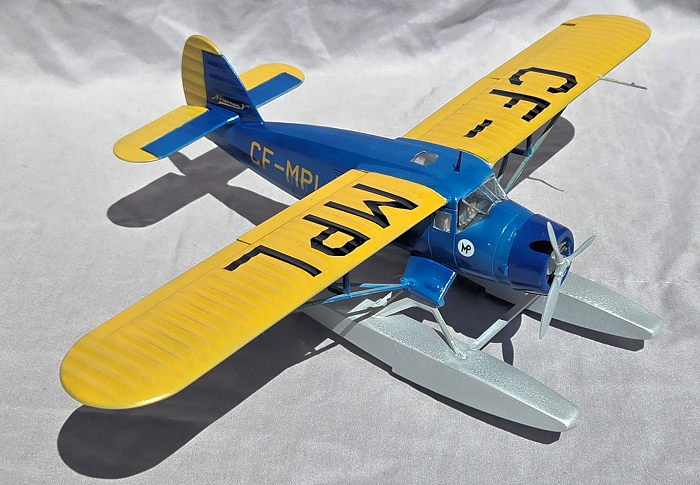 After
achieving flawless seams, the halves cracked in several places, requiring more
work. The result was not as good as the first time. Next came installing the
windshield. As I picked up the clear sprue with only the windshield part
remaining on it, the part split into two. It was then that I discovered that the
quarter windows were missing. I think they had broken off earlier, which might
explain why the kit was never built. I toyed with the idea of covering the crack
with a splotch of white and red and call it a bird strike (Canada goose, of
course) and claim that the quarter windows popped out as part of the damage. I
kept that in mind as I installed the broken parts, which did not fit well. The
clear parts were masked, and bits of foam rubber were stuffed in the openings of
the missing windows.
After
achieving flawless seams, the halves cracked in several places, requiring more
work. The result was not as good as the first time. Next came installing the
windshield. As I picked up the clear sprue with only the windshield part
remaining on it, the part split into two. It was then that I discovered that the
quarter windows were missing. I think they had broken off earlier, which might
explain why the kit was never built. I toyed with the idea of covering the crack
with a splotch of white and red and call it a bird strike (Canada goose, of
course) and claim that the quarter windows popped out as part of the damage. I
kept that in mind as I installed the broken parts, which did not fit well. The
clear parts were masked, and bits of foam rubber were stuffed in the openings of
the missing windows.
Assembly of the wings was straight forward, although the ailerons and flaps were crossed numbered. The instructions show installing the strut braces in this stage. When I located the braces on the sprue, I noticed that they were not molded as airfoil shapes, but as four flat sides. I rounded them slightly, thinking it would take scrutiny to notice.
Mating the tail feathers and wings to the fuselage proved difficult due to loose fit (no surprise there) and the styrene resisting cement and cyano for adhesion. Like the strut braces, the wing struts do not have an airfoil shape. When the time came to install them, cyano was the glue of choice. Some filing at the connecting points was needed to get the parts to fit reasonably well and the cyano was slathered on. A couple of points still popped loose but were not a structural issue.
A hole was drilled in the firewall so that the model could fit vertically on a rod in a paint stand, leaving the cowl to be painted separately. When the model was mounted to the rod, it was ready for paint.
| COLORS & MARKINGS |
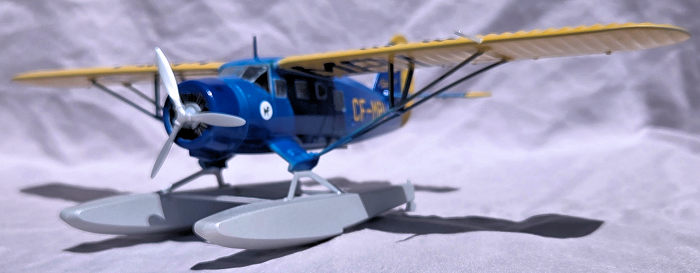 Only the
fin needed more work after a coat of gray primer was sprayed on. Areas for the
blue color were blanked off before the True Color acetone based; yellow paint
was applied. The masking was reversed for the blue enamel paint.
Only the
fin needed more work after a coat of gray primer was sprayed on. Areas for the
blue color were blanked off before the True Color acetone based; yellow paint
was applied. The masking was reversed for the blue enamel paint.
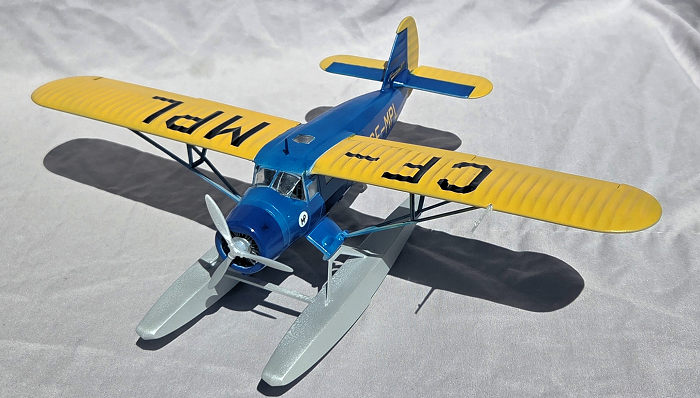
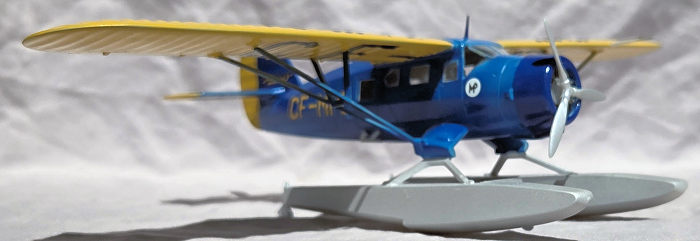
While the enamel paint was curing, the floats were assembled and placed in a jig that used blobs of Silly Putty as cradles. It took two tries getting the float struts to stay anchored, the second time with copious amounts of cyano.
Returning to the airframe, Vallejo’s acrylic gloss varnish from a rattle can was applied. This is a very good varnish; however, it take 24 hours to cure. During that time, the floats were primed and sprayed with AK metallic aluminum, thinned with distilled water. Except for the rudders, there is no detail on floats, and I decided that it would be a wasted effort to scribe hatches and rivets.
So that the two-piece decals of ID letters for the underside of the wings would fit between the struts and braces, they were cut into smaller segments. Despite their age, all the decals behaved well. They did need encouragement to settle into the spaces between the ribs on the top wing surfaces. Another coat of gloss followed.
| FINAL CONSTRUCTION |
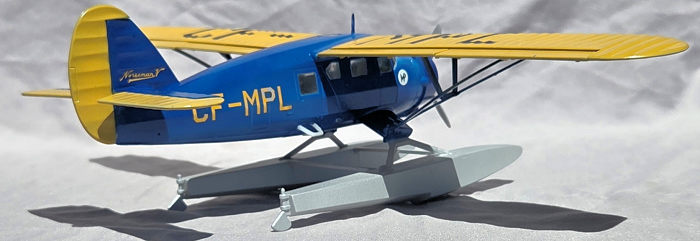 I
can only blame myself for the most glaring error of this project. When I went to
glue the cowl in place after the engine added, I realized that I didn’t get good
saturation of the blue at the nose section of the fuselage. I decided not to
bother to try to correct it.
I
can only blame myself for the most glaring error of this project. When I went to
glue the cowl in place after the engine added, I realized that I didn’t get good
saturation of the blue at the nose section of the fuselage. I decided not to
bother to try to correct it.
After some clean-up, the overscale foot rungs were installed and the moment that I had learned to dread was at hand. Experimenting on the fit of the floats to the fuselage, I found that, with fuselage upside down, the floats would balance on the ends of the legs. There was not any positive fit, so the join was reinforced with strips of styrene and slathered with cyano. I was surprised how well that worked.
The final indignity of the build came when the model was set upon the floats. The right elevator fell off. The model was braced tail up and the elevator was re-glued and left overnight.
The next morning, after heaving a sigh of relief, the radio mast, pitot and, finally, the prop were added.
| CONCLUSIONS |
To put it kindly, the details in the kit are robust. Given today’s technology, they can be finessed much better in a new offering. Getting the parts to stay together was very frustrating and I wonder about the quality of the styrene. Given that the serial number of this kit is -002, I also wonder if there was a -003 kit, or was all production halted. I searched the web for “Modelcraft” and my search engine couldn’t find a kit manufacturer. Even Scale Mates came up empty. The only other Norseman kit that I am aware of is a 72nd scale offering by Dora Wings. I’m not satisfied with this build and if anyone produces another kit in 48th scale, I’ll be the first in line to get one. (Maybe two)
15 April 2026
Copyright ModelingMadness.com. All rights reserved. No reproduction in part or in whole without express permission from the editor.
If you would like your product reviewed fairly and fairly quickly, please contact the editor or see other details in the Note to Contributors.