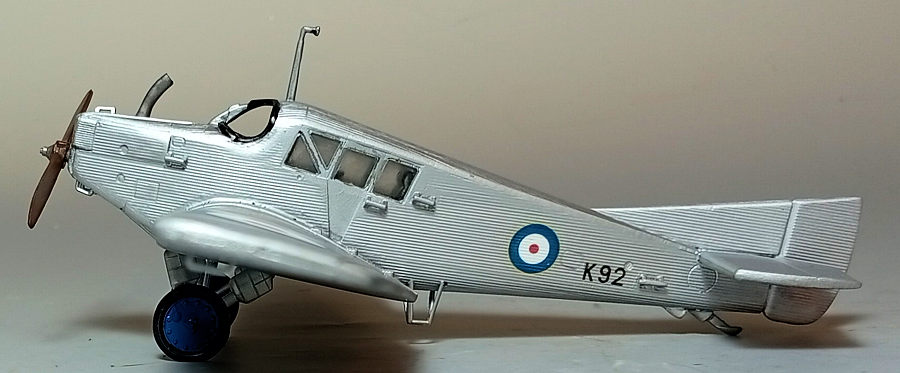
Revell 1/72 Junkers F.13
| KIT #: | 4215 |
| PRICE: | 10 Euros 20 years ago |
| DECALS: | Two options |
| REVIEWER: | Spiros Pendedekas |
| NOTES: | What If markings |
| HISTORY |
K92 — THE SILVER EAGLE
There are aircraft whose histories can be traced almost from the moment they leave the factory. Their registrations are recorded, their owners are known, their pilots write their names in logbooks, and photographs survive long after the machines themselves have disappeared. Then there are aircraft that seem to slip between the lines of history, leaving behind only fragments and rumors.
K92 was one of those aircraft. No official registration has ever been found for it, no complete ownership record survives, and no photograph has ever been conclusively identified. It is speculated that it carried British markings and the fictional code K92 because that identity allowed it to move around the Mediterranean without attracting the attention that a mysterious German aircraft might have received. To most people it was simply a British-operated Junkers F.13. To the handful of people who knew why it was really flying, the markings were nothing more than a disguise.
The aircraft itself was extraordinary. When the Junkers F.13 first appeared in 1919, it represented a completely different philosophy of aircraft construction. While many contemporary machines still depended upon wooden structures, fabric coverings, external struts and wires, the Junkers was built around a metal airframe with a cantilever wing and the unmistakable corrugated duralumin skin that became one of the great visual signatures of early Junkers aircraft. Its enclosed cabin could carry four passengers in comfort, protected from the weather while the pilot and mechanic sat ahead in the open cockpit. It was strong, durable and remarkably advanced for its time, a machine that seemed to have arrived from the future while the rest of aviation was still trying to escape its wooden past.
For Captain Thomas Hale, however, K92 was more personal than that. He trusted the old Junkers. He knew every vibration in its structure, every change in the engine's voice and every little movement of the controls, and he believed that the aircraft would forgive a pilot's mistakes as long as the pilot respected the machine. He called her the Silver Eagle, and on the morning of September 17, 1933, he was about to discover just how much he could ask of her.
Hale was thirty-eight, a former military pilot, quiet and disciplined, with the habit of studying people before deciding whether he trusted them. Four passengers were waiting beside K92 before sunrise for what was officially described as a flight to Rhodes.
The first was Dr. Nicholas Argyros, an elderly Greek archaeologist who had spent his life searching forgotten islands and ancient ruins. His father had disappeared forty years earlier while looking for an island mentioned in Byzantine and Venetian documents but absent from modern charts.
The second passenger was James Whitmore, a young British engineer recruited because Argyros believed that whatever his father had discovered might involve structures that required someone with technical knowledge.
The third was Edward Bell, a British photographer carrying cameras and boxes of glass plates. Bell had accepted the assignment because he believed Argyros knew something about the disappearance of his younger brother, whose merchant ship had vanished in the Mediterranean two years earlier.
The fourth was Anna Markou, a thirty-two-year-old Greek woman who appeared to have almost nothing to do with archaeology, engineering or photography. She carried only a leather case and watched the others with an unsettling calmness.
Hale noticed something else before they took off: Argyros was carrying a small metal box. It was not particularly large or beautiful, but he held it with extraordinary care and refused to let anyone put it with the luggage. When Hale asked what was inside, the old man looked at him for a moment and replied, "My father's last journey." That answer meant little to Hale at the time.
 Anna,
however, looked sharply at Argyros. She already knew what was
inside. Her grandfather had been the last surviving member of
Argyros's father's expedition, and before he died he had
confessed something that had haunted him for the rest of his
life: he had not merely helped Argyros's father find the island;
he had helped another group find him. The old man had betrayed
the expedition because he had become convinced that whatever lay
beneath the monastery should never leave the island. Before his
death he had given Anna a letter and a final warning: "If
Nicholas ever opens the box, go with him. Do not let him take
what is inside back to the world." Anna had kept the secret for
years, but when Argyros finally announced that he was going to
search for the island, she knew she had no choice. She came not
to help him find his father's lost treasure, but to make certain
that the treasure never reached the people who had been
searching for it since 1891.
Anna,
however, looked sharply at Argyros. She already knew what was
inside. Her grandfather had been the last surviving member of
Argyros's father's expedition, and before he died he had
confessed something that had haunted him for the rest of his
life: he had not merely helped Argyros's father find the island;
he had helped another group find him. The old man had betrayed
the expedition because he had become convinced that whatever lay
beneath the monastery should never leave the island. Before his
death he had given Anna a letter and a final warning: "If
Nicholas ever opens the box, go with him. Do not let him take
what is inside back to the world." Anna had kept the secret for
years, but when Argyros finally announced that he was going to
search for the island, she knew she had no choice. She came not
to help him find his father's lost treasure, but to make certain
that the treasure never reached the people who had been
searching for it since 1891.
K92 lifted into the pale morning sky and headed south across the Aegean. The flight was peaceful at first, and for a while the four passengers seemed almost ordinary. Bell photographed the islands through the cabin windows, Whitmore became absorbed in the construction of the Junkers, and Anna watched the sea in silence while Argyros sat with the metal box resting on his knees. Hale enjoyed the aircraft's steady behavior. The F-13 moved through the morning air with a confidence that never failed to impress him, its strong metal structure taking the small bumps without complaint while the sunlight flashed along the corrugated skin. But as the hours passed, Hale became increasingly aware that the passengers were carrying more than luggage. Bell was watching Argyros. Argyros was watching the box. Anna was watching everyone. Hale had been told they were going to Rhodes. He was beginning to suspect that Rhodes was only the destination written on the official paperwork.
By midday, the weather changed. Dark clouds gathered across the southern horizon and Hale altered course, but the storm moved faster than expected. Rain hammered against the corrugated aluminum, turbulence shook the cabin and the horizon disappeared completely. Hale tried the radio and received only static. He checked the instruments and then heard the engine cough. It recovered, coughed again and began to lose power. Hale reduced speed and searched for clear air, but below him was nothing except grey water. Then the clouds opened for a few seconds and he saw land. An island rose from the sea, dark and mountainous, its cliffs disappearing into mist. Hale stared at his chart. There was no island there. He checked again, refusing to believe his own eyes. Still nothing. He had flown across the Aegean for years; he knew its geography almost by instinct. Yet the island beneath them was real, and the engine was failing.
There was no time to solve the mystery. Hale circled once and spotted a narrow valley running inland from the coast. At its bottom was a pale strip of ground that might once have been a road or dried riverbed. It was uneven and far too short, but it was their only chance. Hale brought the Junkers down through the rain, fighting the turbulence while Whitmore braced himself beside him. The wheels struck hard, bounced and struck again before one of the landing gear legs collapsed. K92 swung violently sideways, the wingtip passing within inches of the rocks, and Hale fought the aircraft until the old Junkers finally stopped. For several seconds nobody moved. The engine ticked as it cooled, rain ran across the windshield and Hale realized that his hands were shaking. When he looked back, Anna was crying. She wiped her face and whispered, "I thought we were going to die." Hale looked around the cockpit and answered quietly, "So did I."
The island seemed completely deserted, but after an hour of searching they found a narrow stone path leading into the mountains. It brought them to the ruins of an old monastery, almost completely swallowed by vegetation. Argyros stopped at the entrance and stared at a symbol carved into the stone. It was the same symbol his father had drawn repeatedly in his notebooks. "He was here," he whispered. "My father actually found it."
They entered the ruins and discovered a chamber beneath the floor. Inside was an old table, a rusted lantern and a stone recess containing several papers. One was far newer than the others. Argyros unfolded it with trembling hands and read the faded words: "If you have found this place, the box must not fall into their hands." Bell immediately looked at Argyros. "Whose hands?" he asked, but before the old man could answer, Anna spoke.
"The same hands that took your brother."
Bell turned toward her. For the first time, his face lost its composure.
Anna finally told him what she knew. Bell's brother had not simply vanished at sea. His ship had been carrying a sealed package connected with Argyros's research, and he had discovered that several people were searching for the same island. Before he could return to Britain, the ship disappeared. Anna's grandfather had known the name of the vessel. He had known the men involved. He had even known that Bell's brother had been warned to stay away from the island. Anna had invited Bell onto K92 because she believed he deserved the truth, even if the truth destroyed the last comfortable explanation he had for his brother's disappearance.
Then Argyros opened the box.
Inside were old notebooks, maps, photographs and letters, together with several small Byzantine gold coins wrapped in cloth. For a moment Whitmore thought they had finally found the treasure. Argyros shook his head. "These are valuable," he said, "but they are not why men have killed for this place." Beneath the coins was a leather-bound notebook belonging to his father. The pages described a chamber beneath the monastery and contained drawings of an object unlike anything the archaeologist had ever seen. His father had called it the Star Stone.
They found it before nightfall.
The chamber lay beneath the monastery, deeper than any of them had expected. At the bottom was a stone platform surrounded by strange markings. In its center sat a small object about the size of a man's hand, dark and glass-like, with a faint metallic sheen beneath its surface. It looked almost like a crystal that had been cut by a master craftsman, but there were no visible tools marks, no seams and no obvious explanation for how it had been made. Whitmore examined it carefully and discovered something that made him step back. Inside the object were incredibly fine lines arranged in precise geometric patterns. They looked almost like a circuit.
"This isn't ancient," he whispered.
Argyros stared at him.
"What?"
Whitmore pointed to the pattern. "I don't know what it is, but this isn't something carved by hand two thousand years ago."
Anna closed her eyes.
She had been waiting for this moment.
Her grandfather had told her one final secret before he died: the Star Stone had not been discovered by his generation. It had been discovered by someone else, long before Argyros's father reached the island. The Byzantine coins and ancient inscriptions were real, but they had been deliberately placed around the chamber to make the object appear older than it was. Someone had wanted future explorers to believe that the secret belonged to antiquity.
Whitmore carefully placed his fingers near the object.
It reacted.
A faint blue-white glow appeared inside the crystal.
Everyone froze.
The light lasted only a few seconds and then disappeared.
"What did you do?" Hale asked.
"Nothing."
Whitmore looked terrified.
Bell stared at the object.
Argyros whispered, "My father said it did that."
Hale turned toward him.
"You knew?"
"I knew he had written about it. I never believed him."
There was a silence in the chamber.
Then they heard an engine outside.
Hale immediately understood.
They were not alone.
The sound grew louder, passed over the monastery and circled the island. Another aircraft had arrived. Moments later they heard men moving through the ruins above them.
"They followed us," Whitmore whispered.
"No," Anna replied.
Everyone looked at her.
"They followed the box."
The realization was devastating. Someone had known where the box was going. Someone had known Argyros would eventually search for the island. Perhaps someone had even known the island's location all along.
They returned to K92 under cover of darkness. The landing gear was damaged, but Whitmore believed he could repair enough of it to give them one chance. Hale worked on the engine while Bell watched the hillside through the darkness. Argyros sat beside the aircraft with the box in his hands. Anna stood opposite him.
"You should destroy it," she said.
"I have spent forty years looking for this."
"And my grandfather spent forty years trying to make sure nobody found it."
"Why?"
Anna looked toward the monastery.
"Because he discovered something your father never understood. The people who want this aren't interested in archaeology. They don't care about the coins or the history. They believe the Star Stone can be used."
"Used for what?"
Anna shook her head.
"My grandfather never found out."
Then she added, almost in a whisper, "But he was certain it was made by men."
Argyros stared at her.
"Ancient men?"
"No."
Anna looked toward the dark sky.
"Men who had not yet been born."
Before Argyros could respond, gunfire echoed from the hills.
Hale shouted that the aircraft was ready.
They ran.
K92's engine coughed once, then roared into life. The men on the hillside began descending toward the valley. Hale pushed the throttle forward. The Junkers bounced violently across the rough ground, and Hale knew there would be no second attempt. The end of the valley rushed toward them. He pulled back.
For one terrible second, the F-13 remained on the ground.
Then the Silver Eagle lifted.
The aircraft climbed over the ridge, barely clearing the rocks, and disappeared into the clouds.
Anna looked back through the cabin window.
One of the men had reached the monastery.
He was standing beside the entrance, holding something above his head.
Even at that distance, she recognized it.
It was her grandfather's compass.
The same compass he had carried away from the island forty years earlier.
The same compass he had supposedly lost before his death.
Anna suddenly understood.
Her grandfather had not been protecting the island from the men.
He had been protecting the men from what was inside it.
K92 flew for some time before the weather finally cleared. The Greek mainland appeared beneath them as dawn approached, but nobody felt safe. Bell had learned what had happened to his brother. Argyros had found his father's secret. Whitmore had seen an object that seemed impossible. Hale had discovered an island that did not exist on his charts.
And Anna was sitting alone with the box.
Hale looked back.
She was holding the Star Stone.
 "Where
did you get that?" he asked.
"Where
did you get that?" he asked.
Anna looked at him.
"It was in the box."
Hale frowned.
"I thought Argyros had it."
"He did."
She looked down at the object.
"Until he decided to leave it behind."
Hale stared at her.
"What?"
Anna did not answer.
Instead she opened her hand.
The Star Stone was glowing faintly.
Hale looked toward the cockpit instruments.
The compass needle was moving.
Not wildly.
Not randomly.
It was turning toward the window.
Toward the sea.
Toward the place they had just escaped.
Anna watched the light inside the object.
"It wants to go back," she whispered.
Hale did not ask how she knew.
He simply turned the aircraft north.
K92 eventually reached safety, but the four passengers never gave the same account of what happened afterward. Bell returned to Britain and never published the photographs he had taken on the island. Whitmore disappeared from aviation circles several years later, leaving behind only a technical notebook filled with drawings of the Star Stone. Argyros destroyed much of his research before his death and refused every request for an interview. Anna Markou vanished almost completely from the historical record.
As for K92, its story ends in the same darkness in which it began.
There is no confirmed final flight.
No wreckage.
No registration.
No surviving owner.
Only one photograph, discovered years later among Captain Thomas Hale's possessions, showing the silver Junkers standing beside the monastery. Hale, Argyros, Whitmore and Anna are visible beside the aircraft, but in the mist above the ruins there appears to be another figure.
On the back of the photograph Hale wrote:
"The island was real. The treasure was real. But the greatest mystery was not what we found there. It was who had left it."
The Star Stone was never recovered.
The island was never found again.
And somewhere beneath the Aegean, perhaps the ruins still stand exactly as K92 left them, waiting for another aircraft, another storm and another group of people willing to follow a secret that should have remained buried.
Perhaps the old Junkers really did disappear.
Perhaps someone made it disappear.
Or perhaps K92 simply followed the same path as the island itself—out of the world we know and into a place where maps, registrations and history no longer have any authority.
But there is one final detail.
Several years after Hale's disappearance, a fisherman found a small piece of corrugated aluminum far from any known wreck.
It carried three faded letters and numbers.
K92.
Scratched into the metal beneath them, almost invisible beneath the salt and corrosion, was a symbol identical to the one carved into the monastery wall.
The fisherman kept the fragment.
He later claimed that, on certain nights, it seemed to become warm in his hands.
He never discovered why.
Neither did anyone else.
| THE KIT |
 In
1992, Revell decided to introduce a new mold of the iconic
Junkers F.13, followed two years later, in 1994, by a seaplane
edition that added an extra sprue containing the necessary
parts. From 2006 onward, the kit was issued with all the sprues
in the box, allowing the modeler to build either the landplane
or seaplane version. Further releases appeared in 2008 with
different decals, as a Model Set, and finally in 2020 as both a
standalone kit and a Model Set including basic paints, a brush,
and glue. The tooling also appears to have been released by
Classic Plane with the addition of some extra parts catering to
some less mainstream versions. The kit previewed here is the
original 1992 landplane edition.
In
1992, Revell decided to introduce a new mold of the iconic
Junkers F.13, followed two years later, in 1994, by a seaplane
edition that added an extra sprue containing the necessary
parts. From 2006 onward, the kit was issued with all the sprues
in the box, allowing the modeler to build either the landplane
or seaplane version. Further releases appeared in 2008 with
different decals, as a Model Set, and finally in 2020 as both a
standalone kit and a Model Set including basic paints, a brush,
and glue. The tooling also appears to have been released by
Classic Plane with the addition of some extra parts catering to
some less mainstream versions. The kit previewed here is the
original 1992 landplane edition.
This is a lovely little kit and one that deserves some appreciation simply for the fact that Revell chose to tackle such an important but often overlooked aircraft. The Junkers F.13 is one of those subjects that may not have the immediate appeal of a fighter or bomber, yet its place in aviation history is unquestionable, and Revell's decision to offer it in 1/72 scale gave modelers an accessible way of adding this pioneering aircraft to their collections.
There is also a personal reason why this particular F.13 is rather special to me. The kit was practically handed to me by the widow of a deceased member of my local club. The model had already been started, and the decals were in poor condition, but rather than simply leave it unfinished, I decided to take it over and give the little Junkers a new life. Knowing something about the story behind the kit and its previous owner made completing it considerably more meaningful than simply building another model from the stash.
For a more in-depth look at the contents of the kit, you may look no further than the ever-growing MM Archives, where this and many other classic kits can be examined in considerably greater detail.
| CONSTRUCTION |
Construction started with the installation of the eight transparent window panels from the inside of the fuselage halves. This is a relatively delicate operation, requiring some care to ensure that the windows sit properly and remain clear. Per my usual trend, I did only an average job here, as a couple of the windows were marred by glue during the process. I subsequently had to polish them from the inside to achieve a reasonable result. Thankfully, the polishing worked and the windows ended up looking acceptable.
I continued with the interior, which is built around a very nice, substantial floor. The two passenger seats and sofa were installed, together with the three bulkheads, the pilot and copilot/engineer seats, the two control yokes, the instrument panel and the forward firewall. The engine was also assembled and attached to the front of the interior - although very little of it can actually be seen once the fuselage is closed, it provides a solid mounting point for the exhaust assembly.
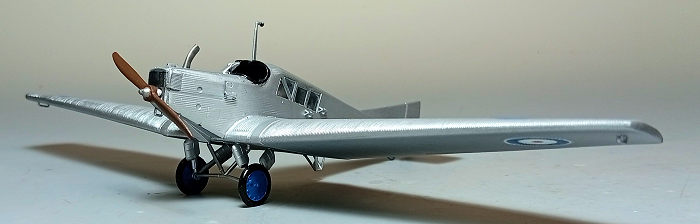 The
interior was painted in a medium grey overall, including the
cabin walls and seat frames, while the various cushions were
painted black. The control yokes were also painted black, as was
the instrument panel. A few switches were picked out with a
silver pen. The transparent instrument panel glazing supplied
with the kit unfortunately disintegrated when I dipped it in
water, so I had to do without it. The forward engine firewall
was painted black as well. In any case, not a lot of the
interior can actually be seen, but I added seat belts made from
strips of masking tape to give the cockpit a little more life.
The
interior was painted in a medium grey overall, including the
cabin walls and seat frames, while the various cushions were
painted black. The control yokes were also painted black, as was
the instrument panel. A few switches were picked out with a
silver pen. The transparent instrument panel glazing supplied
with the kit unfortunately disintegrated when I dipped it in
water, so I had to do without it. The forward engine firewall
was painted black as well. In any case, not a lot of the
interior can actually be seen, but I added seat belts made from
strips of masking tape to give the cockpit a little more life.
Once the interior was completed, it was trapped between the fuselage halves, followed by the upper fuselage section. The front lower fuselage half and engine front were then successively added. This might sound like a very simple process, and in principle it is, but some care is needed to align all these components correctly and obtain a homogeneous result without damaging the very attractive corrugated surfaces.
The impressive main wing was then assembled and attached underneath the fuselage, followed by the tail planes. The landing gear was assembled next, with its various struts fitted underneath the aircraft, followed by the numerous handles, steps and other small fittings scattered around the airframe.
One small point worth mentioning concerns the propeller. The kit provides the option of trapping it between the fuselage and engine front so that it remains free to rotate. I decided not to use this option, as doing so would have made filling and sanding the surrounding joint considerably more difficult.
With the basic assembly completed, I found the construction to be a pleasant and relatively easy process. Overall fit was very good, although some attention was required at the various joints where the corrugated surfaces meet. Nothing was particularly difficult, however, and the model went together without any major problems.
I deliberately kept filling and sanding to an absolute minimum. The only significant work was carried out underneath the fuselage. There was simply no reason to undertake extensive sanding, especially on such a distinctive corrugated surface, where excessive work could easily compromise the fine detail. Preserving this characteristic surface was, in my opinion, far more important than achieving perfectly invisible joints at every location.
With construction complete, I masked the windows with liquid mask, blanked off the cockpit with wet tissue, and finally took the little Junkers to the paint shop.
| COLORS & MARKINGS |
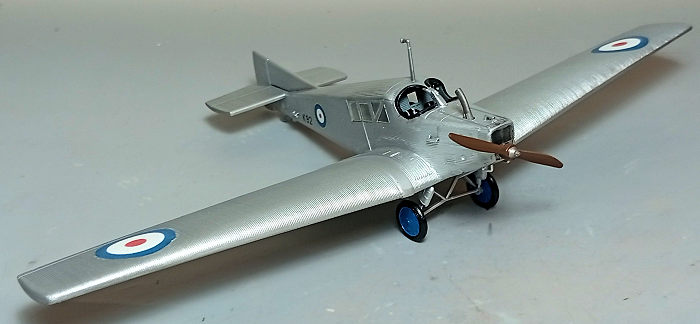 For
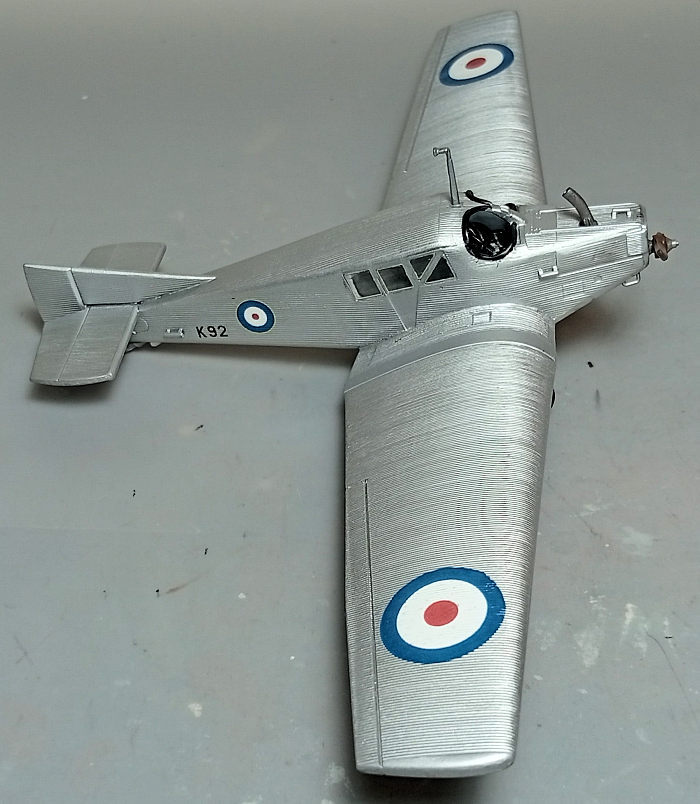
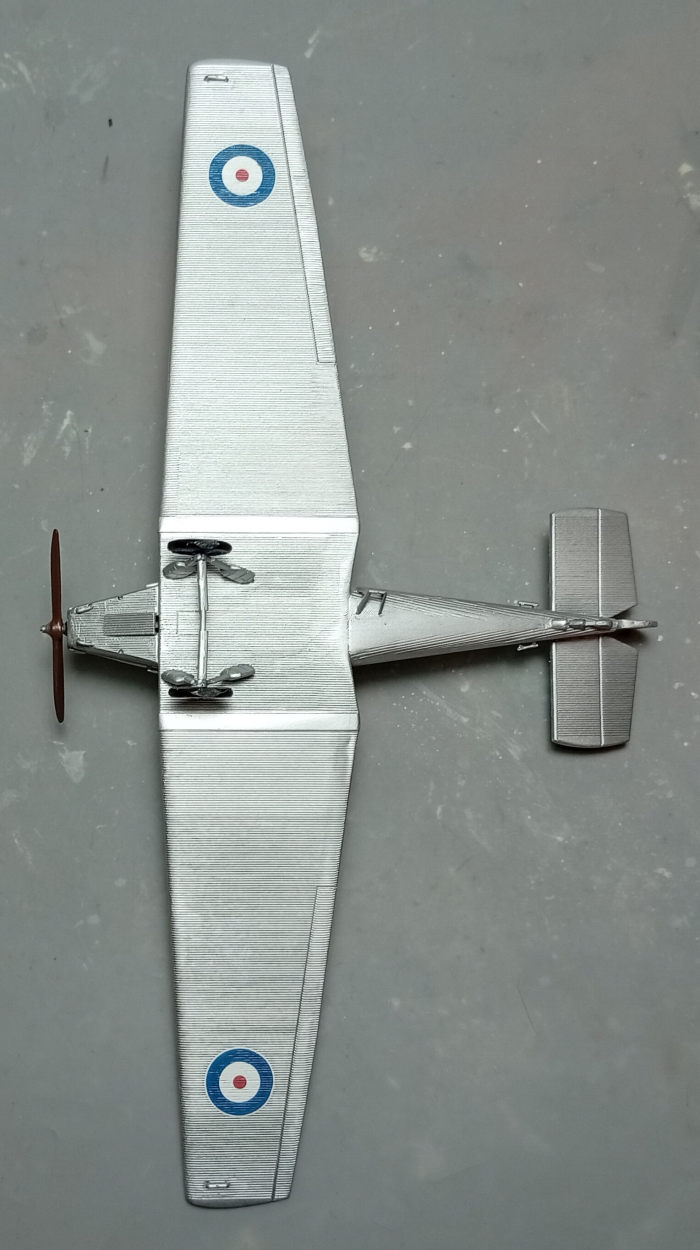
my what-if machine, I decided to finish the Junkers in an
overall aluminum color, for which I used my good old, trusty
Humbrol 11. The paint was sprayed over the entire aircraft and
produced a very nice, clean metallic finish that suited the
character of the F.13 particularly well. The cockpit openings'
trimmings were painted black.
For
my what-if machine, I decided to finish the Junkers in an
overall aluminum color, for which I used my good old, trusty
Humbrol 11. The paint was sprayed over the entire aircraft and
produced a very nice, clean metallic finish that suited the
character of the F.13 particularly well. The cockpit openings'
trimmings were painted black.
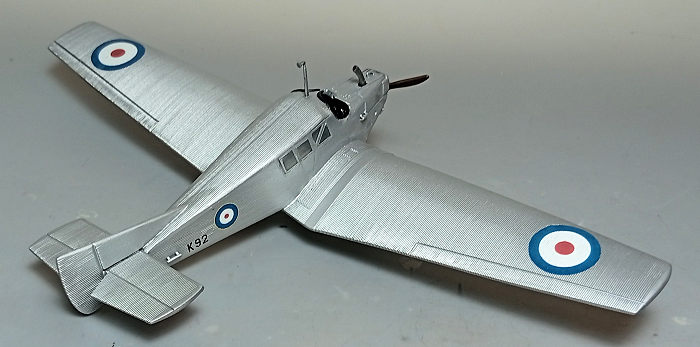
Once the paint had dried thoroughly, I proceeded with the decals. Since my model was to represent the fictional K92 – Silver Eagle from the accompanying story, I used some leftover British decals, which came from an Azur/Special Hobby 1/72 Fairey Battle release and, fortunately, were of very good quality.
Applying decals over the Junkers' characteristic corrugated surfaces was not entirely straightforward, but with patience and several applications of setting solution, I managed to get them to conform reasonably well to the underlying detail. The result was quite convincing and gave the model the appearance I had envisaged for my imaginary K92.
Finally, a coat of Future was applied to seal the decals and bring the painting and markings together.
| REFERENCES |
The final stages of construction were quite straightforward. The wheels were attached to the main landing gear, followed by the tail skid. I decided to add a little color to the model by painting the wheel rims in French blue.
The exhaust was given a little extra attention. Its upper end was drilled out to represent a hollow opening and make it look somewhat more realistic. It was then painted with Testors Burnt Metal and attached in its proper position.
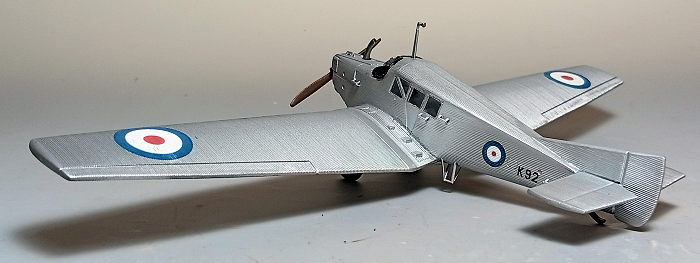 The
propeller was painted in a suitable dark brown to represent
wood, with a few lighter beige streaks added to suggest the
natural grain of the wooden blades. The hub was painted steel,
and the completed propeller was finally installed on the engine
front.
The
propeller was painted in a suitable dark brown to represent
wood, with a few lighter beige streaks added to suggest the
natural grain of the wooden blades. The hub was painted steel,
and the completed propeller was finally installed on the engine
front.
I deliberately decided against applying any significant weathering to the aircraft. I was not convinced that heavy weathering would work particularly well over the Junkers' characteristic corrugated surfaces, and I felt that too much treatment could easily detract from the clean appearance of the model. Instead, I simply added a little dirt to the tires and left the rest of the aircraft largely untouched.
Finally, a coat of matt varnish was sprayed over the entire model. This toned down the rather bright silver finish of the Humbrol 11 and gave the aircraft a more subdued, slightly dull aluminum appearance, which I felt suited the old Junkers much better.
With that, the little Silver Eagle was finished.
| CONCLUSIONS |
There are some kits that are memorable because of their size, complexity or extraordinary detail. And then there are kits that are memorable simply because they are charming. Revell's Junkers F.13 belongs firmly in the latter category.
This is a straightforward and enjoyable representation of one of the most important aircraft of the pioneering years of aviation, and Revell deserves credit for tackling such an unusual and historically significant subject in 1/72 scale. The distinctive corrugated surfaces, compact proportions and unmistakable character of the F.13 are captured very nicely, while the generally good fit makes for a pleasant and rewarding build.
For me, though, this particular Junkers is special for another reason. The kit was passed on to me by the widow of a deceased member of my local club, who was also a good friend. It had already been started and the decals were in poor condition, but I decided to take it over and finish what another modeler had begun. Somehow, that gave the little F.13 a history of its own before it even reached my workbench.
I then gave it another history—this time an entirely imaginary one. My K92 – Silver Eagle, with its aluminum finish and borrowed British markings, became the aircraft at the heart of our mysterious Aegean adventure. And perhaps that is one of the great pleasures of scale modeling: a small piece of plastic can become a link between history, imagination and memories.
The real F.13 opened a new chapter in aviation history. This particular one opened a much smaller chapter in mine, carrying with it the memory of the modeler who started it, the person who passed it on, and the story we eventually gave it.
Perhaps that is what makes our hobby so special.
We don't simply build aircraft. Sometimes, we inherit them, finish them, give them a story, and send them on another journey.
The Silver Eagle may have vanished somewhere over the Aegean, but this one finally made it safely home.
Highly recommended to anyone who enjoys classic aircraft, unusual subjects and, above all, a little imagination at the workbench.
Happy Modeling!
22 September 2026
Copyright ModelingMadness.com. All rights
reserved. No reproduction in part or in whole without express permission from
the editor.
Review kit courtesy of my wallet If you would like your product reviewed fairly and fairly quickly, please contact the editor
or see other details in the
Note to
Contributors. Back to the Main Page
Back to the Review
Index Page
Back to the Previews Index Page