| KIT #: | 14503 |
| PRICE: | $25.00 |
| DECALS: | Several options |
| REVIEWER: | H. Davis Gandees |
| NOTES: |
| HISTORY |
 Although before my time,
these luxurious Pan Am flying boats expanded world travel by air from July
1939 until April 1946. After WWII several other airlines purchased the
Clippers and flew them until 1948. With new modern landplanes like the
Lockheed Constellation, the flying boats were not able to compete.
Although before my time,
these luxurious Pan Am flying boats expanded world travel by air from July
1939 until April 1946. After WWII several other airlines purchased the
Clippers and flew them until 1948. With new modern landplanes like the
Lockheed Constellation, the flying boats were not able to compete.
My mom worked in Navy communications during WWII at NAS Dinner Key where Pan Am’s Miami Clipper base was located. She told me she watched the last Pan Am Martin Clipper take off in 1945 and the base closed at the end of the war. Pan Am moved its operation to Miami International Airport using land-based DC-3, DC-4 and Constellation aircraft.
Pan Am ordered the huge Boeing Model 314 in 1936. The Dixie Clipper, first of these gigantic flying boats, was introduced into service on May 20, 1939. This was Pan American's first scheduled air mail service between the United States and Europe. Passenger service began a month later. When the United States entered WWII, the Army's Transport Command took over four Boeing 314 Clippers for use as cargo and personnel transports. Although now in Navy markings, the planes were still flown by Pan American crews.
On January 11, 1943, the Dixie Clipper now Navy BuNo 48226 was used to fly President Franklin Roosevelt to a conference with British Prime Minister Winston Churchill in Casablanca, Morocco. Following the war, the Clippers were returned to civil operations, but by then, land-based transports were capable of long overwater flights and the giant boats were sold to smaller operators and eventually scrapped.
| THE KIT |
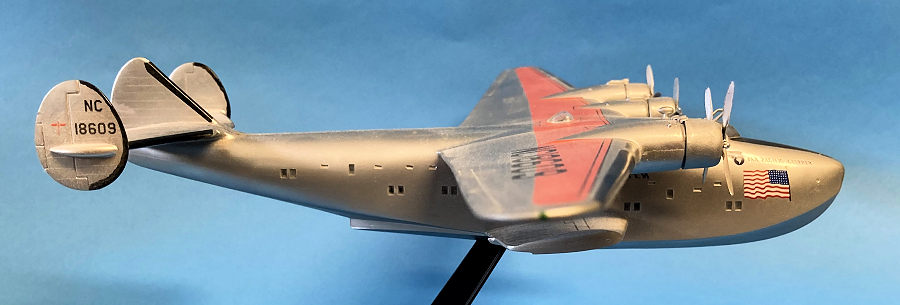
 This build is the Pacific
Clipper (originally California Clipper). At the beginning of WWII this
Clipper was caught up in the war in Auckland New Zealand, and to avoid the
conflict in the Pacific, Captain Robert Ford flew it westward 20,000 miles
making the first commercial circumnavigation by air.
This build is the Pacific
Clipper (originally California Clipper). At the beginning of WWII this
Clipper was caught up in the war in Auckland New Zealand, and to avoid the
conflict in the Pacific, Captain Robert Ford flew it westward 20,000 miles
making the first commercial circumnavigation by air.
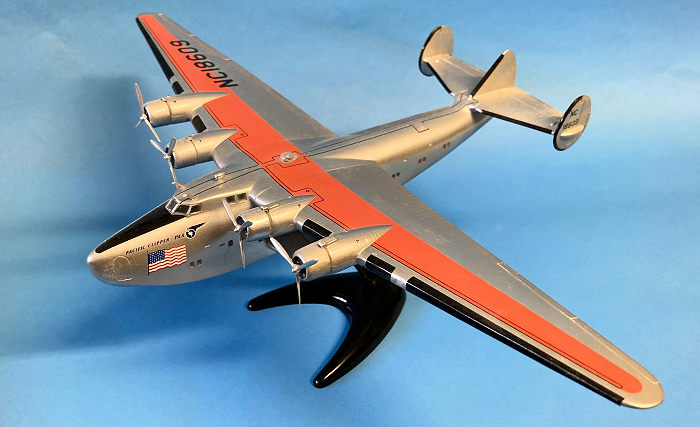
The is a typical well engineered and molded 1:144 Minicraft kit and there are 2 simple blow-up illustrations of how it is assembled.
There is also an excellent 4-view drawing. There are less than 50 parts including a nice stand to display the Clipper in flight.
| CONSTRUCTION |
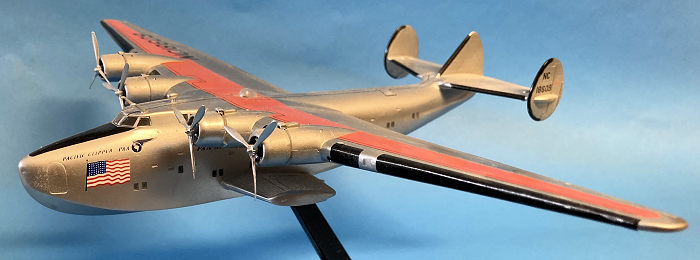 The fit and finish of the model
is excellent for the scale. The fuselage halves and wing to fuselage joins
required no putty. The beautifully molded engines and prop are realistic for
the scale. Great care should be taken removing the dainty props from the
sprue, I broke a blade that was easily repaired and re-aligned.
The fit and finish of the model
is excellent for the scale. The fuselage halves and wing to fuselage joins
required no putty. The beautifully molded engines and prop are realistic for
the scale. Great care should be taken removing the dainty props from the
sprue, I broke a blade that was easily repaired and re-aligned.
The windscreen was masked and installed with white glue and the navigators bubble after painting.
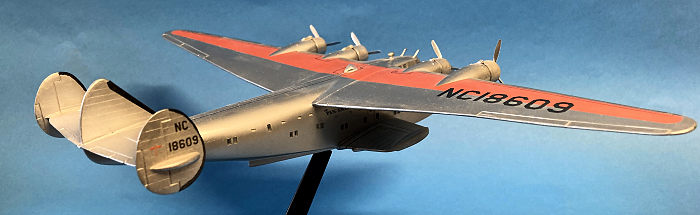
The model was painted with Tamiya TS-30 spray lacquer in 2 light coats and left to dry for 24 hours before decaling. The kit decals were perfect and included de-icer boots that were easier than masking and painting them. The large high visibility orange wing and black anti-glare panel decals looks like they were painted on. The kit display stand finished the Clipper in a nice flight attitude.
| CONCLUSIONS |
I enjoyed this model built in just 18 hours. I’d recommend it for a beginning modeler or anyone who like me has a love for prop airliners.
| REFERENCE |
The Pan Am Clipper- The History of Pan American’s Flying Boats 1931-1946.
7
July 2026
Copyright ModelingMadness.com. All rights reserved. No
reproduction in part or in whole without express permission from the editor.
If you would like your product reviewed fairly and fairly quickly, please
contact the editor or see other details in the
Note to
Contributors.