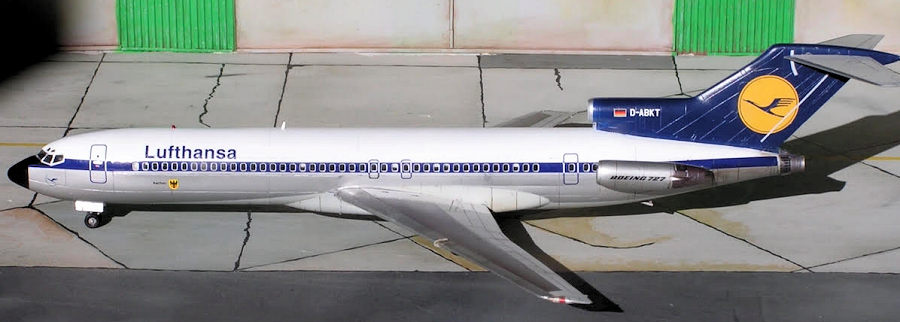
| KIT #: | 144090 |
| PRICE: | $35.95 |
| DECALS: | One livery |
| REVIEWER: | Bob Leonard |
| NOTES: | 26 Decals STS44423 727 Lufthansa/Condor |
| HISTORY |
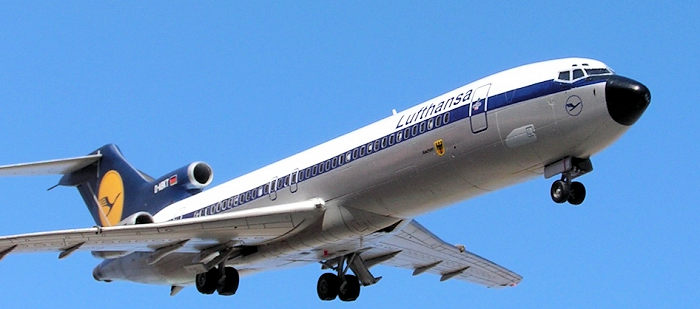 There was a
time in from the mid-1960s until the early 1990s when the 727 was flying
passengers across the planet. The 727 was the first commercial airplane to break
the 1,000-sales mark, but it started out Dec. 5, 1960, with only 40 orders each
from launch customers United Airlines and Eastern Air Lines.
There was a
time in from the mid-1960s until the early 1990s when the 727 was flying
passengers across the planet. The 727 was the first commercial airplane to break
the 1,000-sales mark, but it started out Dec. 5, 1960, with only 40 orders each
from launch customers United Airlines and Eastern Air Lines.
The trijet was designed to service smaller airports with 5,800 – 8,300 feet runways. The 727 had a distinctive appearance, with its super-swept T-shaped tail and three rear-mounted engines. The first 727 rolled out Nov. 27, 1962, but by the time of its first flight, on Feb.9, 1963, orders were still below the estimated break-even point of 200. To spur sales, Boeing sent a 727 on a 76,000-mile tour of 26 countries and it entered service with Eastern on Feb. 1, 1964.
Boeing planned to build 250 of the jets; however, they proved so popular (especially after the larger 727-200 model, which carried up to 189 passengers, was introduced in 1967) that a total of 1,832 were produced at the Renton, WA, plant.
In September 1984, after a 22 year production run, the last of 1,832 727s was delivered. The 737 did not overtake the 727 in terms of deliveries until 1991, 25 years after the first of the twinjet had been delivered and seven years after production of the 727 had ended.
| THE KIT |
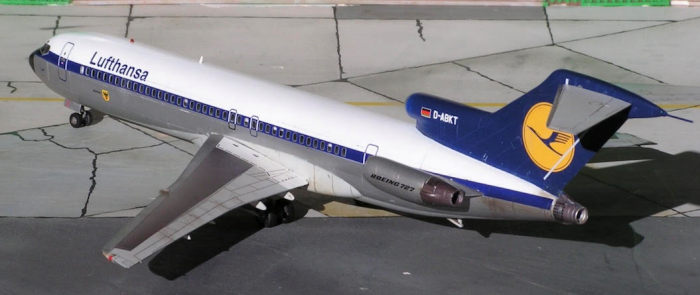 Airfix
issued the first injection molded 1/144 727-200 in 1983, a year before Boeing
ceased production of the full size product. It was a re-work of the Airfix
727-100 first issued in 1966. Despite molding a completely new longer fuselage,
it retained the inaccurate tailfin shape of the original -100 kit. Next up was
the Minicraft 727-200 released in 2004. Despite being 21 years newer, some
issues still remained. The wings were impossibly thick and the engines were
oversized. I built this kit, warts and all, and was satisfied until the CRM kit
was released in late 2024 with JAT decals. The CRM 727-200 is a short run kit
sold out of Germany, but I think it was tooled in Ukraine. At least, it has the
hallmarks of kits released by X-Scale, for example the seam line on the bottom
of the wing half runs across the control surfaces to make razor thin trailing
edges and avoid sink marks. My X-Scale DC-8, 707 and Electra have this same
characteristic. This is a short run kit that doesn’t fit like a Tamiya kit, but
has tremendous features: quality plastic, photo-etched parts, S-duct for the
tail, paint masks for the clear flight deck and cabin windows, alternate engine
fan blades, optional rear airstair, HF antenna or tail strobe light and the most
complete instructions I have ever seen in an airliner kit, jammed packed with
tips and hints.
Airfix
issued the first injection molded 1/144 727-200 in 1983, a year before Boeing
ceased production of the full size product. It was a re-work of the Airfix
727-100 first issued in 1966. Despite molding a completely new longer fuselage,
it retained the inaccurate tailfin shape of the original -100 kit. Next up was
the Minicraft 727-200 released in 2004. Despite being 21 years newer, some
issues still remained. The wings were impossibly thick and the engines were
oversized. I built this kit, warts and all, and was satisfied until the CRM kit
was released in late 2024 with JAT decals. The CRM 727-200 is a short run kit
sold out of Germany, but I think it was tooled in Ukraine. At least, it has the
hallmarks of kits released by X-Scale, for example the seam line on the bottom
of the wing half runs across the control surfaces to make razor thin trailing
edges and avoid sink marks. My X-Scale DC-8, 707 and Electra have this same
characteristic. This is a short run kit that doesn’t fit like a Tamiya kit, but
has tremendous features: quality plastic, photo-etched parts, S-duct for the
tail, paint masks for the clear flight deck and cabin windows, alternate engine
fan blades, optional rear airstair, HF antenna or tail strobe light and the most
complete instructions I have ever seen in an airliner kit, jammed packed with
tips and hints.
| CONSTRUCTION |
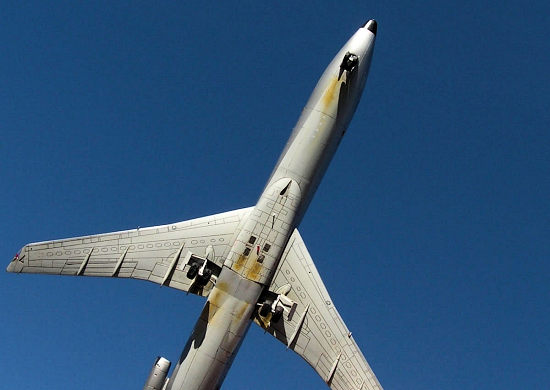 Two cardinal
rules when building this kit: follow the instructions and test fit five times
before applying any adhesive. I first wanted to get two chores out of the way:
those troublesome seam lines on the bottom of the wings and the installation of
the clear cabin windows. Before applying thick black cyano-acrylate glue to the
seam lines, I first deepened all the affected engraved control surfaces with my
scriber. I knew sanding to obliterate the seam lines would render the engraved
control surfaces hard to see, so deepening those lines beforehand was essential.
For the clear cabin windows, I drilled out the recessed areas and razor-sawed
the areas the instructions indicate to remove. I left, to the best of my
ability, the recommended .5mm frame in the recess for the clear part to sit in.
I could have been more careful in testing fitting these pieces, as I was left
with some careful filling around the clear window strips. I added some thin
plastic strip to address a gap between the wing and the fuselage as pointed out
in the instructions. I did so and was rewarded with virtually no gap. The
anti-collision lights, top and bottom of the fuselage, are aftermarket red resin
from CRM.
Two cardinal
rules when building this kit: follow the instructions and test fit five times
before applying any adhesive. I first wanted to get two chores out of the way:
those troublesome seam lines on the bottom of the wings and the installation of
the clear cabin windows. Before applying thick black cyano-acrylate glue to the
seam lines, I first deepened all the affected engraved control surfaces with my
scriber. I knew sanding to obliterate the seam lines would render the engraved
control surfaces hard to see, so deepening those lines beforehand was essential.
For the clear cabin windows, I drilled out the recessed areas and razor-sawed
the areas the instructions indicate to remove. I left, to the best of my
ability, the recommended .5mm frame in the recess for the clear part to sit in.
I could have been more careful in testing fitting these pieces, as I was left
with some careful filling around the clear window strips. I added some thin
plastic strip to address a gap between the wing and the fuselage as pointed out
in the instructions. I did so and was rewarded with virtually no gap. The
anti-collision lights, top and bottom of the fuselage, are aftermarket red resin
from CRM.
| COLORS & MARKINGS |
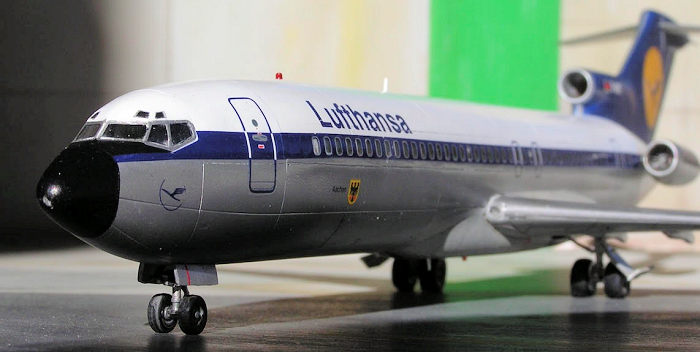 No
offense to JAT airlines, but I used 26Decals Lufthansa 727-200 specifically
designed to fit the CRM kit, Ever since I was stationed in Germany from 1983
to 1987, I was impressed with this elegant scheme on their 727s when I
arrived in Frankfurt. The decals were exceptional. The cheatline fit the CRM
cabin windows with expert precision. The sheet also includes Condor airline
markings. The Lufthansa blue is Revell 350, white is Tamiya Liquid Surfacer
White, Tamiya black for the nose, natural metal is Tamiya LP-70 Gloss
Aluminum and coroguard in Tamiya LP-20.
No
offense to JAT airlines, but I used 26Decals Lufthansa 727-200 specifically
designed to fit the CRM kit, Ever since I was stationed in Germany from 1983
to 1987, I was impressed with this elegant scheme on their 727s when I
arrived in Frankfurt. The decals were exceptional. The cheatline fit the CRM
cabin windows with expert precision. The sheet also includes Condor airline
markings. The Lufthansa blue is Revell 350, white is Tamiya Liquid Surfacer
White, Tamiya black for the nose, natural metal is Tamiya LP-70 Gloss
Aluminum and coroguard in Tamiya LP-20.
| CONCLUSIONS |
If you want an injection molded 1/144 727-200 this is the way currently and I recommend it without reservation. Yes, it is a short run kit, and you will put in some work, but your reward will be a great 1/144 727-200. I already bought two more, before the ridiculous tariffs. Both will be Braniff International markings by 26Decals, one in the Alexander Girard scheme, the other in the Flying Colors scheme. CRM has announced a USAF 1/144 727-100 for January, 2026 with revisions to make construction easier. Rest assured I will grab a few.
| REFERENCES |
I found airliners.net a good source of photos for Lufthansa 727-230s.
15 January 2026 Copyright
ModelingMadness.com. All rights reserved. No reproduction in part or in whole
without express permission. If you would like your product reviewed fairly and fairly quickly, please
contact
the editor or see other details in the
Note to
Contributors.