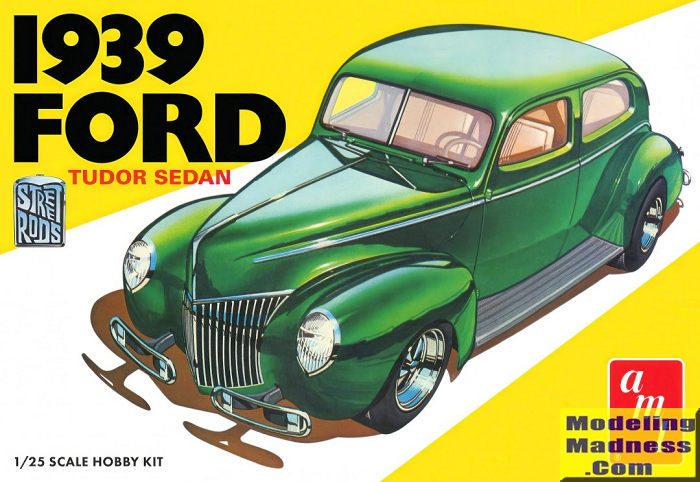
AMT 1/25 1939 Ford Tudor Sedan
| KIT #: | A1434 |
| PRICE: | $30.00 |
| DECALS: | One option |
| REVIEWER: | Joe Essid |
| NOTES: | Venerable mold. Flash warning. |
| HISTORY |
In 1937 Ford redesigned its line of cars to look more aerodynamic than their predecessors, while retainin the popular and, for its era, powerful “Flathead” V-8 much beloved by hot-rodders after World War II. That Flathead ruled the drag strip until the rise of small-block V-8 motors with overhead valves. Whatever engine under the hood, the Ford’s looks became iconic, with the 1939-40 body style being as recognizable to American car buffs (and kids building models) as a 57 Chevy or 68 Charger.
1941 Fords continued that sleek design trend and, with some changes to the front end, so did the 1942s. In early 1942, however, civilian production stopped “for the duration.” Robert Tate remarks on how quickly the factories pivoted back, noting “on June 28, 1945, the last B-24 bomber built by Ford rolled off the Willow Run assembly line. July 3, 1945 . . . Henry Ford II drove the first post-war civilian Ford model off the assembly line.” The recipient? Harry Truman. The 1946 car that “The Deuce” delivered to the White House looked the same as the 42 model, as did the 47s and 48s, which meant that a lot of automobiles on the road, well into the 1960s, had that familiar “40 Ford” look.
In Prewar Ford parlance, a “Tudor” was not an English monarch but a two-door car. Want four doors? Ask the salesman to show you a “Fordor.” We often think today of anything with two doors and a hardtop today as a “coupe.” Some auto sites will note that modern coupes have a sleeker roofline than a sedan.
Easy, right? Not by a mile. Even in the 1960s, some coupes had an adjective attached: a 1967 Pontiac GTO I nearly bought a decade ago (I wisely said no after a test drive, having decided it was a beast and would kill me) was called a “Post Coupe,” since it had a B pillar behind the front two doors, whereas a “hardtop” had none. Pontiac made them both.
Without going all the way back to horse-drawn carriages, we can note that those vehicles gave rise to our modern names. By the 1950s, a coupe meant two rows of seats and two doors. A sedan had similar seating but offered the convenience of four doors.
When the Fordor and Tudor were new, however, Ford still sold coupes with one bench seat, like my late father-in-law’s 1941 “Salesman Coupe.” That car’s bigger siblings, like the car depicted by AMT, share a spacious back seat and similar roof. That meant a big trunk (great for hauling Moonshine; more on that in a moment). As compared to the Ford Victoria of the 1930s, however, the 1939 Tudor/Fordor had an aerodynamic roof that fit into the era of Streamline Moderne design nicely.
As for modelers, we have long had these Fords around to build because of their ubiquity on the street, track, and drag strip.
| THE KIT |
One of the first kits I built as a child was this model. I wanted one because I had seen a few old Fords on the street and my eye always was drawn to them as compared to lower, wider modern cars. For a guy who writes about cars professionally, I don’t much care for building them now but this one is an exception.
My original AMT is long, long gone, but I found an example for a decent price at eBay. I’d plans to turn it into a Moonshine runner. That diorama, called “Blunder Road,” is under way as I write this preview. Our IPMS chapter has a group build for automobiles, not my usual subject-matter but hey, I had that Ford in the stash…
AMT has released this kit continuously in several boxings, since a new-tool kit appeared on Planet Earth in 1960. That was also the year I hit the scene. I built that kit seven or eight years later. It was called a “3-in-1 Trophy Series” then, a “Street Rods” series in the 2024 release I have. You get a few sprues of parts in white plastic, plus one in chrome and another in clear. The Ford Flathead features decent detail as compared to the real thing. A detailer can add plug wires, fuel lines, battery cables, and more under the roomy hood.
The hood lacks realistic hinges but can open. The trunk is sealed over a void behind the back seat.
The builder can make a ’39 or ’40 car, using slightly different hoods, grilles, and headlight buckets. The rest is simple: Stock? Street rod? Gasser? Though this boxing does not include instructions, I found Gasser parts (fuel tank and solid grille) inside from the 1939 issue. You can choose a Flathead or an Olds V-8 with triple carburetors. A few extras are included: a hood scoop, hot-rod or stock bumpers, wide tires and mag wheels, and some obligatory fender-flames.
This kit was the stuff of little-boy dreams. We might even follow some of the instructions. Be mindful that some steps are not included today, such as placement of the trunk’s handle and rear holder for a license plate. I looked at photos of stock examples online to get that right.
Though I too come from the same year as this kit, I don’t (yet) have flash growing from my seams. At this point, the AMT does. I found lots of it on small parts, including the chrome. As I planned to dull down the chrome anyhow for a Shine-runner’s car, that was no concern. I find chrome on models too shiny, anyhow.
My plans include opening the trunk for the diorama, adding a different carb setup and engine details, plus building out some realistic Ford hood hinges. More on that when I write the review.
| CONCLUSIONS |
Still a blast. It’s a simple kit with decent details. Worth cleaning up the sprues for a nostalgic build that invites detailing. If you find an earlier example with less flash, all the better.
| REFERENCES |
Nagy, Christopher, “Coupe Vs. Sedan: Can You Trust the Doors?” https://collectorsautosupply.com/blog/-coupe-vs-sedan-can-you-trust-the-doors-a-comprehensive-guide-to-classic-and-modern-models-coupe-or-sedan/
Tate, Robert. “Remember Ford Motor Company’s Post-War Years” https://www.motorcities.org/story-of-the-week/2021/remember-ford-motor-company-s-post-war-years-1946-1955
Joe Essid
May 2026 Copyright ModelingMadness.com.
All rights reserved. No reproduction in part or in whole without express
permission from the editor. If you would like your product reviewed fairly and fairly quickly, please
contact the editor or see other details in the
Note to
Contributors. Back to the Main Page
Back to the Review
Index Page
Back to the Previews Index Page