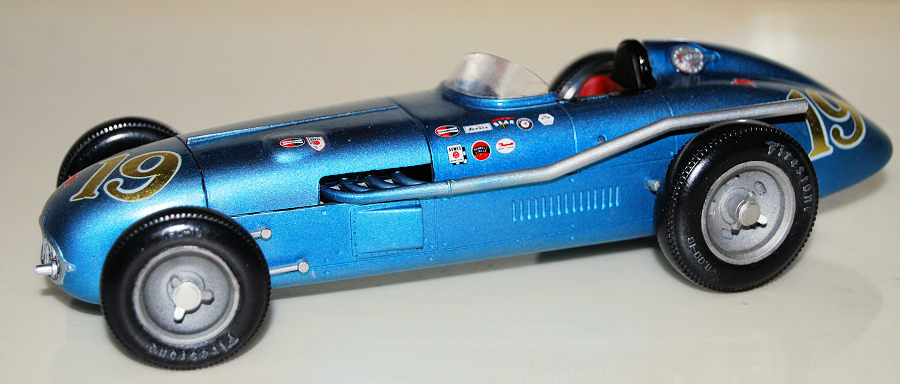
Monogram 1/24 Indy Roadster
| KIT #: | |
| PRICE: | $12.00 'used' |
| DECALS: | Two options |
| REVIEWER: | Christopher Campbell |
| NOTES: | 1957 tooling |
| HISTORY |
It was going to be another hot race, in more ways than one, Lee thought as the cars slowly circled the track, warming up behind the red and white Chevrolet convertible that had been chosen as the pace car. The track temperature had already climbed appreciably as the sun beat down relentlessly upon it. More heat was already blowing back upon him off of the long hood of the sleek, metallic blue roadster, and the race had not yet started.
Beside him and behind him he could feel the eyes of the other drivers upon him. Every man on the track was eager to have a go at him, and he knew it. They all wanted the spot that he held; only they wanted to be there five hundred miles later.
The grandstands were a sea of color and noise as the fans rose to their feet in anticipation of the start. Lee shifted the car decisively into high gear and picked up the speed as the convertible pacing them dipped low upon exiting the fourth turn. Ahead of him he saw the flag in the hand of the starter flutter into a blur of green as he waved it furiously.
Then he slammed his foot down hard and felt the machine surge ahead, the immense power of its massive four-cylinder Offenhauser engine unleashed, and the exhaust bellowing. The rattling vibration of the brick pavement beneath his tires faded, becoming smoother as the speed increased. The two cars that had been beside him lingered for a moment, then slipped behind him as he roared into the first turn alone and in perfect form.
 Good, Lee thought as he gradually, though steadily
pulled away, building an early lead. Yet he was neither pressing himself nor the
car. Just keep it steady and smooth like that, he thought. Maybe this really
would be the year, his year.
Good, Lee thought as he gradually, though steadily
pulled away, building an early lead. Yet he was neither pressing himself nor the
car. Just keep it steady and smooth like that, he thought. Maybe this really
would be the year, his year.
The initial exhilaration of the lead was still upon him as he screamed down the back straight two laps later. Looking at his rearview mirror, he then noticed another car pulling away from the pack and starting to close on him. It was a machine that every driver at the Speedway knew at a glance. Just as he had expected, it was the much darker blue machine driven by Bill Vukovich. No, Lee mused to himself. It was not dark blue; it was royal blue, for he was the King of the Speedway, and he was on the move.
Lee pushed his machine a little harder as it entered the next two turns but found Vukovich still bearing down upon him. He knew there would be little keeping him out of the lead if he really wanted it. He had the tenacity of a badger behind the wheel and skill to match anyone. That had been proven out by his consecutive victories in the two previous years and a near win the year before.
As they entered the third turn three laps later, his roadster was nearly even with him. Lee lifted as late as he dared and dipped the car as low as he ever had towards the green veldt of grass at the inner edge of the curve. He drew a deep breath as he felt the roadster’s tires threatening to lose their tenuous grip on the pavement, the Firestones crying ominously in protest to his abuse.
He did not exhale until he was back on the power and felt the machine stabilize. As he did, out of the corner of his left eye he saw the nose of Vukovich’s car pulling even with him. That was it, Lee thought. He was taking the lead from him, and that was all that there was to it.
Rather than entering into a foolhardy game of chicken that he knew he would not win, Lee eased back slightly and slipped in behind the other driver. They sped through the next turn and back onto the front straightaway to the delighted screams and cheers of the fans. Only this time it was Lee who pursued. It would be a brief chase, though, as he quickly realized that it was futile. Vukovich’s car was faster, plain and simple.
Even with the throttle wide open, he felt his heart begin to sink as he watched the gleaming, sleek machine pull slowly but steadily away from him. It was the same position that he had been in last year, relegated to looking at Vukovich’s tailpipe. Worse, that tailpipe was getting harder to see by the moment as he drew away.
The great difference was that this year he had held the lead, and had it wrested decisively from him before even a tenth of the race had been run. It only added to his frustration that his had been the fastest car all month. Now he was running second, and likely to stay there, perhaps even falling farther back, if his luck did not hold. He knew that he had the skill. Yet it seemed that fortune had abandoned him.
 The race ground on with Vukovich steadily extending
his lead on every lap. Lee could still see him at the end of the straightaways
each time he exited the turns, but he was powerless to close on him, let alone
challenge. He had every advantage a driver could want: the fastest car, a clear
track, a veteran’s experience, and the nerve of the devil himself. The man was
more than just a master of the Speedway. He had nerves of steel and more. He had
balls of solid tungsten.
The race ground on with Vukovich steadily extending
his lead on every lap. Lee could still see him at the end of the straightaways
each time he exited the turns, but he was powerless to close on him, let alone
challenge. He had every advantage a driver could want: the fastest car, a clear
track, a veteran’s experience, and the nerve of the devil himself. The man was
more than just a master of the Speedway. He had nerves of steel and more. He had
balls of solid tungsten.
Lee was comfortably in second, though, having drawn away from the rest of his pursuers by the time that they began to lap the slowest cars. The race was settling into the grind that he remembered from last year. Already his arms and hands were beginning to ache. Every other lap he would come down the straightaway, shaking and flexing one hand and then the other to relieve the numbness starting to set in. Sometimes he even pounded them against his thighs or the walls of the cockpit, hoping to bring back some of the circulation.
Heat from the engine filled the cockpit causing sweat to flow in rivulets from every pore on his body. His nose ached from the goggles pressing against them. His head itched annoyingly beneath his helmet. His mouth was dry and parched with thirst. Yet all he really wanted was to get back into the lead, or at least within striking distance.
From Trophies of Flesh and Ash by Christopher Campbell – 2025
Harry A. Miller entered racing by building aluminum pistons, possibly the first ever made from aluminum, and high-performance carburetors for racing engines. His shop was well known for repairing and improving racing machines of all sorts by 1913 when a Peugeot race car was brought in to have its four-cylinder engine completely rebuilt and improved.
Helming the project was Fred Offenhauser, the absolute authority in the Miller Manufacturing machine shop. What he created was the direct ancestor of the legendary engine that would bear his name and likewise had an integral cylinder head and block. Joined by genius draftsman and engineer Leo Goosen, by 1920 Miller would set the American racing world on fire with a new twin overhead cam inline eight racing engine of three litre’s displacement.
It would give the company their first Indy 500 win in 1922 at the hands of Jimmy Murphy. The next year six of the top ten at Indianapolis were Miller eights, including winner Tommy Milton’s machine. A supercharged 1.5 litre version of the engine would dominate Indianapolis and American racing from 1926 through 1928. Miller engines would win seven more times in the following decade.
However, in 1929 things began to change with new rules known as the “junk formula” designed to reduce manufacturing costs for racing machines in the wake of the all-encompassing great depression. Miller’s company was sold, folded, and then rose like a Pheonix from its own ashes. Harry Miller had initially gone his own way only to come back attempting to field very expensive and complex designs in an era where such things were increasingly impractical at best. Offenhauser, on the other hand, was pressuring him to build a four-cylinder racing engine with gear driven double overhead camshafts, four valves per cylinder, and an integral cylinder block and head aimed at dirt track racing. Miller disliked the idea, such venues being far less prestigious than Indianapolis or the high bank board tracks of the era. Fred Offenhauser prevailed, however, and the four-cylinder Miller soon debuted on short tracks. Within a year it would also be more popularly known as the Offenhauser, or simply the “Offy.”
 Almost as quickly Offenhauser 4-cylinders not only
showed up at Indianapolis; by 1935 they scored their first victory. Despite
having notched twelve Indy 500 victories, 1938 would be Miller’s swansong. The
Age of Offenhauser was at hand.
Almost as quickly Offenhauser 4-cylinders not only
showed up at Indianapolis; by 1935 they scored their first victory. Despite
having notched twelve Indy 500 victories, 1938 would be Miller’s swansong. The
Age of Offenhauser was at hand.
To date, no other engine manufacturer has scored so many victories as the mighty Offenhauser. There have been both normally aspirated and turbocharged configurations and a variety of displacements, taking a total of twenty-seven Indianapolis 500 wins between 1935 and 1976, with an unbroken streak of eighteen victories between 1947 and 1964.
During this period there were some years when it was the only engine in the field, with all thirty-three entrants powered by Offy’s. Yet into the midst of all of this dominance strolled a man named Frank Kurtis. He built Midget racecars, Sprint cars, and even his own sports car for a time before turning the design over to the famous or perhaps infamous Earl “Madman” Muntz who built and sold a variation of it as the Muntz Jet. Now he was going to try something else; something new.
Frank Kurtis had a better idea, what would come to be known as the Indianapolis or Speedway Roadster. It sat lower than any of the cars of the day and offered superior handling. It was sleek and exuded speed, making some of the more conventional machines look almost like tractors by comparison. Powered by the already legendary Offenhauser engine now reaching its peak of refinement in normally aspirated configuration, Kurtis had practically created the perfect storm: a tornado to sweep away all that had come before at Indianapolis.
In its debut at the 1952 Indy 500, only a steering box failure kept Bill Vukovich from the winner’s circle, sidelining him with only eight laps to go. He made up for it in the following two years, utterly dominating both races on his way to back to back victories. Additionally, he was leading the race in another such machine when a fatal crash claimed his life in 1955. Bob Sweikert would go on to win, also in a Kurtis roadster.
Kurtis roadsters would eventually score five Indianapolis wins, with more than one hundred chassis being built. Other builders took notice, producing similar designs, most notably A.J. Watson. The Offenhauser powered roadster would be the ultimate refinement of the front engine American race car and were arguably the most beautiful machines to run at the Speedway. A.J. Foyt would be the last driver to take one to the winner’s circle at Indy when he scored his second win at the Brickyard in 1964. By then, the rear-engine revolution was well underway. That is a different story for another time, though.
| THE KIT |
Released by Monogram in 1957, this kit has been through numerous releases. It was rarely out of production for long until its 1973 release after which it was mothballed for more than a decade. It was then released as part of a dual kit with a Super Modified in a boxing sponsored by Circle Track Magazine in 1988.
Per my Uncle, Richard Cobb, before this was a fully injection molded kit, there was also a mixed wood and plastic kit, as enjoyed some popularity during that transitional age when injection kits were still striving for dominance with balsa and vacuform. He specifically recalled playing with a car built from such a kit that belonged to a neighbor boy over seventy years ago.
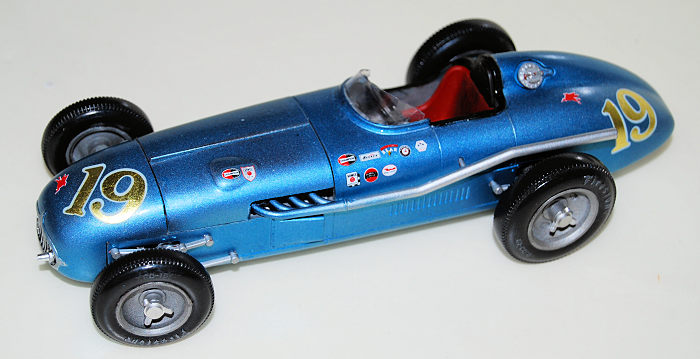 This dual kit release was the first time that I had
actually seen the kit myself. Another individual release followed in 1996,
though the next release that I personally ran across was the 2010 SSP release. I
told myself I should buy one when I saw it at my local hobby shop. Two days
later it was gone and I had missed out. Unfortunately, when I decided to build
one in 2025, they had become decidedly scarce once more.
This dual kit release was the first time that I had
actually seen the kit myself. Another individual release followed in 1996,
though the next release that I personally ran across was the 2010 SSP release. I
told myself I should buy one when I saw it at my local hobby shop. Two days
later it was gone and I had missed out. Unfortunately, when I decided to build
one in 2025, they had become decidedly scarce once more.
What you get inside the box is a decidedly well-done kit given that it is nearly seventy years old. It is basic, though the parts are well molded and mostly flash free. That is something of a surprise given the age of the kit.
The tires and wheels are two-piece injection molded affairs with separate knock off spinners. No rubber tires here. The Firestone lettering is nicely rendered as are the hubs and spinners. These look very much like what Indy roadsters were shod on in that era.
The engine bay can be opened, and there is a nicely molded two-piece Offenhauser engine and gearbox. However, other than these components there is nothing else engine related. Someone with some scratchbuilding experience could work wonders inside the engine bay. There is certainly room for adding wires, hoses, a radiator and so on. This could make quite presentable. As it comes out of the box, it is unquestionably lacking however.
You also get the sleek body molded in two pieces along with the front-end cap. There is no doubting that the lovely lines of the Kurtis roadster were captured here. There is also a seat, functional steering wheel, and suspension components. A mechanic and toolbox along with a driver figure are provided. The driver is the most disappointing part of the kit, however, as the limbs are hollow and what you get is almost a two-dimensional representation. Lastly, the windscreen is a sheet of clear acetate for you to cut your own from. There is enough for more than one attempt, so you do not have to worry about getting it right the first time.
The decals that came with mine were from the 1988 release, though mine was bagged and did not have instructions. I resolved this by downloading and printing them from Scalemates.
| CONSTRUCTION & PAINTING |
I had just finished my novel, Trophies of Flesh and Ash, part of which takes place at the 1955 Indianapolis 500, though not quite as it happened in our timeline. The protagonist, Lee Albers drives a Kurtis roadster at Indianapolis, and I decided that I wanted to build the car from the book. First I had to find a kit,
I checked out vendor tables at two or three model shows, though had no luck. Some on e-Bay were much more than I wanted to pay, at the time being closer to $40 than $30. However, I found my bagged kit for twelve dollars plus shipping and went to it.
While not usually an auto builder, I could tell from my many years of experience as a modeler that I would be diverging from the exact order prescribed by the instructions in building this kit.
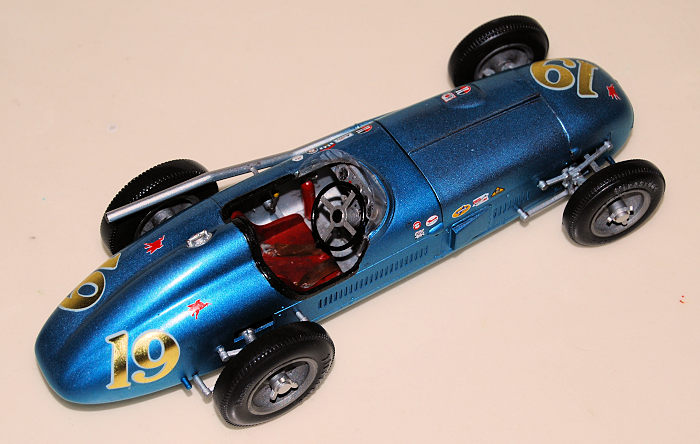 I started by painting all of the interior of the body
halves, the nose cap, and the hood in Testors’ Aluminum. The engine and
transmission assembly were then glued up with CA glue and also given a coat of
Aluminum, along with the suspension and steering components. While this was
drying, I turned my attention to the instrument panel and other parts of the
racer cockpit.
I started by painting all of the interior of the body
halves, the nose cap, and the hood in Testors’ Aluminum. The engine and
transmission assembly were then glued up with CA glue and also given a coat of
Aluminum, along with the suspension and steering components. While this was
drying, I turned my attention to the instrument panel and other parts of the
racer cockpit.
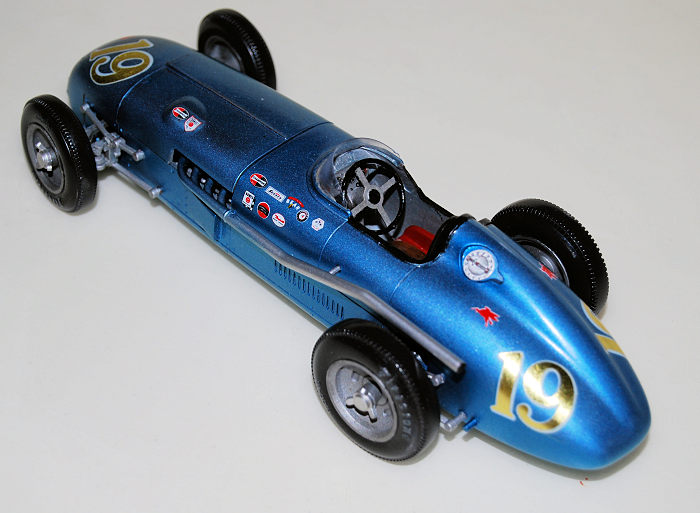
The instrument panel itself was painted in aluminum and the gauges in Tamiya Flat Black. These raised detail was dry-brushed with Testors’s Silver. However, additional detailing was painted by hand in red and black to represent switches, some yellow also being used to detail the tachometer.
It is worth noting that except for the tach, the instruments do not look very much like anything that I have ever seen in a race car. However, I did not feel like scratchbuilding an instrument panel, and I decided that imperfect as it was, it would do. Satisfied enough with it, I gave each gauge a drop of Kristal Klear.
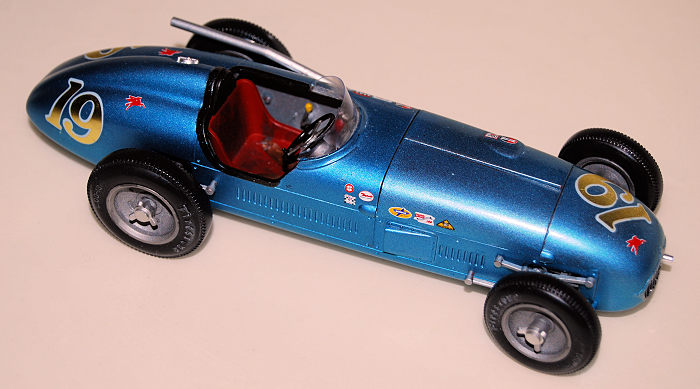
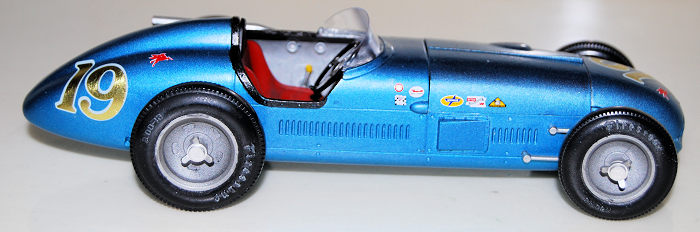
The seats of these roadsters were often covered in leather, frequently in black, brown, or red. I chose to paint the seat in Tamiya Flat Red. Then the steering wheel was painted in Testors’ Steel and Tamiya Flat Black, with the latter used for the “button,” actually a cushion at the center of the steering wheel to protect the driver.
Before any of the components were installed in the model, I assembled the body halves using CA glue and made certain that the seam was very smooth. Any filling was done with more CA glue and it was sanded with 400 grit paper followed by 0000 Steel Wool, then polishing with dryer sheets. The hood and front-end cap were gone over with dryer sheet as well to smooth out any scratches. Testors Aluminum was painted over the interior seam. Then I would begin concocting the exterior color.
I described the machine in the book as being both “deep blue” and “metallic blue.” This was mixed from Tamiya Deep Metallic Blue, Silver, Metallic Blue, and Blue (TS-53, TS-83, TS-19, and TS-15).
I had envisioned something like a steely blue shade in my mind’s eye. This went through several mixes until I was satisfied with the color. This witch’s brew of blue was now sprayed over all of the exterior surfaces and I was quite satisfied with the results.
While waiting for this to dry thoroughly, I turned my attention to tires and wheels. These glued up nicely with CA glue and required only a little more of the same applied with a toothpick and some light sanding to seal the seams along the centers.
The hubs and spinners were painted in Model Master Magnesium. Then the tires themselves were painted in Tamiya Rubber Black. The Firestone lettering was picked out by some careful dry brushing using Tamiya white. Pleased with the results, they were set aside while work continued on the car itself.
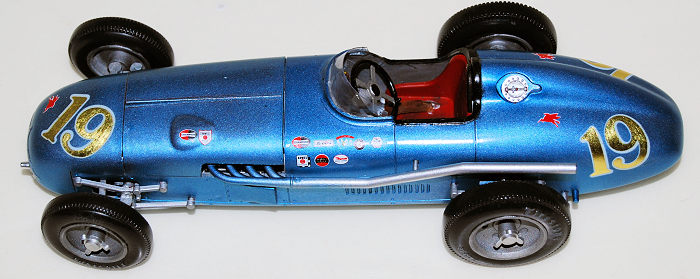 The frontend cap needed some more painting. The guide
for the starter shaft was partially drilled out to give it some depth instead of
simply looking like a metallic stump. The spaces between the grille teeth were
painted in Tamiya Flat Black. Then the grille itself was hand painted in Model
Master Chrome.
The frontend cap needed some more painting. The guide
for the starter shaft was partially drilled out to give it some depth instead of
simply looking like a metallic stump. The spaces between the grille teeth were
painted in Tamiya Flat Black. Then the grille itself was hand painted in Model
Master Chrome.
There is a rudimentary functional steering rack, though once painted and glued up, mine had a tendency to break loose and I eventually resorted to glueing it in a permanent, fixed position that left the wheels cocked enough at an angle to make it look less toylike.
The interior components were then installed, including a set of scratchbuilt pedals along with a similarly crafted gear shift. A fire extinguisher modified from one from an aircraft kit was added, though these were often not carried in those days. However, the cockpit had a somewhat empty look and I wanted to clutter it up a bit.
The headrest was painted black, then the seat itself was given some weathering by dry brushing with flat black. A heavy seatbelt was made from Tamiya tape painted in Testors’ Leather. (Shoulder harnesses would not be required until 1959 and were a rarity at this time.) This was then glued in place with CA glue followed by the steering wheel.
Suspension components were then glued in place using CA glue. Care must be taken here. These parts require some flexing during attachment and are clearly fragile. I had no problems with mine, though depending on the age or embrittlement of the plastic, they could easily get broken here. The wheels and spinners were then glued in place with CA glue as well. Now it was really looking like a proper Kurtis Kraft roadster.
| THE REST OF THE BUILD |
The model was given a coat of Model Master rattle can gloss (the last one in my stash). This gave it a very nice sheen, and it was set aside to dry for an hour or so while I began sourcing decals. Being principally an aircraft modeler, my resources were limited, though I had planned for this.
While writing the novel, I had envisioned Lee Alber’s roadster with a big number 16 on it, though did not specifically mention the number at any point that I could recall. This seemed simple enough as the kit decals included a set of gold number 19’s. In theory, I could simply cut them to create 16.
However, my experiences with metallic decals such as these has always been that they tend to be fragile. I elected to err on the side of caution. 19 was close enough, and perhaps what I had imagined after all. It proved to be the prudent move, as the decals showed hints of fragility merely as I was positioning them and giving them a dab of MicroSet.
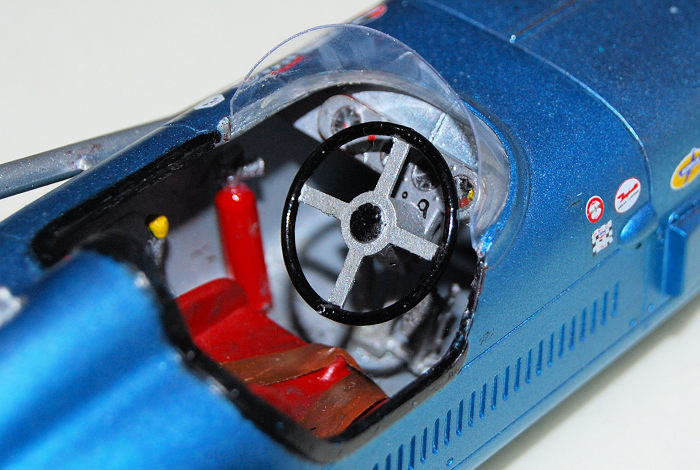 did not care for the printing or thickness of the
rest of the decals on the kit sheet. Instead, I had obtained Big Car Graphics/Etzels
Speed Classics decal sheet #25010 featuring markings for Roger Ward’s and Jim
Rathman’s 1959 & 1960 “500” winning cars. I would source the various sponsorship
decals from this sheet and found them to be excellent.
did not care for the printing or thickness of the
rest of the decals on the kit sheet. Instead, I had obtained Big Car Graphics/Etzels
Speed Classics decal sheet #25010 featuring markings for Roger Ward’s and Jim
Rathman’s 1959 & 1960 “500” winning cars. I would source the various sponsorship
decals from this sheet and found them to be excellent.
Once these had all cured for some time another coat of Model Master Gloss was applied. While this dried, I would turn my attention to the exhaust header and pipe and the windscreen.
The latter was sprayed with Model Master Chrome, black being applied to what would be the exhaust opening. Various metallic blues were shaded from the header back slightly to represent the heat bluing that inevitably occurs on chrome plated headers.
Unfortunately, it looks a little too close to the shade that the car is painted in and looks a bit like overspray. I may correct this, darkening and purpling it slightly in some spots to give it a more distinct and realistic look.
The fuel filler cap was painted in Model Master Chrome and given a couple of red accents on the release applied with the toothpick. This was then also glued in place with CA glue.
The windscreen was drawn out on the clear acetate in pencil and then cut out using a pair of surgical scissors. You really cannot go wrong on what shape or height that you choose for this within reason. These varied widely between race cars and unless you are modeling something specific the only real guide lines are that they were all curved and they often tapered to one side or the other. One thing to be aware of is that, at least in my experience, CA bonds this stuff instantly, a-la skin. I had applied it around the rim of the cockpit opening and fortunately got it right the first time around.
With that, it was done. I had now finished my first automobile model since building the Jo-Han Richard Petty Plymouth Superbird back during my senior year of high school in 1985. That made it forty years between cars. I anticipate more to come, though.
| CONCLUSIONS |
This kit is old and definitely dated. Still, the build went mostly well and was enjoyable. I might build another sometime in the future as an actual competitor’s machine. I would recommend it for modelers with some experience. This is mainly due to potentially fragile parts and the lack of a molded windscreen.
A nicer driver figure could do wonders for the kit, as also could a dedicated and resourceful scratchbuilder. It could also make a wonderful centerpiece for a pitstop diorama with a few crew figures added, in appropriate period attire, of course.
As noted, while a somewhat crude kit, for now, it, and an equally dated and exceptionally rare Aurora kit of similar vintage depicting a slightly earlier Kurtis are all that we have to work with if we wish to model these beautiful machines of the 1950’s in this scale. Perhaps, if we are fortunate, some model manufacturers will delve into these machines, as there were so many variations on a theme: many lovely, some strange, and all interesting. Until then, happy modeling, all.
| REFERENCES |
https://en.wikipedia.org/wiki/Kurtis_Kraft
https://en.wikipedia.org/wiki/Frank_Kurtis
https://en.wikipedia.org/wiki/1955_Indianapolis_500
https://www.amazon.com/dp/B0FF3B92NZ
Trophies of Flesh and Ash by Christopher Campbell - Amazon/Kindell Direct Publishing; 2025
Offenhauser by Gordon Elliot White - Motorbooks International; 1996
The Great Racing Cars and Drivers by Charles Fox- Grossett & Dunlap, Inc.; 1972
Christopher
Campbell 25 May 2026 Copyright ModelingMadness.com. All rights reserved. No
reproduction in part or in whole without express permssion from the editor.
If you would like your product reviewed fairly and fairly quickly, please
contact
the editor or see other details in the
Note to
Contributors.