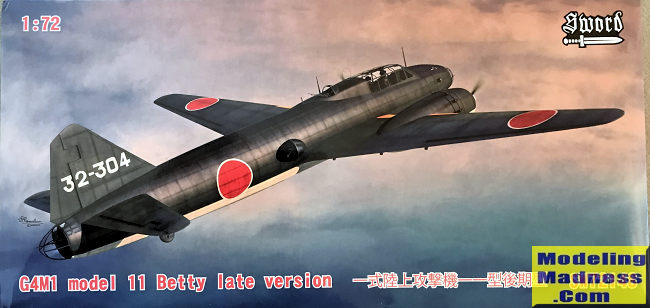
| KIT #: | SW72148 |
| PRICE: | $40.00 or so |
| DECALS: | Two options |
| REVIEWER: | Tom Hall |
| NOTES: | It is not the 1969 Hasegawa kit |
| HISTORY |
The Isshiki Rikujō Kōgeki Ki (Type 1 Land-Based Attack Plane) was built by Mitsubishi from 1941-1945 in a number of variants. This kit depicts a late-production Model 11 (One-One).
When the first G4M1s were built, no Japanese aircraft had anything like the Mareng self-sealing fuel cell, and that became a problem for the Model 11 in combat. To provide some self-sealing for the wing fuel tanks, Mitsubishi fitted sheets of rubber 30 mm thick to the exterior of the wing undersides forward of the main spar. That modification began with airframe 663 and includes all of the late-production Model 11s that this kit depicts. However, Sword failed to put those rubber sheets on the wings!
Around September 1943, Mitsubishi began installing multiple exhaust stacks around each engine nacelle. That provided a small amount of jet propulsion and reduced exhaust flame during night missions. This kit depicts that variant, most or all of which also had the improved rear gunner’s blister that was carried over onto Models 22 and 24.
The combat history of this version of Model 11 is even less well-known than for earlier variants. The first unit to receive this version was apparently No. 732 Kōkūtai, which trained at Toyohashi, Aichi and was initially deployed to Malaya to prepare for mining operations. However, Operation Kon interrupted those plans. No. 732 Kōkūtai was later deployed to Kendari, Digos, Sorong, and Halmahera. They wrapped up their combat missions with a two-plane night attack on Wakde on June 5, 1944. The unit was disbanded in July 1944. Their markings are depicted in this kit. Production of the Model 11 ended in January 1944. (This is more history of this variant and No. 732 Kōkūtai than Sword provided.)
| THE KIT |
This kit depicts the last version of the Model 11 and is the “world premiere” of it in a mass-produced kit. I would be surprised if many modelers were eager to have this variant, but I was.
Minuses
The box is oversized. The box art has the underside of the airplane in off-white, but the painting advice correctly suggests silver paint for the underside. In their paint recommendations, Sword has not realized that Gunze Sangyō changed its name to “GSI Creos” in 2001!
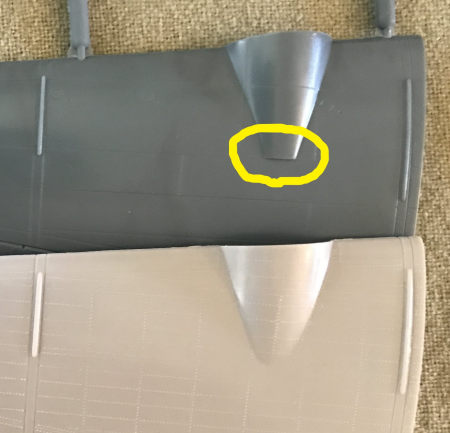 Sword
failed to depict the sheets of rubber that were under the wings of this variant,
but you can fix that with some sheet plastic. (More area was covered with rubber
for the Model 22.) Sword somehow noticed the slight drop-off and opening at the
trailing point of the engine nacelle, but has made it maybe a little too wide.
(See photo, which includes the lighter-colored Hasegawa part for comparison.
(Hasegawa failed to depict the drop-off at the aft end of the nacelle.) Sword
didn’t put any framing in the wheel wells or main gear doors.
Sword
failed to depict the sheets of rubber that were under the wings of this variant,
but you can fix that with some sheet plastic. (More area was covered with rubber
for the Model 22.) Sword somehow noticed the slight drop-off and opening at the
trailing point of the engine nacelle, but has made it maybe a little too wide.
(See photo, which includes the lighter-colored Hasegawa part for comparison.
(Hasegawa failed to depict the drop-off at the aft end of the nacelle.) Sword
didn’t put any framing in the wheel wells or main gear doors.
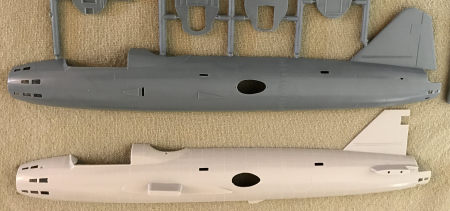
For the fuselage, Sword did not depict the corrugation of bulkheads and flooring. (Marabu Designs produce a set of brass, including corrugated bulkheads and flooring, but it’s nearly the cost of the model itself!) The diamond-shaped splices that attach the rear fuselage to the rest of the fuselage stick out too much.
The clear parts have no numbering on the sprues, so knowing which tiny windows go where may be a headache. For the tail blister, Sword expects the modeler to notice their tiny drawing of a hobby blade and cut their two pieces of early style tail blister into four pieces! Take the forward two and install them above the tail gunner’s seat. Then, somehow glean from step “23 ?” on the instructions that clear part 33, which is shaped like the open mouth of a fish, must be joined to the two clear parts that you installed over the tail gunner’s seat.
I wish this kit had provided some ammo drums for the tail gunner’s position. Neither are aircrew or brass parts provided.
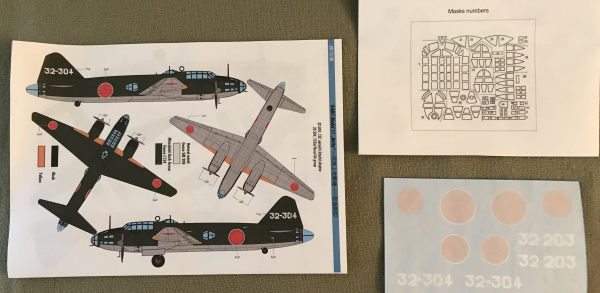
 The
decals are for only one unit, No. 732 Kōkūtai, probably the least interesting of
the several units that received this variant of Model 11. One tail marking has
the unlikely number “203”, the “2” suggesting a dive bomber!
The
decals are for only one unit, No. 732 Kōkūtai, probably the least interesting of
the several units that received this variant of Model 11. One tail marking has
the unlikely number “203”, the “2” suggesting a dive bomber!
Plusses
Except for the above complaint about the tiny windows, the instructions and masking map are pretty easy to understand.
 A
reasonable number of parts. First-rate injection molding.
Good scribing. A wing spar through the fuselage halves
helps us get the dihedral right. Nice Kasei 11 engines in resin. Nice cowlings.
Unlike the 1969 Hasegawa kit, the cowl flaps are closed.
A
reasonable number of parts. First-rate injection molding.
Good scribing. A wing spar through the fuselage halves
helps us get the dihedral right. Nice Kasei 11 engines in resin. Nice cowlings.
Unlike the 1969 Hasegawa kit, the cowl flaps are closed.
Good formers and longerons inside the fuselage. Good cockpit detail. Top-quality clear parts. Bless Sword, for they have supplied masks for all windows! They also provide a very nice Type 99-1 cannon for the tail gunner.
The decals for the hinomaru are a good red and have the white borders in register.
| CONCLUSIONS |
I give this kit a grade of “B” because it is above average but has some mistakes, omissions and the instructions aren’t foolproof. If you check the fit of the tiny windows before gluing, you’ll probably be fine.
| REFERENCE |
Japanese Wikipedia entry on Kaigun Dai 732 Kōkūtai, accessed Nov. 18, 2023.
Maru Mechanic No. 46, Ushioshobō (1984/5);
Mitsubishi Type 1 Rikko “Betty” Units of World War 2, Osamu Tagaya, Osprey Publishing, Ltd. (2001);
Sekai no Kessaku Ki (Famous Airplanes of the World) No. 59, Shigeru Nohara, Bunrindō (1996)
April 2025
Copyright ModelingMadness.com. All rights reserved. No reproduction in part or in whole without express permission from the editor.
If you would like your product reviewed fairly and fairly quickly, please contact the editor or see other details in the Note to Contributors.