Special Hobby 1/48 Fa-223 Drache
| KIT #: | 48201 |
| PRICE: | 25 Euros on sale |
| DECALS: | Three options |
| REVIEWER: | Spiros Pendedekas |
| NOTES: | "Captured" boxing |
| HISTORY |
The Focke-Achgelis Fa 223 Drache, or “Dragon,” is one of those aircraft that seems almost too unusual to have actually existed. Yet this enormous twin-rotor helicopter was very real, and during the Second World War it represented one of the most ambitious attempts to turn the helicopter from an experimental machine into a genuinely useful military aircraft.
Developed by the Focke-Achgelis company, founded by Heinrich Focke and Gerd Achgelis, the Fa 223 was conceived as a heavy transport and utility helicopter. Unlike the smaller helicopters that preceded it, the Drache was designed from the beginning to carry men and equipment and to perform practical military missions. Its two large rotors were mounted on outriggers on either side of the fuselage, giving the machine its highly distinctive appearance.
The first prototype flew in 1940, and the aircraft quickly demonstrated remarkable capabilities. The Drache could carry personnel inside its cabin or lift heavy external loads using its winch and cargo equipment. This made it particularly useful for rescue and recovery missions in mountainous terrain, where conventional aircraft simply could not operate. Among its tasks were the recovery of damaged aircraft and the transportation of engines and other heavy equipment.
The design was nevertheless affected by many of the problems that plagued ambitious German aircraft programs during the war. Production was slow, while bombing repeatedly disrupted the manufacturing facilities. Consequently, only a small number of Drachen were completed and brought into service.
Operational examples eventually served with Transportstaffel 40, the Luftwaffe's specialist helicopter unit, alongside the smaller Flettner Fl 282 Kolibri. The Drache was used for transport, liaison, rescue and recovery duties, often in circumstances where its ability to hover and land in confined areas gave it an enormous advantage.
But the most fascinating chapter of the Drache's story came after Germany's defeat.
As the war came to an end, several surviving examples fell into Allied hands. One of them, V14, became particularly famous. Rather than being immediately dismantled, the helicopter was prepared for evaluation and eventually flown to Britain. On September 6, 1945, German pilot Hans-Helmut Gerstenhauer, together with German technicians and Allied personnel, flew the captured Drache from Cherbourg across the English Channel.
It was an extraordinary flight. The German helicopter, designed and built during the war, was now flying under Allied supervision toward Britain, where it would be examined by the very people against whom Germany had been fighting only months earlier.
The flight also became historically significant as the first helicopter crossing of the English Channel.
The captured Drache was subsequently tested in Britain, where British engineers had the opportunity to examine its unusual twin-rotor configuration and its construction in detail. Unfortunately, its new career was short. During testing at RAF Beaulieu in October 1945, the helicopter suffered a mechanical failure and crashed, bringing the story of this particular machine to an end.
Other captured or incomplete Drachen had different fates. Some components were used after the war in Czechoslovakia, while French engineers also continued development of the basic concept, eventually producing the SE.3000, a post-war helicopter derived from the Fa 223.
The Drache therefore occupies a fascinating place in aviation history. It was a wartime German helicopter, but its story did not end with the collapse of Germany. Some examples survived to become Allied test machines, while its technology continued to influence European helicopter development.
This is precisely what makes the “Captured” boxing so interesting. It does not merely give us another color scheme for an unusual aircraft. It represents the final, extraordinary chapter of the Drache's wartime story—the moment when this strange German machine passed into Allied hands and continued flying.
| THE KIT |
 In
2006, Special Hobby decided to give us something that many modelers probably
never dreamed of seeing in injected form: a 1/48 scale model of the famous
Focke-Achgelis Fa 223 Drache. The choice of subject was certainly an unusual
one, but it was also a very welcome one, as the Drache is such a fascinating
and distinctive aircraft. The first release was followed in 2009 by a
version with different decals, including Czechoslovak markings, and then
again in 2019 by this “Captured” edition. Note that all three boxings also
include a German scheme, so whichever version you happen to find, you will
still have the opportunity to build a Luftwaffe machine.
My particular example was purchased around 2024 from one of my beloved Internet hobby shops at an almost killer price of just €25. At that price, I simply could not resist it!
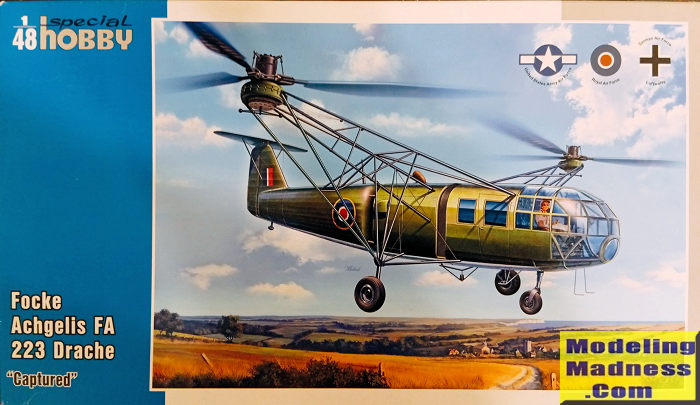
The kit comes in a medium-sized, top-opening box of excellent quality, as we have recently come to expect from Special Hobby. The attractive box art, designed by Michal Reiniš, depicts a captured Drachen in flight, apparently having completed its famous Channel crossing, with what appears to be the English mainland in the background. It is a very atmospheric illustration and immediately sets the mood for what is an equally unusual model.
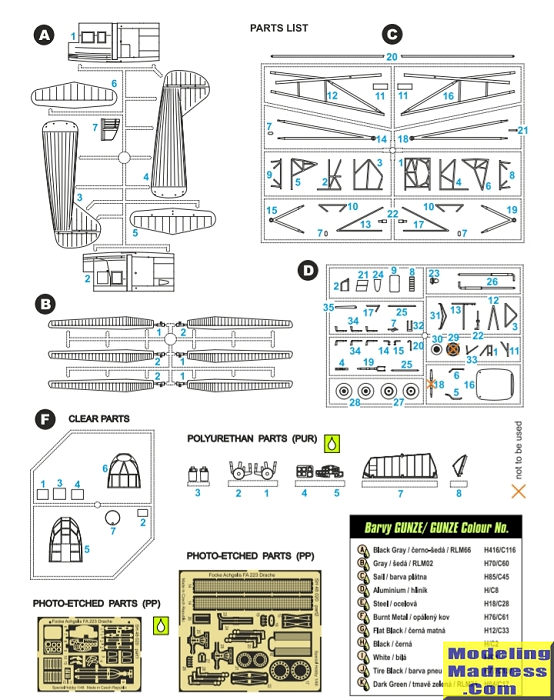
Opening the box reveals 82 medium-gray styrene parts, very neatly arranged on four sprues. One sprue contains the main structural components, fuselage parts and aerodynamic surfaces, another contains the rotor blades, while the remaining two are largely devoted to the numerous distinctive struts and framework members that make the Drache so recognizable, together with the rest of the components.
The molding is excellent. This certainly has the appearance of a modern CAD/CAM-designed kit, with clean and crisp parts, very nice surface detail and finely engraved panel lines. I could not spot any flash on the parts, while the overall quality of the molding is very impressive. Considering the age of the original release, this kit has aged extremely well.
There is also a small bag containing polyurethane parts, together with two photo-etched frets. They are produced by Eduard and one of them is already painted, containing items such as seat belts and other small details that will add considerably to the finished cockpit. The combination of styrene, polyurethane and photo-etched components gives the model a genuinely multimedia character.
The cockpit is particularly nicely represented. The distinctive tubular structure is faithfully reproduced, together with the seats, controls and other equipment that should be visible inside the real helicopter. A little dry-fitting will certainly be required here, but this is one area where the effort will be well rewarded, as so much of the interior will remain visible through the large transparent canopy. The instrument panel is also very nicely done and uses a combination of styrene, polyurethane and photo-etched parts. The various structural details throughout the interior are equally convincing, and Special Hobby has clearly understood that an aircraft with this much glazing needs a properly detailed interior. Even built straight from the box, I believe the interior can look fantastic.
Moving outside, the structural detail is equally impressive. The distinctive fabric-covered sections at the rear of the helicopter are nicely represented, while all the various structural elements and smaller details that give the Drache its unique appearance are included.
Then, of course, there are the struts. There are plenty of them!
The distinctive framework supporting the rotors is one of the defining features of the Fa 223, and Special Hobby has reproduced it in styrene. Thankfully, the parts are delicate enough to look convincing in scale without being so thin that they become completely unmanageable. They will require care during assembly and some patience to align correctly, but once assembled they should form a strong and convincing structure.
The wheels are also nicely represented, while the rotor blades are equally well done. The rotor hubs are supplied in polyurethane, meaning that a little extra work will be required from the modeler, but the resulting assemblies should be very convincing. The blades are attached to the polyurethane hubs through a series of small linkages, so this is another area where careful dry-fitting and patience will be essential.
A particularly nice touch is the inclusion of an optional polyurethane fin/rudder, intended for use with the different camouflage options. The captured examples had some external differences, and this provision demonstrates that Special Hobby has done its research rather than simply offering alternative markings on an otherwise identical machine.
The transparencies are very nicely done too. The distinctive canopy is supplied in two main pieces and is beautifully clear. The clear parts are rather thin, so considerable care should be taken when removing them from the sprue. There is certainly no reason to rush here, as an unnecessary stress fracture would be a shame after all the work put into the model.
The division of the canopy is particularly clever. The upper and lower sections are separated along the framing, meaning that there is no annoying seam running through a large transparent area. Once assembled, this should result in a very clean and convincing canopy.
The instructions are wonderfully produced, as we have come to expect from Special Hobby. The latest incarnation comes in the form of a 12-page, full-color booklet, containing a short history of the type, a sprue map, a color chart and a color profile, followed by the construction sequence. The actual assembly is divided into 22 steps, which are straightforward and concise. Naturally, the instructions deserve careful study because the Drache is a complex machine and there are plenty of structural components whose correct positioning will be important.
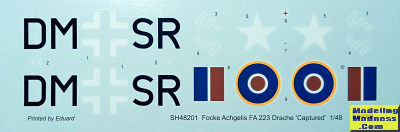 Three
marking options are provided: a captured British example, a captured
American example and an earlier Luftwaffe machine. Colors are given using
Gunze references as well as generic color descriptions.
The decals are beautifully printed by Eduard, with excellent registration, sharp printing and strong-looking colors. They certainly look the part on the sheet, and I would expect them to perform very well during application.
The construction sequence begins, quite logically, with the elaborate interior. The instructions have you assemble the cockpit framework, seats with seat belts and the various other interior components before trapping everything between the left and right fuselage halves. This is an area where I would strongly recommend taking your time, as virtually every effort made here will remain visible through the glazing.
The external windows are shown being installed at this stage, although I can see no particular reason why they could not be left until later if that better suits the individual modeler's preferred construction sequence. The very detailed instrument panel follows, together with the nose landing gear strut, while the canopy is assembled and attached after the smaller cockpit components have been installed.
The exhaust system and what appears to be an air intake are supplied in polyurethane and are fitted around the middle of the fuselage, followed by the exhaust and several smaller aerodynamic components. The horizontal stabilizer is then installed before construction moves on to the complicated framework supporting the rotors.
This is obviously one of the areas where considerable care will be needed. The various struts need to be properly aligned, and a good dry-fit before applying glue will certainly pay dividends. The landing gear follows, and then finally we arrive at the rotors themselves.
Again, patience is the key. The blades are attached to the polyurethane hubs using various small linkages, and Special Hobby provides a useful information view in the instructions to help the modeler position everything correctly.
Naturally, the experienced modeler will probably find several opportunities to alter the suggested construction sequence to suit his own building style. Personally, I would certainly consider leaving some of the more delicate external parts until later, both to make painting easier and to reduce the possibility of damaging them during handling.
One area that deserves particular attention is the joint between the forward and rear fuselage sections, which has been reported as benefiting from careful alignment and, if possible, some reinforcement.
In fact, the best advice I can give when approaching this kit is very simple: Take your time with the cockpit, take your time with the fuselage, take your time with the transparent parts, take your time with the structural framework and especially take your time with those numerous rotor-supporting struts.
This is certainly not a kit for the beginner. It is aimed squarely at the experienced modeler who enjoys studying the parts, dry-fitting assemblies and solving the occasional challenge rather than simply rushing through the construction sequence.
But that is also where much of the appeal lies. Special Hobby has packed a remarkable amount of detail into a subject that, only a few years ago, many of us probably would never have expected to see represented in a mainstream injected 1/48 scale kit.
| CONCLUSIONS |
There are some kits that you buy because you need another version of an aircraft already sitting on your shelf. Then there are those you buy because the subject is simply too unusual to leave behind. The Special Hobby 1/48 Focke-Achgelis Fa 223 Drache belongs firmly in the second category.
Let's be honest: how many of us ever expected to see an injected 1/48 Drache? This is one of those aircraft that seemed destined to remain in photographs, aviation books and perhaps the occasional resin kit. It is strange, complicated and wonderfully unconventional. Yet Special Hobby decided to put it into a proper 1/48 injection-molded kit—and in several different versions at that. For that alone, they deserve considerable credit.
The kit is certainly not an effortless weekend build. The cockpit requires attention, the clear parts need care, and the extensive framework supporting those enormous rotors demands patience and accurate alignment. But for the experienced modeler, these challenges are also part of the attraction.
Take your time, dry-fit carefully, study the instructions and don't be afraid to alter the construction sequence to suit your own methods. The more attention you give this model, the more it will give back to you.
The captured boxing makes the subject even more attractive. The story of these machines surviving the war, changing hands and continuing to fly under Allied supervision—and particularly the remarkable Channel-crossing flight of V14—gives the finished model a story of its own.
At around €40–45, the kit is not exactly cheap, but considering the subject, the multimedia contents and the engineering involved, I think the price is reasonable. I was fortunate enough to find mine for just €25, and at that price I simply could not resist it.
So, is this a kit for everybody? Certainly not. It is a model for the experienced modeler, someone prepared to spend time with the construction rather than rushing toward the finish line.
But for that modeler, there is a very nice reward waiting at the end. The finished Drache is large, unusual and immediately eye-catching. It has a presence that few conventional aircraft models can match, and it represents one of those fascinating moments in aviation history when the helicopter was beginning to demonstrate what it could really do. For me, that is ultimately what makes this kit so appealing.
Special Hobby took an aircraft that many of us probably never dreamed of seeing as an injected 1/48 model and made it a reality. And they did so with a kit that, despite demanding some patience, gives the experienced modeler the opportunity to build something genuinely different.
If you find one at a good price, I would certainly not hesitate. Just take your time, enjoy the process, and let the Dragon come to life.
Happy Modeling!
November 2026
Copyright ModelingMadness.com. All rights reserved. No reproduction in part or in whole without express permission.
If you would like your product reviewed fairly and fairly quickly, please contact the editor or see other details in the Note to Contributors.