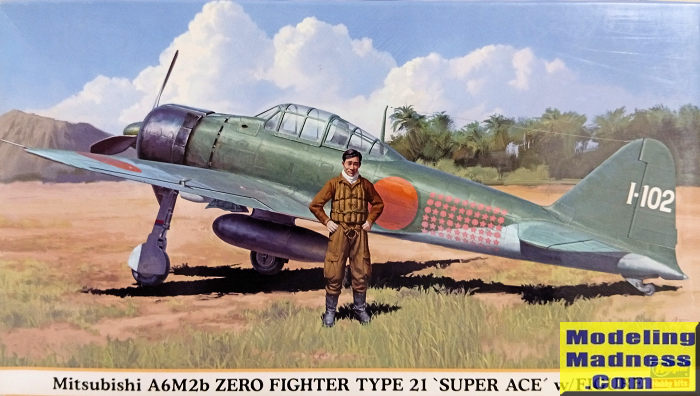
| KIT #: | 09904 |
| PRICE: | 20.00 Euros on sale |
| DECALS: | Three options |
| REVIEWER: | Spiros Pendedekas |
| NOTES: | Super Ace boxing with figure |
| HISTORY |
Few aircraft have achieved the legendary status of the Mitsubishi A6M Zero. Introduced into Imperial Japanese Navy service in 1940, the Zero was designed around an extraordinary combination of range, manoeuvrability and low weight. Its light structure and powerful Nakajima Sakae engine gave it a remarkable ability to turn and climb, while its exceptional range allowed Japanese carrier air groups to operate far beyond what many Allied pilots initially expected.
The A6M2 Type 21 represented one of the most important early versions of the Zero. Distinguished by its folding wingtips and enlarged wing, it offered excellent carrier performance and became the principal Japanese carrier fighter during the opening stages of the Pacific War. At the time of Pearl Harbor and the subsequent Japanese offensives across the Pacific and Southeast Asia, the Zero enjoyed a formidable reputation, particularly in the hands of experienced pilots.
Among those pilots was Warrant Officer Tetsuzo Iwamoto, one of the Imperial Japanese Navy's most celebrated fighter aces. Iwamoto was an experienced and aggressive combat pilot who flew the Zero through several of the Pacific War's most intense campaigns. He eventually became one of the most highly regarded Japanese fighter pilots of the conflict, although, as with many wartime claims, the exact number of his aerial victories remains subject to debate.
Iwamoto's career extended well beyond the early-war period, and he survived numerous campaigns in which many of his contemporaries were lost. His reputation as a skilled fighter pilot, together with the enduring legend of the Zero itself, makes his figure a particularly appropriate companion to this Hasegawa kit.
| THE KIT |
 Hasegawa
first issued this excellent Zero tooling in 1996, which means that it is now
thirty years old. Since then, the company has reissued it a gazillion times in
numerous versions and special boxings, sometimes with additional resin parts or
other extras. It is undoubtedly one of Hasegawa's most successful and enduring
1/48 series, and the fact that it continues to appear on the market after three
decades says quite a lot about the quality of the original tooling.
The specific boxing reviewed here is the A6M2b Type 21 ‘Super Ace’, paying tribute to Warrant Officer Tetsuzo Iwamoto and including a nicely produced resin figure of the famous pilot. I found this particular boxing in one of my now-beloved internet hobby shops at a price that was simply impossible to refuse.
The kit comes in Hasegawa's familiar medium-sized, top-opening box, produced to the company's usual excellent standards. The box art is particularly attractive, depicting Iwamoto standing beside his Zero and immediately giving the boxing a little more character than a standard aircraft-only release.
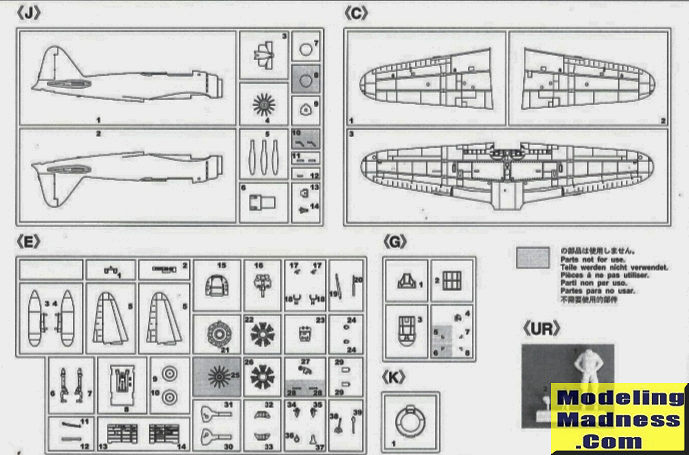
Opening the box reveals a familiar Hasegawa offering that has accompanied modellers for many years. The light-grey parts are very nicely arranged on three main sprues. One sprue contains the wings, another carries the fuselage halves and various smaller components, while the third contains the remaining parts.
Molding is first class and, remarkably, looks much as it did when the tooling first appeared thirty years ago. This is one of the great strengths of Hasegawa: the company has always taken excellent care of its molds. Panel lines are nicely recessed throughout, giving the model a clean appearance while providing a very good basis for painting and weathering.
The cockpit is reasonably well elaborated, although naturally it cannot compete with the extraordinarily detailed cockpits found in the latest generation of 1/48 kits. Considering both the age and the intended scope of the kit, however, it remains perfectly adequate. The basic equipment of the real aircraft is represented, while some nicely molded-on detail is present on the sidewalls. The raised instrument panel can receive a decal for additional realism, if desired.
The engine and landing gear are similarly well represented for the scale and age of the tooling. Again, they will not satisfy the super-detailer straight from the box, but they are perfectly acceptable for a straightforward build and provide a solid foundation for anyone wishing to add aftermarket detail.
One small point worth mentioning is the propeller. The blades are supplied separately from the hub and therefore have to be assembled. This might initially sound slightly inconvenient, but having built the kit before, I can say that it is not difficult at all and presents no real problem during construction.
The clear parts are very nicely molded and crystal clear, and should produce an excellent canopy once carefully prepared and attached.
The instructions come in Hasegawa's familiar pamphlet style and are nicely presented. They include a short history of the aircraft, a sprue map, a useful colour chart and the construction sequence. Construction is divided into eleven clear and concise steps, with colour callouts provided where required.
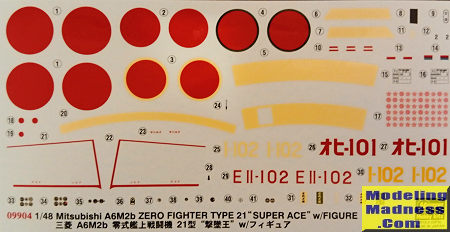 Three
marking options are included:
- 201 Naval Flying Group, I-102 – WO Tetsuzo Iwamoto, Rabaul, November 1943. IJN Green (Nakajima) and grey.
- Aircraft Carrier Zuikaku, EII-102 – NAP Tetsuzo Iwamoto, December 1941, during the attack on Pearl Harbor, Hawaii. IJN Ameiro.
- Oppama Kokutai, 101 – NAP 1/C Iwamoto Tetsuzo, February 1943. Grey and IJN Green (Nakajima).
Colours are indicated using Gunze paints, together with generic colour descriptions, making the schemes reasonably straightforward to follow.
The decals are very nicely printed, and, although being more than fifteen years old, they remain in perfect condition and should be perfectly usable. They provide a good selection of markings and should respond well to careful application.
The resin figure of Warrant Officer Tetsuzo Iwamoto is a particularly nice addition. It is sharply molded, nicely proportioned and captures the character of the subject well. For those who enjoy figures and dioramas, painting the pilot and placing him beside the finished Zero can transform the model from a simple aircraft display into a much more atmospheric little scene.
Construction begins with the cockpit, which is assembled and then trapped between the two fuselage halves. The front upper cowling, incorporating the gun armament, follows, while the engine is assembled and installed in position. The wings and tailplanes are then added.
Some work is required around the recessed panel-line areas at the ailerons and flaps, but this should not present any serious difficulty to the average modeller. The relevant components are fitted beneath the cowling, followed by the landing gear and the central fuel tank.
The propeller is assembled and attached next. As mentioned earlier, its separate blades might look slightly troublesome at first, but having built this kit before, I can assure you that they go together quite easily.
The canopy is finally attached, completing what is a very straightforward construction sequence. Indeed, based on my previous experience with the kit, I would have no hesitation in recommending it even to a beginner looking for a first 1/48 Zero.
| CONCLUSIONS |
This is yet another very nice version of Hasegawa's venerable 1/48 Zero. Thirty years after the tooling first appeared, it remains a very attractive kit and a remarkably convincing demonstration of just how good a well-designed model can remain when the original tooling has been properly looked after.
There is no question that the kit shows its age in certain areas. The cockpit, engine and other details cannot compete with the latest offerings from companies such as Tamiya, and today's modeller has become accustomed to levels of refinement that simply did not exist when this kit was first released in 1996. But that is not really the point. This is an honest, straightforward and beautifully engineered Hasegawa kit, designed to be built rather than to overwhelm the modeller with hundreds of parts.
The recessed panel lines are crisp, the molding remains sharp, the clear parts are excellent, the decals are very good and the instructions are clear and easy to follow. Most importantly, the model goes together without drama. There is something immensely satisfying about a kit that simply allows you to enjoy building an aeroplane.
For the modeller who wants to build straight from the box, there is more than enough here to produce an extremely attractive Zero. The super-detailer, of course, can go considerably further, adding aftermarket cockpit components, seatbelts, engine details and other refinements. The basic kit provides an excellent starting point for either approach.
The inclusion of the Iwamoto resin figure makes this particular boxing even more appealing. It adds something beyond simply another collection of plastic parts. Placed alongside the finished Zero, the figure gives the model a human dimension and offers the possibility of creating a small vignette or diorama around one of the aircraft's famous pilots.
Perhaps that is what I like most about this particular release. It is not trying to be the newest, most sophisticated or most technologically advanced Zero on the market. It is simply a good old Hasegawa kit that has been around for three decades, has been reissued countless times, and still has plenty of life left in it.
For €20 on offer, the decision was an easy one. This is a kit that represents very good value for money, and one that can be approached with confidence by both the newcomer and the experienced modeller. It may now sit beside newer and more elaborate Zero kits, but it certainly does not need to hide from them.
Some kits are fashionable for a few years and then disappear. Others quietly become part of the modelling landscape and refuse to go away. Hasegawa's 1/48 Zero belongs firmly to the second category. It has been with us for thirty years, and I suspect it will continue to give modellers the same simple pleasure for many more.
A very nice Zero, a very attractive boxing, a wonderful subject and, with Iwamoto's resin figure included, a particularly enjoyable package. Definitely worth tackling—and a kit that, even after thirty years, can still put a smile on a modeller's face.
Happy Modeling!
November 2026
Copyright ModelingMadness.com. All rights reserved. No reproduction in part or in whole without express permission.
If you would like your product reviewed fairly and fairly quickly, please contact the editor or see other details in the Note to Contributors.