| KIT #: | 02305 |
| PRICE: | 60.00 Euros on sale |
| DECALS: | Two options |
| REVIEWER: | Spiros Pendedekas |
| NOTES: | What if Luftwaffe subject |
| HISTORY |
Few aircraft looked as extraordinary as the Heinkel He 111Z Zwilling. The name Zwilling, meaning “Twin,” described exactly what it was: two He 111 airframes joined together by a new centre-wing section, with a fifth Junkers Jumo 211 engine installed between the original four. The unusual aircraft was conceived primarily as a powerful towing machine for the enormous Messerschmitt Me 321 Gigant transport glider, for which conventional Luftwaffe aircraft lacked sufficient power. The first examples were tested in 1941, and the Zwilling proved surprisingly successful in this demanding role.
The He 111Z-2 represented a proposed development of the Zwilling into a long-range heavy bomber and weapons carrier. Unlike the Z-1 towing aircraft, the Z-2 was intended to exploit the enormous power and payload capacity of its five-engine configuration for offensive missions. The Z-2, however, remained essentially a paper development as the deteriorating German war situation increasingly curtailed such ambitious projects.
The Bv 246 Hagelkorn was another fascinating product of Germany’s wartime search for precision weapons. Designed by Richard Vogt at Blohm & Voss, it was a sleek, high-aspect-ratio glide bomb designed to be released from considerable altitude and glide towards a target at great distance. Rather than using an engine, the weapon relied on its aerodynamic efficiency, with a remarkably long glide range for its size. Various guidance concepts were investigated, including systems intended to allow the weapon to home on enemy radar emissions.
Extensive trials were conducted during 1944, but the Hagelkorn remained an experimental weapon and never entered operational service. The combination represented by the He 111Z-2 and Bv 246 therefore belongs firmly in the fascinating world of Luftwaffe “what-if” projects: both aircraft and weapon were real, but their operational combination was not.
| THE KIT |
 Hasegawa
released its completely new-tool Heinkel He 111 in 1/72 scale in 2004, and the
modelling world went more or less ecstatic. At last, here was a modern,
beautifully engineered and highly detailed representation of the famous German
bomber in this scale. The kit was, and still is, excellent in many respects, and
it seemed that Hasegawa had covered just about everything one could reasonably
expect from a new 1/72 He 111.
Well, almost everything!
Few modellers could have imagined that Hasegawa would one day take its excellent He 111 and turn it into a Zwilling. Perhaps some dreamed about it, but surely nobody seriously expected it to happen. Yet Hasegawa listened to those dreams. In 2010, the company went one extraordinary step further and produced the He 111Z, combining two of its He 111 fuselages with a completely new centre-wing section and the additional fifth engine.
Hasegawa was not finished. In 2019, the company went even further and released the He 111Z-2 bombing version, complete with the enormous Blohm & Voss Bv 246 Hagelkorn guided glide bomb. This is the subject of the present preview.
My particular example was purchased from one of my beloved internetic Greek hobby shops, at the almost unbelievable price of around €60. Considering what is contained in the box — not only the impressive He 111Z, but also the Hagelkorn — this was a price that was simply too good to resist. For a modeller who enjoys unusual Luftwaffe subjects, this is about as exotic as a 1/72 kit can get.
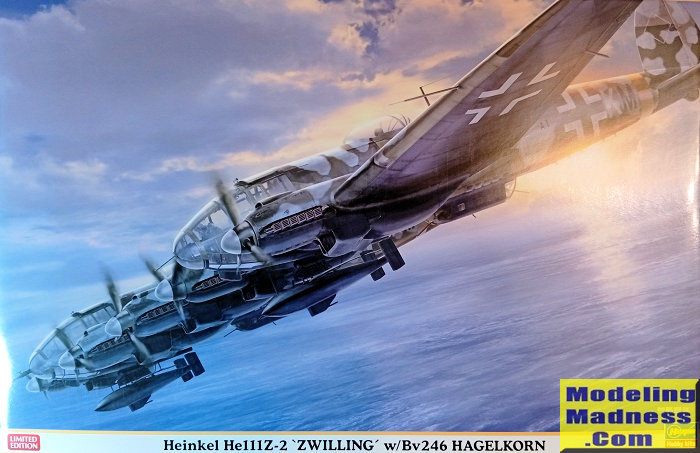
The kit comes in Hasegawa’s typical large top-opening box, with the company’s usual excellent presentation and a very attractive box artwork. The painting depicts one of the two schemes offered in the kit, showing the unusual aircraft banking gently to the right, carrying two Bv 246 Hagelkorn missiles beneath its wings. The atmospheric sunset and sea in the background make for a particularly dramatic scene, and the box art certainly succeeds in making you want to open the box and see what is inside.
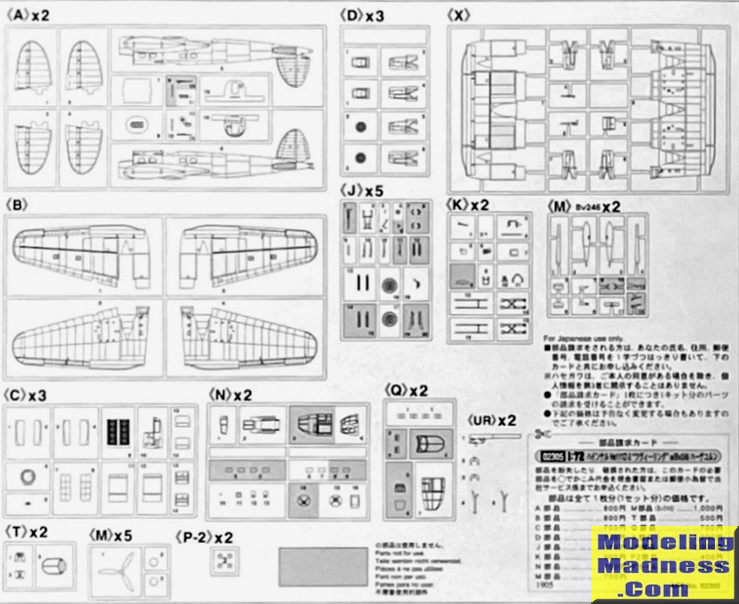
Upon opening the box, I was greeted by no less than 323 light-grey plastic parts, together with a few resin components to complement the Bv 246 missiles. The parts are beautifully arranged on no fewer than 24 sprues of various sizes, which is hardly surprising considering the contents. The majority of the parts originate from the original Heinkel He 111 tooling, while additional sprues provide the necessary parts to build the Zwilling, like the completely new central wing section, or another set of engines to cater for the fifth engine.
The interiors are nicely done, with decals provided for the instrument panels, while molded-on detail is also present in other areas. The internal framing is also quite well replicated and should produce a convincing result straight from the box. The same applies to the other key areas of the model, including the landing gear and engines, which are well elaborated and certainly more than acceptable for the scale.
The distinctive central wing section, which is a key feature that distinguishes this boxing from the more conventional He 111 versions, looks very nicely done. The engineering appears convincing, and hopefully it will present no major problems during construction. Considering the size of the finished Zwilling, this is certainly one area where good fit will be particularly important.
The Bv 246 Hagelkorn missiles are also very nicely replicated in styrene. The basic weapon is crisply moulded, while several resin parts are provided to accentuate its appearance and add finer detail when the missiles are mounted beneath their pylons. This combination of styrene and resin should result in particularly convincing representations of these unusual weapons.
The transparencies are wonderfully molded and crystal clear. The individual panels and framing are beautifully represented and, importantly, there is no mold seam running through the transparent sections that would require troublesome polishing. They should therefore require very little preparation before installation and should make an excellent contribution to the finished model.
The instructions come in Hasegawa’s usual form, as an eight-page black-and-white printed pamphlet, nicely laid out and easy to follow. They include a short history of the type, a sprue map, a colour chart and the construction sequence. Construction is presented in approximately 20 clear and concise steps, with colour call-outs provided where applicable.
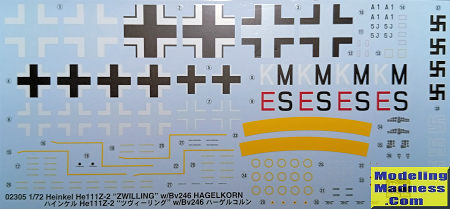 Two what-if
schemes are provided, representing 4./KG 53 “Legion Condor” A1+K, 8./KG 4 5J+ES.
The decals are very nicely printed and appear to be of good quality, so they
should perform well during application. Swastikas are included. Colour
references are given in Gunze codes, together with generic colour descriptions,
making it relatively straightforward to identify the required shades.
The instructions first have the modeller tackle the two interiors, which are then trapped between their respective fuselage halves. The windows, transparencies and upper turrets are also installed at this stage, although, as always, the modeller can alter the sequence according to personal preference and experience.
The wings are next assembled and the fuselage assemblies are subsequently attached to them. This is undoubtedly one of the more important stages of the build. There are many components that have to come together to produce one large, homogeneous structure, so some care and patience here should pay dividends. Alignment will be particularly important given the considerable size of the finished aircraft.
The engines can then be assembled and attached in their respective positions, followed by the landing gear. The tailplanes and propellers come next, after which attention turns to the two Bv 246 Hagelkorn missiles. These are assembled and installed in their underwing positions, followed by the various smaller finishing parts, including antennas and other external details.
This is clearly a multi-stage and relatively complex construction. The number of parts is considerable, and the finished model will be quite large, so there is no escaping the fact that this is a project that requires time and patience. At the same time, the engineering appears sufficiently straightforward that, assuming the generally good fit expected from Hasegawa’s tooling, the modeller should not encounter anything particularly frightening. It is certainly not a kit for the beginner, but an experienced or average modeller who is prepared to take his time should be able to work through it without excessive difficulty.
| CONCLUSIONS |
It was wonderful to have a modern-tooling Heinkel He 111 in 1/72 scale. It was even more wonderful when Hasegawa gave us the extraordinary He 111Z Zwilling. And to go one step further and offer the Z-2 in a what-if configuration carrying the equally extraordinary Bv 246 Hagelkorn is something I certainly would not have expected.
The kit benefits from generally very good external shapes, beautifully moulded parts, engraved panel lines, straightforward engineering, excellent transparencies and very nice decals. The instructions are also clear and well presented. In short, from the beginning, this looks like a winner.
The construction is undoubtedly complex, mainly because of the sheer number of parts and the enormous size of the finished model. This is definitely not a beginner’s kit, but an average modeller with some experience, patience and a willingness to take things one step at a time should be able to produce an impressive result.
Compared with the Italeri He 111Z, the Hasegawa offering is the winner in practically every respect. It is a more modern tooling and offers more detail and a generally more sophisticated representation. The Italeri kit does have one advantage: its construction is considerably simpler, although this does not necessarily translate into better fit. Italeri’s decal sheet is also quite nice, so that area is more evenly matched.
Hasegawa deserves considerable credit for bringing such an unusual subject to the modelling world. Considering that my example cost only around €60, I consider this an absolute bargain for what is contained in the box. Examples can often be found at considerably higher prices, sometimes well above €100, making a good offer particularly attractive.
If you want a He 111Z Zwilling, have the necessary experience and, most importantly, have somewhere to put the finished model, this is definitely a kit worth tackling. And because the He 111Z-2 presented here is itself a projected aircraft, the what-if modeller has even more freedom to develop his own interpretation. There is no need to be restricted to the schemes provided in the box; this is a perfect canvas for letting the imagination run wild and creating a completely personal camouflage and markings scheme for this extraordinary aircraft.
Happy Modeling!
November 2026
Copyright ModelingMadness.com. All rights reserved. No reproduction in part or in whole without express permission.
If you would like your product reviewed fairly and fairly quickly, please contact the editor or see other details in the Note to Contributors.