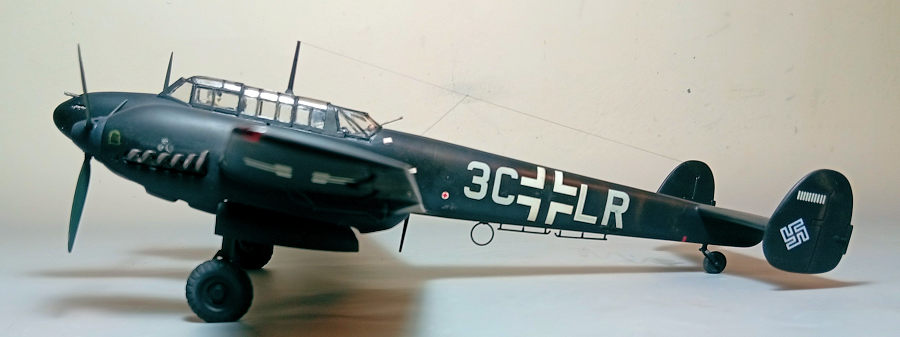
Revell 1/32 Bf-110C-4B
| KIT #: | 4771 |
| PRICE: | €20 “used” |
| DECALS: | Two options |
| REVIEWER: | Spiros Pendedekas |
| NOTES: | 1974 tooling |
| HISTORY |
Reinhard Kollak belongs to that shadowed generation of aviators whose lives were carved into history not by peace, but by the long, electric nights of war over Europe. To speak of him is to speak not only of a man, but of the cold machinery of aerial conflict—engines trembling through cloud, instruments glowing faintly in darkness, and the silent mathematics of interception above a continent under siege.
Born in 1915 in East Prussia, Kollak came of age in a world already bending under the weight of upheaval. By the time he entered Luftwaffe service, aviation had transformed from the romantic frontier of early flight into something far more disciplined, technical, and unforgiving. He would become part of that transformation, serving as a night fighter pilot in units tasked with defending German airspace against the relentless nocturnal bombing campaigns of the RAF.
 It was in
the cockpit of the Messerschmitt Bf 110 that his story truly took shape. The
aircraft itself was a paradox—once conceived as a fast escort fighter, it found
its true purpose not in daylight duels, but in the darkened skies of night
warfare. Heavy, twin-engined, carrying both pilot and observer, it was less a
sword of speed and more a tool of calculated pursuit. In this machine, Kollak
did not hunt by sight alone; he hunted through fragments of information, ground
guidance, and the sharpened instincts that come only after long hours in the
void of night.
It was in
the cockpit of the Messerschmitt Bf 110 that his story truly took shape. The
aircraft itself was a paradox—once conceived as a fast escort fighter, it found
its true purpose not in daylight duels, but in the darkened skies of night
warfare. Heavy, twin-engined, carrying both pilot and observer, it was less a
sword of speed and more a tool of calculated pursuit. In this machine, Kollak
did not hunt by sight alone; he hunted through fragments of information, ground
guidance, and the sharpened instincts that come only after long hours in the
void of night.
Night fighting was a world without horizon. There was no clear sky, no sun, no visual certainty—only instrument lights, coded voices, and sudden moments of violent clarity when a bomber finally emerged from darkness. Kollak flew hundreds of such missions. In that shadowed theater, he achieved the status of a successful and experienced combat pilot, credited with dozens of aerial victories. But behind those numbers lay something harder to define: endurance, repetition, and the psychological weight of endless nights spent navigating between detection and disappearance.
His recognition within the Luftwaffe—decorations such as the Knight’s Cross of the Iron Cross—reflects how highly the wartime German command valued effectiveness in this brutal and technical form of aerial defense. Yet medals in such a context are never simple symbols; they are fragments of a larger, more complex machinery of war.
When the war ended, like so many of his generation, Kollak’s life did not simply vanish into history. He was taken as a prisoner of war and later returned to civilian life, eventually serving in the Bundeswehr, West Germany’s postwar armed forces. In that sense, his story also reflects a broader national transformation—from total war to reconstruction, from destruction to cautious rebuilding.
 He died in
1980, long after the engines of the Bf 110 had fallen silent.
He died in
1980, long after the engines of the Bf 110 had fallen silent.
As for his Messerschmitt Bf 110 was a machine of contradictions—too heavy and cumbersome to dominate the daylight skies as its designers had once envisioned, yet strangely reborn in darkness, where speed mattered less than endurance, stability, and firepower. In daylight combat it suffered against nimble single-engine fighters, its large silhouette and slower reactions exposing the limits of the “heavy fighter” concept. But at night, beneath moonlit clouds and the ghostly glow of burning cities, the Bf 110 found its true calling. Its long range, powerful armament, and the presence of a second crewman transformed it into a deadly nocturnal hunter, stalking RAF bombers through blackened skies like a steel predator guided not by sight, but by ground control, instinct, and the cold discipline of coordinated interception.
What remains of Reinhard Kollak is not a myth, nor a legend, but something more restrained and human: a record of a man shaped by the technical demands and moral ambiguities of his time. His story sits in that uneasy space where skill and conflict intersect, where the night sky was both battlefield and memory.
In that silence after the engines stop, his life becomes what so many wartime lives become—an echo in the dark, carried forward not by noise, but by remembrance.
| THE KIT |
 It’s quite
spectacular that Revell came as early as 1974 with a then state of the art 1/32
Bf110 mold. The kit had been regularly reboxed as a “C” and “D” version another
ten times, with the last reboxing in 2007. Though clearly an old mold in all
respects and definitely superseded by the newer Dragon offering (which Revell
also reboxed in 2019 - and that says a lot…) it is not a bad kit at all,
offering acceptable overall level of detail and promising to deliver a decent
representation of the Bf110. Not a shake and bake kit for sure, needing your
attention in areas like the wing to nacelle joints. Should you wish to have an
in-depth look at its contents, you may read its preview,
found in the ever growing MM archives.
It’s quite
spectacular that Revell came as early as 1974 with a then state of the art 1/32
Bf110 mold. The kit had been regularly reboxed as a “C” and “D” version another
ten times, with the last reboxing in 2007. Though clearly an old mold in all
respects and definitely superseded by the newer Dragon offering (which Revell
also reboxed in 2019 - and that says a lot…) it is not a bad kit at all,
offering acceptable overall level of detail and promising to deliver a decent
representation of the Bf110. Not a shake and bake kit for sure, needing your
attention in areas like the wing to nacelle joints. Should you wish to have an
in-depth look at its contents, you may read its preview,
found in the ever growing MM archives.
| CONSTRUCTION |
Opting for a mostly Out
Of the Box (OOB) build, I started by putting together the crew area, which
comprises a mere 8 parts. Basic cockpit color was Hu32 (for the RLM66), while
the stick grip and its boot were painted black. I used the good looking decals
for the instrument panel and side consoles, while I painted black and dry
brushed with silver those of the gunner’s area, which were raised (wouldn’t hurt
if Revell provided decals for those, as well). The rear gun was painted
gunmetal with black grip and mounting base, while the ammo belts were
highlighted with a fine tip brass pen.
Apart from going grossly aftermarket, I assumed that the other possible
alternative to somehow lessen the cockpit’s sparseness was to use the relatively
good looking kit provided figures. They both had Intermediate blue suits,
“leather” shaded jackets, black boots and goggles, silver goggle lenses, yellow
lifejackets, linen seatbelts and “dark leather” shaded helmets and gloves.
The omission of a gunsight was very prominent, so I fabricated one from leftover
clear styrene pieces.
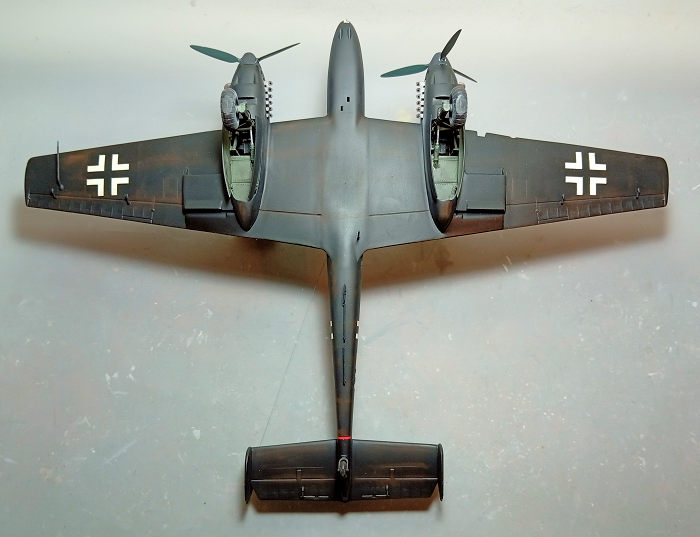 Onto main
assembly, where the cockpit was first trapped between the fuselage halves, and
then entering one of the favorite stages for many of us: sub assembling,
including the main wings (4-piece affairs), the tail planes, the props and the
main wheels.
Onto main
assembly, where the cockpit was first trapped between the fuselage halves, and
then entering one of the favorite stages for many of us: sub assembling,
including the main wings (4-piece affairs), the tail planes, the props and the
main wheels.
The kit provides two reasonably detailed Daimler-Benz engines, which were
assembled, painted black and heavily dry brushed with silver. They were then
trapped between the corresponding lower nacelle halves, which double as main bay
sidewalls, and then attached to the wings, followed by their upper covers, which
I elected to permanently glue (you can leave them unglued, if you wish to show
the engine area). All cowling innards and supporting struts were painted Hu31
for the RLM02 shade.
The assembled wings were next attached to the fuselage, followed by the tail
plane and the nose top gun bay cover, which I also elected to permanently glue
for more homogeneous looks and omit the kit provision to leave it unglued (to
show the guns area - nonetheless too simplified).
This more or less concluded basic assembly, which was surprisingly simple and
straightforward for a twin engine 1/32 model. However, I have to admit that fit
was in areas challenging, with the cowlings-to-wings joints immediately
springing into mind. That said, main construction was nothing the average
modeler cannot tackle. To even the gaps, I first used liquified styrene, then
“classic” model filler. After a couple of such rounds, Mr Kollak’s night fighter
was ready for the paint shop!
| COLORS & MARKINGS |
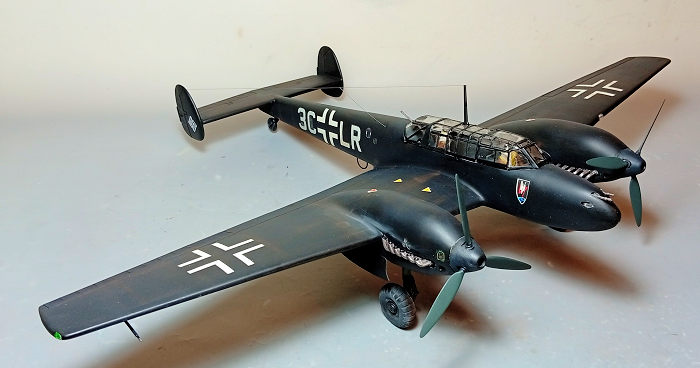
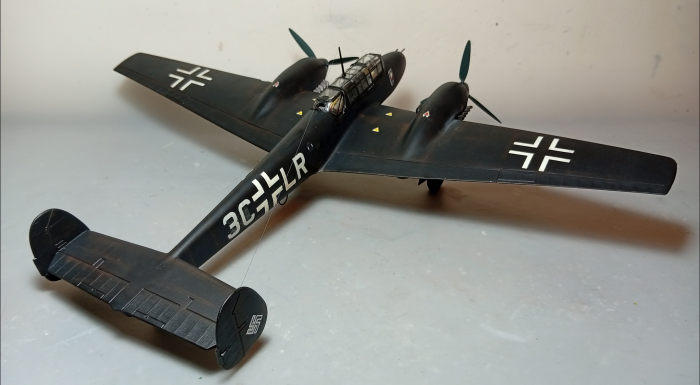 Kollak’s
assigned plane was overall black, and for this I used no less than half a tinlet
of Hu85 Satin Black. I was not too cautious about applying the paint uniformly;
in fact, I somehow longed to achieve a non-uniform finish, to break that
monotonous all black. After a second round, where some spotted blemishes were
fixed, I gave the bird a coat of Future to prepare it for decals.
Kollak’s
assigned plane was overall black, and for this I used no less than half a tinlet
of Hu85 Satin Black. I was not too cautious about applying the paint uniformly;
in fact, I somehow longed to achieve a non-uniform finish, to break that
monotonous all black. After a second round, where some spotted blemishes were
fixed, I gave the bird a coat of Future to prepare it for decals.
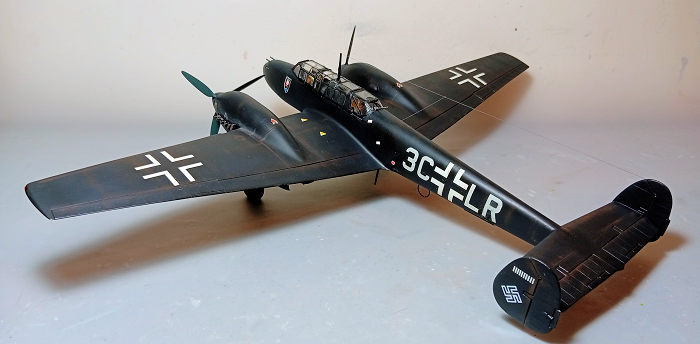
As stated in the preview,
the kit decals were badly yellowed due to age. So I taped them on a window,
letting the spring Greek sun do its magic, which actually did, as most of the
yellowness went away in about three weeks time! Applying the still aged decals
was, to my surprise, a mostly uneventful experience. I did however carefully
slice off the transparent film from the big Balkenkreuze, as it was prone to
silvering. Opting for a historically correct model, I used suitably sized
swastikas from the very good ICARUS48010 decal sheet, with a coat of Future
sealing everything.
| FINAL CONSTRUCTION |
The landing gear was
assembled and attached. Legs, bays, and door innards were painted Hu31 Slate
Grey (for the RLM02), oleo boots, rims, and tyres were painted black, while the
retraction cylinders’ oleos were highlighted with a fine-tip silver pen. I was
tempted to paint the tires a grey shade, but the almost non-existent separation
line between tire and rim made my usual laziness effortlessly persevere. All
wheels were filed to look weighted, with the main ones filed at an angle to
obtain some of the distinctive 6.5° camber angle. I could not resist adding some
basic brake hoses from stretched sprue, painted black.
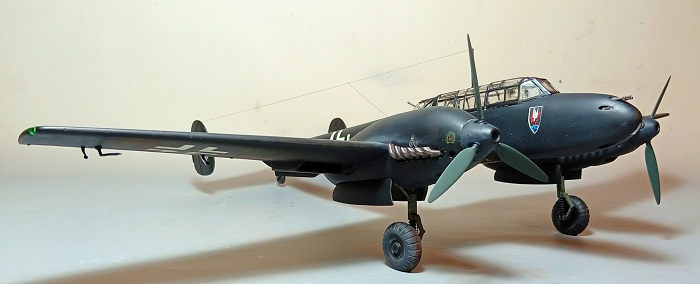
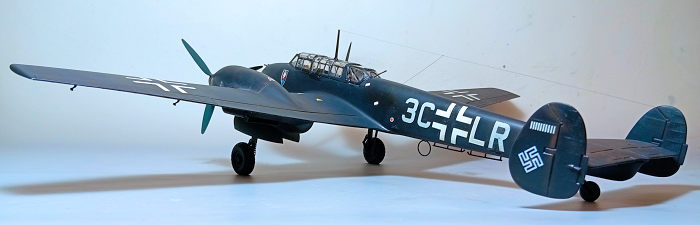 The various
antennas, the big pitot tube, and the aileron mass balances were attached and
painted black as well, with the pitot’s tip painted Mr Hobby Burnt Iron. The
props were next assembled and attached in position, with fit between the
cowlings’ nose and base sections being average and requiring filling and
sanding. Cowlings were painted black, while blades were painted Hu91 Black
Green. The four top nose guns had their rears cut off and, after being drilled
to look hollow, were painted gunmetal and carefully glued in position.
The various
antennas, the big pitot tube, and the aileron mass balances were attached and
painted black as well, with the pitot’s tip painted Mr Hobby Burnt Iron. The
props were next assembled and attached in position, with fit between the
cowlings’ nose and base sections being average and requiring filling and
sanding. Cowlings were painted black, while blades were painted Hu91 Black
Green. The four top nose guns had their rears cut off and, after being drilled
to look hollow, were painted gunmetal and carefully glued in position.
The transparencies had their well-defined frames hand painted and attached in
position. Fit was average, mostly due to the fact that their moving sections
were designed to be positionable, opposing my stubbornness to always go for
closed canopies. The top antenna mast was carefully attached to the canopy and
painted black, with thin stretched sprue used to replicate the antenna wire.
Blobs of red and green clear paint were used to replicate the wingtip lights
before calling Mr Kollak’s bird done!
| CONCLUSIONS |
This is clearly an old
mold in every respect, and the fact that Revell discontinued it in 2007 and
later reboxed the Dragon kit in 2019 says quite a bit. That said, it is by no
means a bad kit. It still offers a respectable level of detail and can result in
a very convincing representation of the Bf 110.
In terms of fit, the experience was mixed but generally acceptable. Some areas
went together quite well, while others (especially the engine nacelles/bay
walls) demanded extra attention and patience, always staying just on the edge of
needing correction without ever becoming unmanageable. The clear parts were a
mixed affair: reasonably molded with nicely defined frames, but less than
perfect in fit due to their original design as movable elements. Closing the
canopy fully required some careful persuasion and “Goldberg-style” perseverance,
which introduced alignment compromises. Overall, workable but not effortless.
The decals, once well printed, were heavily yellowed from decades in storage;
fortunately, the Greek sun restored them after about twenty days taped to a
sunlit window, bringing them back to usable condition.
Building this Bf 110 felt a little like stepping back into another era of the
hobby. It demanded some effort, occasionally tested my patience, and certainly
did not hand out its rewards easily. Yet that is precisely what made the
experience memorable. Every challenge overcome, every troublesome nacelle joint
corrected, and every yellowed decal restored by the Greek sun added to the sense
of accomplishment. There is a special satisfaction in taking an older kit,
accepting its imperfections, and coaxing the very best out of it. In the end,
this model represents more than just a Messerschmitt Bf 110 on the display
shelf; it is a small tribute to the enduring appeal of classic kits and a
reminder that, with a little patience and care, even a decades-old box of
plastic can still provide a thoroughly rewarding modelling experience.
Happy Modeling!
Spiros Pendedekas 12
June 2026 Copyright ModelingMadness.com. All rights reserved. No
reproduction in part or in whole without express permission. If you would like your product reviewed fairly and fairly quickly, please
contact the editor
or see other details in the
Note to
Contributors.