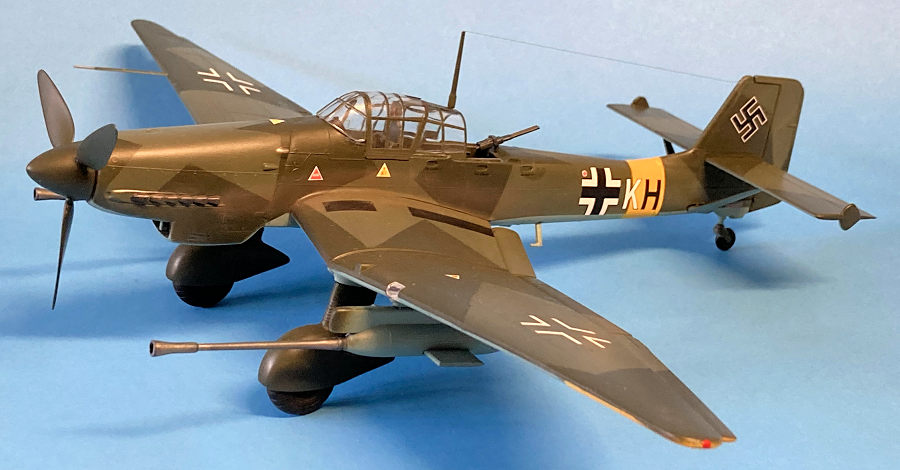
Revell 1/48 Ju-87G 'Tank Buster'
| KIT #: | PA-207 |
| PRICE: | $ |
| DECALS: | One option |
| REVIEWER: | H Davis Gandees |
| NOTES: | 1968 release |
| HISTORY |
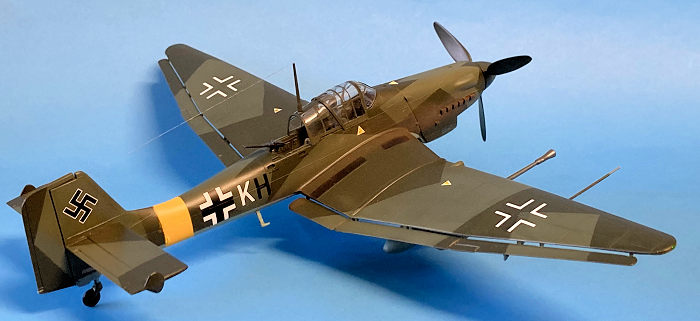 The Ju87
Stuka was not a particularly attractive aircraft, and its performance was poor,
but the Luftwaffe used it well throughout the entire war. Originally a dive
bomber during the Blitz and the Battle of Britain, but it proved vulnerable to
RAF fighters and was withdrawn. After the Battle of Kursk, the G model with two
37 mm cannons mounted under the wings was very effective against the plethora of
Russian tanks on the Eastern Front. Of the over 6000 Stukas built, only 200+ G
models and several converted Ju87D-3s were built before WWII ended. The Stuka
was much modified over its 8-year service life to meet the Luftwaffe’s changing
needs during WWII.
The Ju87
Stuka was not a particularly attractive aircraft, and its performance was poor,
but the Luftwaffe used it well throughout the entire war. Originally a dive
bomber during the Blitz and the Battle of Britain, but it proved vulnerable to
RAF fighters and was withdrawn. After the Battle of Kursk, the G model with two
37 mm cannons mounted under the wings was very effective against the plethora of
Russian tanks on the Eastern Front. Of the over 6000 Stukas built, only 200+ G
models and several converted Ju87D-3s were built before WWII ended. The Stuka
was much modified over its 8-year service life to meet the Luftwaffe’s changing
needs during WWII.
| THE KIT |
The 4-page instructions are very clear and include a 4-view with painting and decal instructions and color callouts. The kit has features of a G1 and G2, but for its age it produced a presentable model that qualifies for the new IPMS Vintage kit for kits produced before 1981.
When I opened the sealed box, I sensed stale 1968 Elk Grove, Illinois air!
| CONSTRUCTION |
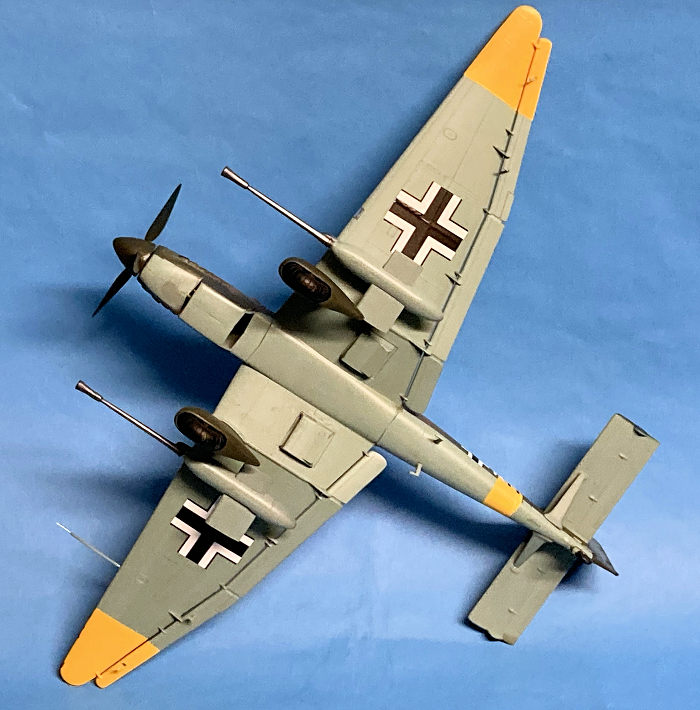 The
simple 40-piece model was built out-of- the-box and as is often the case with
these vintage kits, the fit was quite good with no serious problems. Only a
minimum of putty was needed but moderate flash removal was required as the
50-year-old molds have continued to be used by Revell until recently.
The
simple 40-piece model was built out-of- the-box and as is often the case with
these vintage kits, the fit was quite good with no serious problems. Only a
minimum of putty was needed but moderate flash removal was required as the
50-year-old molds have continued to be used by Revell until recently.
The cockpit was painted with RLM 02 and dry brushed with aluminum. Because it was somewhat sparse other than the basic seats, rear machine gun, kit instrument decal and dubious molded sidewall detail, it was decided the 4-piece canopy would be closed, and it surprisingly fit quite well.
The most obvious features of this model are the Bordkanone 37 mm antitank guns. For whatever reason, Monogram molded the muzzle openings solid, so the bores were drilled out and the flash hiders opened up appropriately.
| COLORS & MARKINGS |
With the absence of my usual Model Master RLM hues, I used mixtures of Tamiya acrylics for the ubiquitous splinter camouflage scheme and a considerable amount of Tamiya masking tape.
As there are no commercial canopy masks available (if there ever were), I spent 3 hours masking the complex 28 pane canopy with even more Tamiya tape.
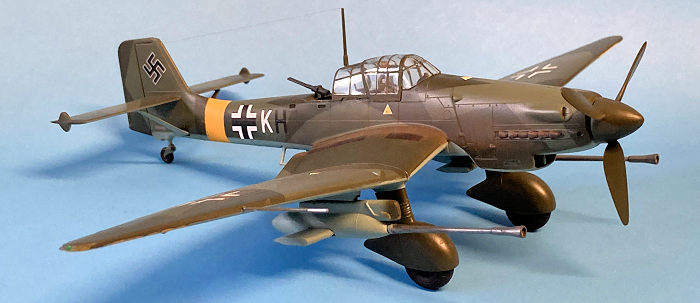 After the
paint dried, I sprayed a coat of Tamiya gloss clear and when dry applied the
decals. Rather than build the popular “Tank Buster” choice of Hans Rudel’s Stuka.
I selected generic markings for perhaps a young Feldwebel who just wanted to go
home from the war.
After the
paint dried, I sprayed a coat of Tamiya gloss clear and when dry applied the
decals. Rather than build the popular “Tank Buster” choice of Hans Rudel’s Stuka.
I selected generic markings for perhaps a young Feldwebel who just wanted to go
home from the war.
The next day a coat of Tamiya flat clear was applied and when dry, subtle black/brown pastel exhaust staining was applied. The engine exhausts were painted Model Master gunmetal and lightly dry brushed with steel and rust brown.
The red, green and white nav lights were painted at the appropriate positions with a sharp toothpick. The finishing touch was a nylon radio antenna wire stretched from a #80 pre-drilled hole on the tail to the mast.
| CONCLUSIONS |
I spent 30 enjoyable hours building the Stuka, more than half of it masking! With a bit of patience these vintage kits can be made into a presentable model.
The lesson from this project was, build your stash before you’re snipped from the sprue of life. I think the gentleman whose wife supplied this kit, would be happy his Stuka was finally built.
| REFERENCES |
Squadron Signal JU 87 Stuka in Action #73
3 September 2026
Copyright ModelingMadness.com. All rights reserved. No reproduction in part or in whole without express permission.
If you would like your product reviewed fairly and fairly quickly, please contact the editor or see other details in the Note to Contributors.