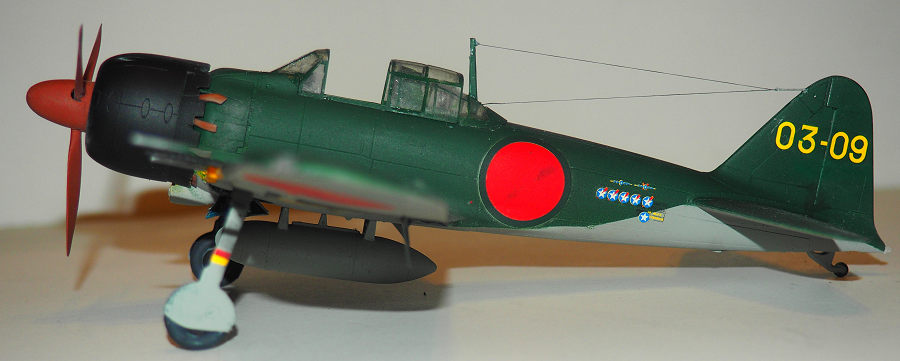
Hasegawa 1/48 A6M5c Zero
| KIT #: | |
| PRICE: | $30.00 |
| DECALS: | Two options |
| REVIEWER: | Mark Rossmann |
| NOTES: |
This kit does not include the
Air-to-Air rockets used against B-29’s. (Tamiya kit does).
Aftermarket: Zotz Decals; markings for four (4) A6M5 Zeroes. Canopy Masks; Eduard EX245 for1/48 A6M5c Hasegawa |
| HISTORY |
Mitsubishi was hard pressed to keep the Zero superior to the newer U.S. aircraft. Needing more firepower and armor protection led the combined companies of Nakajima and Mitsubishi to produce the A6M5 Type 52 series. About 6000 were produced with the series entering combat in August of 1943.
IJNAF needed further upgrades of the ‘52’ series because of the lack of a replacement fighter. The improvements requested were armament, armor protection, additional fuel tank and greater diving speeds. But the IJNAF refused a request for a more powerful engine to counter the increased weight, which was 600lbs more than the earlier 52 series.
 The
52c was the last of the A6M5 series, with 93 built by Mitsubishi and an
unknown number by Nakajima. Numbers of 52a and 52b models were also
modified to the ‘c’ weapons configuration. The 7.7mm nose guns were less
effective as heavier armor was introduced in allied aircraft. The 52c
production began in September of 1944 with these changes included:
The
52c was the last of the A6M5 series, with 93 built by Mitsubishi and an
unknown number by Nakajima. Numbers of 52a and 52b models were also
modified to the ‘c’ weapons configuration. The 7.7mm nose guns were less
effective as heavier armor was introduced in allied aircraft. The 52c
production began in September of 1944 with these changes included:
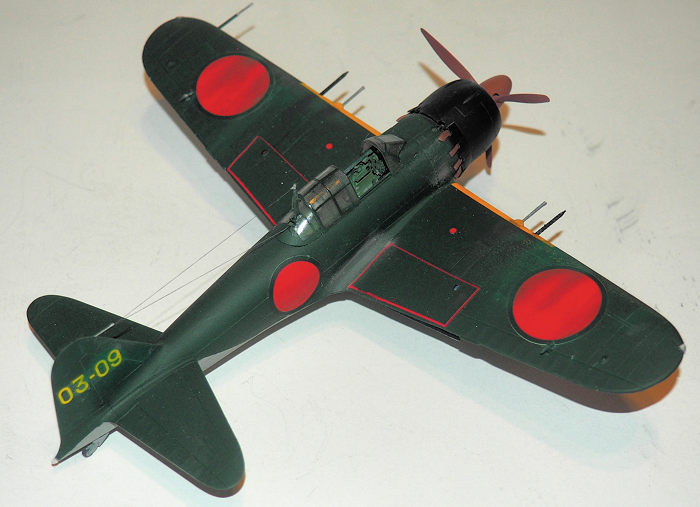
Removal of both cowling 7.7mm machine guns, replacing with one 13mm machine gun in the right side only (because of weight). This caused the enlargement of the right-hand projectile exit and cowling input tube. Two 7.7mm machine guns added to each wing, outboard of the existing 20mm cannon.
Armor improvements were done by installing a sheet of armor plate behind the pilot seat with armor glass panes behind the headrest. (Hasegawa provided a nice rendition of this) . Fuel tanks were rearraigned to keep the proper center of gravity. Wing tank capacity was reduced; a new 31-gallon mid-fuselage tank was added. Attachment points, on each wing, for air-to-air rockets to combat the B-29. (Hasegawa doesn’t provide these)
The new Nakajima Sakae 31 engine, with water-menthol injection, could not be installed as it failed its tests, so the Nakajima Sakae 21 remained. The new four-point attachment drop tank was used for the ‘c’ version, (Hasegawa provides this version). Unsurprisingly, the pilot’s assessment indicated the 52c performance deteriorated, losing its superlative handling qualities.
Warrant Officer Takeo Tanimizu – 203rd Naval Air Group 303rd FS, Kagoshima AB
The kit provides the decals for Tanimizu’s A6M5c, flown in June of 1945. He graduated in March of 1942, however not until November of 1943, at Rabaul, did he engage allied aircraft, claiming two P-38’s on his first mission.
Tanimizu said the Hellcat was the greatest foe of the zero pilots. It could maneuver and roll, whereas the P-38 and Corsair made hit and run passes and weren’t very maneuverable. He said it was difficult to set any of them on fire, they would puff smoke, by which you could tell if it was an enemy or Zero. He noted that he saw Corsairs unable to pull out of dives, because of being too heavy, crashing into a land or the sea. He did have compassion as he threw his life ring to downed VMF-321 Capt. Harvey F. Carter, however he was never recovered.
 He
was transferred to the Tinian AG as an instructor, then onto Formosa in
mid-1944. On August 31st, 1944, he engaged 11 425th BS B-24’s attacking
Takao Harbor. Shooting down Lt. Norman B. Clendenen, causing it to crash
with only one survivor. He also damaged Lt. George Pierpoint’s B-24,
which never returned to base. In 1996, it was found crashed into a
mountain peak in mainland China, crew remains were turned over to the
U.S. Ambassador in 1997.
He
was transferred to the Tinian AG as an instructor, then onto Formosa in
mid-1944. On August 31st, 1944, he engaged 11 425th BS B-24’s attacking
Takao Harbor. Shooting down Lt. Norman B. Clendenen, causing it to crash
with only one survivor. He also damaged Lt. George Pierpoint’s B-24,
which never returned to base. In 1996, it was found crashed into a
mountain peak in mainland China, crew remains were turned over to the
U.S. Ambassador in 1997.
On November 3rd, 1944 he and his wingman were jumped by P-51’s, while landing over Amoy Harbour, mainland China. He was able to get out at 250ft above the water, with his chute just opening before he hit. He spent a month in a hospital in Formosa. Then ordered back to Japan, he requested a kamikaze assignment but was denied, instead he was ordered to the 203rd AG at Kagoshima Prefecture.
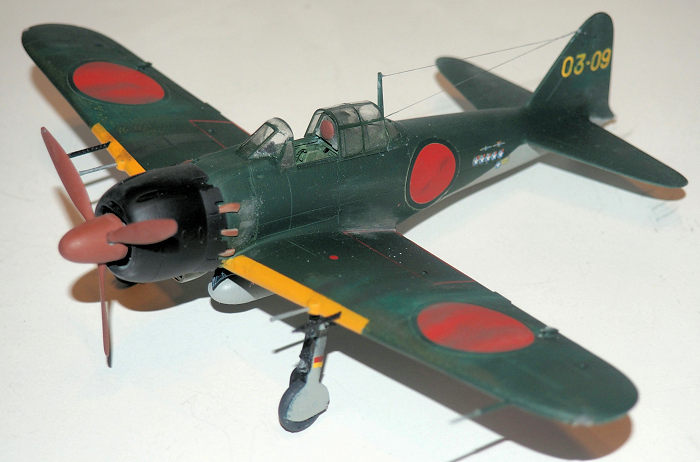
To provide the younger pilots confidence, he started adding kill markings to his plane, one for a recently shot down VBF-83 Corsair. Two head-on silhouettes of B-29’s represent one jointly shot down with Ens Tetsuzo Iwamato, the top JNAF ace claiming 202 planes, and a second was a B-29 probable. The five stars with pierced arrows are for kills, the single star no-arrow one is for a probable. His unique kill markings made it the most celebrated Zero depicted in post war publications. The broken hulk of this plane was photographed in November 1945, at a Nagasaki Hanger.
When the surrender was announced on August 15, he would not accept defeat. For 5 days he searched for enemy aircraft and dropped leaflets to the population urging them to fight on. In the end, he had 1425 flight hours and claimed 32 victories.
Mark provides no information on the kit or the build, but you can find plenty in the archives. Ed.
| COLORS & MARKINGS |
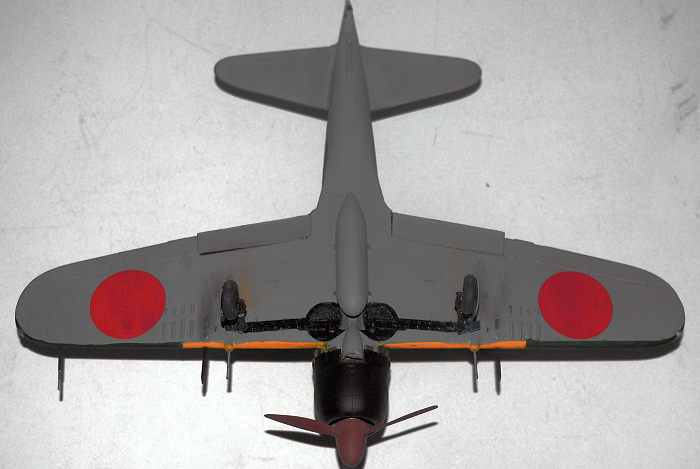 On
many occasions, the white surround was overpainted with green, in the
field, not by the factory. Zotz provides the green ring to overlay the
white.
On
many occasions, the white surround was overpainted with green, in the
field, not by the factory. Zotz provides the green ring to overlay the
white.
Paints used: Tamiya AS-2 Light Gray IJN spray, AS-21 Dark Green 2 IJN spray, TS-29 Semi-gloss black for cowling, and TS-47 Chrome Yellow spray for the leading wing edges.
Model Color 70486 Mahogany Brown for propeller.
| REFERENCES |
Osprey: Imperial Japanese Navy Aces 1937-45, #23. By Henry Sakaida
Osprey: Duel F6F Hellcat vs. A6M Zero-Sen, #62. By Eduard M. Young
Hasegawa Instructions
Tamiya Instructions
Zotz A6M5 ‘Gekitsuio’ aircraft #48/034 decals.
9 June 2025 Copyright ModelingMadness.com. All rights reserved. No
reproduction in part or in whole without express permission from the editor.
If you would like your product reviewed fairly and fairly quickly, please contact the editor or see other details in the Note to Contributors.