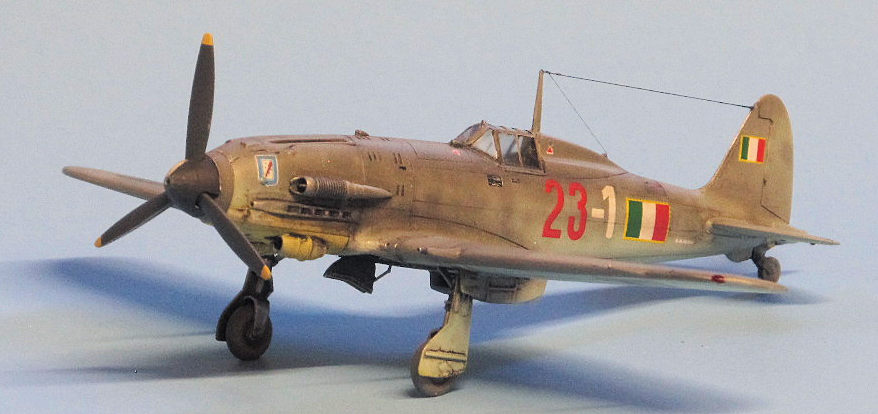
Italeri 1/72 Macchi C.205 Veltro
| KIT #: | 1227 |
| PRICE: | $15.00 |
| DECALS: | Three options |
| REVIEWER: | Ryan Grosswiler |
| NOTES: | Falcon canopy, Quickboost carburetor intake, and lots of additional detailing in the gear bay |
| HISTORY |
After a decade of thinking of itself as being possessed of one of the world's finest military forces, the second half of the 1930s had caught Fascist (actual 'fascist') Italy at an awkward spot. Especially its Regia Aeronautica, which had fielded their three newest air-superiority aircraft just before the stupendous advances in aerodynamic refinement and engine power which occurred at the end of the 1930s. With such aircraft as the Spitfire and Bf-109 entering service concurrently, the open-cockpit, 800-hp Fiat CR.42, Fiat G.50, and Macchi C.200 were all essentially obsolete upon delivery. Competing aircraft had 1000-HP liquid cooled engines, cleaner forms, and more guns. Fiat had been unsuccessfully noodling around with such an engine on its own, and when this development effort began to falter, had also acquired production rights to Germany's DB.601. However, Italian fighter design itself remained stagnant.
Seeing this impending problem, Mussolini forced a shakedown at the RA's
highest levels, and his new air force Chief of Staff promptly killed Fiat's
indigenous engine effort, following in the first month of 1940 by ordering
license production of the German DB engine. To speed the development process,
four new engines were rushed from Germany and shared between Macchi and Reggiane,
both of whom had been working on fighter designs for the licensed Italian copy,
now designated Alfa-Romeo RC.41. Less than seven months later, Macchi's new
C.202 prototype had flown. The earlier C.200 Saetta, while a firm member of that
underperforming triumvirate of Italian fighter designs, had a reputation as
 a
superb 'pilot's aircraft', and so chief engineer Mario Castoldi had taken the
wings, tail surfaces, and landing gear from the design and mated them to an
entirely-new fuselage for the new engine. Rushed to the RA's testing unit at the
end of summer 1940, it met an immediately enthusiastic approval from test pilots
and ordered into production as the "Folgore". Arriving in combat a year later
over North Africa, the Folgore immediately reversed the air superiority enjoyed
by such types as RAF's Hawker Hurricane and Gloster Gladiator.
a
superb 'pilot's aircraft', and so chief engineer Mario Castoldi had taken the
wings, tail surfaces, and landing gear from the design and mated them to an
entirely-new fuselage for the new engine. Rushed to the RA's testing unit at the
end of summer 1940, it met an immediately enthusiastic approval from test pilots
and ordered into production as the "Folgore". Arriving in combat a year later
over North Africa, the Folgore immediately reversed the air superiority enjoyed
by such types as RAF's Hawker Hurricane and Gloster Gladiator.
By mid-1942, however, this brilliance had faded. Better Allied aircraft
had appeared, but there were limitations to the Folgore itself. Besides the
engine, which by that time represented a horsepower shortfall, the primary
problem with the Folgore was that it was essentially a two-gun fighter. Sure,
there was provision for a pair of .30 cal Breda guns in the wings, but these
were seldom fitted in the field and even less often provided with ammo, as
rifle-caliber guns were by now recognized to be ineffective in aerial combat. A
pair of underwing cannon gondolas was tested, like those often seen on the
Bf-109G, but the Italians weren't as willing as the Germans to suffer the
degradation in performance and maneuverability that came with the gain in weight
and drag.
Again, the Germans provided the answer, and again it would be a lash-up.
The availability of both the new 1400 HP DB.605 and 20mm MG-151 cannon from
their allies to the north promised to resolve these two problems for the
Italians. In a story that was to uncannily mimic that of the Spitfire Mk. IX
versus VIII going on at about the same time in Great Britain, a major redesign
of the C.202 airframe to properly accommodate the brake horsepower increase was
begun. However, the urgent need in the field was more acute than that, so a
stop-gap solution was found by directly adapting the basic C.202 airframe to
take the bigger engine and additional pair of cannon. This didn't require much
work; the DB 605 had the about the same dimensions as the earlier 601 and it
turned out that the Folgore's wings likewise could contain the cannon with just
a couple small bulges added beneath. A new, more rounded propeller spinner and
retractable tailwheel were fitted. All this created the C.205 Veltro. The
'properly engineered' version, the C.205N Orione, featured a major stretch in
the fuselage length and four dramatic bulges around the fuselage circumference
aft of the engine for a like number of .50 caliber Breda guns, with a cannon
firing through the prop spinner. This effort would be a waste, however: the RA
selected the Fiat G.55 for its long-term plans.
Regardless of this, being tactically effective and a mere modification
of an existing design meant that the stop-gap C.205V went into production and
service with little further thought. The 40% horsepower upgrade and set of
cannons succeeded in making the design competitive again, but by the time of its
introduction in the spring of 1943 Italy's strategic situation had darkened
considerably. The Allies landed in Sicily in July, the RA throwing in everything
it had there and being virtually demolished in the process. The island fell in
August, what was left of the RA's contingent withdrawing to a desperate defense
of the southern portion of the Italian peninsula, the new 205s providing the
only bit of success against USAAF bombers beginning to hit the region. The Rome
government surrendered in Sep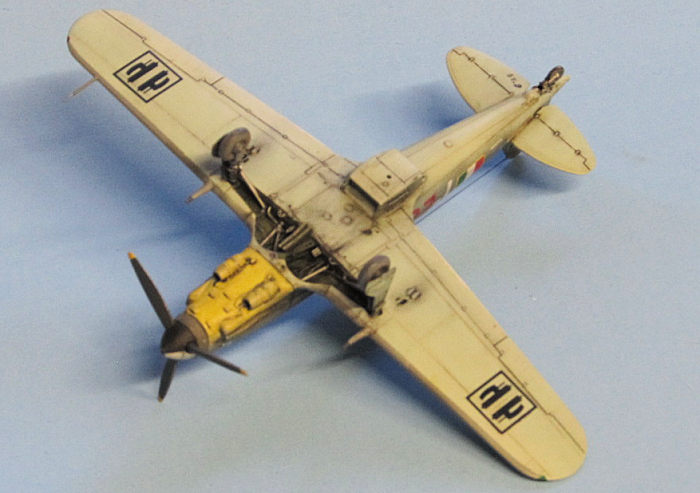 tember, the Social Republic set up a rump Fascist
government in the North, and the C.205's combat career really began.
tember, the Social Republic set up a rump Fascist
government in the North, and the C.205's combat career really began.
The Allied-aligned Co-Belligerent air force had about twenty-five
serviceable 205s, and managed to create about twenty more 'Franken-Veltros' in
the fall of 1943 by fitting available DB.605s to Folgore airframes. However, cut
off from the factories, the spares flow could not be maintained and the fighters
were replaced by the P-39 and Spitfire Mk.V within 8 months. More to the point,
the Allies were fairly reluctant to commit their new Italian allies freshly
switched sides to the fight.
Things were different elsewhere. Up north, the Axis-aligned ANR had
inherited about forty operable Veltros and, with the factories still in their
possession, managed to manufacture another hundred or so. The aircraft saw heavy
fighting beginning on the third day of 1944 with spirited defense of Italian
industries in the region, still supplying the Axis war machine, against repeated
attacks from B-17s and B-24s. By the end of winter, the Veltro units had claimed
about 70 Allied bombers and fighters against about fifteen losses. Despite a
forceful German attempt to disband the organization, the Italian pilots would
continue the stubborn regional fight. Gradually converting to the G.55 and
Bf-109, the ANR units would provide the only Axis air power presence over the
southern Alps for the last year of the war, in the end claiming about 100 total
kills for a like number of their own lost.
Following the war, famous RAF test pilot Eric Winkle Brown was absolutely
effusive in his praise for the Veltro and everything about it, and an Australian
who had operated a captured example in the reconnaissance role echoed these
sentiments. However, logistics matter! Supply of DB.601 had never been more than
50 per month, and this had to be split between the C.202 and Reggiane's Re.2001.
The situation with the DB.605 was little better and never close to production
requirements. As it would happen, these meager supplies of both engines meant
that the old open-cockpit C.200 Saetta, the old airplane this whole story was
based upon, would remain in production all the way to the 1943 Armistice. The
Veltro would find employment postwar with Egypt, seeing action against Israel's
Spitfires and Messerschmitts in the latter's 1948 war of independence. Remaining
mysterious is its service with Croatia, and postwar with Syria.
Three C.205s survive, one being kept airworthy all through the '80s.
These have a mix of C.202 and 205 details, and are probably modified C.202s. It
is interesting to note that the Italians persisted with their unique open-aft
cockpit canopies on a 400 MPH fighter. I wonder how this affected pitot-static
instruments.
| THE KIT |
 Previous 1960s-'70s kits of the MC.202/205 family from Frog and
Supermodel were relegated to obscurity by the release of the excellent MC.202 Folgore Hasegawa kit in 1992. Italerei came out with this kit about ten years
later, released also under the Tamiya label.
Previous 1960s-'70s kits of the MC.202/205 family from Frog and
Supermodel were relegated to obscurity by the release of the excellent MC.202 Folgore Hasegawa kit in 1992. Italerei came out with this kit about ten years
later, released also under the Tamiya label.
Modelers who own the Hasegawa MC.202 Folgore will find some haunting
familiarity in this product's contents. A comparison of all the main parts
reveals that they fit together exactly once the alignment aids are removed.
External detail is almost identical. Sure, the necessary changes to make a '205
have been made, with some alterations in the kit engineering around the cowl,
and cockpit detail has been added, a few rivet lines on the wings, etc....but,
folks, it looks like we have a direct derivative on our hands! The modeler wins
here, however, as the Hasegawa release is quite a fine kit and its attributes
are generally passed forward into this one.
An insert for the tail wheel well is provided to provide the option for a
fixed unit of an MC.202 conversion or the retractable type of later production.
Likewise, early and late stabilizers are present. A simple instruction booklet
and decals covering three post-Armistice painting options (two in "smoke-ring"
camo, plus an ANR machine wearing RLM 74/75/76) round out the package.
| CONSTRUCTION |
 The type's characteristic open wheel well vaulted ceiling is
depicted with a molded-over partition on the lower wing part. This will be fine
for the vast majority of modelers, but I wanted to depict the correct gaping,
tubing-choked look to the area, so I started the project by cutting this
'membrane' out of the wheel wells and adding spar detail, accessory end of the
engine, etc., before depicting the mass of plumbing withing using bits of
styrene and fine solder. The cockpit also received a little extra detail before
being painted and weathered, then both wing and fuselage sub-assemblies were
glued together, sanded, and lost detail re-scribed before general assembly.
The type's characteristic open wheel well vaulted ceiling is
depicted with a molded-over partition on the lower wing part. This will be fine
for the vast majority of modelers, but I wanted to depict the correct gaping,
tubing-choked look to the area, so I started the project by cutting this
'membrane' out of the wheel wells and adding spar detail, accessory end of the
engine, etc., before depicting the mass of plumbing withing using bits of
styrene and fine solder. The cockpit also received a little extra detail before
being painted and weathered, then both wing and fuselage sub-assemblies were
glued together, sanded, and lost detail re-scribed before general assembly.
Parts fit overall isn't quite as outstanding as on the Hasegawa release,
but isn't bad either; the gear fork and tail wheel insert being the only items
requiring concentrated care. The former was really the only surprise: I found I
had to glue the forks together without fitting the wheels, cut off the axle
stubs, and open up the interior of the fork itself by sanding it out with a
folded piece of sandpaper for the main wheels slip in properly. The prominent
carburetor intake was represented with a more refined one by QuickBoost. I also
substituted the kit's injected canopy with a vac-formed one from Falcon (though
the kit's is fine) for the more in-scale thickness visible at the rear in those
open panels.
Speaking of these: the open panels make masking rather a challenge, as they greatly increase the risk of the canopy inside being contaminated by airbrush overspray. I had to carefully mask those open bits with tiny semi-circles of tape and seal it off with equally tiny dabs of liquid mask.
| COLORS & MARKINGS |
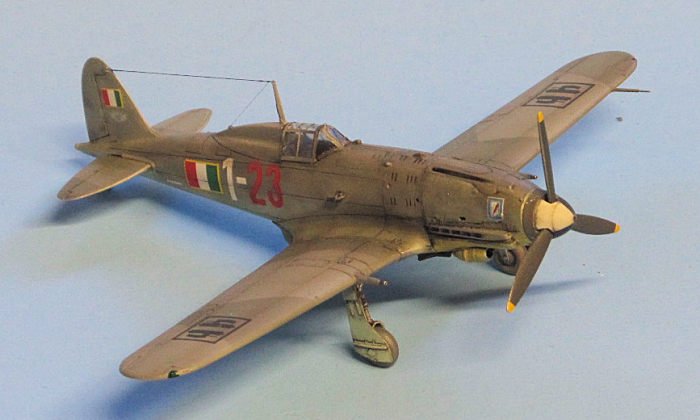
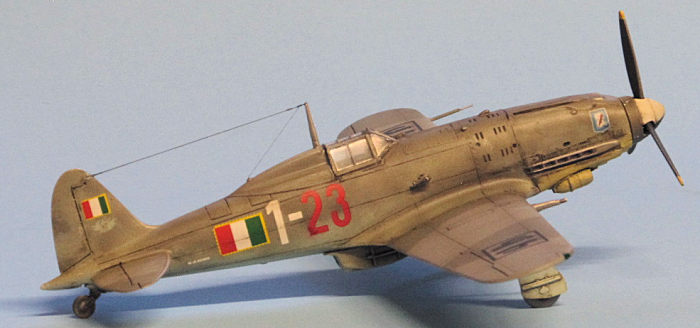
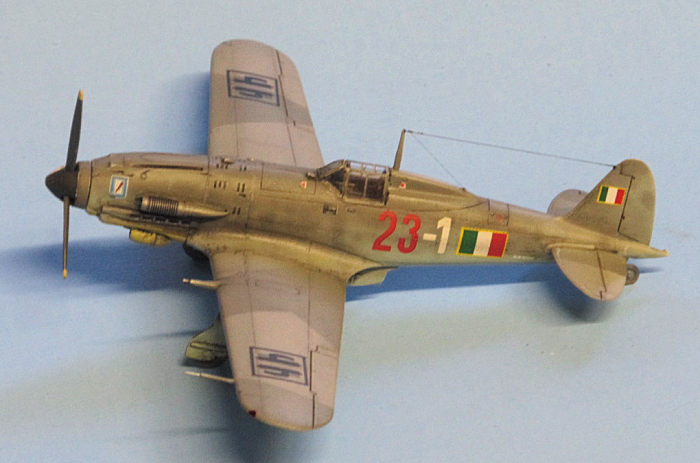
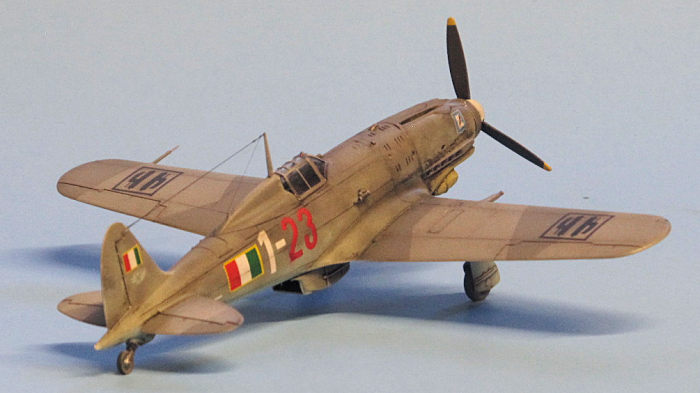 Nothing too difficult here. I chose the ever-popular ANR 23-1 for
the novelty of an Italian airplane wearing Luftwaffe colors. The model was
primed with my custom mix of Tamiya White sprayed into a little jar, outgassed,
and cut 50% with Randolph butyrate dope thinner. This was followed by the Yellow
panel under the nose; the two colors being allowed to cure overnight before the
latter was masked and an overall coat of RLM 76 sprayed over the model. This
enamel was allowed to cure for a week, then the RLM 74 and 75 followed.
Nothing too difficult here. I chose the ever-popular ANR 23-1 for
the novelty of an Italian airplane wearing Luftwaffe colors. The model was
primed with my custom mix of Tamiya White sprayed into a little jar, outgassed,
and cut 50% with Randolph butyrate dope thinner. This was followed by the Yellow
panel under the nose; the two colors being allowed to cure overnight before the
latter was masked and an overall coat of RLM 76 sprayed over the model. This
enamel was allowed to cure for a week, then the RLM 74 and 75 followed.
I am terrible at the art of depicting mottled finishes. Every result I've achieved has been less skill or scientific application more the end state of throwing every technique I know of separately at the problem repeatedly and interchangeably until I achieve something like the result I was after. That's why I do it as a separate procedure. I also never remember how exactly I did it. The painting done, the colors were sealed under a couple coats of Gunze Gloss cut 50% with Mr. Paint Leveler.
Italerei's decals took their sweet time (about fifteen minutes!) to come off their backing sheet in warm water, but responded well to Micro Set and Sol. Note that the "23-1" code on the fuselage left side should read "1-23" on the right, so the kit's corresponding decal needs to be dismembered and rearranged to depict this order accurately. They're a little thick, so I shot two gloss coats on the main markings and wet-sanded them with a 1500-grit foam sanding block to get them more level with their surroundings. My usual procedure of oil wash, highlighting and pastels, then a final finish with a semigloss acrylic followed. Detail paint and a pair of antenna lines from EZ Line and Ushi van der Rosten finished the project.
| CONCLUSIONS |
Plagiarism aside, this is really a neat little kit. I spent an inordinate amount of time detailing the model--I probably doubled construction effort with my decision to open up and create the landing gear bay 'snake pit'--but that's only because I like the subject and enjoyed working on it. Getting that main gear fork worked out is the only challenge that keeps me from recommending the kit to the beginner, but this little problem is also a good exercise for the newish modeler ready to step up his game. At this writing IBG Models has announced an all-new Folgore/Veltro family in 1/72, which will be undoubtedly eclipse both Hasegawa's and this Italerei kit, but probably at triple the price. If you want an inexpensive example of this fine Italian fighter in your lineup look no further than here.
| REFERENCES |
Plenty out there in both Italian and English. If you want the
ultimate technical references go for the MMP books. For most of the project, I
merely referred to the old Squadron "In-Action" MC.202 title and poked about
online for pictures of the wheel well.
Skulski, Przemyslaw. Macchi C.205 Veltro. MMP/Stratus, Poland 2020. ISBN
978-83-65958-70-9
Gentilli, Roberto. Macchi C.202 In Action. Squadron/Signal, Carrollton TX 1980. ISBN 0-89747-100-8
16 January 2026 Copyright ModelingMadness.com. All rights reserved. No
reproduction in part or in whole without express permission. If you would like your product reviewed fairly and
fairly quickly, please
contact
the editor or see other details in the
Note to
Contributors.