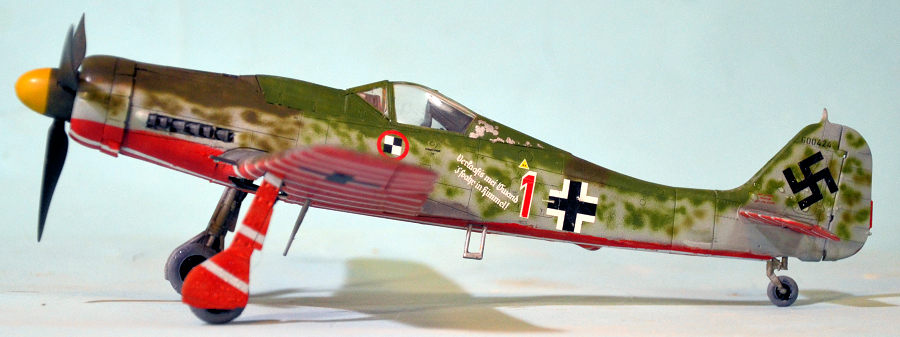
MiniArt 1/48 FW-190D-9 (early)
| KIT #: | 48093 |
| PRICE: | $44.00 |
| DECALS: | Two options |
| REVIEWER: | Tom Cleaver |
| NOTES: | Doras of Galland Flying Circus decal sheet |
| HISTORY |
The Fw 190D-9 appeared in the summer of 1944, with the first production aircraft arriving in III/JG 54 in August. The fighter had been developed for the air superiority role, with the engine changed from the BMW radial of the Fw 190A fighters to a Jumo 213 V-12 inline engine. The fuselage was extended with a longer cowl, and a rear fuselage extension to provide aerodynamic balance.
Kurt Tank was dissatisfied with the Dora-9 because he had been forced to use a bomber engine, rather than the DB 603 he wanted to use. He told pilots of the units equipped with the fighter that it was an “interim type”. Thus, pilots did not expect to find it had the performance it did. Indeed, the Fw 190D-9 would be recognized as perhaps the best German piston-engine fighter of the war.
 Due to the fuel
shortages from September 1944 on as a result of the Allied campaign against the
synthetic oil industry that saw Luftwaffe aviation fuel availability drop 90% by
late September, never to recover over the rest of the war, there was little
opportunity for training; pilots learned their mount in the limited combats they
engaged in during the longest and coldest European winter in a century.
JV 44 and the Platzshutz Staffel:
When Adolf Galland got his special Me 262 unit - Jagdverband 44 (JV 44)- operational in late March 1944, the unit was supposed to receive a staffel of Fw 190D-9s for airfield defense from II/JG 2. In the deteriorating conditions. That did not happen. Galland organized his own platzshutz staffel in early April. The unit would become known as the “Papagei Staffel” - Parrot Flight - in postwar aviation history, with the name coming from their callsign.
Leutnant Heinz “Heino” Sachsenberg, also known by the nickname “Wimmersal” for unknown reasons, was named commander of the unit. The son of World War I flying ace Oberleutnant-zur-See Gotthard Sachsenberg, Heino was also an experte with 100 victories credited by June 8, 1944 on the Eastern Front with JG 52. He was awarded the Ritterkreuz that day. He was happy to receive the assignment to set up a flight of piston-engine fighters, since he had found the Md 262 “not to my liking” when he was assigned to JG 7 the previous January.
Oberleutnant Klaus Faber from JG 6; Feldwebel Bodo Dirschauer from EJG 2; Leutnant Karl-Heinz Hoffman, an instructor from EJG 2; and Hauptmann Waldemar Wubke from JG 54 were the first to join the unit; several others - including two other NCO pilots - joined over the course of April. Dirschauer told researcher Robert Forsyth that he only ever heard the group called the “Wurger Staffel,” with callsigns “Wurger-one,” “Wurger-two,” etc. The pilots of the Wurger Staffel lived apart from the Me 262 pilots and only interacted with them when providing take-off and landing defense.
 At least five
Fw-190s were assigned to the unit - three Fw 190D-9s and the two Fw 190D-11s
previously assigned to the Verbandsfuhrerschule General der Jagdflieger (General
of Fighters Unit Leaders’ School), which were “requisitioned” after they were
found abandoned on their airfield. These fighters became well-known in the 1970s
as a result of work by researcher Jerry Crandall, who established that the
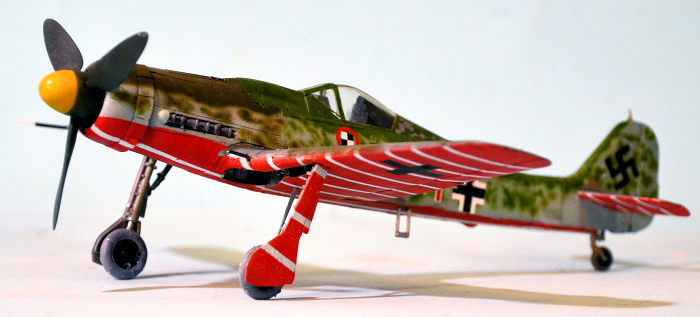
fighters’ bellies and lower wing and tail surfaces were painted red with white
stripes for instant indentification by the defending AA gunners. The three
Dora-9s and one of the Dora-11s had “suggestive” mottos painted on them, while
Rot Zwei - the second Dora-11 - was not so named. Sachsentberg’s Rot Ein had the
motto "Verkaaft's mei Gwand I foahr in Himmel!"(Sell my clothes, I’m going to
Heaven”).
The Doras flew in two-plane rotte elments and maintained an altitude of 460m when providing defense for the Me-262s takihg off; they had to land beforethe jets when they returned to the field, largely negating the protection. They did not have direct communication with the Me 262s. Galland later wrote that, “The Americans were constantly observing our airfields, and they attacked anybody who came out, or who tried to get in, expecialy at Munchen-Reim once they knew we were there, and we lost some of our men that way. Sachsenberg was a good pilot, andwe felt safer when his planes were in the air.” The Wurger flight is definitelyh known to have engged P-47s in a fight over Munchen-Reim on April 16, 1945.
(I’m indebted for this information to well-known Luftwaffe Jagdwaffe researcher Robert Forsyth, who spent nearly 40 years tracking down the members of the Sachsenbergschwarn as part of his research for his masterful “Jagdverband 44 - The Luftwaffe’s Mavericks” that Osprey will publish on November 3, 2026. The book is “definitive” and I recommend it without hesitation.)
| THE KIT |
 MiniArt released
this first kit of their Dora-9 series earlier this year. They have already
followed this “basic” kit with the “advanced” Dora-9 that has a full engine and
open cowling, a “basic” kit of the late-production Dora-9, and the “basic” kit
for the Fw 190D-11. The Fw 190D-13 will be released early next year.
The easiest thing to say about these kits is they are “definitive”. The best comparison is to the new-production Eduard Fw 190A series. The kit has petite surface detail, crisp molding, and supplies the rear portion of the Jumo-213 engine, which can be seen through the open wheel wells.
Decals for this kit provide markings for a Fw 190D-9 of JG 301; there is a second “basic” kit that has markings for II/JG 54, the first unit to take the Doira-9 on operations.
| CONSTRUCTION |
 Like the Eduard
Fw 190As, this kit is easy to assemble - if you follow the instructions.
The kit gets around the problem of fuselage centerline seams by a separate lower fuselage part. Be certain to assemble things per the instructions: the wing sub-assembly fits to the fuselage sub-assembly, and then the real lower fuselage plate is attached. Doing otherwise is not what you want to do, do not “assume” you know what is to be done without consulting the instructions, or “assume” really will make an “ass” of “u.” (Ask me how I found out). Follow the instructions and all goes well with a quick assembly.
| COLORS & MARKINGS |
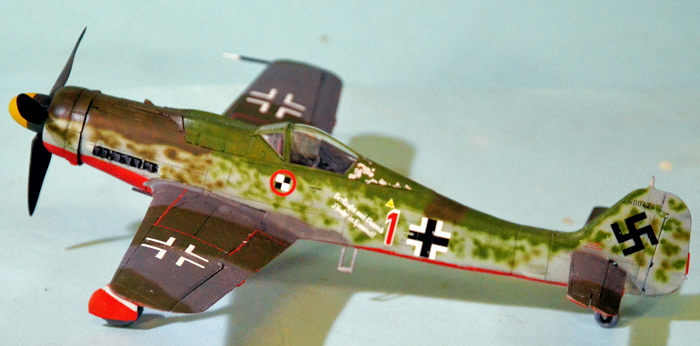
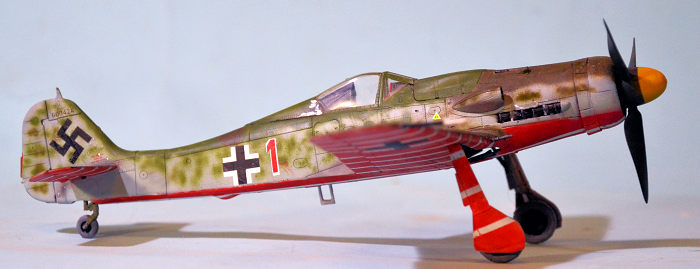
I decided I would do Sachsenberg’s Rot Ein since I didn’t have his airplane in my Sachsenberg Staffel collection. I used the Eagle Editions sheet for this.
After
preshading the model along panel lines with black, I painted the wheel wells,
gear legs and inner gear doors with Mr Hobby H-70 RLM02 Grau and masked off the
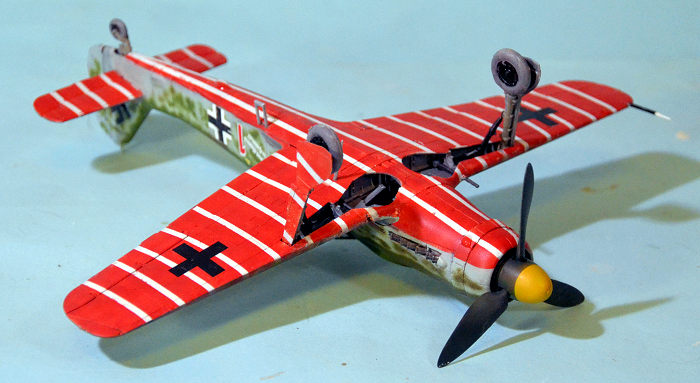
gear wells with kleenex stuffed in them. I then painted the lower surfaces with
Tamiya LP-35 “Insignia White”, after which I masked off the stripes with precut
Tamiya tape. On the original, this painting was done with the airpla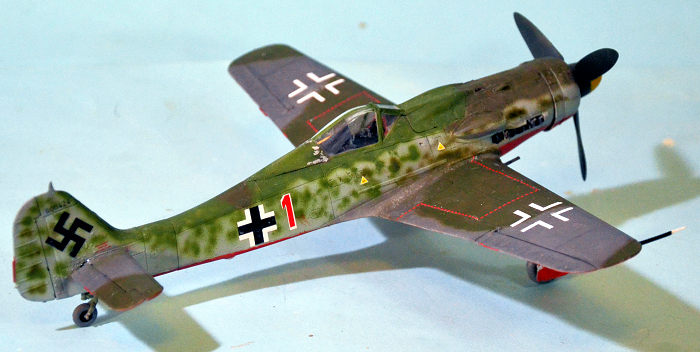 nes
sitting on their gear - the stripes are not nice and even; they go all over the
place in approximations of “straight and nice”. I then applied Mr. Hobby C-114,
“RLM23 Red” and masked that off.
The fuselage sides were painted with Mr. Hobby C-117 RLM76 Hellblau. The upper fuselage was painted with C-122, RLM85 Hellgrun and C-123 RLM80 Olivegun. The upper wings and stabilizers were painted with C-37 RLM75 Grauviolett and C-36 RLM75 Graugrun. The prop was painted with C-113 RLM04 Gelb, and C-18 RLM70 Dunkelgrun.
I then gave the model an overall coat of clear gloss and did the decals. EagleCals present no problems and everything went down under a coat of Micro-Sol.
When the decals were set, I gave the model a coat of clear flat.
I assembled and attached the main gear, the tailwheel and the prop. With that I declared victory.
| CONCLUSIONS |
The Mini-Art Dora 9 series is as excellent as Mini-Art’s P-47 series. The model is “definitive” of the Dora series as the new-mold Eduard kits are for the Anton series. Take care in following the instructions and all will be well. Highly recommended.
Review kit courtesy of all you book buyers.
29 October 2026
Copyright ModelingMadness.com. All rights reserved. No reproduction in part or in whole without express permission.
If you would like your product reviewed fairly and fairly quickly, please contact the editor or see other details in the Note to Contributors.