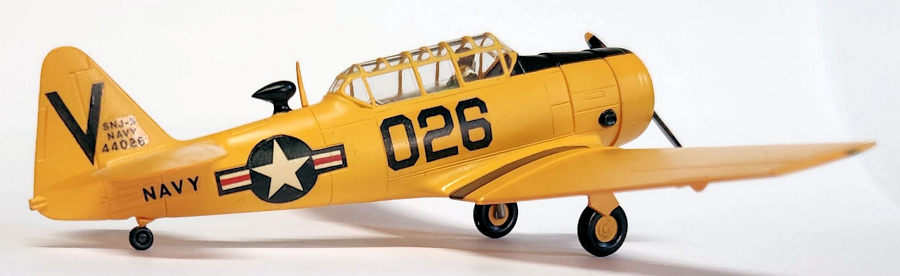
Hawk 1/72 SNJ
| KIT #: | 609 |
| PRICE: | $ |
| DECALS: | One Option |
| REVIEWER: | Chris Mikesh |
| NOTES: | Basic Kit Build |
| HISTORY |
The North American SNJ (AT-6 Texan in Army Air Forces service) became one of the most recognizable advanced trainers of World War II. Thousands of naval aviators took their final step toward earning carrier wings in the bright yellow "Yellow Peril." Although designed as a trainer, the rugged SNJ handled much like the fighters students would soon fly in combat. By war's end, nearly every U.S. Navy and Marine Corps pilot had accumulated many memorable hours in the cockpit of an SNJ before moving on to front-line aircraft.
A Student's First Solo
 Ensign
Richards had spent the past several weeks under the watchful eye of an
instructor who seemed convinced that every landing could be improved. This
morning was different. After one final circuit around the field, the
instructor climbed out, leaned into the cockpit, and simply said, "Don't
bend my airplane."
Ensign
Richards had spent the past several weeks under the watchful eye of an
instructor who seemed convinced that every landing could be improved. This
morning was different. After one final circuit around the field, the
instructor climbed out, leaned into the cockpit, and simply said, "Don't
bend my airplane."
As Richards taxied away with a big smile and eagerness… until he realized he was alone. The empty rear cockpit suddenly made the SNJ feel much larger than it had only moments before. Every sound seemed louder, every vibration more noticeable. He couldn't help wondering whether he would return with an intact airplane—or an unforgettable story for the Accident Board… or maybe not at all.
The takeoff was smooth with a little cross wind from the right. The pattern was uneventful. Turning onto base leg, he reminded himself of everything his instructor had drilled into him. Flaps, landing gear, RPM, speed, pitch, runway alignment, “what if I mess this up?” Turn onto Final. Line up the runway, check the wind sock… The landing wasn't perfect. There was one small hop before the tires settled onto the runway.
Good enough.
As he taxied back toward the line, the instructor was smiling. Richards let out the breath he'd apparently been holding since takeoff.
He made it…he was now a solo naval aviator.
| THE KIT |
 The Hawk SNJ
is very much a product of its era, yet it remains one of those kits that can
still put a smile on a modeler's face. Consisting of only twenty-one parts, it
was designed for simplicity rather than super-detailing. The one-piece wing
eliminates alignment problems, while the flying surfaces are molded in place.
More surprising are the finely recessed panel lines, a feature uncommon on kits
produced during the late 1950s and early 1960s.
The Hawk SNJ
is very much a product of its era, yet it remains one of those kits that can
still put a smile on a modeler's face. Consisting of only twenty-one parts, it
was designed for simplicity rather than super-detailing. The one-piece wing
eliminates alignment problems, while the flying surfaces are molded in place.
More surprising are the finely recessed panel lines, a feature uncommon on kits
produced during the late 1950s and early 1960s.
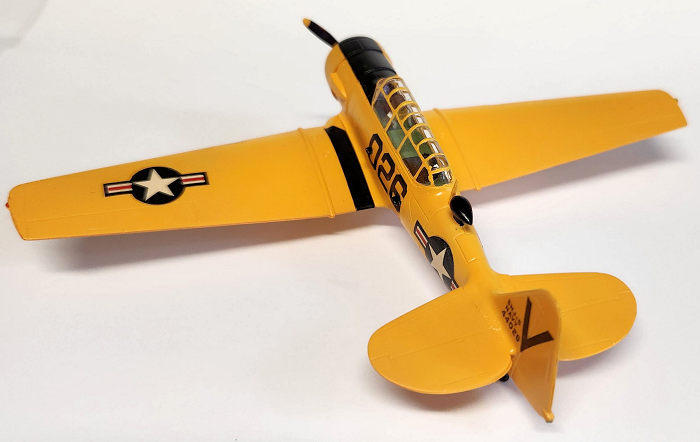
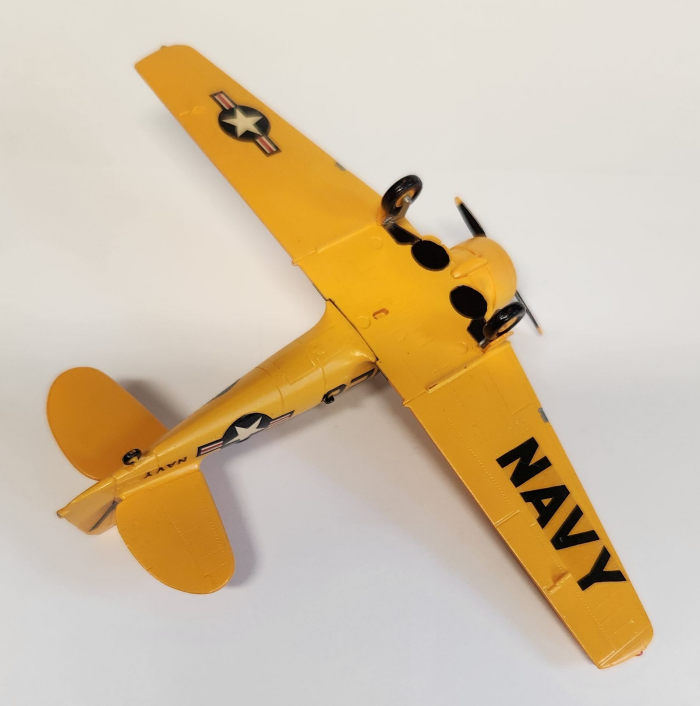
Cockpit detail is minimal, consisting of a seated pilot with little else inside the fuselage. For this build, I added a simple bulkhead between the front and rear cockpits to create the illusion of a more complete interior when viewed through the canopy. It is a small modification, but one that noticeably improves the appearance without sacrificing the simplicity of the kit. There are no wheel wells, the engine is basic, and assembly is straightforward. Very little filler was required, and the model could easily be completed over a relaxing weekend.
| COLORS & MARKINGS |
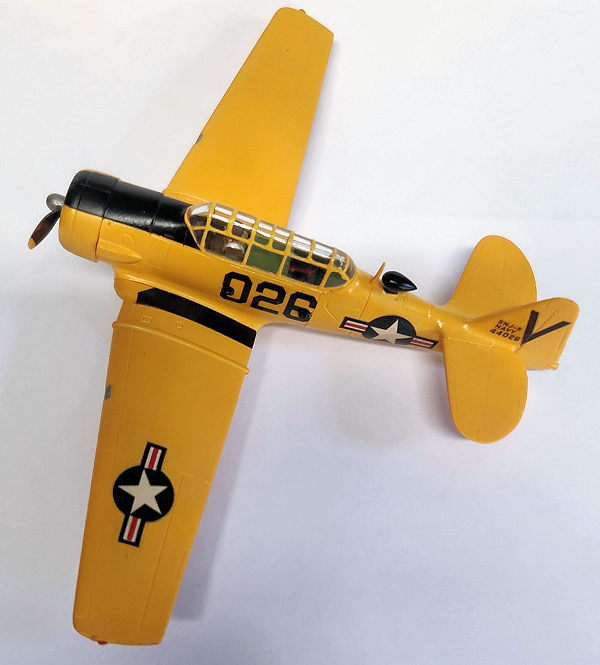 This model
was finished using the kit decals, which performed surprisingly well considering
their age. The overall Trainer Yellow finish (Aerosol Testors Yellow Gold) is
one of the most recognizable paint schemes ever worn by a U.S. Navy aircraft.
The black anti-glare panel, propeller, wheel hubs, and trim provide an
attractive contrast to the bright yellow airframe. The finished model captures
the unmistakable appearance of the famous Navy trainer and makes an eye-catching
addition to any collection of World War II aircraft.
This model
was finished using the kit decals, which performed surprisingly well considering
their age. The overall Trainer Yellow finish (Aerosol Testors Yellow Gold) is
one of the most recognizable paint schemes ever worn by a U.S. Navy aircraft.
The black anti-glare panel, propeller, wheel hubs, and trim provide an
attractive contrast to the bright yellow airframe. The finished model captures
the unmistakable appearance of the famous Navy trainer and makes an eye-catching
addition to any collection of World War II aircraft.
Because Hawk omitted wheel wells, I simply painted the openings flat black to suggest depth rather than attempting major modifications. Final assembly consisted primarily of installing the landing gear, propeller, canopy, and radio mast. The canopy was carefully masked and hand-painted before receiving a coat of Future floor finish to restore its clarity and shine. Like many vintage Hawk kits, the engineering is uncomplicated, the fit is surprisingly good, and the project moves along quickly from start to finish.
| CONCLUSIONS |
The Hawk SNJ will never rival today's highly detailed kits, nor was it intended to. Instead, it offers exactly what many modelers occasionally need—a straightforward, enjoyable project that can be completed in a weekend without hundreds of tiny parts. It captures the unmistakable character of the Navy's famous advanced trainer and provides an excellent canvas for practicing painting, finishing, or simple detailing techniques. More than sixty years after its introduction, this little Hawk classic still reminds us that the hobby is supposed to be enjoyable. Sometimes the simplest kits provide the greatest satisfaction.
17 July 2026 Copyright ModelingMadness.com. All rights reserved. No
reproduction in part or in whole without express permission from the editor. If you would like your product reviewed fairly and fairly quickly, please
contact the editor or see other details in the
Note to
Contributors.