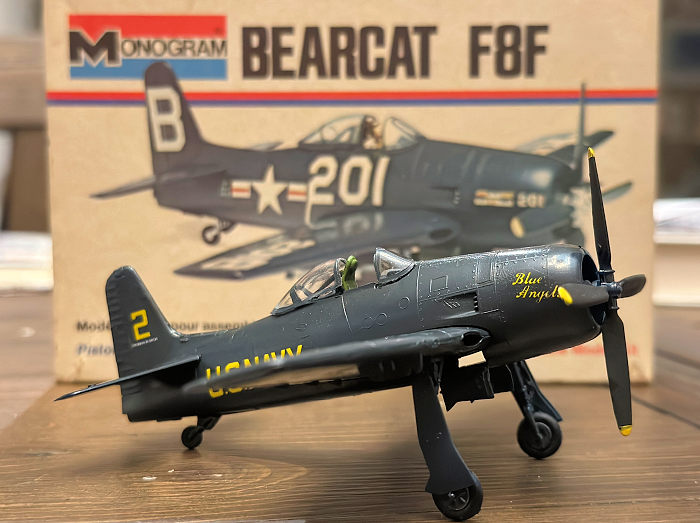
Monogram 1/72 F8F-2 Bearcat
| KIT #: | 6789 |
| PRICE: | $10.00 'used' |
| DECALS: | One option |
| REVIEWER: | David Traill |
| NOTES: | Microscale 72-217 |
| HISTORY |
(The following his is taken directly from Nicolai Plesberg’s review of this same kit from years past.)
With the advent of the F6F Hellcat the Allied air forces in the Pacific were winning the air war against the Japanese air forces, most notably against the once so dreaded Mitsubishi Zero, which so effectively had hacked Allied airpower out of the sky during the first year of the Pacific war. Even so, the growing Allied success was a combination of the Allied planes, namely the aforementioned F6F (not forgetting the F4U Corsair) and the fact that pilots had improved combat experience, while the Japanese still suffered from those crippling defeats at Midway and the Solomon Islands, which cost them their most skilled pilots not to mention their largest carriers. They were never able to recover from these defeats by training new pilots, nor rebuilding its carrier force because it takes time and the Japanese didn’t have the necessary time at this stage of the war.
The Hellcat was, because of its weight (fully loaded the Hellcat weighted more than double of the Zero), not able to turn directly with the Zero in a dogfight, so the Navy put out a request for a carrier-based interceptor, which should be capable of outrunning, out climbing and outmanoeuvring anything in service or under design at that time. To achieve this, the Navy was willing to sacrifice range and armament.
Grumman’s engineers responded to the request
by taking the best feature of the Hellcat, namely by keeping the Pratt & Whitney
R-2800 Double Wasp, and then simply design the smallest possible airframe th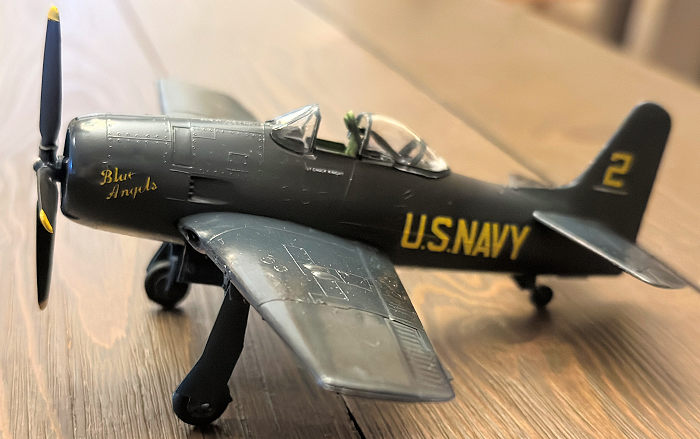 is
monster of a fuel thirsty engine would fit into. The main goal was to reduce
weight and this was mostly accomplished by reducing fuel capacity the resulting
airframe being sleeker, but without compromising the Grumman trademark of rugged
construction. The Hellcat´s armament of six .50 cal. machine guns were reduced
to four in the new fighter, since it was reasoned to be adequate to destroy the
lighter build and less rugged Japanese aircraft, such as the Zero, which
fireballed immediately if hit.
is
monster of a fuel thirsty engine would fit into. The main goal was to reduce
weight and this was mostly accomplished by reducing fuel capacity the resulting
airframe being sleeker, but without compromising the Grumman trademark of rugged
construction. The Hellcat´s armament of six .50 cal. machine guns were reduced
to four in the new fighter, since it was reasoned to be adequate to destroy the
lighter build and less rugged Japanese aircraft, such as the Zero, which
fireballed immediately if hit.
The first prototype designated XF8F-1 flew on 21 August 1944, and the first production F8F-1 Bearcat (as the new Grumman fighter was named) in November 1944 and in the following months Bearcats were delivered to squadrons, and training commenced simultaneously. By July 1945 the first squadrons were almost combat ready, but the war ended before any Bearcats had reached the combat zone. The Bearcat served in first line service in the US Navy until 1951-52, when jets finally had surpassed its performance – the Bearcat could climb faster than most early jets, but by 1950 this gap had rapidly been closed.
The Bearcat also attracted foreign service; with the Armée de l’Air in Indochina the French used it in the fighter bomber role and it served with distinction during the battle for Dien Bien Phu in 1954. In service it was known as the “Beercat” because most French personnel did mispronounce its name. Ex- French machines served with the VNAF (South Vietnamese Air Force) until 1959, when these were replaced by Trojans (and later Skyraiders). Also Thailand received more than 100 Bearcats, where they served until around 1960.
The Bearcat has also been used as civilian racing aircraft more or less modified to attain as high a speed as possible. Notably the Conquest 1, Daryl Greenamyer´s Bearcat, set a new world speed record for non-jet aircraft at 482.5 mph (776.3 km/h) in August 1969. A later record pushed this figure up past 520 mph in 1989, but that was achieved in a highly modified and tuned Bearcat named Rare Bear.
| THE KIT |
Monogram released this kit at least two times, first in 1967 and then in 1979, which is when my kit dated from. This older and simpler kit consisted of only 30 parts. The instructions that came with the kit are in an exploded form, rather than a step-by-step assembly. Decals were provided for only one example, which was not identified in the kit instructions (Scalemates says the decals are for a plane from VF-20A aboard the USS Boxer (CV-21)). A centerline drop tank and underwing rockets are provided as armament.
| CONSTRUCTION |
 I knew
from the start that I wanted to build this kit to add to my history of the Blue
Angels planes. The first step was to join the upper and lower wings together
since they are intended to be the base that the fuselage halves are joined onto
by sliding them from the ends of the wings toward the center. The machine guns
molded onto the wings were not used for Blue Angels planes so I took those off
at the start. After painting the rather limited interior in Testors green
chromate, I chose to omit the pilot and, as instructed, slid the solid tailplane
and wings into position on one half of the fuselage and then cemented the other
side into place after putting in the engine and firewall up front. At this point
the plane’s construction was nearly complete given its simplicity.
I knew
from the start that I wanted to build this kit to add to my history of the Blue
Angels planes. The first step was to join the upper and lower wings together
since they are intended to be the base that the fuselage halves are joined onto
by sliding them from the ends of the wings toward the center. The machine guns
molded onto the wings were not used for Blue Angels planes so I took those off
at the start. After painting the rather limited interior in Testors green
chromate, I chose to omit the pilot and, as instructed, slid the solid tailplane
and wings into position on one half of the fuselage and then cemented the other
side into place after putting in the engine and firewall up front. At this point
the plane’s construction was nearly complete given its simplicity.
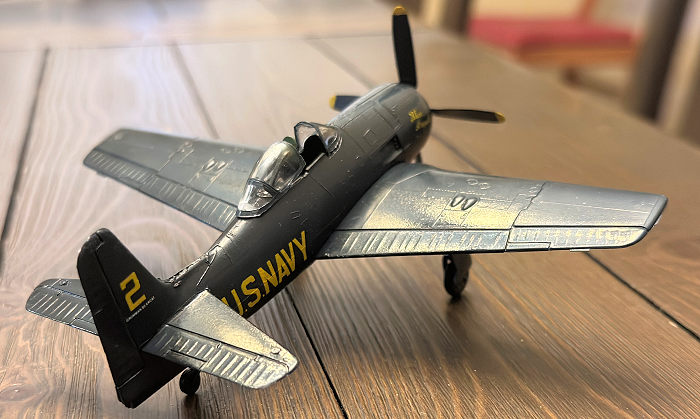
After a lot of Internet research showed that standard “Blue Angels Blue” was not the original color, I had a devil of a time finding what several authoritative websites suggested was the right color, Gloss Sea Blue FS 15042. Amazon sells a model paint brand I had not used before, Mission Models, and after reading online reviews I got bottles of the paint, mix additive and thinner to mix for my airbrush as recommended. I first used Mission Models’ black primer to lay down as a base, and it did a phenomenal job. The mixed paint went on easily and I came away thoroughly impressed with the paint job in the end.
After airbrushing the gear doors and handpainting the wheels and struts they were assembled and attached. Interior wheel wells were supposedly also the Glossy Sea Blue so they did not need attention having been airbrushed along with the rest of the model. The canopy, windshield and propeller were painted and added, and now all that remained was the decals.
I was concerned that the ancient Microscale sheet (72-217) I had with Bearcat Blue Angels markings might not work well, but they ended up behaving perfectly and went on very smoothly. Two things that were hard to pin down was when the silver leading edge of the wings was added as websites differed, and under the wings the decals on both sides said “US NAVY” while photos showed examples of planes with “US” under one wing and “NAVY” under the other. I chose to follow the guidelines of the Microscale sheet since few people would be looking under the wings and I build models for my enjoyment, not for competitions.
| CONCLUSIONS |
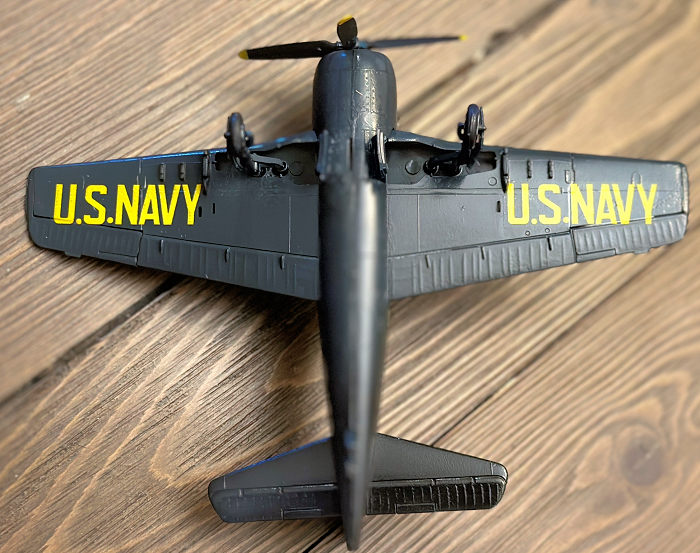 This
older kit did bring me closer to finishing my history of the Blue Angels and was
a fun, easy build aside researching the right shades and then mastering a non-Testors
paint experience. Being an older kit means it is not amazingly detailed- you can
see straight through the landing gear compartments toward the other side since
there is nothing filling in that area. Modelers will need to fill a hole that is
intended for an included plastic display stand unless the want to position their
plane that way. I’m sure the long out-of-production Microscale sheet might be
hard to find, but there is a Print Scale decals sheet with plane #2 (and the
yellow Bearcat decals for the solo plane they used). This build could easily be
done with the right preparation over a weekend and made me very happy in the
end.
This
older kit did bring me closer to finishing my history of the Blue Angels and was
a fun, easy build aside researching the right shades and then mastering a non-Testors
paint experience. Being an older kit means it is not amazingly detailed- you can
see straight through the landing gear compartments toward the other side since
there is nothing filling in that area. Modelers will need to fill a hole that is
intended for an included plastic display stand unless the want to position their
plane that way. I’m sure the long out-of-production Microscale sheet might be
hard to find, but there is a Print Scale decals sheet with plane #2 (and the
yellow Bearcat decals for the solo plane they used). This build could easily be
done with the right preparation over a weekend and made me very happy in the
end.
| REFERENCES |
https://www.scalemates.com/kits/monogram-6789-bearcat-f8f--121796
The History of the Blue Angels - A reasonable Modeler's Guide (Updated!)
https://www.wingsofgoldscalemodels.com/post/the-history-of-the-blue-angels
29 April 2025
Copyright ModelingMadness.com. All rights reserved. No
reproduction in part or in whole without express permission.
If you would like your product reviewed fairly and fairly
quickly, please
contact
the editor or see other details in the
Note to
Contributors.