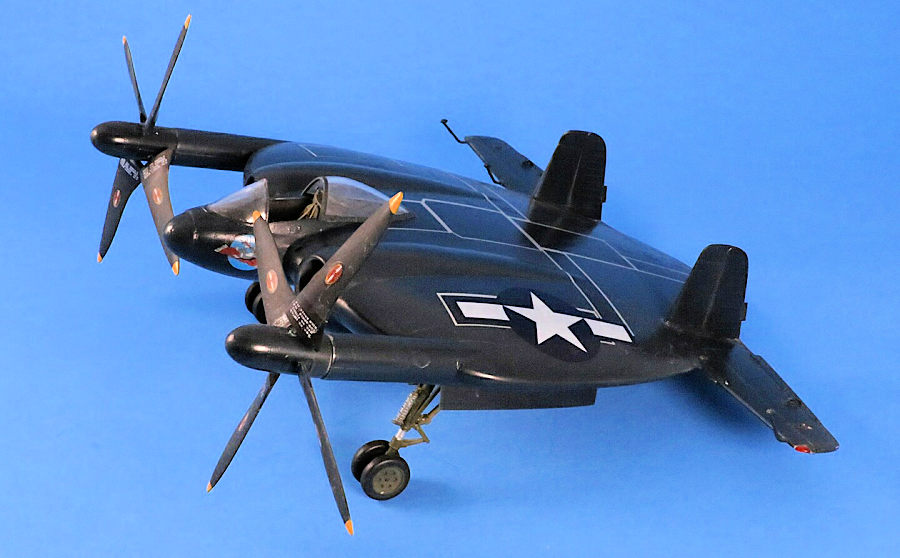
KittyHawk 1/48 XF5U-1 'Flying Flapjack'
| KIT #: | KH10835 |
| PRICE: | $ |
| DECALS: | Two options |
| REVIEWER: | Chuck Horner |
| NOTES: |
| HISTORY |
The XF5U-1 was a WWII Naval fighter designed by Charles H. Zimmerman, an aeronautical aerodynamics engineer working for the Chance Vought company. Zimmerman’s near circular wing-body design with large roto-type propellers at the wing tips, something he had been working on during the 1930’s, offered excellent low-speed handing yet high-speed maneuvering. This would have been a near VTOL aircraft with projected top speed in excess of 450 mph. This very much interested the Navy and a development contract was issued to Vought.
 A
small-scale, light-weight demonstrator, made of wood and fabric, took to the air
in November 1942 with the Vought designator V-173. It was powered by two 80 hp
Ranger engines swinging two three-bladed, 16 ft., counter-rotating props. The
aircraft flew very well and proved the concept.
A
small-scale, light-weight demonstrator, made of wood and fabric, took to the air
in November 1942 with the Vought designator V-173. It was powered by two 80 hp
Ranger engines swinging two three-bladed, 16 ft., counter-rotating props. The
aircraft flew very well and proved the concept.
In July 1944, the Navy order two prototypes of the full fighter version, designated XF5U-1, powered by a pair of P&W R2000 engines. Due to war priorities, especially Vought’s F4U Corsair production requirements, development of the XF5U lagged. It wasn’t until August 1945 that the aircraft was ready for ground tests. But there were still more delays. The special roto-props were slow in coming and early ground tests used Corsair propellers. Finally in February 1947, test pilot, Boone Guyton was able to make high-speed taxi tests at Vought’s Connecticut plant.
The complexity of the systems and heavy vibration problems prolonged these tests until the Navy, with the arrival of jets, could no longer see any reason to continue. The plane’s first flight was deemed too dangerous to take place at Vought’s Connecticut plant. The one-piece, wing-fuselage was too wide to transport by either road or rail and could not be broken down any smaller. Transporting by ship, through the Panama Canal, was the only way to get it to Edwards and this was just too expensive. The Navy cancelled the project on March 17, 1947 before the prototype could take to the air. Vought tried to interest the Navy in a turbo-prop version, but the proposal went nowhere and both prototypes were scraped. The machine was so well built and so strong it literally took a large wrecking ball to break them up.
| THE KIT |
 I had been
aware of “Zimmerman’s Skimmer” for some years, but never expected to see a
main-stream model of it in 1/48 scale. When Kitty Hawk issued this kit in 2015,
I scooped it up. For me, the completely fictional “Uncle Sam” markings was
something of a turn-off, but the simple prototype markings were also included.
The model comes with 162 pieces on five sprues, including clear parts, a
multi-page instruction book with full-color drawings showing the plane in its
various markings, a small photo-etched fret of seat belts, and decal markings on
two sheets.
I had been
aware of “Zimmerman’s Skimmer” for some years, but never expected to see a
main-stream model of it in 1/48 scale. When Kitty Hawk issued this kit in 2015,
I scooped it up. For me, the completely fictional “Uncle Sam” markings was
something of a turn-off, but the simple prototype markings were also included.
The model comes with 162 pieces on five sprues, including clear parts, a
multi-page instruction book with full-color drawings showing the plane in its
various markings, a small photo-etched fret of seat belts, and decal markings on
two sheets.
| CONSTRUCTION |
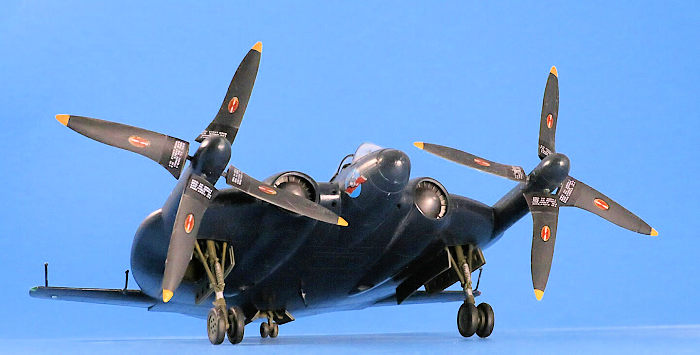
The construction is pretty straight forward. The entire circular wing-fuselage is a two-piece clam-shell. This captures the cockpit, main gear wells, tail wheel well and two large engine exhaust pipes although no engines. There are separate panels top and bottom over the engine area and it looks like Kitty Hawk was going to include engines, but didn’t. In any case, there is room to add a pair of resin R2000 if one wanted too.
The first issue for me was the main landing gear. The gear struts are made up of 5 pieces each, most small and delicate. I had trouble getting these to line up correctly in the bays. Even though I added them at the end of the build, I still manage to break one of the thin support braces.
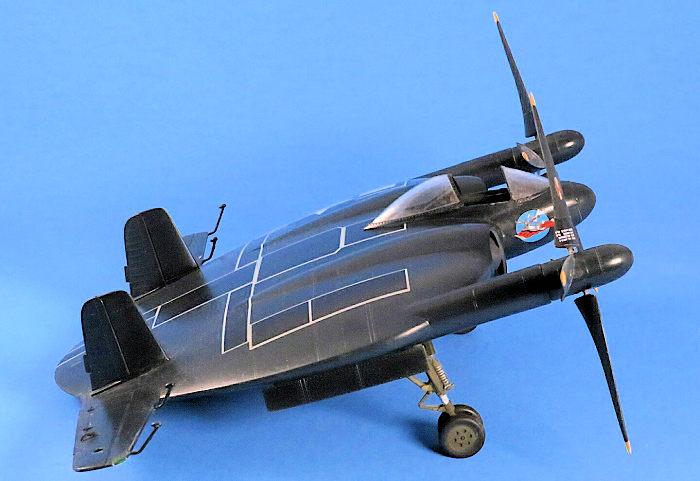 I decided to
keep the arresting gear closed. On the real plane, this device come out of the
top of the plane and reaches over the back end to grab the arresting wire. It
looks like a giant spider’s leg. Although authentic, it looked too weird to
include. Unfortunately, the doors do not fit well closed and some sanding and
filling were in order.
I decided to
keep the arresting gear closed. On the real plane, this device come out of the
top of the plane and reaches over the back end to grab the arresting wire. It
looks like a giant spider’s leg. Although authentic, it looked too weird to
include. Unfortunately, the doors do not fit well closed and some sanding and
filling were in order.
The last issue I had was the roto-props. The hubs are four pieces and each blade is attached individually by a single, small pivot rod. There is supposed to be a notch to correctly lock the blade in place, but it’s a little vague and I had trouble get them attached correctly.
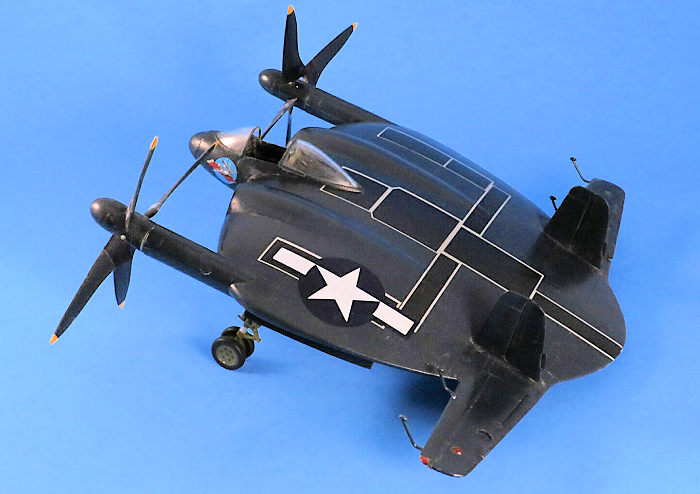
All and all, these were somewhat minor and the build went pretty smooth. I decided to show it in its late prototype dress—dark Navy Sea Blue with a single large WWII star & bar on the top left. Kitty Hawk provides an elaborate set of what they describe as black “walkway” makings, out-lined in white. I applied them as part of the markings but later learned that they were really rubber work matts laid on top of the fuselage to make access easier to various panels.
| CONCLUSIONS |
Finally, something that I usually don’t think about: There isn’t any way to safely pick the finished model! If you try picking it up on the side (like a wing tip), you’ll probably break a main gear door or worst, a gear leg. From the back, the tail wheel doors are in the way. If your hand is big enough, you might be able to stretch and grab across to both wing tips. From the nose is safer, unless you bend or break a prop blade at its single-point attachment. All of the above brought it back to the table for repairs a number of times.
Just looking at the model now in front of me, in the short trip from the display shelf to my writing desk, I manage to nick a prop blade and bent it back. It just fell off as I type this. Oh well, back the repair desk.
| REFERENCES |
THE AMERICAN FIGHTER by Enso Angelucci, copywrite
1965, Crown books
Wikipedia – Vought XF5U
18 July 2025
Copyright ModelingMadness.com. All rights reserved. No reproduction in part or in whole without express permission from the editor.
If you would like your product reviewed fairly and fairly quickly, please contact the editor or see other details in the Note to Contributors.