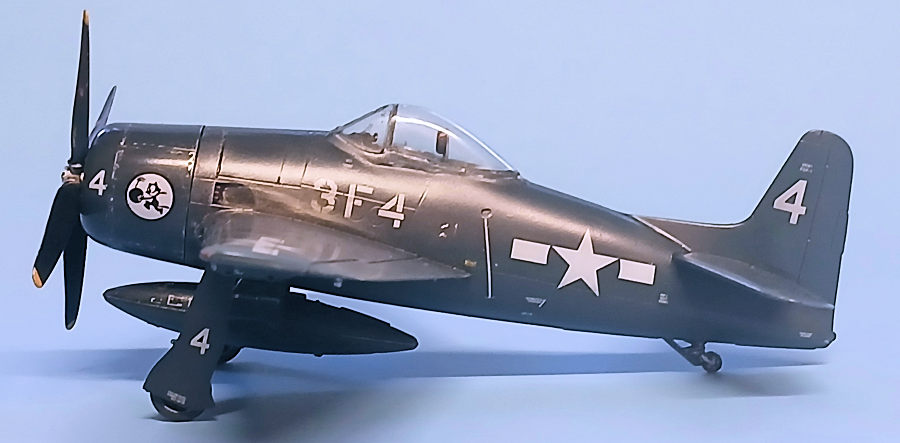
Hobby Boss 1/72 F8F-1 Bearcat
| KIT #: | 87267 |
| PRICE: | $15,00 |
| DECALS: | Two options |
| REVIEWER: | Ryan Grosswiler |
| NOTES: | Easy Assembly kit. Vac canopy. |
| HISTORY |
The Bearcat is a great example of how a certain set of technologies, developed by the best minds and most skilled hands available, can somehow manage to inadvertently demonstrate the exact definition of "dead end". In a period where American naval fighter aircraft were designed and built with a big-heavy-and-massive-firepower design philosophy, it was recognized that there was a need to meet the lighter, cleaner Japanese opponent more directly. The F8F was conceived at the end of 1943 by Grumman engineer William Schwendler as a fighter to fill this gap, the first prototype flying nine months later. A jetlike climb rate of 4800 feet per minute, speed of 341 knots over the waves and close to 400 MPH at high altitude, a roll rate double that of the Hellcat, plus racks for a fairly substantial load of exterior ordinance were among many attributes that distinguished the new airplane.
 Immediately, the
reviews by both civilian test crew and Navy pilots were over-the-top ecstatic,
with one unattributed individual bubbling, "This is the first real fighter I
have ever flown!" Within two months, the airplane was present at the Joint
Fighter Conference at Pax River, where--still in test status-- it was mobbed by
the pilots present and continued praise, a pat on the back for both the Grumman
test and development team and the nascent Lightweight Fighter Mafia who'd been
pushing it. Some problems with the hydraulic system (the backup gear extension
proved itself a most reliable design during this period) and other sundries were
worked out, and by several months into 1945 both production and the formation of
combat units for the fleet were ramping
up. The first squadron, VF-19, departed westward from Hawaii on board the USS
Langley on 02 August, missing the war by mere days.
Immediately, the
reviews by both civilian test crew and Navy pilots were over-the-top ecstatic,
with one unattributed individual bubbling, "This is the first real fighter I
have ever flown!" Within two months, the airplane was present at the Joint
Fighter Conference at Pax River, where--still in test status-- it was mobbed by
the pilots present and continued praise, a pat on the back for both the Grumman
test and development team and the nascent Lightweight Fighter Mafia who'd been
pushing it. Some problems with the hydraulic system (the backup gear extension
proved itself a most reliable design during this period) and other sundries were
worked out, and by several months into 1945 both production and the formation of
combat units for the fleet were ramping
up. The first squadron, VF-19, departed westward from Hawaii on board the USS
Langley on 02 August, missing the war by mere days.
While by 1947 the Bearcat was beginning to crowd the decks of US aircraft carriers as intended, the end ironically seemed near. In the spring of 1946, a P-80 bailed to the Navy for jet carrier operations development had been pitted against the Bearcat in a mock turning fight, both being flown by combat-experienced pilots. The pilot of the F8F stated afterwards that he was unable to take the initiative at any time, only once or twice had the Shooting Star lined up in his sights at all, and never long enough for even a single burst of his guns. In the year and a half since being the star of the Joint Fighter Conference, this fine specimen of the very pinnacle of piston-engine fighter technology was thoroughly bested by the very lowliest and undeveloped of the jets!
One would think that this was the end of the story, but further south and west in the Pacific, the Chinese Communists were gaining the upper hand in their own country, and there were immediate effects in two bordering countries. In one of them, the occupying French were beginning to look less like a naughty colonial power and more like a Bulwark Against The Communist Menace. They were still recovering from their disastrous experience in World War II, however: Their armed forces in the region, two-thirds of which were comprised of North and sub-Saharan Africans, local Vietnamese, and Foreign Legionnaires, were likewise equipped with a motley and polyglot complement of aircraft against an increasingly better-armed and cunning enemy. But maybe I'll tell this story later with another model...
| THE KIT |
 All sprues are well
packed and protected. If you're not familiar with this range of kits, they're
aimed at the neophyte and generally consist of a 2-part wing-fuselage assembly
with a set of small bits to attach to the resulting airplane form. Just 29 parts
on this one. All panel lines are recessed and quite refined. Cockpit and engine
are molded integrally with the fuselage and cowl, respectively, the only major
compromise toward simplicity experienced modelers will note, and the engine
crankcase front is rather square. Wheels are likewise molded to the landing
gear, but in this scale that really doesn't make any difference. Fins on the
bombs and rockets are wonderfully slide-molded to make these parts single-piece;
a more subtle and impressive display of this technology are the crisp gun ports
and intakes formed in place along the wing leading edge.
All sprues are well
packed and protected. If you're not familiar with this range of kits, they're
aimed at the neophyte and generally consist of a 2-part wing-fuselage assembly
with a set of small bits to attach to the resulting airplane form. Just 29 parts
on this one. All panel lines are recessed and quite refined. Cockpit and engine
are molded integrally with the fuselage and cowl, respectively, the only major
compromise toward simplicity experienced modelers will note, and the engine
crankcase front is rather square. Wheels are likewise molded to the landing
gear, but in this scale that really doesn't make any difference. Fins on the
bombs and rockets are wonderfully slide-molded to make these parts single-piece;
a more subtle and impressive display of this technology are the crisp gun ports
and intakes formed in place along the wing leading edge.
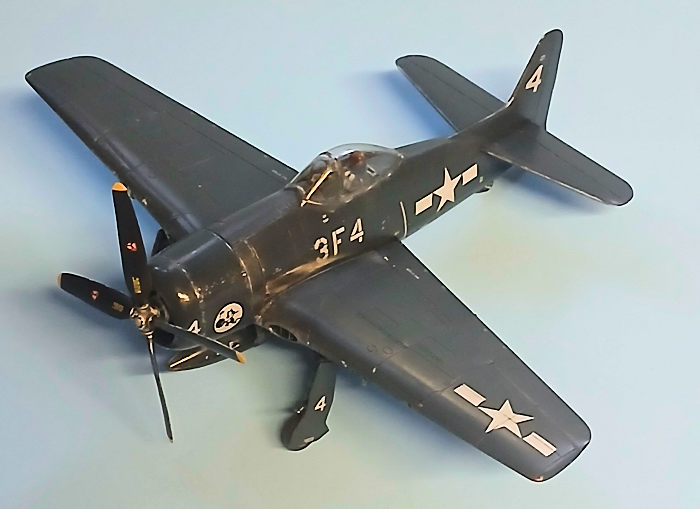
Hobby Boss' three releases of this kit have different fuselage or wing combinations to accommodate the cannon wing or the taller tail of the -2. These are combined with a sprue common to all of them for the stabilizers and small parts. Here, four cannon barrels go unused. As mentioned, some simplification is evident here and there, but ends up being almost unnoticeable on the finished model. The only real concern upon inspection is that the characteristically proud and bulbous Bearcat canopy is too short, almost like the Unlimited racer Rarebear. Decals cover both a standard Gloss Sea Blue example from the immediate postwar fleet and the garish, all-yellow Beetle Bomb of the early Blue Angels act. Comprehensive technical stenciling for both is included.
| CONSTRUCTION |
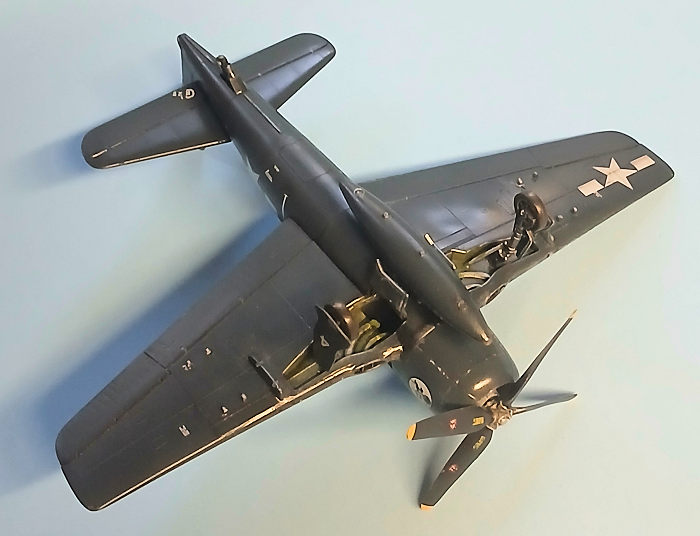
Working with quick-setting cement and a set of precut masks, a modeler could have this project ready for paint in about thirty minutes. All parts fit exceptionally well, and hold with a little friction...almost like a snap-together kit. Snip them off the sprue, press them together, run a little cement into the joint, and move ahead. I spent some time filling, sanding, and rescribing the main seam between the top and bottom main components, but for what it's worth, this joint does in fact fall exactly on a panel line.
 Despite my desire to
keep this project a quick one, I took the time to improve some other things: 1)
the unrealistic ribbing on the control surfaces was filled and sanded, 2) a bit
more detail was added into the cockpit and wheel wells, remembering that these
early airframes didn't have the full roll-over structure behind the pilot: there
was only a simple armor plate there. I also (3) deepened the scribing in some
areas, especially the cowl flaps.
Despite my desire to
keep this project a quick one, I took the time to improve some other things: 1)
the unrealistic ribbing on the control surfaces was filled and sanded, 2) a bit
more detail was added into the cockpit and wheel wells, remembering that these
early airframes didn't have the full roll-over structure behind the pilot: there
was only a simple armor plate there. I also (3) deepened the scribing in some
areas, especially the cowl flaps.
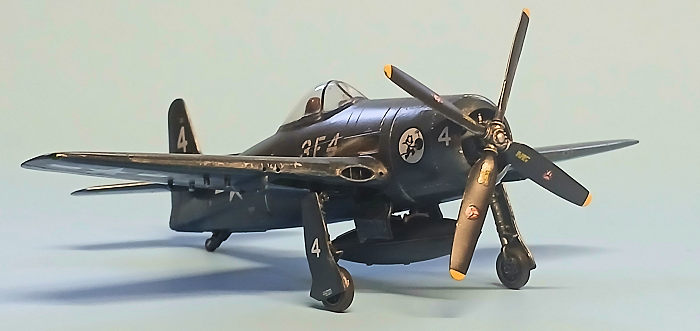
Finally (4) the kit canopy was replaced, as noted being noticeably too short (thus lacking the characteristic Bearcat proud look) and a big mold parting line running down the topside. A Falcon/Squadron canopy took its place, having better shape and height. It did require some adaptation (it's meant for the Monogram kit) as it shares the same "footprint" as the kit's canopy in plan view, but the bottom contouring is different. Once cut free from its backing sheet, I got the canopy to fit as close as I could with my sanding stick, then CA'd it into place. The gaps were then filled with a bit of J&B Weld, brushed into shape with isopropyl alcohol, and treated with a little wet-sanding when cured. Now I think I got the canopy a bit too tall. Is it? Is it? Nahhhhh....
Landing gear is thoughtfully engineered for correct alignment during assembly and strength when done; I really wish more manufacturers would take the time ensure that experience in this scale. After dry-fitting the mains, gluing the retraction struts and doors and letting the joints dry, I pulled the landing gear off the model, painted and dry-brushed the wheel hubs separately before masking them for separate painting. Likewise, the drop tank was made up and set aside, and the underwing racks were cut from their ordinance (to depict typical postwar emptiness) and glued on the model.
| COLORS & MARKINGS |
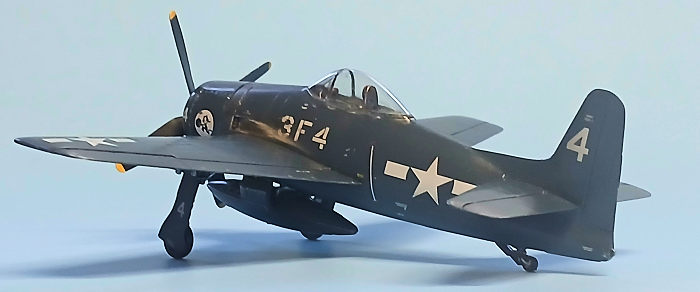 I didn't bother with
primer. The canopy and wheel wells were masked and a couple of coats of
Xtracolor Gloss Sea Blue (lightened with a little Testor's Flat Sky Blue to
bring it into scale effect and blue it up a bit) were shot over the bare
plastic. This base coat was allowed to cure for a week.
I didn't bother with
primer. The canopy and wheel wells were masked and a couple of coats of
Xtracolor Gloss Sea Blue (lightened with a little Testor's Flat Sky Blue to
bring it into scale effect and blue it up a bit) were shot over the bare
plastic. This base coat was allowed to cure for a week.
Decals went on straight over this, and proved exceptionally thin and sharp, responding well to Micro Set and Sol. The "13" and "31" designation difference on the national markings is not a misprint, nor a subtle reference to "Pretty Fly For A White Guy". Quality is such that when fully dried the decals almost totally disappeared into that glossy finish, even before the first clear coat went on. The decals in fact looked and behaved very much like Microscale/Superscale products, meaning that they're going to be a bit challenging for the neophyte, being very thin and fragile. If you're the beginner this kit is aimed at treat them especially carefully, and you might want to skip the stenciling.
Belatedly, two apertures in the right wing leading edge (incorrect repeats of features on the left) on either side of the gun ports were filled, sanded, and painted over.
| CONCLUSIONS |
If you want the canopy to look right you'll need to swap it. Other than that, great product. Fun stuff, suitable for all comers. Even with all my horsing around box opening to finish clear coat in less than 6 hours, greased lightning for me. If you can look past the canopy this is a fantastic one-weekend build, and that's the only major goof I noticed on the model. The 'integral' cockpit and engine don't detract from the finished model in any meaningful way.
This series of fast-build kits might be hit-or-miss regarding accuracy, but who cares? Keep a couple on hand for a fun weekend project with related small children (who, despite what so-smart-they're-stupid adults will tell you, are desperate to spend time with you...and work with their hands. You just gotta catch them before they get hooked on that alluring digital device) or to blow past your current AMS boggle.
| REFERENCES |
Andrews, Hal. Grumman F8F Bearcat. Profile Publications, Berkshire, UK. 1982 reprint
Kasulka, Duane. USN Aircraft Carrier Air Units, Volume I 1946-56. Squadron/Signal Publications, TX. 1985
Treadwell, Terry. Ironworks: Grumman's Fighting Aeroplanes. Motorbooks International Osceola, WI. 1990
Francillon, Rene. Vietnam: the War in the Air. Arch Cape Press, New York. 1987
22 July 2025
Copyright ModelingMadness.com. All rights reserved. No reproduction in part or in whole without express permission.
If you would like your product reviewed fairly and fairly quickly, please contact the editor or see other details in the Note to Contributors.