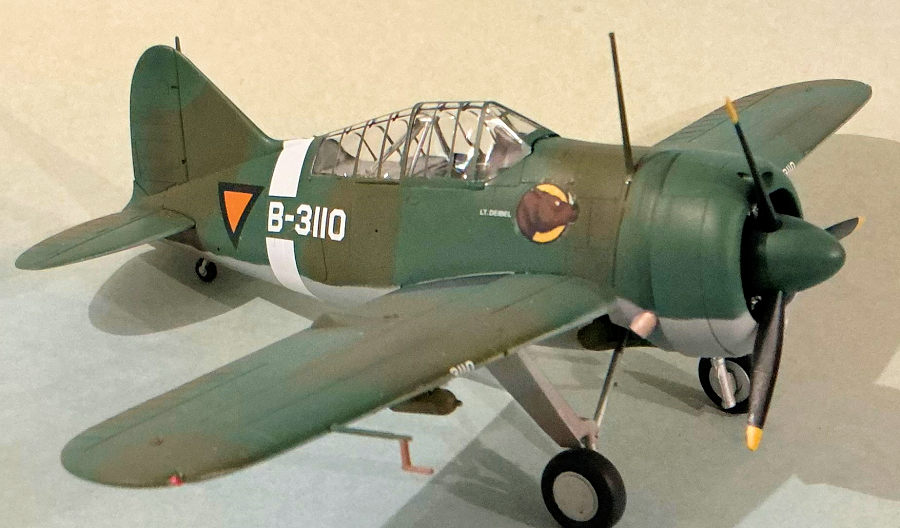
Tamiya 1/48 Buffalo
| KIT #: | 48100 |
| PRICE: | CAN$30.00 |
| DECALS: | Three options |
| REVIEWER: | Pablo Calcaterra |
| NOTES: | Decals are from kit #61094 |
| HISTORY |
The Dutch Air Force purchased some Brewster Buffaloes after lots of struggles as demand for war planes was extremely high in 1940. It is said that the little amount spent by the Dutch to defend their Asian territories was the equivalent to a millionaire having his possessions protected by a little boy with a slingshot…Initially 72 airframes were purchased but engines for these had to be sourced somewhere else! Deliveries began in March 1941. Three different models were purchased: B-339C with 1100 hp engines (x24), B-339D with 1200 hp engines (x48) and B-339-23 with 1000 hp engines (20). Out of these 24, 43 and 0 were delivered before the fall of the NEI with the balance going to the USAAF in Australia.
Split into 3 main Squadrons across Indonesia (then called Netherlands East Indies) these planes were actually a bit better than the British ones as their engines was a bit more powerful (1200 hp instead of 1100) and had less equipment thus they were lighter. In fact Capt Piet Tideman, commander of 3-VLGV said that the Buffalo was a good, study and fast fighter (I don’t think that 494 km/h is that fast…besides it climbed like a dog…) with good protection for the pilot. The draw back, he maintained, was that they did not have enough of them and that the armament was too light. And besides, they were flying against the vastly more experienced JNAF pilots…
When the Japanese attacked the Allied positions and following an agreement the Dutch flew 2-V1G2-2 from Buitenzorg in Java to Kallang on December 14, 1941. Eleven Dutch pilots and nine planes made it to the British base. Armoured windshields were scavenged from crashed British planes and attached to the Dutch ones. Besides the Dutch pilots have hundreds of hours of experience which is something the RAAF/RZNAF pilots did not have. They drew praise and admiration of the RAAF and RZNAF members.
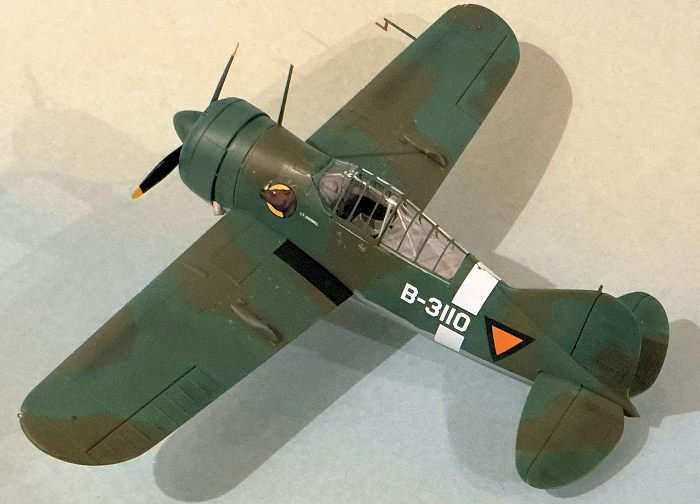 From
here onwards I will focus on the actions of Lt Agustus “Gus” Diebel, one of
the most successful Dutch pilots whose plane I have built. He was born in
the Dutch Easat Indies in 1915. On January 12, 1942 the 26 years old took
off along with two more pilots to engage Japanese planes attacking
Singapore. They fought 9 Ki-27s and after claiming two enemy fighters shot
down, Diebel was in turn shot down and baled out from B-3110 (a 1100 hp
engined plane) with a slight injury to his head that kept him in hospital
for 4 days. The commanding officer Kapt Jacob van Helsdingen in B-396 (in
fact the original Tamiya kit has decals for this plane) shot down another
Ki-27 as did Sgt Gerardus Bruggink (but he had to force land his plane with
a damaged engine). In all during the combats on this day the Allied Buffalo
pilots claimed 27 Ki-27 shot down which for sure it is grossly overclaimed.
From
here onwards I will focus on the actions of Lt Agustus “Gus” Diebel, one of
the most successful Dutch pilots whose plane I have built. He was born in
the Dutch Easat Indies in 1915. On January 12, 1942 the 26 years old took
off along with two more pilots to engage Japanese planes attacking
Singapore. They fought 9 Ki-27s and after claiming two enemy fighters shot
down, Diebel was in turn shot down and baled out from B-3110 (a 1100 hp
engined plane) with a slight injury to his head that kept him in hospital
for 4 days. The commanding officer Kapt Jacob van Helsdingen in B-396 (in
fact the original Tamiya kit has decals for this plane) shot down another
Ki-27 as did Sgt Gerardus Bruggink (but he had to force land his plane with
a damaged engine). In all during the combats on this day the Allied Buffalo
pilots claimed 27 Ki-27 shot down which for sure it is grossly overclaimed.
The Dutch returned to Java on January 18
On February 19 the JAAF attacked Buitenzorg. Eight Brewsters took off against 5 bombers and 19 Ki-43s. Overwhelmed by quality and numbers most of the Buffaloes were shot down with two pilots killed. Diebel in B-398 fought against a single Ki-43 for ten minutes but finally wounded again he had to force land his plane. Two kills were claimed by the Dutch for the loss of 4 planes shot down and Diebel’s damaged one. On the other hand apparently 11 Japanese crashed planes were located in the area where the combat took place…
On March 7 the last 4 Dutch Buffaloes were sent to attack the Japanese at Kalidjati. Flying in two separated pairs (veterans for the Singapore missions) were led by van Helsingden. He was attacked by six Japanese fighters and shot down and killed on his 35th birthday. Gerardus Bruggink escaped into cloud. Lt Gus Diebel damaged a Japanese fighter that escaped into cloud. He then tackled three more enemies. Two fell away under his fire but he was hit in the oil tank and had to return to Andir with his wingman. Landing in a thunderstorm his Buffalo ground looped because one of his wheels had been damaged. It is very fitting that Diebel fought in the 1st and last combat of the Dutch Buffaloes. Java surrendered the following day. Three of the most successful Dutch pilots had flown in that last mission. Van Helsdingen and Diebel had claimed 3 victories each while Bruggink was credited with 2 as Van Rest (this one from 1-V1G-V).
 Diebel
became a POW. After the war was first attached to the Operationeel Oefen
Centrum (OOC)(Operational Training Centre) at Tjililitan. He then had the
rank of Captain probably flying P-40s (?). On 1 November 1946 he became
commander of the 122 Squadron ML-KNIL, which flew P-51s. On 15 November 1948
he became commander of Luchtvaart Commando SUmatra (LUCOSU) (Aviation
Command Sumatra), located in Palembang.
Diebel
became a POW. After the war was first attached to the Operationeel Oefen
Centrum (OOC)(Operational Training Centre) at Tjililitan. He then had the
rank of Captain probably flying P-40s (?). On 1 November 1946 he became
commander of the 122 Squadron ML-KNIL, which flew P-51s. On 15 November 1948
he became commander of Luchtvaart Commando SUmatra (LUCOSU) (Aviation
Command Sumatra), located in Palembang.
Diebel awarded the Ridder vierde klasse der Militaire Willems Orde (MWO.4). The Order was instituted by King William I in 1815 and is the highest military Order in the Netherlands. It is awarded to military personnel of all ranks and services as well as to civilians for 'most conspicuous acts of bravery, leadership and extreme devotion to duty in the presence of the enemy'
He joined the KLU (Netherlands Air Force) after
the ML-KNIL was abolished in 1950.
He died in a Gloster Meteor (I-111) that crashed on 12 June 1951 at
Uithuizen during a demonstration flight.
Out of the 92 Buffaloes ordered 67 were delivered. 30 were shot down in combat with 18 pilots killed, 15 were destroyed on the ground and around 15 more were lost in accidents. The NEI pilots claimed 55 kills for an almost 2:1 ratio in their favor. Even if their claims were accurate it has to be remembered that, as it had happened in other early battles in Asia, Japanese planes outnumbered the Allies. Therefore if you have a 1:5 or more ratio in terms of planes available, achieving a 1:1 or even a 2:1 kill ratio in your favour won’t do…eventually you will run out of pilots and planes…
Dedicated to my friends in Java and Borneo and their brave defenders.
| THE KIT |
Typical high quality, very well detailed and low parts count of any Tamiya kit from the ‘70s it comes with masking tape that needs to be carefully cut to be used for the multiple small windows on the kit. Decals for a British, US and Dutch planes are provided along with a seated and a standing pilot.
| CONSTRUCTION |
 After
priming them with Vallejo Light Grey all cockpit and landing gear surfaces
were painted with Model Master Interior Green (US). The simple engine was
painted black with details highlighted with Aluminum. Same colour was used
for the seat, landing gear wheels on the wings. Some instruments were
painted black, others (like the link from joystick to tail surfaces) in
Aluminum. There are some decals for the instrument panels. I drybrushed
sanded brick red pastels on the floor and pedals. Seat belts are moulded on
the seat and I painted them in light sand. Aluminum was drybrushed on all
cockpit instruments.
After
priming them with Vallejo Light Grey all cockpit and landing gear surfaces
were painted with Model Master Interior Green (US). The simple engine was
painted black with details highlighted with Aluminum. Same colour was used
for the seat, landing gear wheels on the wings. Some instruments were
painted black, others (like the link from joystick to tail surfaces) in
Aluminum. There are some decals for the instrument panels. I drybrushed
sanded brick red pastels on the floor and pedals. Seat belts are moulded on
the seat and I painted them in light sand. Aluminum was drybrushed on all
cockpit instruments.
Only area that required attention was the joint of wings to the fuselage, specially under it.
I opened up the holes for the small bombs under the wings. The build is very easy and fast. In two days the kit was ready to be painted!
| COLORS & MARKINGS |
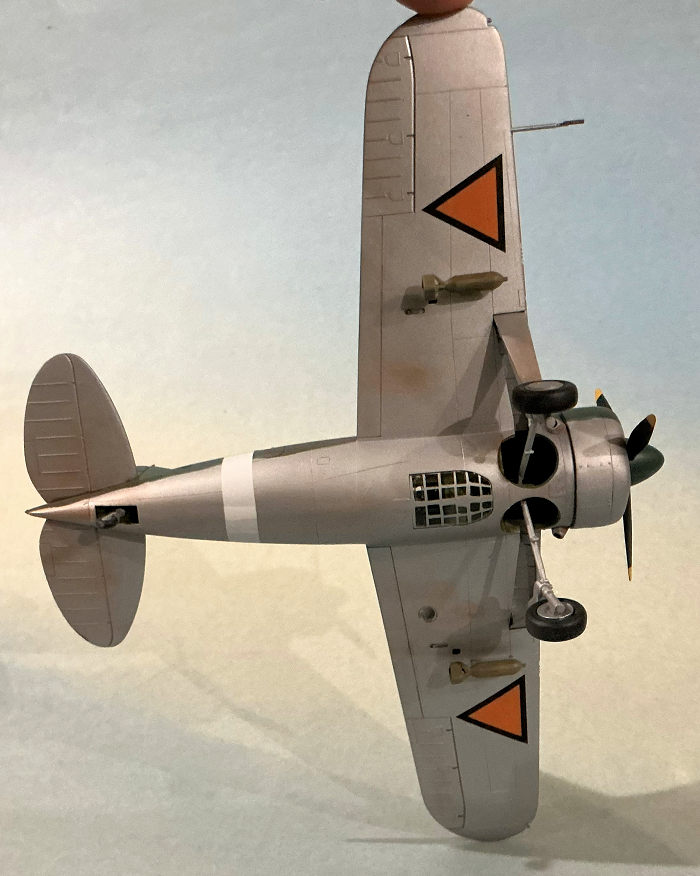
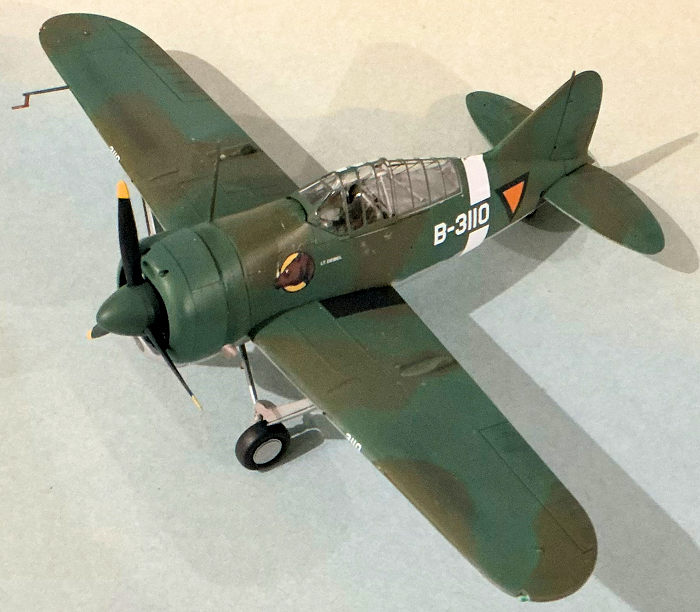
I primed the model with Vallejo Light Grey Primer. The top was painted with ModelMaster 34079 and 34092. Undersurfaces in Aluminum, propeller in black. I drybrushed some sanded pastels in some areas of the model (i.e. under the wings behind the wheels with brown, black on moveable surfaces and inspection doors, etc).
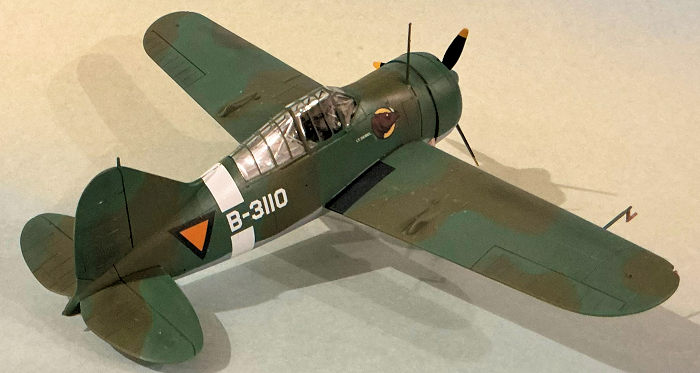 The kit
was sprayed with Quick Shine and decals applied. There were only 2 problems:
the white band is too long and I failed to cut it short. Thus it overlaps
under the fuselage delivering a different shade of white. The main problem
was the most important decal: The Javanese Rhino. I dunked one of the 2 in
water and after a few seconds it cracked in 3 pieces. I thought OK, I can
manage placing 3 pieces. When I tried to move them on the fuselage these
became 5 pieces, then 9, then it was unmanageable. Luckily I had not dunked
in water the 2nd Rhino. I scanned it, mirrored it and printed 2 copies in
clear decal paper that were then applied over the round white circles
supplied by Tamiya. Phew! Model Master clear sealed the decals. Exhausts
painted in aluminum were drybrushed with Rust paint.
The kit
was sprayed with Quick Shine and decals applied. There were only 2 problems:
the white band is too long and I failed to cut it short. Thus it overlaps
under the fuselage delivering a different shade of white. The main problem
was the most important decal: The Javanese Rhino. I dunked one of the 2 in
water and after a few seconds it cracked in 3 pieces. I thought OK, I can
manage placing 3 pieces. When I tried to move them on the fuselage these
became 5 pieces, then 9, then it was unmanageable. Luckily I had not dunked
in water the 2nd Rhino. I scanned it, mirrored it and printed 2 copies in
clear decal paper that were then applied over the round white circles
supplied by Tamiya. Phew! Model Master clear sealed the decals. Exhausts
painted in aluminum were drybrushed with Rust paint.
Unmasked the clear parts, attached small details including the antenna mast and light under the wing it plus some touches of paint for the formation lights on tail and wingtips. The gunsight was added along with the small bombs. Canopy (with is a bit too narrow) was attached.
Finally, the propeller was added and the plane was finished.
| CONCLUSIONS |
A very faithful representation of the Buffalo can be obtained using this simple but accurate Tamiya kit. Personally, I like these older simple Tamiya kits. They don’t have a gazillion pieces that then are hidden away once you close the fuselage parts. Simple, effective.
| REFERENCES |
- The Java Gold’s Blog – Buffaloes at NEI 1942
- Buffaloes over Singapore (Brian Cull)
- Traces of War
- Wikipedia
- Outlived.org
27 January 2026
Copyright ModelingMadness.com. All rights
reserved. No reproduction in part or in whole without express permission from
the editor.
Review kit courtesy of my wallet If you would like your product reviewed fairly and fairly quickly, please contact the editor
or see other details in the
Note to
Contributors. Back to the Main Page
Back to the Review
Index Page
Back to the Previews Index Page