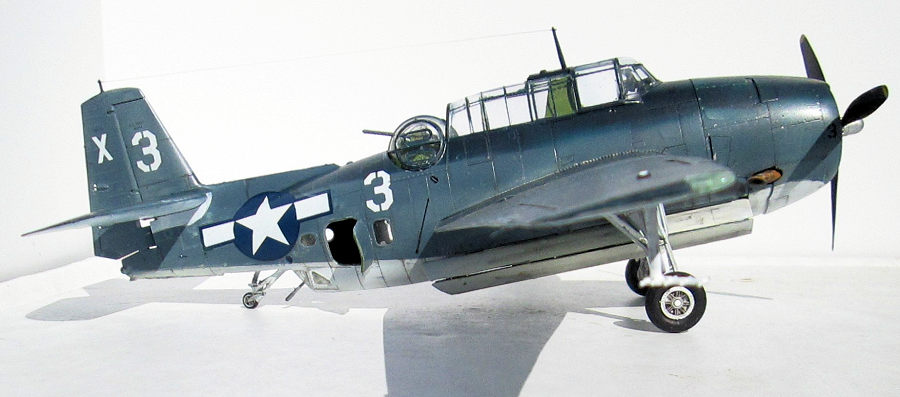
Accurate Miniatures 1/48 TBM-1c Avenger
| KIT #: | 480120 |
| PRICE: | ~$30-40.00 |
| DECALS: | Two options |
| REVIEWER: | Dave Cummings |
| NOTES: | Eduard Mask set |
| HISTORY |
In 1940 the US Navy began to look for a modern replacement for the Douglas TBD. Grumman’s design was selected and within a year the first XTBF-1 made its maiden flight in August 1941. With few design problems to overcome TBFs began rolling off the production line on 3 January 1942. Avengers proved to be an effective and versatile part of the US Navy’s carrier force. They served throughout WWII with various upgrades incorporated into succeeding versions. General Motors became a major contractor and built the majority of Avengers, designated TBM. The versatile TBF/M continued to serve post-war into the 1950s in anti-submarine and utility roles. Early in production the anemic single forward firing .30 cal mg of the TBF-1 was upgraded to two, wing mounted, .50 cals and designated TBF-1c.
George Herbert Walker Bush.
On hearing of the Pearl Harbor attack while in high school, George Bush decided he wanted to join the Navy to become an aviator. Six months later, after graduation, he enlisted in the Navy on his 18th birthday and began preflight training. After completing the 10-month course, he was commissioned as an ensign in the U.S. Naval Reserve on 9 June 1943, several days before his 19th birthday, making him one of the youngest naval aviators.
 After finishing flight
training, he was assigned to Torpedo Squadron 51 (VT-51) in September 1943.
His squadron was based on USS San Jacinto in the spring of 1944. San
Jacinto was part of Task Force 58 that participated in operations against
Marcus and Wake Islands in May, and then in the Marianas during June. On 19
June, the task force triumphed in one of the largest air battles of the war.
Returning from the mission, Ensign Bush's aircraft made a forced water
landing, and the crew was rescued by a destroyer. On 25 July, Ensign Bush
and another pilot received credit for sinking a cargo ship.
After finishing flight
training, he was assigned to Torpedo Squadron 51 (VT-51) in September 1943.
His squadron was based on USS San Jacinto in the spring of 1944. San
Jacinto was part of Task Force 58 that participated in operations against
Marcus and Wake Islands in May, and then in the Marianas during June. On 19
June, the task force triumphed in one of the largest air battles of the war.
Returning from the mission, Ensign Bush's aircraft made a forced water
landing, and the crew was rescued by a destroyer. On 25 July, Ensign Bush
and another pilot received credit for sinking a cargo ship.
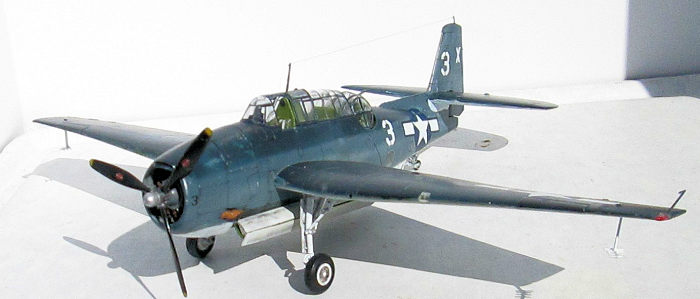
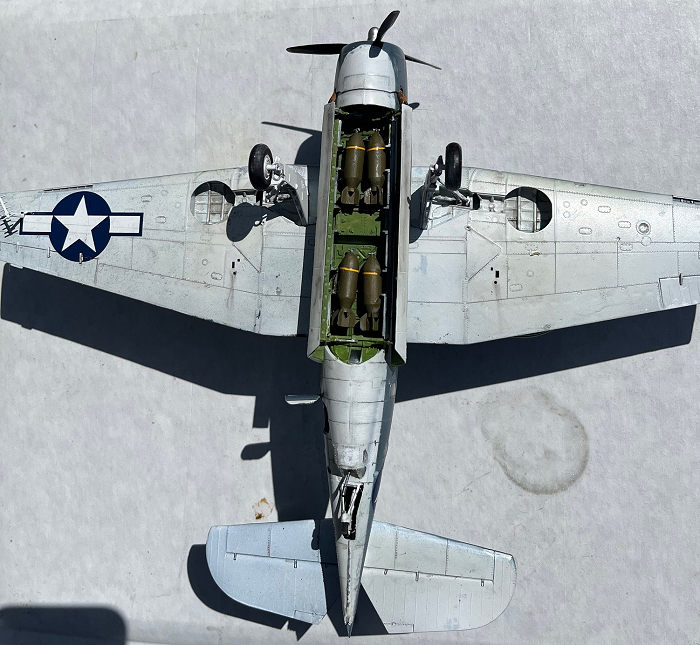
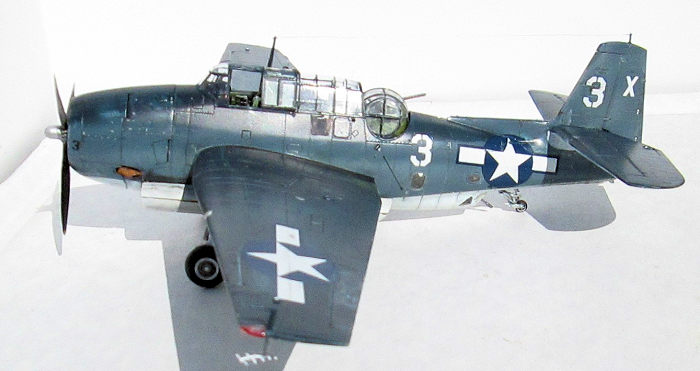
Bush was promoted to Lieutenant Junior Grade on 1 August while San Jacinto conducted operations against the Japanese in the Bonin Islands. On 2 September 1944, Bush piloted one of four aircraft from VT-51 that attacked Japanese installations on Chi Chi Jima. For this mission Bush was assigned aircraft white X3 since his regular aircraft, X2, was down for maintenance. His crew included Radioman John Delaney, and LTjg William White who substituted for Bush's regular gunner. They carried the standard ordinance load of four 500 lb. bombs. During their attack, the four Avengers encountered intense antiaircraft fire. Bush's aircraft was hit and his engine caught fire. Despite being hit, he completed his attack releasing his bombs on the target. With his engine on fire, Bush flew several miles from the island, where he and one other crew member on the Avenger bailed out of the aircraft. However, the other man's chute did not open, and he fell to his death. Both Delaney and White were killed in action. While Bush anxiously waited four hours in his inflated raft, several US fighters circled protectively overhead until he was rescued by the lifeguard submarine, USS Finback. During the month he remained on Finback, Bush participated in the rescue of other pilots.
Bush was returned to San Jacinto in November 1944 and participated in operations in the Philippines. When San Jacinto returned to Guam, the squadron, which had suffered 50 percent casualties of its pilots, was replaced and sent to the United States. Throughout 1944, he had flown 58 combat missions for which he received the Distinguished Flying Cross, three Air Medals, and the Presidential Unit Citation awarded San Jacinto.
Because of his valuable combat experience, Bush was reassigned to Norfolk and put in a training wing for new torpedo pilots. Later, he was assigned to a new torpedo squadron, VT-153. But with the surrender of Japan, he was honorably discharged in September 1945. He then entered Yale University.
| THE KIT |
 This kit is of the heyday of Accurate Miniatures.
A serious model that set the standard in its day for accuracy, detail, and
quality. The kit is labeled TBF-1c and Bush flew the TBM version. But there
are no noticeable differences in the two. With no experience manufacturing
aircraft, Grumman sent a TBF to General Motors who simply took it apart and
copied everything. The kit lacks nothing requiring aftermarket to correct.
Maybe better seatbelts if you’re a stickler. The engine is nicely done, the
molded plug wires may be overly thick, but I like it. The only negative is
the instructions don’t quite match up to the complexity of the kit. This
leaves one having to contemplate, test fit, and figure it out in a few
places. Turret construction and engine attachment being prime examples.
Decals are well printed, though a bit thick. Mine required much Micro-Sol to
settle the fuselage stars. I sprung for the Eduard mask set which is a
godsend for masking that huge greenhouse. The die-cut masks are easy to
apply and fit perfectly. Overall quality and fit of the kit are excellent.
This kit is of the heyday of Accurate Miniatures.
A serious model that set the standard in its day for accuracy, detail, and
quality. The kit is labeled TBF-1c and Bush flew the TBM version. But there
are no noticeable differences in the two. With no experience manufacturing
aircraft, Grumman sent a TBF to General Motors who simply took it apart and
copied everything. The kit lacks nothing requiring aftermarket to correct.
Maybe better seatbelts if you’re a stickler. The engine is nicely done, the
molded plug wires may be overly thick, but I like it. The only negative is
the instructions don’t quite match up to the complexity of the kit. This
leaves one having to contemplate, test fit, and figure it out in a few
places. Turret construction and engine attachment being prime examples.
Decals are well printed, though a bit thick. Mine required much Micro-Sol to
settle the fuselage stars. I sprung for the Eduard mask set which is a
godsend for masking that huge greenhouse. The die-cut masks are easy to
apply and fit perfectly. Overall quality and fit of the kit are excellent.
| CONSTRUCTION |
 As noted the interior is extensive consisting of
22 parts. The kit is built up in a series of sub-assemblies, cockpit/bomb
bay, engine, radio compartment, wings, and turret. Again, study the
instructions but in a few places, you are going to have to play around with
parts to figure out just how it goes, notably the turret, the bomb bay
assembly, and engine attachment. I painted everything inside interior green,
and hand painted the details. The instrument panel is a clear bit with an
instrument decal placed on the back side. The instrument dials have raised
detail letting you flow thinned black paint around them with a small brush.
Even with all the interior plumbing the fuselage halves fit nicely with
little seam clean up needed. The engine cylinders were painted steel with a
gray crankcase. When dry they received a black wash, Then the plug wire
harness painted red-brown and glued in place. Instructions are a bit vague
about attaching the engine and getting it properly aligned on its mount.
Suggest you spend some time dry fitting here. I had no real gotcha moments
in building, maybe that #%&! turret assembly. All the clear bits were masked
and attached in place minus the turret. Do yourself a favor with this one
and cough up for a masking set. The wings were attached but the tail planes
left off to facilitate painting. Openings were packed with sponge and damp
tissue, then off to the paint booth.
As noted the interior is extensive consisting of
22 parts. The kit is built up in a series of sub-assemblies, cockpit/bomb
bay, engine, radio compartment, wings, and turret. Again, study the
instructions but in a few places, you are going to have to play around with
parts to figure out just how it goes, notably the turret, the bomb bay
assembly, and engine attachment. I painted everything inside interior green,
and hand painted the details. The instrument panel is a clear bit with an
instrument decal placed on the back side. The instrument dials have raised
detail letting you flow thinned black paint around them with a small brush.
Even with all the interior plumbing the fuselage halves fit nicely with
little seam clean up needed. The engine cylinders were painted steel with a
gray crankcase. When dry they received a black wash, Then the plug wire
harness painted red-brown and glued in place. Instructions are a bit vague
about attaching the engine and getting it properly aligned on its mount.
Suggest you spend some time dry fitting here. I had no real gotcha moments
in building, maybe that #%&! turret assembly. All the clear bits were masked
and attached in place minus the turret. Do yourself a favor with this one
and cough up for a masking set. The wings were attached but the tail planes
left off to facilitate painting. Openings were packed with sponge and damp
tissue, then off to the paint booth.
| COLORS & MARKINGS |
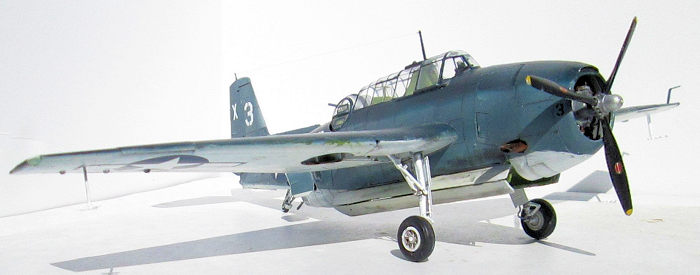 X3 was painted in the standard Navy 3-color
scheme. Paints used were Vallejo Model Air Insignia White for the underside,
Mission Models USN Sea Blue and Mission Models Intermediate Blue for the top
side. So, I had some bad experiences with Mission Models paints when I first
started using them. What I have learned is it doesn’t pay to be cheap. These
paints and Vallejo, etc. all say they are water-based. But they are not
really. Fooling around with water, alcohol, lacquer thinner, etc. to save
money has caused me much anxiety. Especially the Mission Models stuff that
just don’t work well with anything other than their proprietary thinner. I
also recommend getting their Polyurethane mix additive which provides a more
durable finish and improves flow and leveling. Excellent paints when mixed
right.
X3 was painted in the standard Navy 3-color
scheme. Paints used were Vallejo Model Air Insignia White for the underside,
Mission Models USN Sea Blue and Mission Models Intermediate Blue for the top
side. So, I had some bad experiences with Mission Models paints when I first
started using them. What I have learned is it doesn’t pay to be cheap. These
paints and Vallejo, etc. all say they are water-based. But they are not
really. Fooling around with water, alcohol, lacquer thinner, etc. to save
money has caused me much anxiety. Especially the Mission Models stuff that
just don’t work well with anything other than their proprietary thinner. I
also recommend getting their Polyurethane mix additive which provides a more
durable finish and improves flow and leveling. Excellent paints when mixed
right.
Carrier based aircraft didn’t show the kind of weathering and wear their land-based counterparts suffered. But available color film shows there is some to varying degrees. I mixed some intermediate blue into the sea blue (about 1 to 2), thinned it down, and set the compressor to about 10 lbs. pressure. I lightly misted some sun fading blotches on the upper surfaces. I did a little paint chipping with a toothpick dipped in aluminum paint. I then smeared on some black pastel exhaust stains. A coat of clear gloss sealed it all up and prepped for decaling. But next was to apply a wash to panel lines. I tried the Tamiya Panel Line Color (black). It comes with a fine line applicator on the lid. Easy to use, it is enamel based so cleans up with enamel thinner. Obviously not meant for enamel paints.
The decals worked well but a bit thick. Much Micro-Sol needed to settle them into the engraving. I wiped it down and sprayed a coat of matt clear.
| FINAL CONSTRUCTION |
 First all that masking was
removed. The Eduard masking worked great, no bleed under. Next the dreaded
turret attachment procedure. I followed the instructions for this procedure
and was amazed it worked as advertised. No real issue there. The Landing
gear went together well and is nicely detailed. Struts painted white and
given a wash. The bay doors come as left and right halves you can attach in
the closed position. For open doors there is a pronounced scribe line at the
inside fold line. The instructions seem to indicate you should run a hobby
knife along this line until you are able to fold the doors in the open
position. Doesn’t work that way. The doors have to be cut through and
separated with these pieces glued to the operating mechanism that aligns
them properly. The challenge is getting a straight cut line.
First all that masking was
removed. The Eduard masking worked great, no bleed under. Next the dreaded
turret attachment procedure. I followed the instructions for this procedure
and was amazed it worked as advertised. No real issue there. The Landing
gear went together well and is nicely detailed. Struts painted white and
given a wash. The bay doors come as left and right halves you can attach in
the closed position. For open doors there is a pronounced scribe line at the
inside fold line. The instructions seem to indicate you should run a hobby
knife along this line until you are able to fold the doors in the open
position. Doesn’t work that way. The doors have to be cut through and
separated with these pieces glued to the operating mechanism that aligns
them properly. The challenge is getting a straight cut line.
I applied a drop of red and blue paint to the attachment points for the clear wing tip light lenses. I just stuck the lenses to the paint drop. Then all the sticky outy things glued in place. Lastly the prop was attached, and she was done.
| CONCLUSIONS |
Accurate Miniatures mades serious models for serious modelers. This is a great kit that builds into a beautiful replica and a tribute to this significant historical event. I’m happy with the way mine turned out. Now I’m not saying that a novice builder can’t handle this project, I know in my novice days I would have been overwhelmed by this kit. But I’ve never been all that smart.
| REFERENCES |
website: US Navy Historical Command
7 July 2025
Copyright ModelingMadness.com. All rights reserved. No reproduction in part or in whole without express permission from the editor.
Review kit courtesy of my wallet
If you would like your product reviewed fairly and fairly quickly, please contact the editor or see other details in the Note to Contributors.
Back to the Main Page Back to the Review Index Page Back to the Previews Index Page