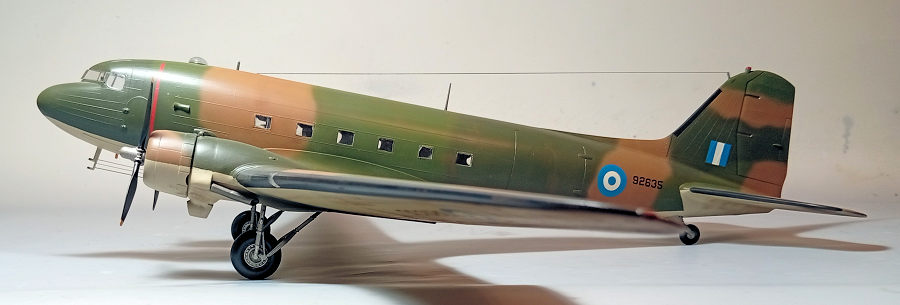
Monogram 1/48 DC-3
| KIT #: | 5610 |
| PRICE: | $ |
| DECALS: | One option |
| REVIEWER: | Spiros Pendedekas |
| NOTES: |
| HISTORY |
The Greek Dakotas:
The Aircraft That Carried a Nation
Few aircraft have left such a deep mark on Greek aviation history as the
Douglas C-47 Dakota. More than a transport airplane, the Dakota became a
symbol of endurance, reliability, and service. For decades its unmistakable
silhouette crossed the Greek skies, carrying soldiers, supplies,
paratroopers, wounded personnel, and hope to every corner of the country.
Even today, the sound of its radial engines evokes memories of a different
era, when aviation relied as much on courage and craftsmanship as on
technology.
The story of the Dakota began in the United States during the 1930s.
Developed from the famous DC-3 airliner, the military version received the
designation C-47 Skytrain, while Commonwealth forces popularized the name
"Dakota." During the Second World War, the type became one of the most
important transport aircraft ever built. More than 10,000 examples were
produced, serving on every front and earning a reputation for exceptional
reliability under the harshest conditions.
 Greece
first received Dakotas in the years following World War II through American
military assistance programs. Eventually, more than seventy aircraft would
serve with the Hellenic Air Force. At a time when the country was recovering
from occupation, war, and economic hardship, these rugged transports became
indispensable. They connected distant regions, supplied isolated garrisons,
and helped maintain links between the mainland and Greece's countless
islands.
Greece
first received Dakotas in the years following World War II through American
military assistance programs. Eventually, more than seventy aircraft would
serve with the Hellenic Air Force. At a time when the country was recovering
from occupation, war, and economic hardship, these rugged transports became
indispensable. They connected distant regions, supplied isolated garrisons,
and helped maintain links between the mainland and Greece's countless
islands.
The aircraft quickly proved its worth. During the Greek Civil War, Dakotas
transported troops, equipment, and supplies to remote areas where roads were
poor or nonexistent. They evacuated wounded personnel, delivered
humanitarian aid, and supported military operations throughout the country.
Their ability to operate from short and often primitive airfields made them
perfectly suited to Greece's rugged terrain.
Powered by two Pratt & Whitney Twin Wasp radial engines, each producing
approximately 1,200 horsepower, the Dakota combined dependable performance
with remarkable durability. It could carry nearly thirty fully equipped
troops or several tons of cargo while maintaining a range sufficient to
cover virtually any mission within Greece and the Eastern Mediterranean.
Maintenance crews appreciated its simple and robust construction, while
pilots admired its forgiving handling characteristics and dependable nature.
One of the Dakota's greatest strengths was its versatility. Its spacious
fuselage could be quickly adapted for cargo transport, passenger service,
paratroop operations, or medical evacuation duties. Few aircraft of its
generation could perform so many different tasks with such effectiveness.
 Throughout
the 1950s, 1960s, and well into the 1970s, the Dakota became a familiar
sight over the Aegean. It participated in military exercises, supported
remote island communities, and answered the call during natural disasters.
Whenever floods, earthquakes, or emergencies struck, Dakotas were often
among the first aircraft dispatched to deliver aid and relief supplies.
Throughout
the 1950s, 1960s, and well into the 1970s, the Dakota became a familiar
sight over the Aegean. It participated in military exercises, supported
remote island communities, and answered the call during natural disasters.
Whenever floods, earthquakes, or emergencies struck, Dakotas were often
among the first aircraft dispatched to deliver aid and relief supplies.
As newer transport aircraft entered service, the Dakota gradually moved into
secondary roles. Yet it remained respected by all who flew and maintained
it. Generations of Hellenic Air Force pilots learned their craft aboard
these dependable machines, and many veterans still speak of them with
genuine affection. The Dakota was not merely an aircraft; it was a trusted
companion that never failed to do its duty.
Eventually age and advancing technology brought the Dakota's long service
career to an end. Yet its legacy remains deeply embedded in the history of
the Hellenic Air Force. The surviving aircraft preserved in museums stand as
reminders of a remarkable machine that served Greece faithfully for decades.
The Dakota was never the fastest aircraft in the sky, nor the most
glamorous. It lacked the sleek lines of a fighter and carried none of the
prestige associated with modern combat aircraft. Yet its contribution to
Greece was immeasurable. It connected communities, supported national
defense, saved lives, and quietly carried out the countless tasks upon which
nations depend.
That is why the Dakota remains so beloved. It was an aircraft that simply
did its job, day after day and year after year, asking for little and giving
everything in return. For those who flew it, maintained it, or watched it
pass overhead, the C-47 Dakota was far more than aluminum, rivets, and
engines. It was one of the true workhorses of Greek aviation and a faithful
servant of a nation rebuilding itself in the aftermath of war.
| THE KIT |
It was in 1978 that
Monogram introduced its then all-new 1/48 scale C-47 Skytrain, a kit that
quickly established itself as one of the finest representations of the legendary
transport aircraft. A few years later, the company expanded the range with a
civilian DC-3 version, achieved through the addition of several new parts.
Between them, the two kits have appeared in no fewer than fifteen reboxings over
the years, the final release arriving by Revell (having taken over Monogram) in
2015 as the AC-47 Spooky gunship.
Despite its age, the tooling has stood the test of time remarkably well. The
model features raised panel lines, a characteristic that may divide opinion
today, but one that many modelers still appreciate. On an aircraft such as the
C-47/DC-3, with its overlapping skin panels, raised detail arguably captures the
appearance of the real aircraft, better than deeply engraved panel lines. More
importantly, the overall shape is excellent. The distinctive lines of the Dakota
have been faithfully reproduced, and the finished model simply looks right -
perhaps the greatest compliment any scale model can receive.
 Boasting a
parts count not much more than 100, the kit is not over engineered by modern
standards, nor does it rely on excessive part counts to make an impression.
Instead, it is an honest, solid representation of the legendary transport,
offering an enjoyable and remarkably trouble-free build. Assembly is
straightforward and surprisingly pleasant, particularly considering the size of
the aircraft, remaining a thoroughly satisfying kit and one that still deserves
a place on the workbench of any enthusiast of this iconic aircraft.
Boasting a
parts count not much more than 100, the kit is not over engineered by modern
standards, nor does it rely on excessive part counts to make an impression.
Instead, it is an honest, solid representation of the legendary transport,
offering an enjoyable and remarkably trouble-free build. Assembly is
straightforward and surprisingly pleasant, particularly considering the size of
the aircraft, remaining a thoroughly satisfying kit and one that still deserves
a place on the workbench of any enthusiast of this iconic aircraft.
The kit featured here is the 1992 Monogram DC-3 release, which I picked up
sometime around 2002 from a beloved/now sadly closed hobby shop in my equally
beloved hometown, Chalkis, Greece. At the time, it cost an almost unbelievable
sum of around €20. Better still, it was still factory sealed, untouched despite
its age.
Upon opening the box (yes, I resisted the temptation to keep it as a collector's
item) I was greeted by crisply molded silver-grey sprues that had stood the test
of time remarkably well. A pleasant surprise was that Monogram had retained
most, if not all of the military-specific parts in the DC-3 boxing, making the
conversion back to C-47 relatively straightforward. The vivid decals were in
surprisingly excellent condition - a pity those pristine decals were of little
use for my project, as I had already decided to build the model as a military
C-47 in Hellenic Air Force service.
| CONSTRUCTION |
Construction began with
the interior. The assembly started with the cabin floor, onto which the cockpit
components were installed, including the two pilot seats, control columns,
instrument panel, top console and throttle quadrant. This was followed by the
installation of the three (cockpit, forward cabin and rear cabin) bulkheads,
creating the characteristic interior layout of the Dakota.
The crew area was finished primarily in Green Zinc Chromate. The seats and their
supporting frames, along with the instrument panel, top console, throttle
quadrant, and control columns, were painted black. The raised instrument faces,
switches, and various levers were then picked out with
 dry
brushing and small touches of white, yellow and red. Seat belts were added from
masking tape and that's all about I did with the cockpit, as the very small
windscreen ensured that most of it will be totally invisible.
dry
brushing and small touches of white, yellow and red. Seat belts were added from
masking tape and that's all about I did with the cockpit, as the very small
windscreen ensured that most of it will be totally invisible.
The cabin windows come in the form of two transparent strips, which were
attached from the inside of the fuselage halves, and the passenger door was
permanently glued in closed position. Loyal to my “Not Changing The Habits Of A
Lifetime -Walk Down Laziness Lane”, I convinced myself that the fuselage windows
are so tiny that even a trained microscope operator would need a search party to
find the interior. After many years of advanced modelling research, I have
discovered the golden rule: if you cannot see it, it does not exist. Therefore,
I bravely resisted the temptation to spend three weeks adding cargo details that
would disappear forever behind those postage-stamp-sized windows.
Instead, the entire interior was painted black, creating a highly realistic
“classified military storage area” where all details go to retire. Any missing
features are now safely hidden in the darkness, never to complain. A perfect
modelling solution: maximum visual effect, minimum effort - a technique proudly
developed by my decades of experience in the ancient art of selective laziness.
With all the interior components secured, the fuselage halves were joined,
enclosing the cockpit and
 trapping the
tailwheel bay between them. The fit was pleasantly good, requiring the “usual”
attention along the fuselage seam before construction could continue.
Considering the age of the tooling, this was already proving to be a very
enjoyable experience.
trapping the
tailwheel bay between them. The fit was pleasantly good, requiring the “usual”
attention along the fuselage seam before construction could continue.
Considering the age of the tooling, this was already proving to be a very
enjoyable experience.
Attention then turned to the wings. Construction begins with the center wing
section, to which a cleverly designed main spar is attached. This component is
an excellent example of Monogram’s simple but effective engineering, as it not
only provides structural strength and ensures the correct wing alignment, but
also doubles as the rear wall of the main wheel bays. The left and right wing
panels were then assembled directly onto this spar, producing a strong and
accurate wing structure. It is a straightforward solution, and an extremely
effective one, demonstrating the thought that went into Monogram's design work.
Even by today's standards, this remains a very clever approach to engineering a
large model.
The tailplanes were next attached, bringing the basic airframe assembly to
completion. At this point, the kit had become a very pleasant surprise. The
construction was remarkably straightforward and uncomplicated, especially
considering that this is a 1/48 scale twin-engine transport aircraft of
considerable size.
Of course, some compromises were made along the way. The interior was not
treated as a museum exhibit, and some areas received only the attention they
realistically deserved, especially those that would remain almost invisible
after assembly. Regarding fit, a little attention was needed in the usual areas,
like the wing-to- fuselage joints, but nothing beyond normal modelling practice.
A couple of rounds of filling and sanding were all that was required before
moving on.
Once the airframe was complete, the correct air filters for my chosen version
were added on top of the engine cowlings, which, together with the separate
cooling louver rings, were temporarily affixed in position, so the model can
head to the paint shop!
| COLORS & MARKINGS |
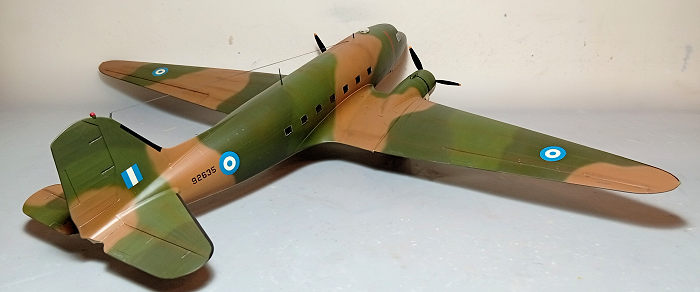
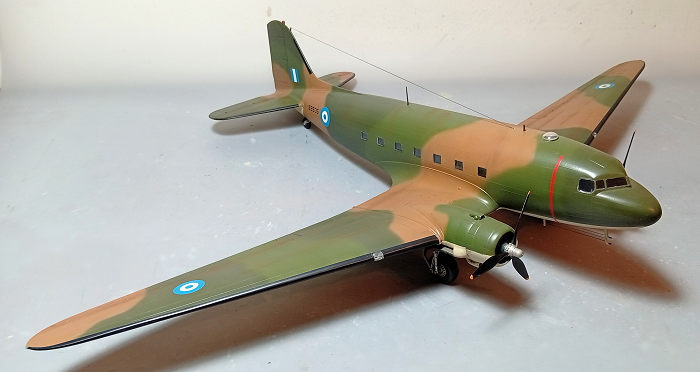
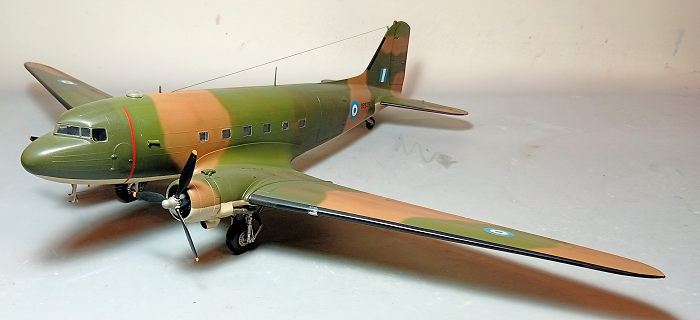
From the 1970s onwards,
Greek Dakotas wore the familiar (and very attractive for many of us)
Vietnam-style camouflage, although in a rather irregular fashion. In fact, there
appears to have been no standardized pattern, with each aircraft displaying its
own subtle (or not that subtle) variations. After studying a number of period
photographs, I replicated a camouflage scheme that closely matched the examples
I found.
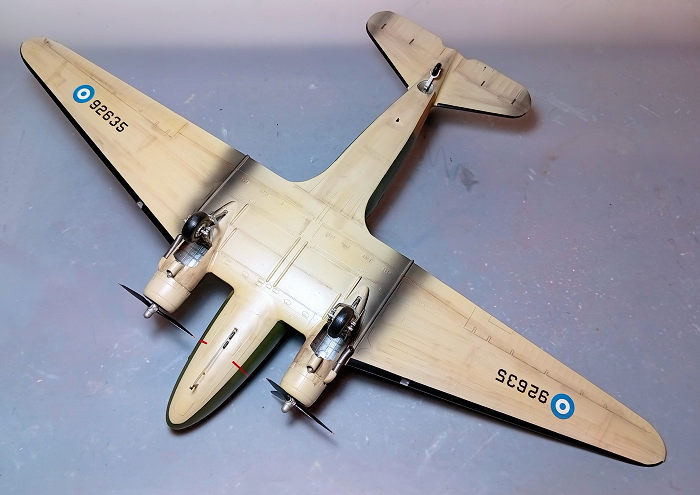
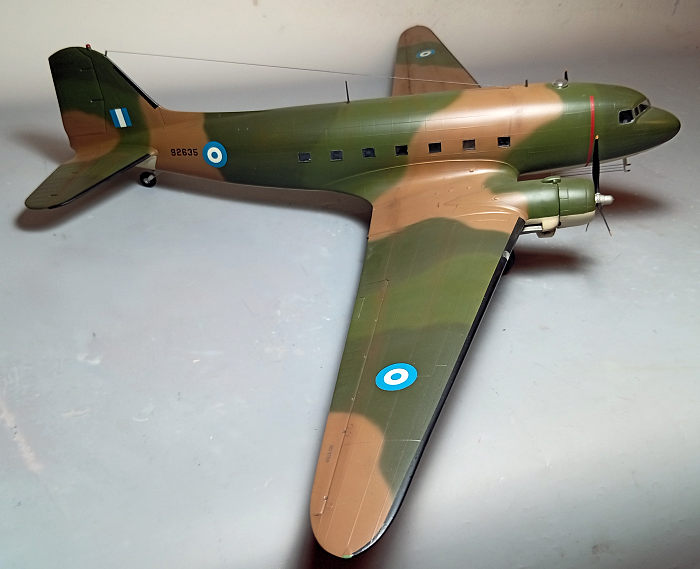
I began by spraying the undersurfaces with Humbrol 28 Camouflage Grey. Once this
had cured, the undersides were masked off and the upper surfaces were painted
using a freehand application of Humbrol 116, 117 and 118, representing the dark
green, light green and tan shades respectively. As the m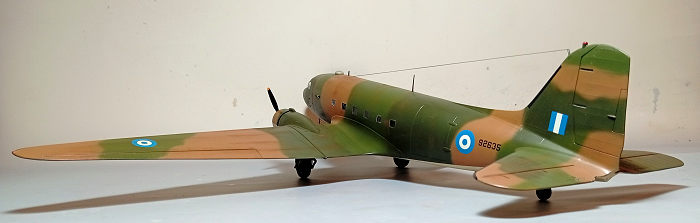 odel
is in 1/48 scale, I chose to spray the camouflage freehand, carefully adjusting
the airbrush to its finest settings and using the lowest practical pressure to
achieve soft, feathered demarcation lines. The de-icing boots were then masked
and painted black. A generous coat of Future completed the painting stage,
preparing the old bird for its decals - and, hopefully, hiding the occasional
artistic interpretation of the camouflage pattern!
odel
is in 1/48 scale, I chose to spray the camouflage freehand, carefully adjusting
the airbrush to its finest settings and using the lowest practical pressure to
achieve soft, feathered demarcation lines. The de-icing boots were then masked
and painted black. A generous coat of Future completed the painting stage,
preparing the old bird for its decals - and, hopefully, hiding the occasional
artistic interpretation of the camouflage pattern!
For the national insignia, I used a generic HAF decal sheet produced by Kalfakis
and printed by Cartograf back in the 2000s decade. Unfortunately, this excellent
sheet has long been out of production and has become something of a collector's
item. The serial numbers came from a generic lettering sheet, while the various
maintenance stencils were scavenged from my ever-growing "decal dungeon" - that
mysterious place where leftover decals accumulate, just waiting for the day they
finally become useful.
Once I convinced myself that everything was straight enough (always a dangerous
assumption), another coat of Future sealed the decals and blended them into the
paintwork, bringing the old Dakota one step closer to its well-worn Greek
Vietnam-style appearance.
| FINAL CONSTRUCTION |
With the painting
complete, the landing gear was assembled and attached. The gear legs and
associated components were finished in silver, the the wheel wells and rims were
painted steel, while the tyres received a coat of black.
The nicely detailed engines were first painted black and then heavily
dry-brushed with silver to bring out the molded-on details. The propeller shafts
were inserted, but not glued, and trapped between the front cowlings and the
rear cooling louver plate, allowing the propellers to rotate. The cowlings’
interior was finished in steel.
The propeller blades were painted black with yellow tips, while the hubs were
finished in silver. A light silver dry-brush added a subtle touch of wear to the
blades’ leading edges before the propellers were finally installed. The exhausts
were painted Testors Burned Metal and attached at this time as well.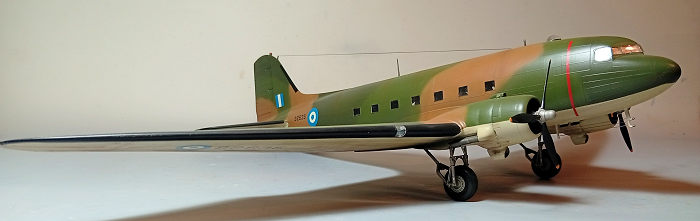
Onto weathering. A black wash was applied around the landing gear, wheel wells
and beneath the engine cowlings to reproduce the characteristic oily appearance
of a well-used Dakota. Brown and black dry pastels added dirt, and grime and
exhaust stains were replicated by lightly airbrushing black towards the
direction of the airflow (or, better, the exhaust gases),, while a final satin
coat blended everything together - performing its usual bit of modelling magic.
The windscreen had its well defined frames carefully hand-painted before being
secured in position with small amounts of white glue. The landing lights were
similarly fitted to the wing leading edges, while the appropriate antennas were
installed and accordingly painted. Fine stretched sprue was used to replicate
the various aerial wires. Small drops of clear red and green paint reproduced
the navigation lights, and with that, this veteran Hellenic Dakota was finally
ready for duty once again.
| CONCLUSIONS |
More than four decades
after its original release, Monogram's C-47/DC-3 continues to prove that a
well-designed kit never really grows old. Its straightforward engineering,
excellent fit and sensible level of detail make it a thoroughly enjoyable build,
while the raised panel lines are far less of an issue than many would have us
believe. In fact, once painted and weathered, they look perfectly convincing and
preserve the character of this classic kit.
Perhaps its greatest strength is that it focuses on what really matters:
capturing the unmistakable shape and presence of the legendary Dakota without
unnecessary complexity. The result is a relaxing, rewarding project that can
still stand proudly alongside many newer and far more expensive releases.
Considering that it often costs only a fraction of the price of modern
alternatives, it represents outstanding value for money.
Like many classic Monogram kits, this one offers something beyond plastic parts
and decals - it brings back memories of a time when modelling was simply about
enjoying the hobby. It reminds us that older kits still have plenty to offer and
that a satisfying result depends far more on the modeller than on the age of the
molds.
Sadly, the last reissue dates back to 2015, and the kit has not been seen since.
Hopefully, the molds have been carefully preserved and will find their way back
into production one day, allowing a new generation of modellers to discover just
how good this venerable Dakota kit still is.
Warmly recommended.
Happy Modeling!
Copyright ModelingMadness.com. All rights reserved. No reproduction in part or in whole without express permission.
If you would like your product reviewed fairly and fairly quickly, please contact the editor or see other details in the Note to Contributors.