| KIT #: | 48108 |
| PRICE: | $60.00 |
| DECALS: | Three options |
| REVIEWER: | Chuck Horner |
| NOTES: | Rebox with additional resin. |
| HISTORY |
“Out of the clear blue of the western sky …. Comes Sky King!” the announcer proclaims as the light twin aircraft buzzes the camera and zooms off into the clear sky. This was the opening to the SKY KING television program.
ACT ONE – The TV Program
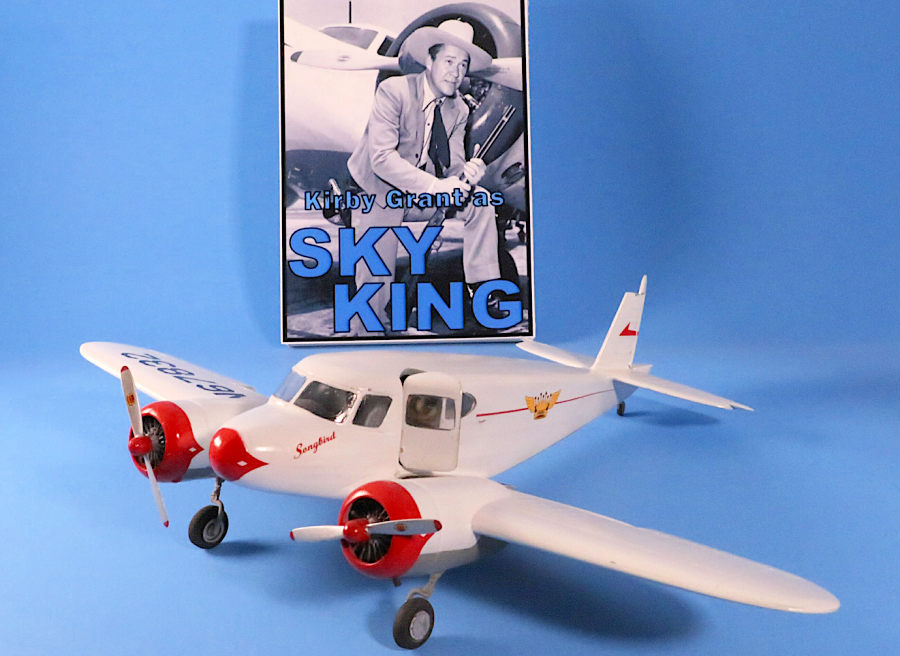
SKY KING was a half-hour, American, adventure television program, that ran for 72 episodes from 1951 to 1966. Schuyler “Sky” Kings was an ex-naval aviator who lived on his Flying Crown ranch in Grover, Arizona. His niece, Penny King and nephew, Clipper King, live with him. The other star of the program was Sky’s airplane, the Songbird, first played by an ex-military Cessna UC-78 then later by a Cessna 310B. In each episode, Sky and the Songbird, would help the local sheriff catch “bad guys”, find lost people in the desert and other adventures.
The program came to television in 1951. Sky was played by Kirby Grant, a working actor who had previously appeared in a number of “B” western movies. Penny was played by Gloria Winters, an experienced teen actor and Clipper by Ron Hagerthy, who only stayed one season. The Songbird was Paul Mantz’s UC-78B (N67832).
After episode 39, the airplane was grounded, probably due to fatigue or dry rot. The Songbird was replaced by a new Cessna 310B, provided by Cessna Corp at no cost to the producer. The last new episode (#72) was broadcasted on March 8, 1959.
CBS picked up the entire rerun package for Saturday noon broadcasts from October 1959 to September 1966.
ACT TWO – The Actors
Kirby Grant started out as a singer with big bands, before WW II. He moved into acting and was cast mostly in westerns. At some point he acquired his pilot’s license. When cast as Sky King, this added more realisms to his movements in the show’s cockpit scenes. There is no evidence that he ever flew either Songbird aircraft on camera but it seems very likely that Grant was at the controls in scenes where the plane taxied into camera frame, shut down and Sky gets out or viscera, starts up and taxies out of frame.
Many of the exteriors were shot at the Iverson Movie Ranch, in the high desert of California. In some weeks, Grant would fly is personal plane from his ranch, located north east of San Diego, to the filming site. While the original Flying Crown ranch house still exists, Grant’s own ranch house was destroyed by wild fires in the 1980’s.
 After the
series ended, Grant did little acting but continued to make appearances through
the 1960’s and 70’s, sometimes with Gloria Winters.
After the
series ended, Grant did little acting but continued to make appearances through
the 1960’s and 70’s, sometimes with Gloria Winters.
Grant bought the “Sky King” series complete with all rights in 1959 and made several attempts to revive it over the years. He and his wife moved to Florida where he went to work for Sea World. He maintained the “Sky King persona”, often appearing in his “Stetson” and western business suit until his death in 1985 at age 73.
Gloria Winters quite acting after the series and married a sound technician she met on set. She took flying lessons during the show’s run and remained connected to aviation. She died in 2010 at age 86.
ACT THREE – The Plane
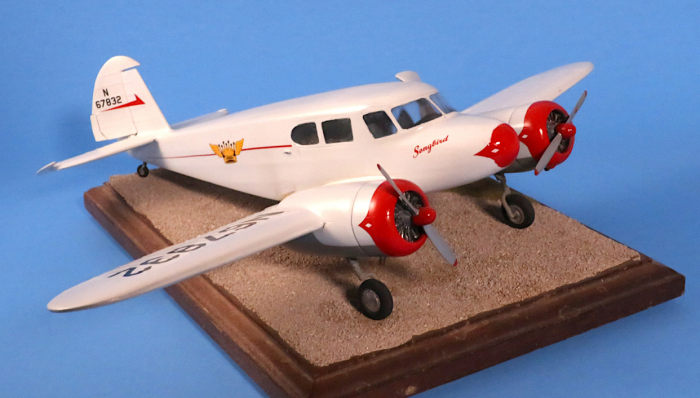
As previous stated, Sky King’s original Songbird was a Cessna Bobcat owned by Paul Mantz. The aircraft was built as a UC-78B (43-32179) for the Army Air Corps. It was a sold surplus in 1946 and flew with Mantz until grounded in 1956 from dry rot.
Cessna introduced the T-50 model in 1939, a five-passenger, low-cost, light twin, as an alternative to the Beech 18. The T-50 was basically a wood and fabric airplane, powered by a pair of 225 hp Jacobs radial engines with Hamilton Standard constant-speed props and featured semi-retractable landing gear.
In 1940 the Army order 33 examples, designed AT-8. Changes included 290 hp Lycoming R-680 engines, cockpit roof windows as well as military radios and other equipment. The Army’s next order of 450 aircraft were designated AT-17 and reverted back to the Jacobs engines.
After 1942, new aircraft were designated UC-78. By war’s end, Cessna had produced more than 4,600 Bobcats.
Since many of the these were used as advance trainers for pilots headed for bombers, it got the name “Bamboo Bomber” due to its wood construction.
ACT FOUR –
| THE KIT |
 The Bobcat,
to my knowledge, has only been created in 1/48 scale once in 2009 by Czech
Model. It’s a limited run kit with thick plastic, some resin and PE. Markings
were for Sky King’s Songbird, an Army UC-78 and a Navy JRC-1. Decals were
printed by Cartograf of Italy.
The Bobcat,
to my knowledge, has only been created in 1/48 scale once in 2009 by Czech
Model. It’s a limited run kit with thick plastic, some resin and PE. Markings
were for Sky King’s Songbird, an Army UC-78 and a Navy JRC-1. Decals were
printed by Cartograf of Italy.
Then in 2016, Squadron’s Encore brand released an updated kit with all of the original plastic and resin parts plus the add-on True-Detail resin that Squadron had produced to that date.
The original kit resin consisted of a pair of 7-cylinder Jacobs and the 9-cylinder Lycoming engines, propeller blades and spinner, wheels and other small parts. The added True-Detail parts include two complete interiors – military and civilian, replacement control surfaces and flaps.
ACT FIVE –
| CONSTRUCTION |
I started by cutting out the flaps, elevators and rudder, to be replace by resin. I left the ailerons neutral and did not replace them.
The real wing is predominantly fabric covered, with the leading edges and wing tips wood and metal around the engines. The plastic molding only had a single line where the wing ribs were. In the real world, the fabric covering is tied to the ribs so it won’t balloon out. Each rib-area is then covered with strip of reinforcing fabric that is glued down.
To simulate this look, I laid down strips of thin Tamiya tape over each wing rib the brushed on several thick coats of Future, just on the fabric areas. This gave the area a slightly different texture as well as sealing the tape.
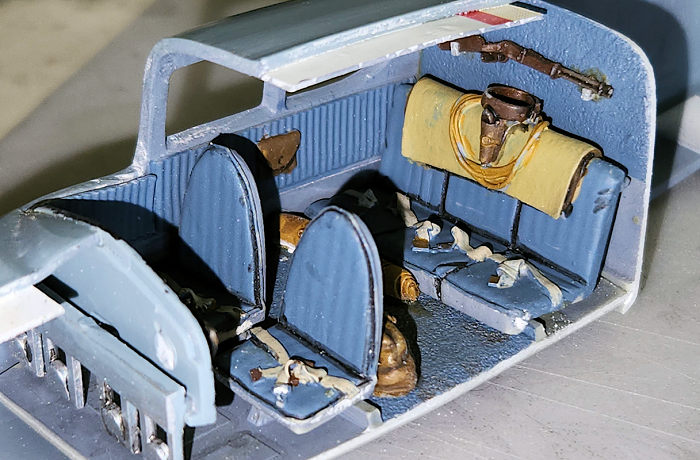 Next came
the interior. The instructions point out that there are no color photos of
Mantz’s UC-78 interior as Sky King was filmed in glorious Black & White. The
instructions suggest either a two-tone tan or gray, based on Cessna sales
brochures. I chose the gray and used some artistic license on the shades.
Next came
the interior. The instructions point out that there are no color photos of
Mantz’s UC-78 interior as Sky King was filmed in glorious Black & White. The
instructions suggest either a two-tone tan or gray, based on Cessna sales
brochures. I chose the gray and used some artistic license on the shades.
The resin is very well molding with the two front pilot’s chairs having seat belts and a storage pouch on the seat back. The rear seat is set up for three people with seat belts. Since the interior is primarily designed for King’s Songbird, there are some interesting additions. First, the rear seat has a large horse blanket draped over the back along with a loop of rope and a “six-gun” in a holster. Above, on the rear wall, is a gun rack with a Winchester rifle. Two more separate items were a bed-roll and a soft-sided leather luggage bag. None of these actually appear on any of the Sky King shows, but I thought they added interest and included them.
Before I closed up the fuselage, I added the interior windows. There is only one door, located on the left side between the pilot’s seats and the rear bench seat. There is the option of use a completely clear piece or a solid piece where you have to add your own window. Nether fit well in the closed position. I selected the clear piece, masked the window and painted the interior colors.
The fuselage closed up with no real problems. Next, I turned to the wings.
The top and bottom of the wing went together without a problem. The main landing gear then must be attached to the bottom of the wing. Then the two halves of the extending engine fairings are glued to the lower wing, around the gear, to form the wheel wells. If I built this again, I would definitely purchase the S.A.C. metal landing gear. I broke the gear off… TWICE! The second time nearly ending the build.
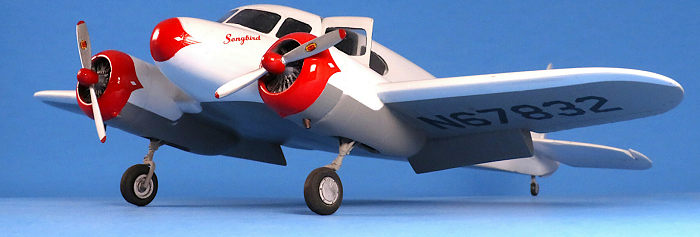 After a
week’s pause, to re-think the project, I decided I could re-attach the gear
later and proceeded to the next step of attaching the engines.
After a
week’s pause, to re-think the project, I decided I could re-attach the gear
later and proceeded to the next step of attaching the engines.
The Songbird used the 9-cylinder, Lycoming engines which I had previously painted. Instructions called for them to be glued to the firewall then add the cowling pieces. After doing this, I realized that they sat too far back from the cowling edge and the props won’t even reach them.
Fortunately, I was able to pry them off. I glued them to the inside of the cowling, at the correct distance from the outer edge.
The kit offers two different sets of props. One is a single plastic piece for the military versions and the other is two resin blades glued to a solid resin spinner for the Songbird. The gluing surface of the resin blades to spinner is almost nil, with no positive positioning pins. I had contemplated digging out the solid spinner and using the one-piece blades but went with the resin. Getting the blades both straight, level and pitched correctly was a real challenge since no jig was provided. Re-attaching them sever times after breaking off also didn’t help.
Moving back to the fuselage, I was ready to attach the front glass which comes as a wrap-around windshield and a top cap. The military versions had extra top windows while Songbird did not. The cap fit pretty good but the windshield did not. Its radius was larger than the fuselage. I found that if I squeezed the ends in to match the fuselage, the front bowed out only slightly. It was easier to fill in the front gaps with white glue if the sides were attached flush with the fuselage.
I completed the final assembly by attached the wings and tail as well as the broken landing gear.
ACT SIX -
| COLORS & MARKINGS |
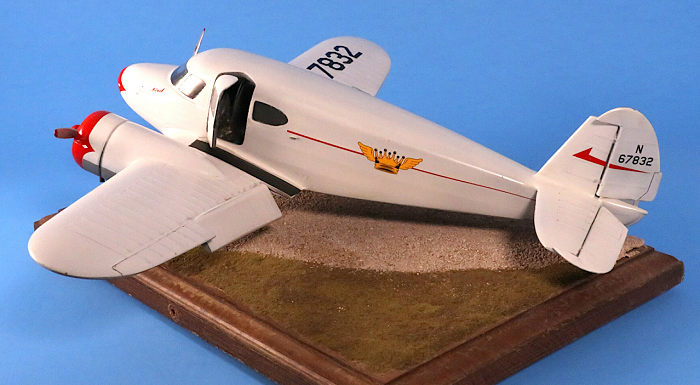
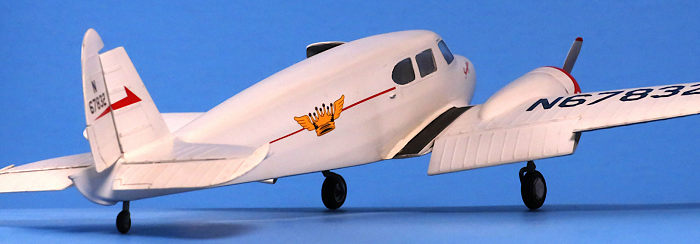 The Songbird
was painted a satin white on top and a gloss medium gray on the bottom with red
trim on the cowlings, spinners and nose. It was no problem matching the white
and gray colors from my paint stock. Decals were provided for the wrap-around
red trim on both cowlings and nose, each with a small flare at the mid-point. It
is always problematic in trying to apply a flat decal to a rounded surface so I
found that Tamyia’s X-7 red matched the red decals. I painted the cowling,
spinner and nose then cut out just the flare part of the decal and applied over
the red paint. With a brush I was able to blend in the decal edges.
The Songbird
was painted a satin white on top and a gloss medium gray on the bottom with red
trim on the cowlings, spinners and nose. It was no problem matching the white
and gray colors from my paint stock. Decals were provided for the wrap-around
red trim on both cowlings and nose, each with a small flare at the mid-point. It
is always problematic in trying to apply a flat decal to a rounded surface so I
found that Tamyia’s X-7 red matched the red decals. I painted the cowling,
spinner and nose then cut out just the flare part of the decal and applied over
the red paint. With a brush I was able to blend in the decal edges.
As a final decal note, the prominent N-number on the upper and lower wings came in both Red and Black. The instructions explained that it was unclear which was correct since only black & white photos were available, but FAA regulations of the time stated the these should be black. That’s what I used.
This hard-fought battle was over. I had my Sky King Songbird.
| CONCLUSIONS |
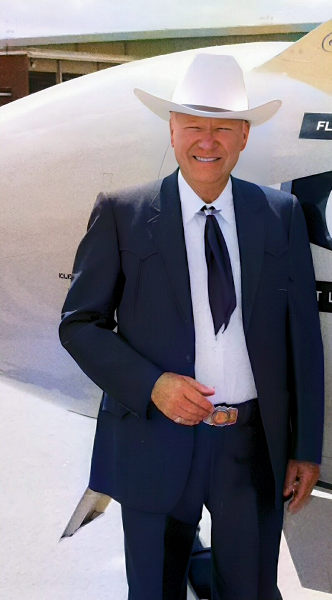 I met
Kirby Grant in 1985. He was a guest speaker at an FAA Safety Seminar at Hanscom
Field, MA.
I met
Kirby Grant in 1985. He was a guest speaker at an FAA Safety Seminar at Hanscom
Field, MA.
Grant came on stage wearing his traditional Stetson hat and western-style suit. His talk was mostly about the flight safety on Sky King. Later, during a break, I talked with him and he allowed me to take his picture. He was quite pleasant.
It was only a few months later that he died in an auto accident while driving across Florida to Cape Kennedy. Shuttle astronauts were scheduled to honor him for his achievements in encouraging children in future aviation careers. A speeding driver ran him off the road into a water-filled drainage ditch. He was 73 years old.
This project brought back childhood memories of Saturday mornings and the anticipation of the next exciting adventure of Sky King. While doing research, I discovered that many of the 72 episodes are available on You Tube and there is still an official Sky King website.
| REFERENCES |
Various internet articles, kit instructions, my personal meeting with actor, Kirby Grant.
Chuck
Horner
18 August 2026
Copyright ModelingMadness.com. All rights reserved. No reproduction in
any form without express permission from the editor.
If you would like your product reviewed fairly and fairly quickly, please
contact
the editor or see other details in the
Note to
Contributors. Back to the Main Page
Back to the Review
Index Page
Back to the Previews Index Page