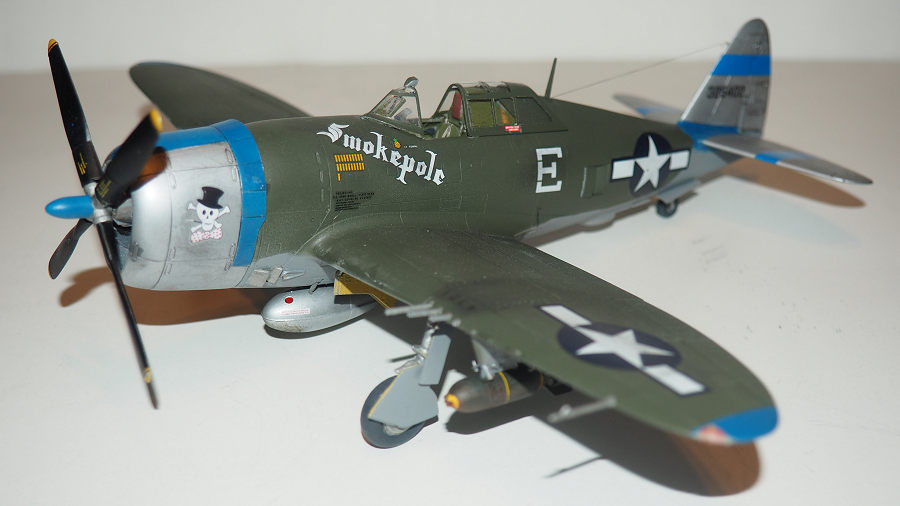
Tamiya 1/48 P-47D Thunderbolt
| KIT #: | 61086 |
| PRICE: | $40.00 |
| DECALS: | Two options |
| REVIEWER: | Mark Rossmann |
| NOTES: | Thundercals 48-004 |
| HISTORY |
The P-47 was an outstanding escort and ground attack aircraft and was the heaviest and largest single seat fighter built during WWII. It rose out of a humble beginning which saw use by U.S., British, French, Mexican, Brazilian, Chinese and Russian air forces.
Seventh Air Force
The Seventh Air Force initially provided air defense for the Hawaiian Islands. It also became the hub of the Pacific aerial network. In addition to Depot functions, it supported the 4-engine all-weather transport used in ferrying troops, supplies, and evacuating wounded from forward areas. These transport planes were under the command of Pacific Division, Air Transport Command. The command also played a major role throughout the Pacific War as a training, staging, and supply-center for air and ground troops.
The command deployed most of its combat units to the Central Pacific, where operations were best summed up by its air and ground crews as "Just one damned island after another!"
 Seventh Air Force units
deployed 2,000 miles southwest to the Gilbert Islands, then 600 miles northwest
to the Marshall Islands, 900 miles west to the Caroline Islands, 600 miles
northwest to the Mariana Islands, 600 miles north to Iwo Jima, 1,000 miles west
to Okinawa, always edging closer towards the center of Japanese power. A map
story of the Seventh Air Force would cover 3,000 miles north and south of Midway
Atoll to Fiji, and 5,000 miles east and west from Pearl Harbor to the Ryukus.
Seventh Air Force units
deployed 2,000 miles southwest to the Gilbert Islands, then 600 miles northwest
to the Marshall Islands, 900 miles west to the Caroline Islands, 600 miles
northwest to the Mariana Islands, 600 miles north to Iwo Jima, 1,000 miles west
to Okinawa, always edging closer towards the center of Japanese power. A map
story of the Seventh Air Force would cover 3,000 miles north and south of Midway
Atoll to Fiji, and 5,000 miles east and west from Pearl Harbor to the Ryukus.
Pineapple Air Force
This term was derogatory or affectionately used, depending on each person’s point of view, while assigned to the 7th AAF in Hawaii. The units there were readiness training units (RTU), before sent to the 5th or 13th AAF, known as the “Pacific War Zone”. Men staying in Hawaii were known as Pineapples.
Early 1944 the 318th was equipped with Republic P-47D Thunderbolts, while still stationed in Hawaii. On June 22nd and 23rd, from the escort carrier USS Natoma Bay, the 318th catapulted 37 P-47’s landing at Aslito airfield. During the Marianas campaign, it worked closely with Marine ground forces, pioneering close infantry support and employing the first use of napalm. On Saipan the 318th had the dubious distinction, along with the 21st Fighter Group on Iwo Jima, of being the only Army Air Force units to engage in ground combat.
June 26, 1944
The ground crews and pilots lived through long nights of rifle fire and shell bursts. The worst of their nights came in the early hours of 26 June. In the darkness a Japanese sabotage party sneaked onto the airfield to destroy the P47s where they were parked, and three hundred Japanese troops broke through the infantry lines and also reached the field. Men of the squadron became infantry soldiers and held them along with a unit of Marines and Marine artillery that were in reserve. Almost all the Japanese soldiers were killed in the ensuing firefight. The next day, the elements of the 27th Infantry Division that had been fighting at the point moved in to occupy the area, no survivors were found. The Japanese left behind 2 damaged P-47’s and the burned out remains of ‘Head-up N’locked’, the sole P-47 the sabotage party was able to set afire, with their Molotov Cocktails.
 As Army troops strove to
clear the south coast of Saipan, tenacious Japanese forces there were supported
by artillery batteries hidden in caves and pillboxes on Tinian, only three miles
across the channel from Saipan. The P-47s devoted countless efforts to attacking
these positions which were as hard to hit as they were hard to spot. Missions
against these targets were often completed in just eighteen minutes from takeoff
to landing, with the result that the pilots were given credit for only half a
mission each time although the missions were seldom easy ones.
As Army troops strove to
clear the south coast of Saipan, tenacious Japanese forces there were supported
by artillery batteries hidden in caves and pillboxes on Tinian, only three miles
across the channel from Saipan. The P-47s devoted countless efforts to attacking
these positions which were as hard to hit as they were hard to spot. Missions
against these targets were often completed in just eighteen minutes from takeoff
to landing, with the result that the pilots were given credit for only half a
mission each time although the missions were seldom easy ones.
On 27 June, seven P-47s of the 19 FS took off from Saipan on such a mission to strike at an artillery position on Gurguan Point, Tinian, with rockets. One of the P-47s was flown by Lt. Wayne F. Kobler. As he came in low over his target the enemy set off a land mine almost directly under him. The blast caught Kobler's plane square and it went straight in. Later, when the number two strip at Aslito was completed, it was named Kobler Field in his honor.
From November 1944 to March 1945, the 318th Fighter Group helped counter the Japanese air attacks on the Mariana Island. During this time, they gave up their P-47’s for P-38’s. Late in March they transitioned to the P-47 ‘N’ version and moved north to Okinawa.
The 318th Group was officially credited with 164 air combat victories by 15 August cease fire, with 6 pilots shot down by enemy planes.
Seventh AF P-47 units were:
15th FG (45th, 47th, 78th FS), converting to P-51.
318th FG (19th, 73rd, 333rd FS),
508th FG (466th, 467th, 468th FS)
| CONSTRUCTION |
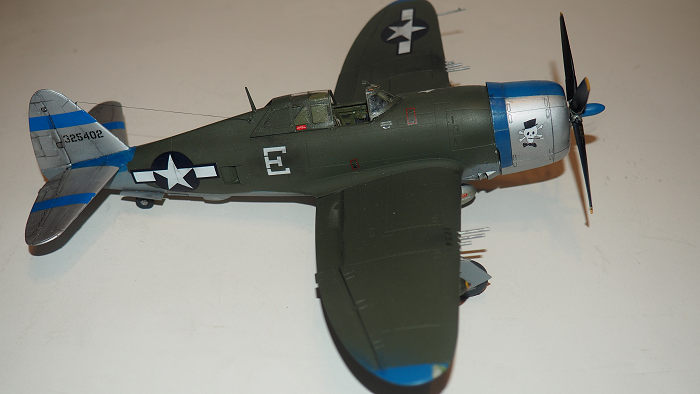
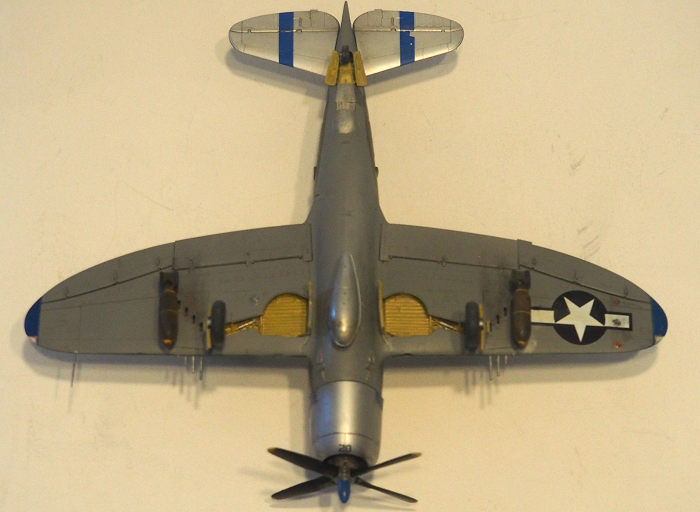
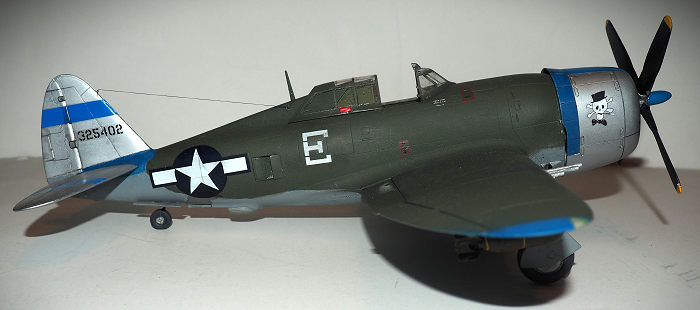 This is a Tamiya P-47 Razorback, with the build taking
about 3 weeks. The cowling was not attached during overall painting, this
allowed the taping and painting for the aluminum and blue nose colors a separate
entity keeping the rest of the model out of the picture. The two stabilizers I
did not attach, making it easier to mask and paint the stripes and the blue at
the base of the tail over the silver and OD.
This is a Tamiya P-47 Razorback, with the build taking
about 3 weeks. The cowling was not attached during overall painting, this
allowed the taping and painting for the aluminum and blue nose colors a separate
entity keeping the rest of the model out of the picture. The two stabilizers I
did not attach, making it easier to mask and paint the stripes and the blue at
the base of the tail over the silver and OD.
Bombs, drop tanks and Bazooka Tubes are provided, as are .50 caliber drilled out barrel ends. These are sufficient to create a great kit without necessarily buying aftermarket product. The kit was painted with various Tamiya and Testors spray paints.
| REFERENCES |
Wikipedia
P-47 Thunderbolt with the USAAF in the MTO, Asia and Pacific – SMI Library (Kagero)
ThunderCals Decals – T-004 P-47D Razorbacks PTO Part 4 19th, 333rd FS/318th FG
USA Unit History: https://usafunithistory.com/
12 May 2025
Copyright ModelingMadness.com. All rights reserved. No reproduction in part or in whole without express permission.
If you would like your product reviewed fairly and fairly quickly, please contact the editor or see other details in the Note to Contributors.