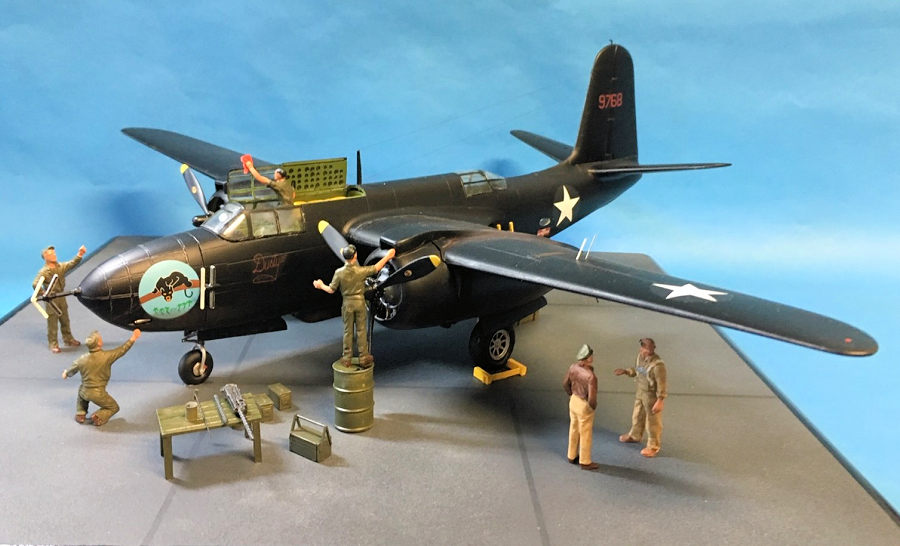
AMT 1/48 P-70
| KIT #: | 8646 |
| PRICE: | $30.00 when new |
| DECALS: | Two options |
| REVIEWER: | H Davis Gandees |
| NOTES: |
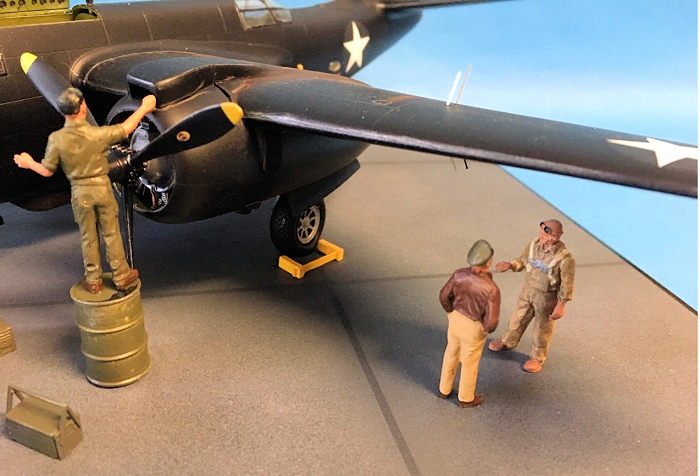
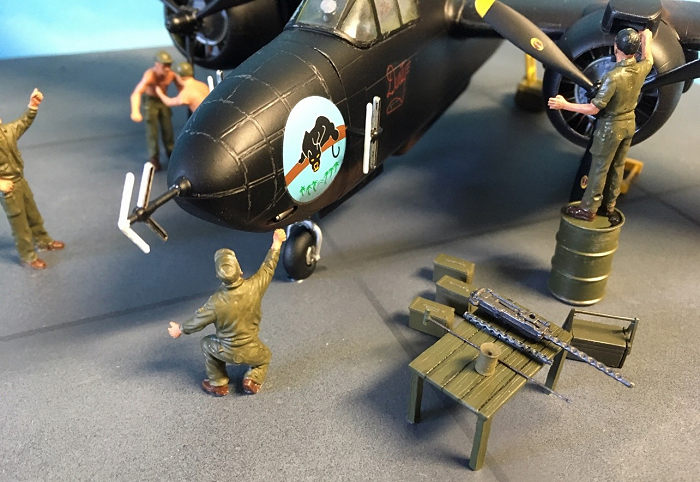
I’ve had this kit with the subject “Dusty” decals in my stash for 30 years and after seeing the color photo of “Dusty” in a magazine, I was motivated to build this scene. Dioramas are 3-dimensional creations that tell a story. “Preparing for the Dark” shows P-70, “Dusty” being readied for a night mission flown from 3-Mile Air Strip on New Guinea by 6th Night Fighter Squadron pilot, Lt. Fred Secord. Building a diorama often affords the modeler artistic license and this scene depicts how I envisioned it in my mind. “Preparing For the Dark” would include multiple events taking place preparing “Dusty: for a night mission. Under the wing, the radar operator appears to be trying to collect his poker winnings from his pilot, and an armorer is completing his work on the twin .50 machine guns. A mechanic makes a last-minute check on the #1 engine, while 2 ground crewmen prepare to pull the #2 engine through. The Crew Chief reminds another to be sure to clean the canopy glass. |
| HISTORY |
 In
October 1940, at the request of the USAAC who foresaw the need for a night
fighter, Douglas Aircraft converted 60 A-20Cs from the production line to
P-70 night-fighters. 4 squadrons operated in the S. Pacific from 1942-1944.
A total of 163 P-70s of all variants were produced by late 1942.
In
October 1940, at the request of the USAAC who foresaw the need for a night
fighter, Douglas Aircraft converted 60 A-20Cs from the production line to
P-70 night-fighters. 4 squadrons operated in the S. Pacific from 1942-1944.
A total of 163 P-70s of all variants were produced by late 1942.
The P-70 was equipped with 4-20mm cannons with 120 RPG in a ventral tray, that also included a 250-gallon fuel tank for additional flight duration. Two .50 caliber machine guns were installed in the nose to assist with initial sighting for the 20mm cannons.
The P-70s had Wright R-2600-23 engines with 1,600 HP giving the P-70 a top speed of 315 MPH and a range of 1,300 miles. The glazed nose was painted over, and an SCR-540 radar was installed. The radar operator was seated in the former rear gunner position.
The more successful Northrop P-61 Black Widow replaced the P-70s that were all withdrawn from service in 1945. The majority of P-70s built were utilized stateside for training the P-61 Black Widow crews. The P-70 was a stopgap effort until the faster purpose-built, supercharged P-61 went into service in late 1944.
P-70s continued to serve as night intruders against Japanese held territory and shipping.
| THE KIT |
This AMT kit originated from the A-20G Havoc kit and was released in 1995 and was re-released in 2013 by Italeri. There are 18 clear steps of how to assemble the kit with excellent pictographs, written notes in each step and color callouts are included. The AMT kit is well engineered, accurate in shape and required minimal putty.
| CONSTRUCTION |
 Dusty was
built out-of-box except for a few additions and modifications, including
nicely molded True Detail diamond tread main gear tires/wheels and the
included bonus life raft for the rear of the cockpit area that mandated an
open canopy.
Dusty was
built out-of-box except for a few additions and modifications, including
nicely molded True Detail diamond tread main gear tires/wheels and the
included bonus life raft for the rear of the cockpit area that mandated an
open canopy.
The P-70 kit included the radar transmitting arrowhead on the nose, azimuth receiving antennas on the fuselage sides and 20 mm ventral gun tray. However, no provisions were included for the P-70s radar operator station. So, a radar set was acquired from a Monogram P-38 Pathfinder and modified with an orange CRT screen and positioned on the bulkhead. A seat from the scrap box was positioned on a fabricated mount, but unfortunately little of this detail is visible. The missing elevation receiving antennas were made from music wire and mounted on the upper and lower port wing in drilled holes. A gunsight sourced from the scrap box was attached to the pilot’s glare shield. A pitot tube was fashioned from music wire and attached to the top of the tail finishing the P-70.
| COLORS & MARKINGS |
 The model
was first painted with Tamiya TS-14 Gloss Black and the excellent 30-year-old
kit decals were applied with no trouble.
The model
was first painted with Tamiya TS-14 Gloss Black and the excellent 30-year-old
kit decals were applied with no trouble.
A lightly misted coat of Tamiya TS-80 Flat Clear on the lower surfaces and 2 misted coats on the upper surfaces toned down the glass black and sealed the decals.
Oil leaks and exhaust stains from the Wright R-2600s were replicated with pastels and minor wear with a silver Prismacolor artist’s pencil. The painted over glazed nose framework and other areas were also subtly highlighted with silver pencil.
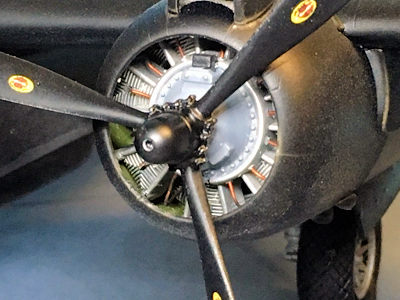
The engines were painted aluminum and engine gray, and the cylinders given a black wash. Ignition wiring was done with copper bell wire, and the engine assemblies were given a final mist coat of Tamiya TS-80 Flat Clear. Nylon thread was used for the two radio wire antennas.
| CONCLUSIONS |
After languishing in my stash for 30years, it was satisfying to finally build it in a diorama.
| REFERENCES |
Various magazines and online articles.
1 October 2026
Back to the Previews Index Page
Back to the Previews Index Page