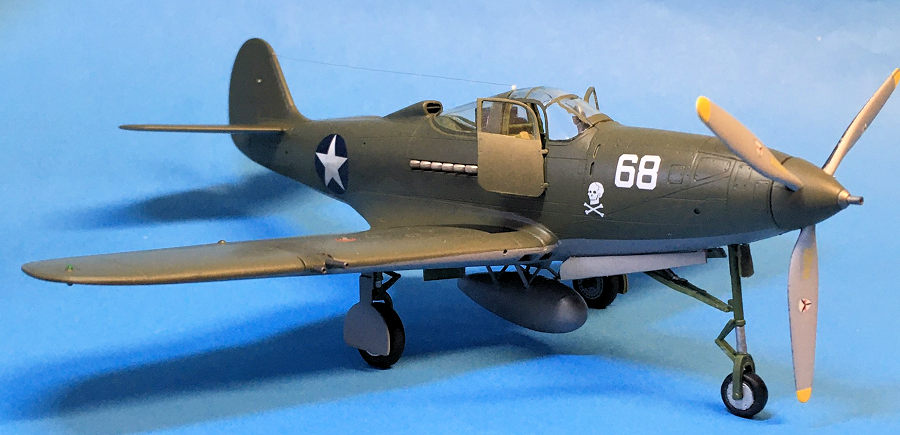
| KIT #: | 09093 |
| PRICE: | $35.00 |
| DECALS: | Three options |
| REVIEWER: | H Davis Gandees |
| NOTES: |
| HISTORY |
I recently conducted extensive research for a magazine article on the Bell P-39 Airacobra and the only USAAF “Iron Dog” ace, Lt. William Fiedler. I have gained great respect for both, especially Fiedler, hence this P-39N model build of his aircraft.
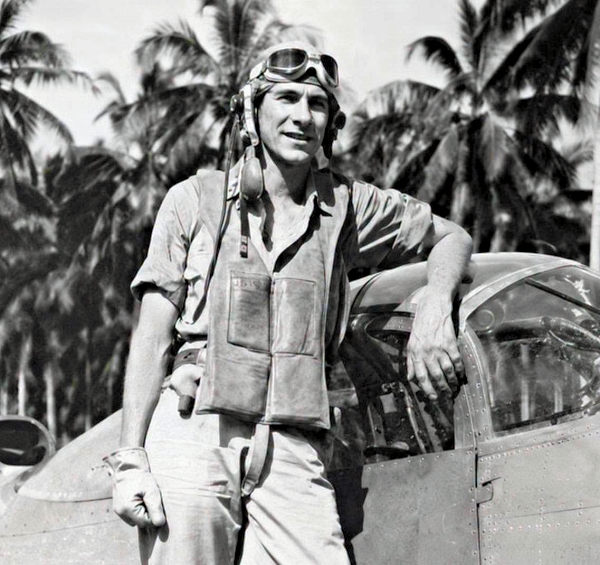 The Bell P-39 Airacobra has been much maligned by
historians, most who knew little of its success flying with the USAAF in the
South Pacific. Along with the P-40B/C Tomahawk and Navy F4F Wildcat. That’s
what the U.S. took to war early in the Pacific, while focused on a “Europe
First” strategy against the Nazis.
The negative reputation of the P-39 started with the British in 1940 with unwarranted arrogant and egotistical disclaimers and who ultimately refused the P-400 version of it even though it was better than most of what the besieged RAF was flying at the time.
Obviously, no one had told Lt. William Fiedler, 13th AF, 347th FG, 70th FS, that the P-39 was an ineffective fighter. He was the only USAAF P-39 ace with 3 Zero and 2 Val kills attesting to his skill flying the Airacobra. Unfortunately, he was killed by an out-of-control P-38 that lost an engine on take-off and crashed into his P-39 on June 30, 1943.
During Lt. Fiedler’s short service, he was awarded The Distinguished Flying Cross, Air Medal with 7 Oak Leaf Clusters and The Purple Heart. He was 23 years old.
It should be noted the Russians received about half of all P-39s built and claimed the it was one of the best Lend-Lease aircraft. There were hundreds of Russian Aircobra aces, the highest number of kills was Aleksandr Pokryshkin with 47.
| THE KIT |
he kit was released in 2007 which was quickly followed by a variety of subsequent boxings and alternative configurations. It is well molded with fine recessed panel lines and good shape and dimensions. Mine seemed to have a narrow canopy, but I might have made the fuselage too wide. The doors fit poorly. Decals were on the thick side. There were 9 pages of excellent instructions with color callouts.
| CONSTRUCTION |
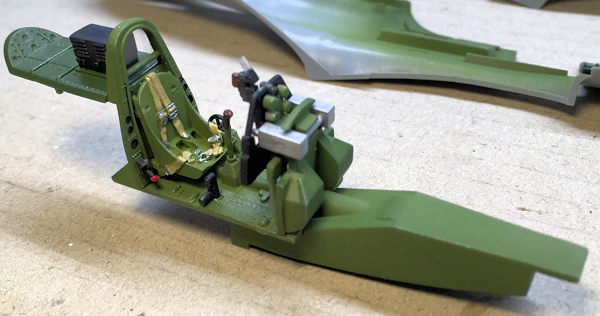 I was fortunate to procure the 1:48 Hasegawa
P-39N/Q kit that provided the needed decals for Fiedler’s aircraft. It’s
interesting the instructions mention Fiedler as the pilot of #68, but there
is no mention of him as the only USAAF Airacobra ace.
The kit went together with no problems except for a slightly narrow canopy and poorly fitting doors. So, I decided to leave the doors open showing off the cockpit with a nicely molded Quickboost (QB-48392) resin seat.
My research indicated that Fiedler first flew the P-39D and later this improved P-39N. Also, there is no history of Fiedler’s aircraft’s tail number, possibly painted over at some point. It was also devoid of any kill markings.
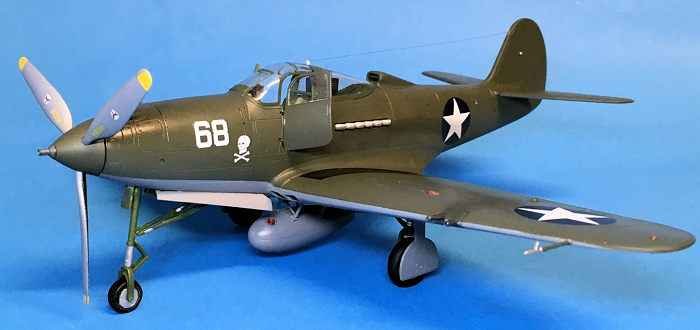 The kit .50 cal. nose
gun barrels were smaller than the beautifully molded .30 cal. wing guns, so
I replaced them with 1 mm styrene rod and drilled them out.
Hasegawa did a nice job with this 2007 release kit. One of the cleverest features was keying the main gear axles to correctly position the flattened tires. Everything fit perfectly except the narrow canopy (possibly a wider fuselage caused by me?). There was a parting line down the center of the clear gunsight that I polished out and applied a coat of Pledge. To avoid a tail sitter, 18 grams of lead buckshot was applied in the nose.
| COLORS & MARKINGS |
Research indicated landing gear struts, inner gear doors and the area under the rear canopy were painted “Bell Green”. I found the remnants of my last bottle of Model Master FS 34079 Dark Green a close match.
The spray can paint scheme is Tamiya AS-6 USAAF Olive Drab and AS-7 USAF Neutral Gray underside. Painting with a spray can is just like an airbrush in that the spray orifice must be cleaned before use as tiny, dried paint specks will show up in the finish. A quick cleaning with a Q-tip and lacquer thinner is all that’s needed.
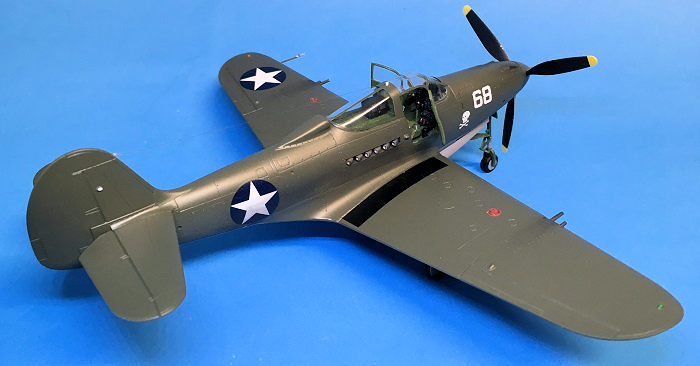 After drying, I sprayed a coat of Tamiya TS- 13
Gloss Clear for applying the decals. I did not use the kit decal stencils as
they were thick and silvered badly. All the larger decals went on ok with a
liberal use of Solvaset.
Unlike many WWII propellers that were painted black, the Aeroproducts prop on many P-39s was a gray/metallic front surface that was painted with Tamiya TS-30 Silver Leaf and after decaling was given a light coat of Tamiya TS-80 Flat Clear. The rear of the blades were painted Tamiya TS-6 Matt Black. While waiting for things to dry the kit exhausts stacks were drilled out for a more realistic appearance.
Once dry a coat of Tamiya TS-80 Flat Clear provided the faded look desired. I elected to go for a subtle look for the weathering, that in reality was very heavy in the hostile Pacific theatre climate. I lightly applied black/gray pastel exhaust staining and black/brown gun smoke stains on the wings and nose.
Nav lights were painted on with a sharpened toothpick and a nylon antenna wire was attached from the tail to an insulator on the cabin roof, finishing Lt. Fiedler’s Airacobra
| CONCLUSIONS |
One wonders if Bill Fiedler had not been tragically killed in an accident if he might have ended up in the ranks of Dick Bong and Tommy McGuire flying P-38s? But don’t we wonder what the future might have been for all those killed in all wars? The Aircobra was finished in 30 hours.
| REFERENCE |
Squadron Signal P-39 on Action No. 43
2
0 October 2026
Copyright ModelingMadness.com. All rights reserved. No
reproduction in part or in whole without express permission from the editor.
If you would like your product reviewed fairly and fairly quickly, please
contact the editor or see other details in the
Note to
Contributors.