| KIT #: | 72303 |
| PRICE: | 10 Euros |
| DECALS: | Four options |
| REVIEWER: | Spiros Pendedekas |
| NOTES: | Reboxed Hasegawa kit |
| HISTORY |
The Brewster SB2A Buccaneer was developed in response to a 1939 U.S. Navy requirement for a new generation of carrier-based scout bombers. Designed as an all-metal monoplane with an enclosed cockpit, retractable landing gear, and modern construction features, it represented a significant step forward compared with the biplanes then still operating with naval aviation units. However, by the time it entered production, aircraft technology had advanced rapidly, and the Buccaneer soon found itself overtaken by more capable designs.
In service evaluation, the SB2A revealed several shortcomings. It was considered overweight, underpowered, and unable to deliver the performance expected from a modern combat aircraft. The U.S. Navy eventually favoured more successful designs such as the Douglas SBD Dauntless and later the Curtiss SB2C Helldiver, and the Buccaneer never achieved frontline combat status with the U.S. Navy.
Despite its disappointing reputation, the aircraft was produced in considerable numbers and supplied to Allied nations through the Lend-Lease program. The Royal Air Force received the type under the designation Bermuda, but similarly found it unsuitable for frontline operations. Most examples were instead used for training, target towing, and other secondary duties. Although the SB2A did not become the combat aircraft its designers had hoped for, it remains an interesting example of how wartime developments could quickly make an otherwise modern design obsolete.
| THE KIT |
 Special
Hobby first released its 1:72 SB2A Buccaneer in 2009, tackling a rather
esoteric subject that had been largely ignored by mainstream manufacturers.
The initial release appeared in two versions: a U.S. Navy aircraft and the
British Bermuda. In 2020, the company reissued the kit with new markings,
this time representing a U.S. Marine Corps aircraft and a hypothetical Dutch
version, reflecting an order that was ultimately never fulfilled.
Special
Hobby first released its 1:72 SB2A Buccaneer in 2009, tackling a rather
esoteric subject that had been largely ignored by mainstream manufacturers.
The initial release appeared in two versions: a U.S. Navy aircraft and the
British Bermuda. In 2020, the company reissued the kit with new markings,
this time representing a U.S. Marine Corps aircraft and a hypothetical Dutch
version, reflecting an order that was ultimately never fulfilled.
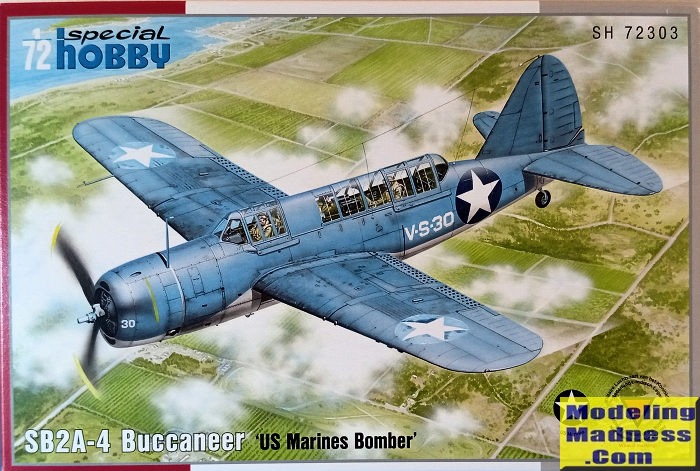
The kit reviewed here is the 2020 release, purchased at a bargain price from one of my favourite Greek hobby shops, which nowadays operates exclusively online. It comes in Special Hobby's familiar, excellent quality, sturdy top-opening cardboard box, adorned with attractive artwork depicting a U.S. Marine Corps Buccaneer in flight.
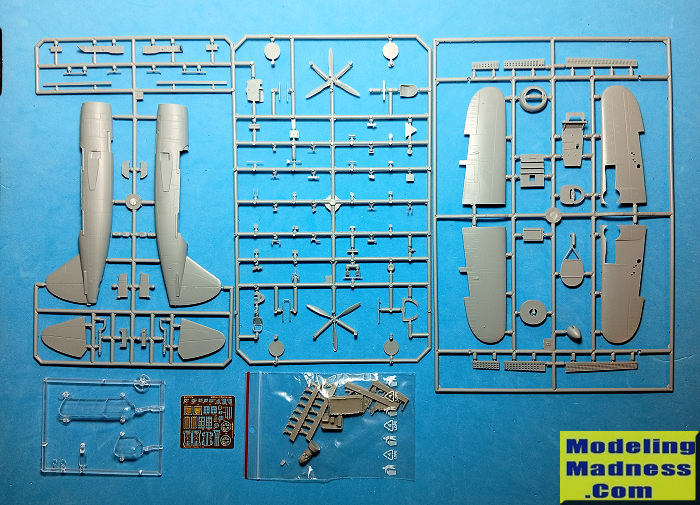
Opening the box reveals no fewer than 94 medium-grey styrene parts, distributed over three sprues, together with a small bag of finely cast polyurethane resin goodies and a photo-etched fret for the finer details. Not all parts are required for this particular version, as several are included to accommodate the alternative releases.
Molding quality is excellent throughout, with crisp detail, virtually no flash, and finely engraved panel lines that appear accurate when compared with available references.
The cockpit is particularly impressive for this scale. It is well detailed straight from the box, featuring a comprehensive representation of the crew stations. The instrument panel is molded with raised dial detail, allowing the supplied instrument decal to settle over it for an especially convincing appearance. Complementing the plastic parts are several finely cast polyurethane resin components, included to further enhance the cockpit and add an extra level of realism where it matters most.
The landing gear is equally well rendered, with impressive detail in the wheel wells and finely molded main landing gear struts. The characteristic perforated dive brakes are an absolute highlight of the kit. They are beautifully made, amazingly detailed for the scale, and capture the delicate appearance of the real aircraft remarkably well. Whether displayed in the open or closed position, they add considerably to the overall appeal of the model and demonstrate the care Special Hobby has invested in this release.
The engine is another highlight of the kit. It is provided as a combination of finely cast polyurethane resin parts, with the 18 individual cylinders attached to the central crankcase to build up the complete powerplant. The resin castings are exceptionally clean, with sharp cooling-fin detail and virtually no imperfections. While many modelers might have preferred the engine to be molded entirely in styrene for ease of assembly, there is no denying the excellent quality of the resin parts. Once assembled and painted, the finished engine should become a very attractive focal point of the model.
The propeller is also very well executed, featuring sharply molded blades and a well-defined hub. Equal praise goes to the rear defensive armament, which is reproduced as an impressive little sub-assembly combining styrene, photo-etched, and polyurethane resin parts. This multimedia approach results in a highly detailed representation of the twin machine guns, making this area one of the visual highlights of the completed model.
A nicely produced photo-etched fret is included, containing seat belts, gun sights, and a variety of other fine details. While many modelers are not particularly fond of working with photo-etched parts, there is no denying that these additions can further enhance the already impressive level of detail provided in the kit.
Transparencies are beautifully molded, crystal clear, and commendably free of distortion, allowing the well-appointed cockpit to remain fully visible once the model is completed.
Instructions follow the excellent standard that Special Hobby has established in recent years. They are presented in a high-quality, full-color, A5-sized booklet spanning 12 pages. Inside, the modeler will find a concise history of the aircraft, a clearly laid-out sprue and parts map, a comprehensive color chart, and the construction sequence presented in clear, easy-to-follow steps. Color callouts are provided throughout the assembly process wherever required, making construction both straightforward and enjoyable.
Four attractive marking options are included in the kit: three representing U.S. Marine Corps aircraft and one depicting a hypothetical Dutch machine. The latter illustrates how the Buccaneer might have appeared had the Dutch order been delivered before the outbreak of war prevented the aircraft from reaching service.
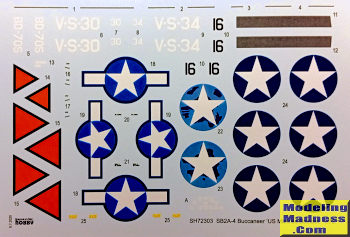 The
decals are beautifully printed, with excellent register, sharp detail, and
vibrant colors. They appear to be of the high quality we have come to expect
from Special Hobby and should perform flawlessly with the usual
decal-setting solutions. I particularly liked the faded top wing ones that
are to be affixed onto one of the schemes.
The
decals are beautifully printed, with excellent register, sharp detail, and
vibrant colors. They appear to be of the high quality we have come to expect
from Special Hobby and should perform flawlessly with the usual
decal-setting solutions. I particularly liked the faded top wing ones that
are to be affixed onto one of the schemes.
The instructions begin with the assembly of the cockpit interior, which is then trapped between the two fuselage halves together with the front engine firewall and rear bulkhead. A considerable amount of time should be dedicated to this highly detailed interior, but the effort is certainly worthwhile, as the finished result will be one of the most attractive features of the completed model.
Attention then turns to the wings, where the landing gear bays need to be assembled before the wing halves are joined. The beautifully rendered dive brakes can also be installed at this stage, either in the extended or retracted position. The landing gear follows, with the engine assembly coming next. As this is a resin component, extra care is required in the use of suitable adhesives and in the alignment of the parts, but careful work should result in an impressive powerplant.
The transparencies complete the main construction sequence. Overall, the build is not overly simplified but can be considered of average complexity. The inclusion of photo-etched parts, polyurethane components, and numerous detailed pieces means that this is not a beginner's kit. It is better suited to modelers who already have some experience, particularly with multimedia kits.
| CONCLUSIONS |
The Brewster SB2A Buccaneer can certainly be described as an esoteric subject. It was never produced in the same numbers as many of its contemporaries, achieved only limited operational success, and quickly disappeared from frontline service as more capable aircraft became available. For this reason, it is exactly the type of aircraft that mainstream manufacturers often overlook. Special Hobby is therefore once again to be congratulated for bringing such an unusual and historically interesting subject to modelers.
Apart from this release, the Buccaneer has received very little attention in 1:72 scale. A few older examples exist, but they are extremely limited in availability and belong to an earlier generation of limited-run production. Therefore, this Special Hobby kit can be considered the only realistic modern option for modelers wishing to add this aircraft to their collection.
The kit itself is beautifully produced. It features excellent molding quality, crisp details, finely engraved panel lines, and an impressive level of detail straight from the box. The polyurethane resin parts may not appeal to every modeler, but they provide excellent enhancements, particularly for the engine and cockpit areas. The photo-etched fret is an additional bonus, allowing further refinement of an already highly detailed model.
With careful assembly and painting, a superb SB2A Buccaneer can be produced directly out of the box. It is not a kit aimed at beginners, but rather one that will reward the experienced modeler who is willing to invest time and patience. The result will be a distinctive and attractive addition to any collection, especially for those interested in dive bombers or less common aircraft subjects.
The final judgment on fit and construction will have to wait until the model is built, but considering the steady improvement of Special Hobby releases in recent years, expectations are very positive. This is a beautiful kit of an unusual aircraft and a very welcome addition for anyone looking for something different from the usual subjects.
Happy Modeling!
A
ugust 2026
Copyright ModelingMadness.com. All rights reserved. No
reproduction in part or in whole without express permission from the editor.
If you would like your product reviewed fairly and fairly quickly, please
contact the editor or see other details in the
Note to
Contributors.