Monogram 1/48 B-29 Superfortress
|
KIT #: |
5706 |
|
PRICE: |
30 Euros in 2002 |
|
DECALS: |
One option |
|
REVIEWER: |
Spiros
Pendedekas |
|
NOTES: |
An impressive kit, a classic in every respect |
Few aircraft have come to symbolize American long-range air power
during World War II more strongly than the Boeing B-29 Superfortress.
Designed as a long-range, high-altitude heavy bomber, the B-29 represented a
major technological step forward. It incorporated pressurized crew
compartments, remote-controlled defensive turrets, an advanced fire-control
system, powerful Wright R-3350 engines and a sophisticated internal
arrangement that allowed it to operate at altitudes and ranges beyond those
of the heavy bombers that preceded it.
The B-29 entered combat in 1944 and became the principal American heavy
bomber employed against Japan during the final stages of World War II. Its
historical importance was further cemented by the specially modified
aircraft used during the atomic missions of August 1945. After the war, the
B-29 continued to serve in a variety of roles and saw combat again during
the Korean War. With thousands produced, it became one of the most important
and recognizable aircraft of its generation. For the modeler, however, there
is another aspect of the B-29 that makes it particularly attractive. It is a
big airplane. And in 1/48 scale, it is an enormous model.
 In
1977, Monogram came up with a new-tool 1/48 B-29 Superfortress, an
impressive model and, quite frankly, a daring step for the time. Producing a
B-29 in 1/48 scale was no small undertaking. The aircraft itself was
enormous, and translating it into a large-scale injection-molded model
represented a considerable investment in tooling, engineering and
production. The B-29 joined the other large and ambitious aircraft kits that
Monogram had been issuing during this period, establishing the company's
reputation for tackling subjects that were not necessarily easy or
inexpensive to reproduce in large scale. And Monogram did it again here. The
result was an impressive model that has remained in production in one form
or another for decades.
In
1977, Monogram came up with a new-tool 1/48 B-29 Superfortress, an
impressive model and, quite frankly, a daring step for the time. Producing a
B-29 in 1/48 scale was no small undertaking. The aircraft itself was
enormous, and translating it into a large-scale injection-molded model
represented a considerable investment in tooling, engineering and
production. The B-29 joined the other large and ambitious aircraft kits that
Monogram had been issuing during this period, establishing the company's
reputation for tackling subjects that were not necessarily easy or
inexpensive to reproduce in large scale. And Monogram did it again here. The
result was an impressive model that has remained in production in one form
or another for decades.
The original tooling has subsequently been reboxed numerous
times—approximately a dozen different issues—appearing under Monogram and
later Revell branding, with different box art and decal options. The tooling
has survived remarkably well and even reached the 2020s in a Platinum
Edition, which adds masks and a photo-etched fret intended to enhance some
of the finer details of the original model. The special editions and
aftermarket support given to the tooling over the years are a testament to
just how enduring this B-29 has been.
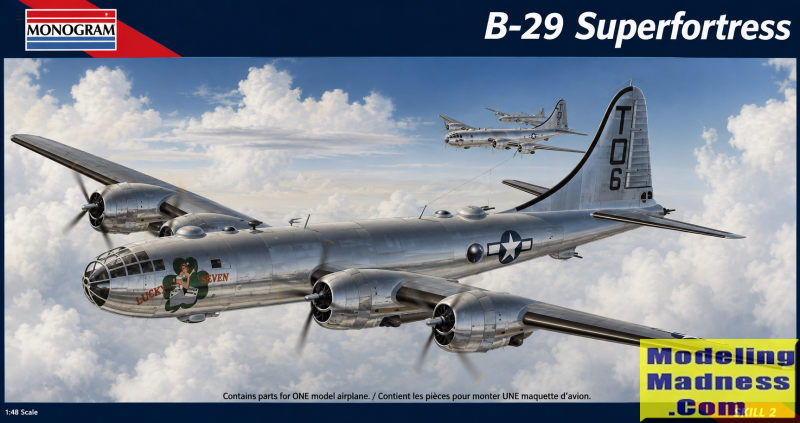
The particular kit reviewed here is the 1990s issue of the original tooling.
It comes in an impressively large, top-opening box, although it is not
particularly robust, with somewhat flimsy cardboard that can easily show its
age after several decades. The box art, however, is quite attractive,
depicting the B-29 gracefully in flight, with the aircraft dominating the
artwork and the marking option represented by the kit—“Lucky 'Leven”—clearly
visible.
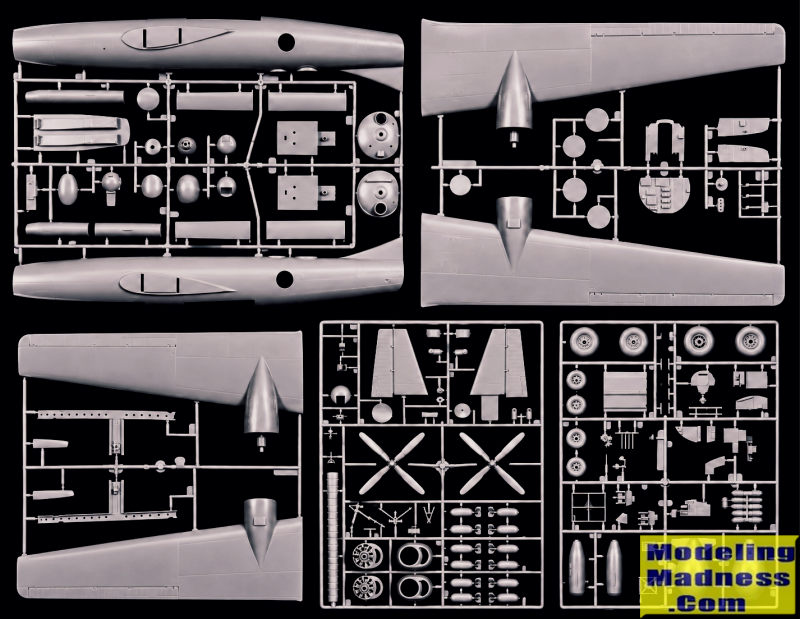
And then you open the box, and that is when the real experience begins. The
first thing that strikes you is the amount of plastic. It is massive. Around
130 parts are arranged on six sprue assemblies, with one of the sprues being
duplicated. The duplicate contains the propellers and several other
components, meaning that there are effectively five different sprue designs
represented in the box. The sprues are nicely arranged and the parts are
relatively easy to locate. All sprues are molded in silver-gray styrene,
save the one containing the wheels and atomic bombs, which is molded in
black (I reversed the colors on it for clarity in the sprues photo).
For a tooling originating in 1977, the molding is quite nice. There is some
flash, as would be expected from a kit of this age, but it is neither
excessive nor particularly difficult to remove. A little work with a sharp
hobby knife and some light sanding should take care of most of it without
any drama. The parts themselves are crisply molded and, perhaps most
importantly, their shapes look convincing. This is one of the areas where
Monogram has traditionally deserved considerable credit. Even with its older
toolings, the company generally paid close attention to the basic shapes of
its subjects, and the B-29 is no exception.
The panel lines are, of course, raised. For some modelers today, this may
immediately be considered a disadvantage. Personally, I don't see it as a
problem, as the panel lines are located where they should be and are not
excessively heavy. In fact, once painted and weathered, the raised detail
can produce a very pleasing appearance. There is certainly an argument that
raised panel lines can look particularly convincing on a large model when
viewed from normal display distance.
The overall detail is quite good for the scale and is more than sufficient,
especially when the origins of the tooling are taken into account. The
cockpit is very well appointed. Even by today's standards, the interior is
more than sufficient, with most of the major components found in the real
aircraft represented. The rear crew section receives similar attention, with
a surprisingly comprehensive collection of parts. Most seats feature
molded-on seat belts, and everything is nicely arranged. Considering the age
of the tooling, the interior is one of the areas where Monogram really
deserves credit.
The bomb bay is also nicely done and quite sufficient for the scale. A
particularly interesting feature is the distinctive tunnel through which
crew members could crawl past the bomb bay. Since the bomb bay itself was
not pressurized, this feature was an important part of the aircraft's
internal arrangement, and it has been well reproduced in the kit.
The engines are also very nicely represented. Only the engine faces are
provided rather than complete engine assemblies, but they will be more than
sufficient once the engines are assembled and installed behind the cowlings.
The propellers are equally nicely done and capture the characteristic
appearance of the B-29's four-bladed units. As a note, only cuffed
propellers are supplied in this issue (the 2004 and 2015 reissues, but to my
understanding not the 2020 one, provided an extra sprue with uncuffed
propellers).
The landing gear is another strong point. The assemblies are nicely
detailed, with sufficient detail around the wheels and wheel bays to produce
a convincing result. What deserves particular praise is the sturdiness of
the landing gear. This is a very important consideration with a model of
this size. The completed B-29 is a massive model, and the landing gear
appears more than capable of supporting its considerable weight.
Two substantial wing spars are also provided. These are very cleverly
designed and provide strong mounting points for the wings. Apart from making
construction easier, they add considerable structural strength to the
completed model and should help prevent the wings from sagging over time—a
problem that can affect some large aircraft models. This is excellent
engineering from Monogram.
The transparencies are also quite well done. They are clear and should
respond well to careful masking and painting. The instructions are typical
Monogram, very nicely done, and come in the form of a compact pamphlet. A
paint chart is included, while the entire construction sequence is spread
over only 23 steps. This may sound surprisingly few for a model as large
(and complex) as a B-29, but the instructions are clear and concise, the
construction sequence is logical, and experienced modelers can alter the
sequence slightly to their preference. Color callouts are provided where
applicable, making it easy to identify the required shades during
construction.
The kit offers a number of useful options. The crew entry hatch can be
displayed with its associated ladder, and some nice figures are included,
allowing the modeler to place the B-29 into a simple diorama or ground
scene. The two atomic bombs, Little Boy and Fat Man, together with a nice
transport trolley, are also provided. These are not applicable to the
aircraft represented by the supplied markings, but they can nevertheless be
assembled and displayed separately if desired. The bomb-bay doors are
intended to be installed open; whether they can be fitted closed without
considerable modification is less clear. For a diorama builder, however, the
combination of the open bomb bay, ladder, figures and weapons provides
plenty of possibilities.
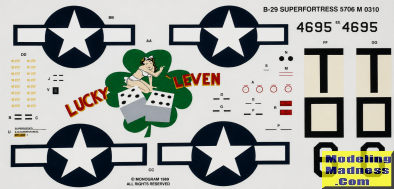 Only one
marking option is supplied in this particular boxing, and I certainly would
not have minded seeing another couple of options included. The subject is
Boeing B-29-45-BW Superfortress, serial 42-24695, “Lucky 'Leven,” of the
73rd Bombardment Squadron, 498th Bombardment Group, US Army Air Forces, in
1945 at Isely Field, Saipan, finished in natural metal. The 1990s decals are
quite sharply printed, with good registration and convincing colors. There
is some yellowing of the carrier film, but considering their age they appear
usable. Naturally, their real condition will only become apparent once they
are placed in water and applied to the model.
Only one
marking option is supplied in this particular boxing, and I certainly would
not have minded seeing another couple of options included. The subject is
Boeing B-29-45-BW Superfortress, serial 42-24695, “Lucky 'Leven,” of the
73rd Bombardment Squadron, 498th Bombardment Group, US Army Air Forces, in
1945 at Isely Field, Saipan, finished in natural metal. The 1990s decals are
quite sharply printed, with good registration and convincing colors. There
is some yellowing of the carrier film, but considering their age they appear
usable. Naturally, their real condition will only become apparent once they
are placed in water and applied to the model.
The instructions begin by having the modeler assemble the nose wheel bay
underneath the flight deck, followed by the attachment of the nose landing
gear. I am not entirely convinced that the landing gear needs to be
installed at this early stage. It may be possible to leave it until later,
which would make handling the model considerably easier and reduce the
possibility of breaking it during subsequent construction.
Construction then moves to the interiors. The forward crew compartment is
particularly well elaborated, with Monogram providing the seats, control
columns, gun sights, consoles, tables, bulkheads and other equipment
associated with the area. And it is really nicely detailed. For a tooling
originating in 1977, the amount of equipment supplied inside the forward
fuselage is impressive. This is an area where I would recommend taking your
time, as careful painting and perhaps some additional detailing will
certainly reward the modeler, even though not a great deal will ultimately
be visible through the closed transparencies.
The bomb bay is then detailed, followed by the rear crew compartment and its
associated equipment, which is similarly well detailed as the front one. The
tail skid is also attached during these stages. Before closing the fuselage
halves, I strongly recommend considering some nose weight. The B-29 can have
a tendency to become a tail sitter, and it is far better to deal with the
problem while the fuselage is still open. If necessary, some weight can also
be added inside the engine nacelles before the engines are attached to the
wings.
Once all the interior components are in place, the two fuselage halves can
be joined, trapping all the interior detail inside. The two substantial wing
spars are also trapped into the fuselage at this stage and will provide very
strong mounting points for the wings, which are next assembled and attached
in position, followed by the engines, which look quite nice once assembled,
and the main landing gear. The bomb-bay doors can be positioned open, while
the tailplanes are then attached, followed by the various defensive turrets
and antennas. Finally, the transparencies are installed, bringing the
construction to an end.
This is perhaps the most pleasant surprise of the entire kit.
Despite the enormous size of the aircraft, the construction is far less
complicated than one might expect. If we remove the sheer size of the parts
from the equation, the actual construction can be considered quite
straightforward. The engineering is conventional, the parts count is
manageable, and the instructions guide the modeler through the process
without unnecessary complications. The real challenge is therefore not so
much technical complexity as simply handling a huge model. For something
this big, that is quite an achievement.
Without a doubt, this is an excellent kit, and perhaps the most
remarkable thing about it is that Monogram had the courage to produce such
an enormous 1/48 aircraft in 1977. It was a daring decision then and, in
many respects, it would still be a daring decision today. The B-29 joined
the other great large-scale subjects that Monogram tackled during its golden
era, and the result is a kit that has survived for almost half a century and
continues to be enjoyed by modelers.
Of course, it cannot match the finesse of the best 2020s tooling. The raised
panel lines and some of the simplified details remind us of its age, but the
basic shapes are convincing, the molding remains good, the interior is
surprisingly comprehensive, the landing gear is detailed and wonderfully
sturdy, and the engineering—including those excellent wing spars—is
genuinely clever. The later Platinum Edition, with its photo-etched parts
and masks, only reinforces the fact that the old tooling still has plenty of
potential.
What I particularly like about this kit is that it is big without being
unnecessarily complicated. It looks intimidating when you open the box, but
the construction looks surprisingly straightforward, and the finished model
has an undeniable presence.
So, congratulations to Monogram. Nearly fifty years ago, they took on a
subject that was enormous in every sense of the word and produced a model
that has stood the test of time. It may be an old kit, but it remains a very
enjoyable one, and there is something genuinely special about seeing a
classic Monogram B-29 come together on the workbench. For lovers of large
aircraft and classic kits, this Superfortress remains a wonderful piece of
modeling history—and definitely, a kit worth tackling.
Happy Modeling!
August 2026
Copyright ModelingMadness.com. All rights reserved. No
reproduction in part or in whole without express permission.
If you would like your product reviewed fairly and fairly
quickly, please
contact
the editor
or see other details in the
Note to
Contributors.
Back to the Main Page
Back to the Review Index Page
Back to the Previews Index Page
 In
1977, Monogram came up with a new-tool 1/48 B-29 Superfortress, an
impressive model and, quite frankly, a daring step for the time. Producing a
B-29 in 1/48 scale was no small undertaking. The aircraft itself was
enormous, and translating it into a large-scale injection-molded model
represented a considerable investment in tooling, engineering and
production. The B-29 joined the other large and ambitious aircraft kits that
Monogram had been issuing during this period, establishing the company's
reputation for tackling subjects that were not necessarily easy or
inexpensive to reproduce in large scale. And Monogram did it again here. The
result was an impressive model that has remained in production in one form
or another for decades.
In
1977, Monogram came up with a new-tool 1/48 B-29 Superfortress, an
impressive model and, quite frankly, a daring step for the time. Producing a
B-29 in 1/48 scale was no small undertaking. The aircraft itself was
enormous, and translating it into a large-scale injection-molded model
represented a considerable investment in tooling, engineering and
production. The B-29 joined the other large and ambitious aircraft kits that
Monogram had been issuing during this period, establishing the company's
reputation for tackling subjects that were not necessarily easy or
inexpensive to reproduce in large scale. And Monogram did it again here. The
result was an impressive model that has remained in production in one form
or another for decades.