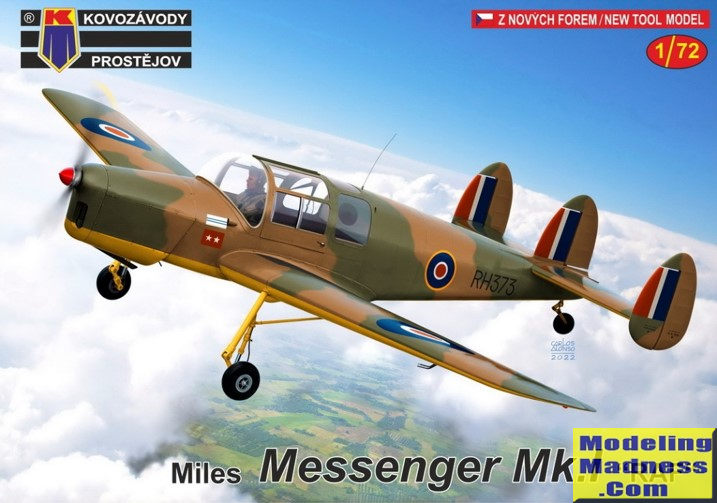
| KIT #: | KPM 0319 |
| PRICE: | AUD$5.00 |
| DECALS: | Three options |
| REVIEWER: | George Oh |
| NOTES: |
| HISTORY |
(Possibly, this IS the start of a joke) In June 1942, a group of British Army officers walk into the office of aircraft designer George Miles, (of Miles Aircraft) and ask for an aircraft that is robust with low maintenance and short-landing capable, that is suitable for Air Observation Post (AOP) duties (so able to fly slowly) because the current Army Co-operation aircraft aren’t up to the job. So, Miles modified the design of his existing M.28 Mercury by substituting the engine, using fixed undercarriage, and adding retractable auxiliary flaps & a 3rd fin-and-rudder. When the ‘new’ aircraft, designated the Miles M.38, was informally test flown by an Aerial Observation Post Squadron, only 3 months later, it was declared a success, meeting all the Army's requirements.
However, when the MAP (Ministry of Aircraft Production) was advised of the success, they reprimanded George Miles for failing to seek the Ministry's permission before rebuilding the aircraft and refused to order the Miles M.38 for the AOP role. Undaunted, Miles experimented with the M.38 – trailing it as a light ship-borne anti-submarine aircraft (with equal Ministry enthusiasm). I suppose that the MAP finally threw him a bone a year later, by placing a small order for the M.38 (now the Miles Messenger), for the RAF’s VIP passenger transport role. One (and its pilot?) was allocated to Field Marshall Montgomery (aka, Monty).
Post-war, the Messenger was upgraded, and limited production continued in Northern Ireland. In all, only 93 were built. Able to carry 4 adults, it is essentially a small family sedan, with wings, that can go about 450 miles/700km at over 100mph/150kph.
| THE KIT |
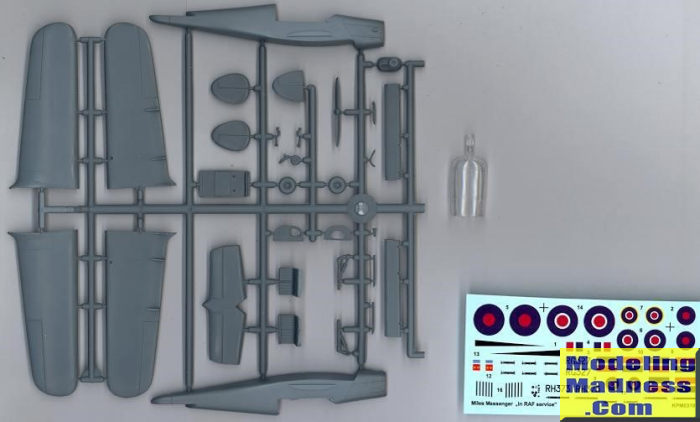 We
modellers have a choice of Messengers in 72-scale. This is the KP issue from
2022. It comes in a light end-opening box, as a single sprue of 31 parts and
a single bagged clear piece. A short-run kit, it lacks alignment pins & tabs
(or their possible associated sink dimples), and shows just a little flash
or mould-slip seams. The seats seem to have long pans, but low backs. The 4
prominent exhaust pipes under the nose (see the painting guide) are missing
(though easily fixed), but the kit supplies a single long horizontal exhaust
pipe. Lift-up entry panels would have been nice, (but this, too should be an
easy fix – for a modeller). Panel lines are few, engraved and quite petit,
though the control surfaces are strongly marked. The cockpit is basic with a
floor, 4 seats, 2 control sticks & an IP, decals for the IP and seatbelts,
and some sidewall detail. The propeller is to be glued in-place, though a
modeller may re-engineer it to spin.
We
modellers have a choice of Messengers in 72-scale. This is the KP issue from
2022. It comes in a light end-opening box, as a single sprue of 31 parts and
a single bagged clear piece. A short-run kit, it lacks alignment pins & tabs
(or their possible associated sink dimples), and shows just a little flash
or mould-slip seams. The seats seem to have long pans, but low backs. The 4
prominent exhaust pipes under the nose (see the painting guide) are missing
(though easily fixed), but the kit supplies a single long horizontal exhaust
pipe. Lift-up entry panels would have been nice, (but this, too should be an
easy fix – for a modeller). Panel lines are few, engraved and quite petit,
though the control surfaces are strongly marked. The cockpit is basic with a
floor, 4 seats, 2 control sticks & an IP, decals for the IP and seatbelts,
and some sidewall detail. The propeller is to be glued in-place, though a
modeller may re-engineer it to spin.
The instructions are on a single A4 sheet (= 4 x A5-sides) showing a history (in Czech & English), outside schematic drawings, a parts lay-out plan and assembly in 6 suggested, logical steps. The painting and decal plan is in colour, on the back of the box. The decal sheet is small but crowded (vs cluttered) because it holds markings for 3 x aircraft in RAF markings, with 2 of them still in single-colour civilian livery. But they are quite crisp and in-register. (A parallel release has the markings for Monty’s invasion striped plane)
| CONCLUSIONS |
This recent purchase is a neat little model of an unusual-looking plane (that 3rd tail). You probably don’t realise that you’ve already seen in the movie ‘633 Squadron’. It looks like a quick, simple build (32 parts), but it might be slowed because of the butt-joins.
F
ebruary 2026
Copyright ModelingMadness.com. All rights reserved. No
reproduction in part or in whole without express permission from the editor.
If you would like your product reviewed fairly and fairly quickly, please
contact the editor or see other details in the
Note to
Contributors.