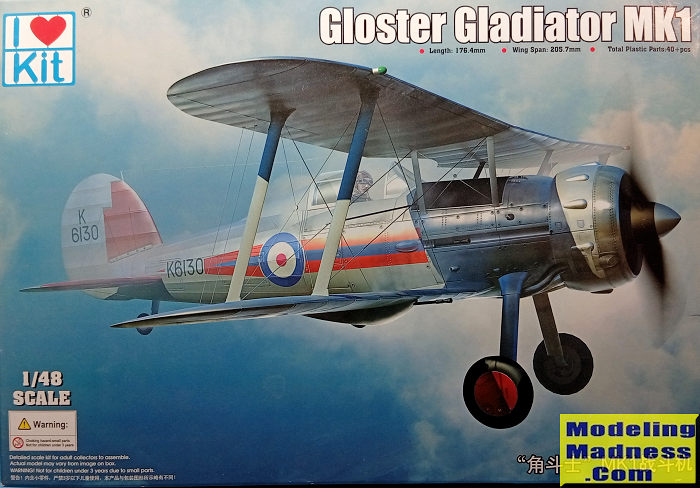
I Love Kit 1/48 Gladiator Mk.I
| KIT #: | 64803 |
| PRICE: | 25 Euros |
| DECALS: | Three options |
| REVIEWER: | Spiros Pendedekas |
| NOTES: | Merit kit |
| HISTORY |
The Gloster Gladiator is a British biplane fighter. It was used by the Royal Air Force (RAF) and the Fleet Air Arm (FAA) (as the Sea Gladiator variant) and was exported to a number of other air forces during the late 1930s.
Developed privately as the Gloster SS.37, it was the RAF's last biplane fighter aircraft and was rendered obsolete by newer monoplane designs even as it was being introduced. Though often pitted against more advanced fighters during the early days of the Second World War, it acquitted itself reasonably well in combat.
The Gladiator saw action in almost all theaters during the Second World War, with a large number of air forces, some of them on the Axis side. The RAF used it in France, Norway, Greece, the defense of Malta, the Middle East, and the brief Anglo-Iraqi War (during which the Royal Iraqi Air Force was similarly equipped). Other countries deploying the Gladiator included China, Finland, Sweden, Norway, Belgium, and Greece. South African pilot Marmaduke "Pat" Pattle was the top Gladiator ace with 15 victories with the type.
| THE KIT |
 Merit
came in 2015 with a new tool 1/48 Gladiator MkI, followed by a MkII one year
later. Then, both of those kits were reissue by the new "I Love Kit" company in
2020, being spitting images of the Merit one. They use exactly the same boxes
and even the instructions are the Merit ones, but with a black sticker blanking
the Merit logo. This makes Merit and I Love Kit the same company, which, in
turn, is reportedly a branch of the HobbyBoss company and, in fact, everything
in this kit dictates HobbyBoss origins.
Merit
came in 2015 with a new tool 1/48 Gladiator MkI, followed by a MkII one year
later. Then, both of those kits were reissue by the new "I Love Kit" company in
2020, being spitting images of the Merit one. They use exactly the same boxes
and even the instructions are the Merit ones, but with a black sticker blanking
the Merit logo. This makes Merit and I Love Kit the same company, which, in
turn, is reportedly a branch of the HobbyBoss company and, in fact, everything
in this kit dictates HobbyBoss origins.
The specific kit was a gift from my good Dutch friend John vd Biggelaar and arrived in a relatively small-sized, top-opening box of excellent quality, carrying a nice boxart of RAF’s K6130 machine flying through the clouds.
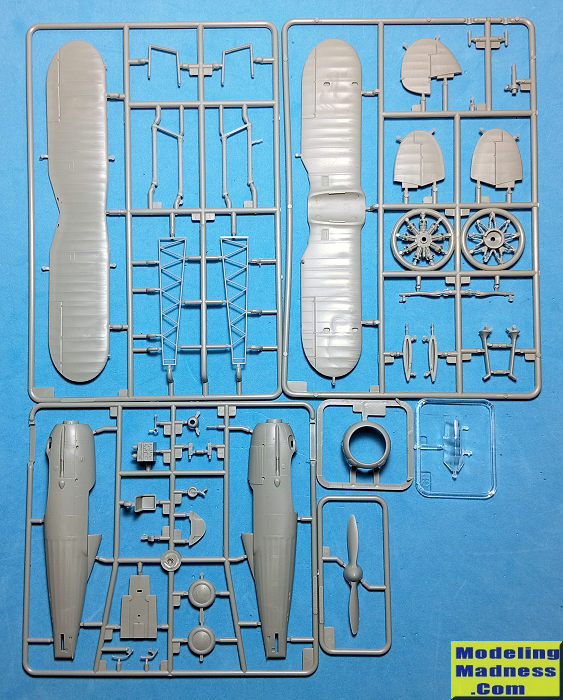
Upon opening the box, I was greeted with 41 light gray styrene parts, arranged in three main sprues (which are common to both the MkI and MkII versions) and two petite sprues which contain the correct cowling and prop for the specific version. Typically for HobbyBoss, all sprues are individually packaged and the sensitive parts are additionally protected by foaming. Bravo HobbyBoss/I Love Kit!
Molding is excellent with no flash noted, with just a mere cleanup of some tiny mold separation lines needed. Panel lines are finely engraved and fabric representation is realistic. Cockpit is reasonably detailed, containing all basic stuff found on the real thing. The instrument panel has finely molded instruments, with a decal provided to represent the instrument faces. The Bristol engine is also well represented, as is the prop, the internal fuselage framing, the wing struts and the landing gear. Each wing, elevator and the rudder are molded as one piece each, which is very nice.
The one piece canopy is crisply molded and clear. Instructions are typical HobbyBoss, coming in the form of a 4-page leaflet, containing a sprues map, while the construction is spread in 5 steps which are easy to follow. No rigging diagram is provided, so you have to source one from the net. Basic colour callouts are given throughout, but the best thing to do is to do some research for areas like the cockpit.
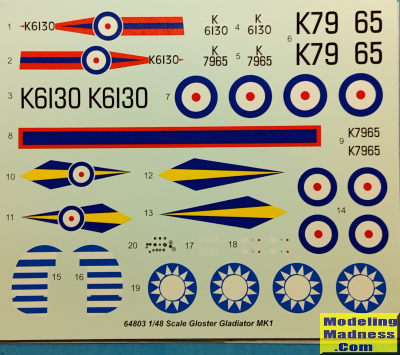 Three
schemes are provided, for two nicely decorated RAF machines in Natural Metal
Finish and a very interesting Republic of China Air Force example in overall
forest green. Colours are given in Mr Hobby, Vallejo, Model Master, Tamiya,
Humbrol and in generic form. Decals are nicely printed and expected to work
well.
Three
schemes are provided, for two nicely decorated RAF machines in Natural Metal
Finish and a very interesting Republic of China Air Force example in overall
forest green. Colours are given in Mr Hobby, Vallejo, Model Master, Tamiya,
Humbrol and in generic form. Decals are nicely printed and expected to work
well.
Instructions want you to first assemble the interior and trap it between the fuselage halves. The engine and cowling is next assembled, followed by attachment of the lower wing, the elevators and the canopy. Landing gear is then attached, followed by the engine/cowling assembly and attachment of the upper wing, the rudder and the propeller, ending a certainly uncomplex build - apart, of course from the rigging.
| CONCLUSIONS |
This is a good kit for the iconic Gladiator: shapes of parts look correct, molding is crisp, panel lines are finely engraved, fabric representation is nice, overall detail is sufficient, the canopy is well molded and crystal clear, instructions are followable and decals look great.
Out of the box, a good representation of the Gladiator is expected to emerge. Construction itself looks straightforward and uncomplicated for a biplane, deeming it suitable for less experienced modelers. In fact, this kit's engineering looks focused in easiness of assembly, compared with the (not that departed) more detailed and certainly more complex Roden kit.
Priced very sensibly, if you like the Gladiator and don't mind some rigging, this is definitely a kit worth tackling.
Happy Modeling!
March 2026 Copyright ModelingMadness.com.
All rights reserved. No reproduction in part or in whole without express
permission. If you would like your product reviewed fairly and
fairly quickly, please
contact
the editor or see other details in the
Note to
Contributors.