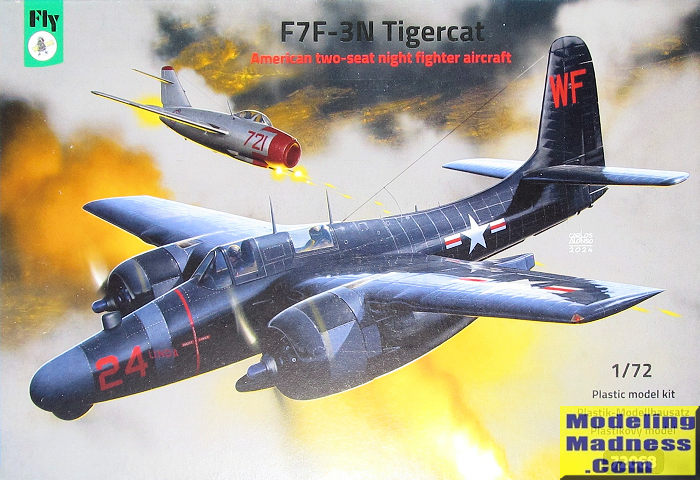
Fly Model 1/72 F7F-3N
| KIT #: | 72068 |
| PRICE: | 31.5 Euros |
| DECALS: | Three options |
| REVIEWER: | Dan Lee |
| NOTES: | Same sprues for all F7F kits |
| HISTORY |
The Twin engine Tigercat was a departure from the single engine fighter aircraft Grumman usually designed as it was supposed to be a convoy escort fighter and originally named Tomcat. However, thanks to the name offending certain segments of the America public at the time, the F7F prototype was renamed to the less offensive Tigercat.
It was a one or two crewed fighter depending on the variant armed with four 20mm cannons in the inner wings and equipped with an air to air radar set or an additional four .50 caliber machine guns in the nose.
The Tigercat arrived almost too late for WW2, only serving in a land based Marine photo recon squadron and not seeing much combat. Part of that was due to the fact that the Tigercat was designed to fly off the new Midway class carriers as well as the fact that it didn’t pass carrier qualification due to some very suspect flying characteristics landing on one engine and issues with the arrestor hook.
It did see service with mostly land based squadrons mostly including a short stint with VMF(N)-513 during the Korean War (including the downing of 2 Po-2 biplanes.)
The F7F-4 with a bigger tail would be the only version that passed carrier qualifications but by then the jet age arrived and the Tigercat would soon be a relic of the prop age.
| THE KIT |
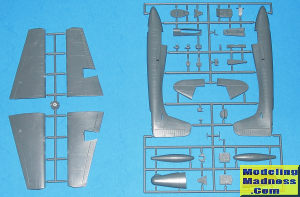
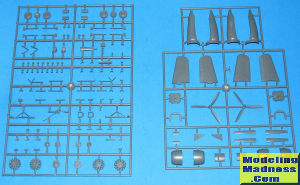 FLY
Model designed the sprues to be the same sprues for all versions of the Tigercat
kit so there is a lot of stuff that you don’t need or have to cut off and
replace includes all the various parts needed for the different versions
including noses, cockpit coamings, canopies, tails and even a pair of 1/72
drones for the drone controller version.
FLY
Model designed the sprues to be the same sprues for all versions of the Tigercat
kit so there is a lot of stuff that you don’t need or have to cut off and
replace includes all the various parts needed for the different versions
including noses, cockpit coamings, canopies, tails and even a pair of 1/72
drones for the drone controller version.
The kit is made up for four grey sprues and one clear sprue. This is a short run kit so there is some flash on the parts and they do require a bit of clean up (but not as bad as it could be.) The surface detail is okay but rough in places, with moderate sized panel lines but with some raised details (especially the fabric tail and ailerons) so it looks like some surface priming is needed to smooth the surface out. The sprue gate attachment points aren’t big or require careful cutting, but the sprue nubs have to be completely sanded down to get a clean join. The small parts are a bit clunky and require some careful clean up although they have some decent surface detail. However, the spindly thin landing gear looks like they might need to be replaced with metal ones especially if one jams a lot of weight in its nose. Also one should be careful of removing the thin parts from the sprues as they look very fragile.
The clear parts are okay, but are touch thick for the scale.
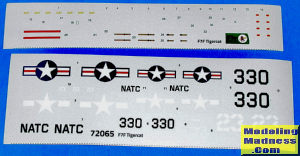
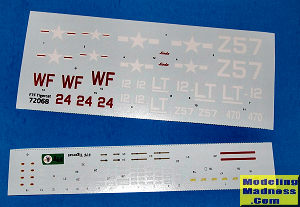 Finally,
the decals look well done for 1/72 scale. Not sure who printed them but they
look decent enough. Included are a set of decal seatbelts for both cockpits.
There are three sets of markings of planes from land based night fighter
squadrons: one US Navy plane in gloss sea blue and two USMC planes (one from
Korea) in flat black. The decal placement and color schemes for each plane
markings are on the back of the box so don’t throw it out or recycle it till
you’re done with the kit!
Finally,
the decals look well done for 1/72 scale. Not sure who printed them but they
look decent enough. Included are a set of decal seatbelts for both cockpits.
There are three sets of markings of planes from land based night fighter
squadrons: one US Navy plane in gloss sea blue and two USMC planes (one from
Korea) in flat black. The decal placement and color schemes for each plane
markings are on the back of the box so don’t throw it out or recycle it till
you’re done with the kit!
The instruction booklet shows all the assembly steps for any of the F7F models including the stencil placement. One has to identify what is needed for the version you want to build.
| CONCLUSIONS |
The Fly F7F-3N kit looks like it will not be an easy build because of its short run nature. I would expect that a lot of work will be required to produce a nice model as with any short run kit. But for fans of the Grumman Tigercat night fighter this kit should make a welcome addition to their Grumman, USN, night fighter or twin engine carrier based aircraft collection.
May 2026
Copyright ModelingMadness.com. All rights reserved. No reproduction in part or in whole without express permission.
If you would like your product reviewed fairly and fairly quickly, please contact the editor or see other details in the Note to Contributors.