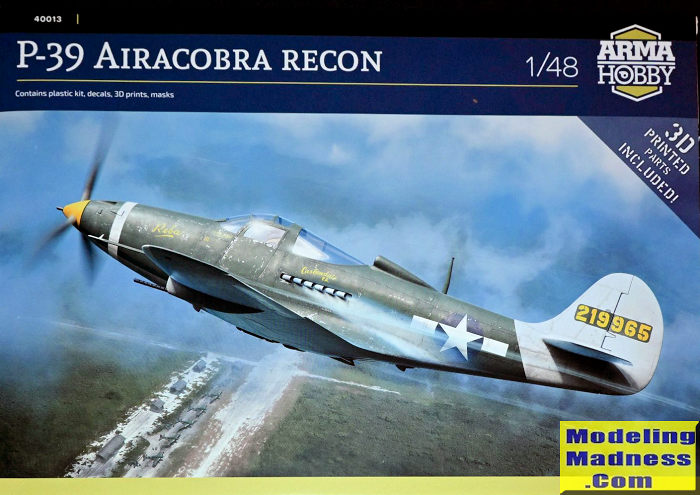
Arma Hobby 1/48 P-39 Airacobra
| KIT #: | 40013 |
| PRICE: | $71.00 |
| DECALS: | Three options |
| REVIEWER: | Chuck Horner |
| NOTES: | 3D parts. |
| HISTORY |
The Bell P-39 had a less than stellar reputation coming out of WWII, with complaints about its lack of high-altitude performance and its supposed tendency to tumble due to its mid-engine location. It served throughout the war in North Africa, the Mediterranean and Pacific theaters, but had its most success with the Russian air force.
In recent years, its short-comings have been debated. Its lack of high-altitude performance was not the fault of its design, but from the US Air Corps removing the super-charger from its initial design. The reports of tumbling have been disputed as unusual conditions or incorrect reporting. The Russians loved the plane and used it successfully as both a ground attack and fighter interceptor. Of the ten top Russian aces, five flew the Airacobra.
A number of P-39’s, primarily N’s and Q’s, were converted to armed-recon versions by fitting K-24 and K-25 cameras to the lower fuselage. They served in the Mediterranean and Pacific, but also in the Caribbean and along the US east coast looking for German U-boats.
| THE KIT |
 P-39 models have been
produced in all mediums since 1941. In more recent times, every major plastic
model company (and some minor ones) have produced versions of the Airacobra in
all scales. My first introduction to the plane was the Monogram 1/48 scale kit
in the mid-1970’s.
P-39 models have been
produced in all mediums since 1941. In more recent times, every major plastic
model company (and some minor ones) have produced versions of the Airacobra in
all scales. My first introduction to the plane was the Monogram 1/48 scale kit
in the mid-1970’s.
Arma Hobby is a Polish company that released their versions of the P-39 in both 1/72 and 1/48 starting in 2022. Both scales offer lots of detail. The Recon kit came out in 2024.
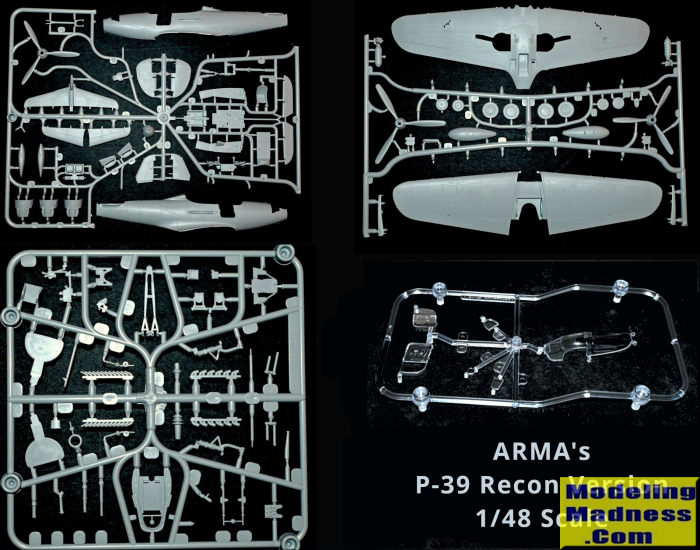
The kit comes in a side-opening box with very nice artwork on both front and back. Parts are held in a heavy-duty cardboard tray which slides out and contains 98 light-gray and clear parts. The kit also includes three steel balls for nose weight and canopy masks. Seat belts are provided on the decal sheet, but I have found that cutting them out and gluing them to the seat, still on the paper backing, works very well. Adding black marker ink to the edges and back, enhances the effect.
Like the Eduard kits, there are pieces on the trees for most of the different versions. What is added in this kit are 3D printed parts consisting of the cameras and a template for cutting the camera opening in the lower fuselage.
Two model design features that I have not seen on other P-39 kits are 1) that the complete tail, including the vertical, is separate from the fuselage, and 2) both the bottom and top of the wing parts are single pieces. This appears to make the fuselage-to-wing fit very tight.
I can’t speak for all of the small pieces, but test fitting the major parts looks good.
The instructions are a 12-page, glossy, full-size booklet, printed in full color. The steps clearly show the minor alterations for the recon version as well as differences to each of the airplanes offered.
 Markings
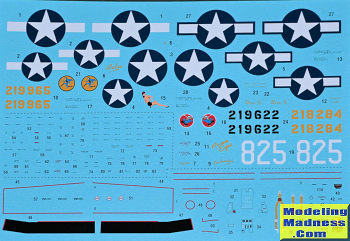
There are decals for three airplanes. Two are OD and gray and the third is a natural metal, unusual for the P-39. The instructions have a full-page, color, 4-view drawing of each of the three planes.
P-39Q, 82nd Tactical Reconnaissance Sqn., New Guinea, 1944.
P-39N, 118th Tactical Reconnaissance Sqn., (CT Air Guard) covering the US East Coast, 1943.
P-39Q, 4th Reconnaissance Sqn, Puerto Rico, 1943.
| CONCLUSIONS |
For the those collecting P-39 models, it’s a version I haven’t seen before. Without a mirror base, though, the added recon pieces won’t be visible to the observer as the kit sits on the shelf.
For me, as a Connecticut native, finding war-time markings for the Connecticut Air Guard brings a local flavor to the kit. I’ve built several P-39’s over the years, but I added this one to my To-Build-Soon list.
Chuck Horner
January 2026 Copyright ModelingMadness.com. All rights reserved. No
reproduction in part or in whole without express permission from the editor. If you would like your product reviewed fairly and fairly quickly, please contact the editor or see other details in the
Note to
Contributors.