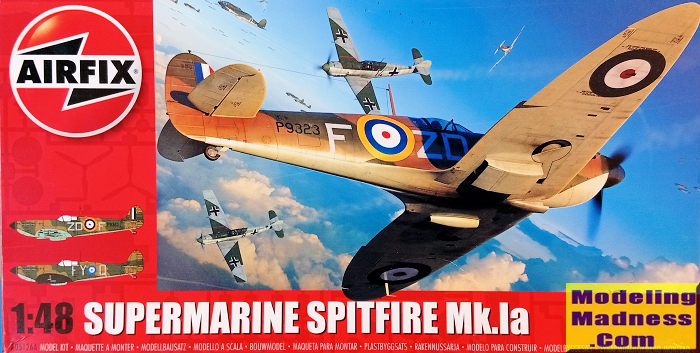
Airfix 1/48 Spitfire Ia
| KIT #: | A05126A |
| PRICE: | 16.00 Euros on sale |
| DECALS: | Two options |
| REVIEWER: | Spiros Pendedekas |
| NOTES: | More recent tooling |
| HISTORY |
The Supermarine Spitfire was one of the most famous fighter aircraft of the Second World War, and the Mk.Ia represented the version that helped establish its legendary reputation. Designed by Reginald J. Mitchell, the Spitfire combined elegant lines with excellent manoeuvrability and a distinctive elliptical wing, which provided the aerodynamic qualities that made it such an exceptional fighter. Powered by a Rolls-Royce Merlin engine, the aircraft was a significant step forward for the Royal Air Force as the threat of war grew across Europe.
The first production Spitfires entered RAF service in 1938, initially with No. 19 Squadron at Duxford. Early aircraft were armed with eight .303-inch Browning machine guns, providing a substantial volume of fire against contemporary opponents. The Spitfire Mk.Ia incorporated refinements to its equipment and armament installation, and its combination of speed, agility and responsive handling made it a formidable adversary in the hands of experienced pilots.
The Mk.Ia came to prominence during the Battle of Britain in the summer and autumn of 1940. Flying alongside the Hawker Hurricane, Spitfires intercepted German formations attacking Britain, engaging fighters such as the Messerschmitt Bf 109 and confronting the bombers of the Luftwaffe. While the Hurricane accounted for a considerable share of the RAF's victories, the Spitfire became especially celebrated for its ability to challenge German fighters. Its contribution to the defence of Britain secured its place among the defining aircraft of the war.
Although superseded by progressively improved variants as the conflict continued, the Spitfire Mk.Ia remains an enduring symbol of the RAF's struggle in 1940. Its graceful appearance, unmistakable elliptical wings and association with the Battle of Britain have made it one of the most recognisable aircraft in aviation history. More than simply an early version of a successful fighter family, the Mk.Ia represents the Spitfire at the moment when it first proved its worth in combat on a world stage.
| THE KIT |
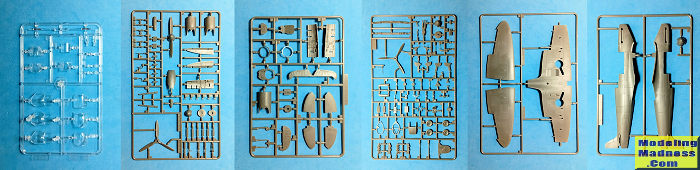 This
is Airfix's new-tool 1/48 Spitfire, which first appeared in 2014 as the Mk.Vb,
and subsequently adapted for other versions, including the Mk.I and Mk.Ia. The
kit previewed is the 2020 Mk.Ia release.
I purchased it from one of my now-beloved online hobby shops. Originally priced at 21 euros, it was offered at a further discount, bringing the final price down to just 16 euros. At that price, it was simply too good a bargain to pass up!
The kit arrived in Airfix's familiar, medium-sized, top-opening red box. The attractive box art, by Adam Tooby, depicts one of the marking options engaged in a dogfight, banking slightly to the left. It is a dynamic and beautifully executed illustration that immediately catches the eye and adds considerably to the overall appeal of the package.
Upon opening the box, I was greeted by approximately no less than 130 dark gray styrene parts, neatly arranged on five sprues. The wings occupy one sprue, the fuselage halves (and a prop spinner) another, while the remaining sprues contain everything else. What immediately catches the eye is the quality of the molding. Everything is relatively crisp and clean, with no flash whatsoever. The plastic is somewhat softer and less shiny than what we are accustomed to from manufacturers such as Hasegawa or Tamiya, but this should not present any particular problems during construction.
The panel lines are finely recessed and beautifully executed, capturing the characteristic surface detail of the Spitfire without appearing exaggerated. More importantly, the overall shape looks exceptionally convincing. The curvature of the fuselage, the proportions of the wings and the general outline of the aircraft all appear very close to the real thing. Airfix deserves credit for what seems to have been excellent research into the proportions and distinctive contours of this famous fighter. The result is a kit that looks every inch a Spitfire.
The cockpit is beautifully elaborated and contains all the usual details expected in a modern kit of this scale. The instrument panel features raised instrument bezels, and decals are provided to represent the instruments, offering the opportunity to achieve a very convincing result with a little care. The cockpit should satisfy most modelers straight out of the box, although those who enjoy adding extra detail will certainly find opportunities to do so.
A nicely molded pilot figure is also included. Those who prefer to display their Spitfire in flight or simply wish to fill the cockpit can make good use of it. If the cockpit is to be displayed without the pilot, however, seatbelts must be added, whether by using aftermarket items or fabricating them from suitable material, as they will be quite prominent in the finished model.
The landing gear is equally well done, with convincing detail on the legs, struts and doors. The wheels feature separate hubs, a welcome touch that should make painting easier while also contributing to a more realistic appearance. The ailerons, elevators and rudder are supplied as separate parts, allowing the modeler to position them as desired and introduce some additional dynamic character to the finished aircraft. Drooping the elevators, for example, can give a parked Spitfire a particularly convincing appearance.
Another attractive feature is the possibility of displaying the wing gun bays open. This requires cutting away the appropriate molded wing panels, for which separate access panels are supplied. It is a welcome addition for those who enjoy showing off the internal details of an aircraft, although modelers who prefer a clean, straightforward build can simply leave the gun bays closed.
Airfix has included quite a few optional parts. These cover different propellers, exhausts, cowlings, transparencies and other components intended to accommodate variations between versions. I will leave it to the Spitfire Aficionados to identify every detail and determine which alternatives are appropriate for particular aircraft. Nevertheless, some of these parts may prove useful for other projects, leaving the modeler with a respectable collection of spare components for the parts box.
The transparent parts are beautifully molded and crystal clear. Together with the various optional components, they provide plenty of flexibility when choosing how to present the finished aircraft.
The instructions follow Airfix's familiar modern style and come in a 16-page A4 booklet. They begin with a short history of the aircraft and then proceed through no fewer than 62 construction steps. The drawings are clear, concise and well organized, with colour callouts provided where necessary. I particularly appreciate the explanatory nature of the instructions when dealing with potentially tricky operations, such as cutting open the gun bays and positioning the landing gear legs and wheels at the correct angles. These details can make a considerable difference to the final result, and Airfix has done a very good job of guiding the modeler through them.
Two relatively early RAF schemes are provided:
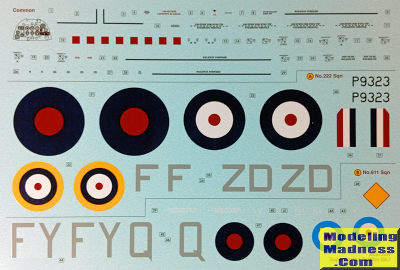 - No. 611
(West Lancashire) Squadron, FY-Q, RAF Duxford, October 1939. An early Spitfire
in the service of the Royal Auxiliary Air Force, representing the period before
the Battle of Britain.
- No. 222 Squadron, ZD-F, aircraft P9323, flown by Sergeant Arthur William Peter Spears, RAF Hornchurch, August 1940. This option represents the Spitfire Mk.Ia during the Battle of Britain.
The colour references are given both as Humbrol codes and in generic form. The decals are beautifully printed, with good definition, and should produce an excellent result when applied carefully.
Construction begins, as expected, with the cockpit. Given the amount of detail provided, it is well worth taking your time here. Careful painting of the instrument panel, seat, sidewalls and other components will pay dividends once the cockpit is enclosed within the fuselage. The supplied instrument decal offers a useful shortcut to a convincing result, while the addition of seatbelts will further enhance the appearance if the pilot figure is not used.
The fuselage is then assembled, followed by the wings. Particular attention should be paid to the wing assembly and the installation of the spar, which also forms part of the landing gear support structure. It is advisable to study the instructions carefully before proceeding, especially if you intend to display the gun bays open. The decision to open these bays should be made early, as the appropriate wing panels need to be cut away and the separate access panels fitted.
Once the main wing assembly is completed and attached to the fuselage, construction moves on to the remaining external details and landing gear. Airfix provides the option of displaying the landing gear extended or retracted. For an in-flight presentation, the specially supplied retracted gear components allow a convincing representation without having to improvise complicated solutions. Those opting for the conventional parked configuration will benefit from the good detailing of the landing gear legs, doors and wheels.
The transparent parts are fitted towards the later stages, followed by the smaller components, including the antenna mast and other external fittings. With so many optional parts available, it is important to keep referring to the instructions and ensure that the components selected correspond to the chosen aircraft and marking option.
Although the number of parts and the variety of options may initially appear a little intimidating, the construction sequence is logical and the instructions are sufficiently detailed to make the process manageable. This is not a kit that needs to be rushed, but rather one that rewards a careful and methodical approach. Even a modeler with relatively limited experience should be able to achieve a very satisfying result by taking their time and following the instructions.
| CONCLUSIONS |
This is a superb kit in practically every respect. The molding is very good, the surface detail is beautifully rendered, the overall shape looks very convincing, and key areas like the cockpit and landing gear are particularly well executed. The many optional parts, crystal-clear transparent components, beautifully printed decals and excellent instructions complete a very attractive package.
The kit is not entirely without complexity, mainly because of the number of parts and the various options available. Nevertheless, the clear instructions and logical construction sequence make it accessible to modelers with relatively limited experience, provided they take their time and work carefully. It is an enjoyable project that should reward both newcomers to the hobby and more experienced Spitfire enthusiasts.
Airfix deserves congratulations for producing such a fine kit at such an attractive price. I was fortunate enough to acquire mine for just 16 euros, but even at its original price of around 21 euros, it represents outstanding value for money.
Highly recommended.
Happy Modeling!
Spiros Pendedekas
| CONSTRUCTION |
| COLORS & MARKINGS |
| FINAL CONSTRUCTION |
| REFERENCES |
Copyright ModelingMadness.com. All rights reserved. No reproduction in part or in whole without express permission.
If you would like your product reviewed fairly and fairly quickly, please contact the editor or see other details in the Note to Contributors.