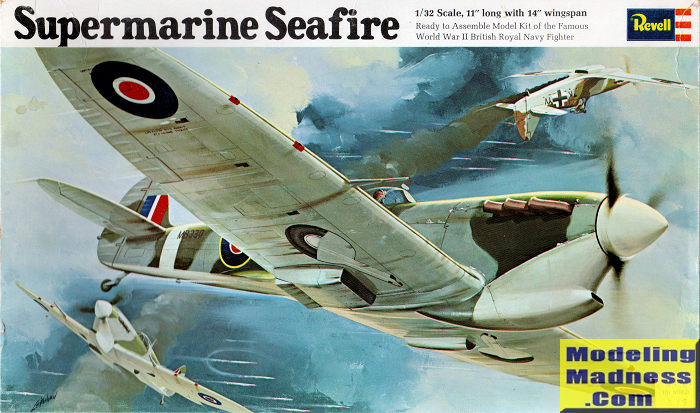
| KIT #: | H-294 |
| PRICE: | CAD$3.79 in 1974 |
| DECALS: | One option |
| REVIEWER: | Bob Perry |
| NOTES: | 1969 release |
| HISTORY |
I think everyone who reads this site will know something of the Supermarine Spitfire, the legendary Royal Air Force fighter of the 1940s. Developed in the late 1930s as one of the first of the RAF’s modern monoplane fighters, it was head and shoulders better than its contemporaries, possible excepting the Bf 109 at the outset. It was a design with some stretch built in and if later designs eventually overtook the Spitfire, its long development history took it from the earliest Merlin engines of about 1,000 horsepower through the larger Griffon of 2,000 horsepower and top speeds from 360 miles per hour in the early days to nearly 460 mph in the final variants. Thousands of Spitfires were used all over the world and were supplied to multiple allied forces from the USA and USSR to smaller air arms rebuilding after the end of hostilities. Many survive in museums and on the airshow circuit to this day.
The Spitfire design was also modified for sea duty for service aboard Royal Navy carriers as the lesser known Seafire from 1942 through the Korean War. Though not designed for the hard life of deck use, the Seafire was a capable fighter that helped the Royal Navy carry the fight to the enemy.
| THE KIT |
 I
was at a loss for something useful to do around the house a few days ago and
decided to take a tour of the stash. This kit resurfaced from the depths of
a basement closet. I have only vague recollections of buying it one day in
1973 or ’74 in a toy store, long since gone, in the underground shopping
concourse of one of the big bank towers in Toronto. The bank is still there
of course but these days the store spaces seem to be all high-end women’s
clothing.
I
was at a loss for something useful to do around the house a few days ago and
decided to take a tour of the stash. This kit resurfaced from the depths of
a basement closet. I have only vague recollections of buying it one day in
1973 or ’74 in a toy store, long since gone, in the underground shopping
concourse of one of the big bank towers in Toronto. The bank is still there
of course but these days the store spaces seem to be all high-end women’s
clothing.
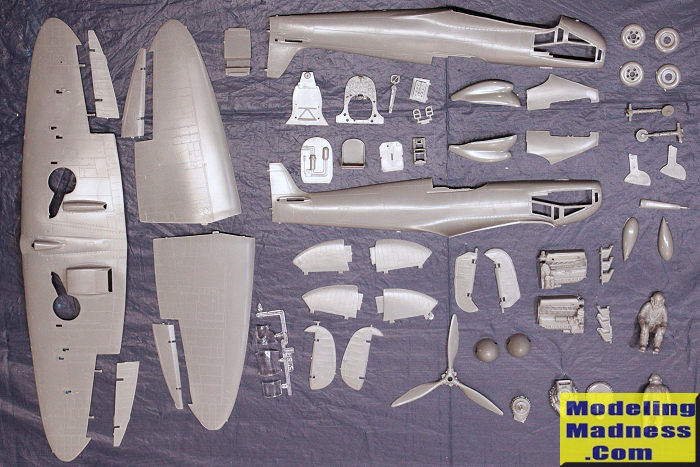
The kit is a 1969 re-release of Revell’s original Spitfire I kit in 1/32 scale, first issued back in 1967, and it shares all the original issue’s parts with a few added to cater to the Seafire. It is a basic kit compared to what one would expect nowadays and that is not, in my view, a bad thing. There are just over sixty parts in pale grey plastic plus four clear, three for the canopy and a marker light for the rear fuselage. The moldings are quite clean with only minor amounts of flash.
The overall dimensions are pretty close to published data. The wingspan is short by about one quarter inch – that’s one eighth of an inch for each wing, close enough for me. I eyeballed the fuselage and wing pieces against downloaded GA drawings – well, there’s scientific for you – and am satisfied things are in the right proportion. Your mileage may vary - mine certainly does – but this is a plastic model and life’s too short to get tragic.
Surface detail is subtle and looks very good, conforming to Revell practice of the time. The panel lines are all engraved and so are the wing rivets while the fuselage riveting is raised, just like the real thing. The control surfaces are separate and intended to move, the elevators connecting to keep them at the same deflection. The toolmakers avoided the sackcloth treatment used by some kit manufacturers on the fabric surfaces and contented themselves with a slightly rougher texture than the neighboring metal areas and that will look just fine under a coat of paint. The ribbing under the fabric is very subtle, manufacturers please note.
The radiator and oil cooler baths are moulded into the single piece lower wing with inserts for the cooling equipment that look quite effective. Note the oil cooler has the semi-circular intake of the Mk. I and II. One thing that isn’t quite right is the lack of the Spitfire’s gull wing effect, hinted at but not fully realised. Those requiring less subtlety should look elsewhere.
The kit includes a basic Merlin engine covered by separate cowling panels either side that fit quite well. Fitting the engine will be necessary even if cementing the cowling closed since it carries the propellor shaft and the exhaust stubs.
The canopy is thin and quite clear. The windscreen has the early exterior armoured glass fitted. The sliding section features the early oval clear vision panel, intended to be opened in an emergency to clear smoke or haze. The combination of the windscreen and hood might narrow the choice of colour scheme a bit, though it was common for the Battle of Britain period.
On the downside, the wheel wells could use side walls though the well roof correctly shows moulded strengthening strips. I have reservations about the wheels themselves for they appear too narrow. The pilot is quite nicely moulded in two pieces, front and back. I expect he’ll cut quite a dashing figure if painted with skill. That’s good because there isn’t much cockpit detail.
Turning to the Seafire, the earliest examples were converted Spitfires without folding wings or catapult spools. Revell’s kit is a minimum change version of their Spitfire I that aims to replicate the earliest version, the Seafire IB, based on the Spitfire VB. It adds a few pieces to be attached – a pair of 20 mm cannon and their broad blisters, an A-frame arresting hook and a large tropical filter for placement under the nose. Extra marks to Revell who recognized and included the longer, more pointed spinner of the VB but did not delete the blunt one of the Mk. I, a bonus for the spares bin. The tropical filter really needs the underside of the nose removed - a couple of passes with a saw should do it - so it can fit snugly, though the instructions imply you can just stick it on. And the A-frame arrestor gear appears as an applique rather than the beefy semi-recessed structure it was.
As if to underline the development of the Seafire, decals are provided for MB330 which had started life as BL678, a Spitfire VB. The decal sheet in this 50-year-old kit had long since gone walkabout but the instructions indicate only roundels and fin flash to complement the serial numbers so that’s not much of a loss. There should be little difficulty in finding something suitable from the aftermarket. Scalemates reports that Revell Germany re-issued the same plastic as late as 1992 and included decals for two operational machines, one in standard Royal Navy camouflage and the other in a striking overall dark blue with Far East roundels.
| CONCLUSIONS |
Overall, finding this kit took me by surprise, and a pleasant one at that. It is simple, accurate enough for me and gently detailed, a blank slate that I am looking forward to tuning up. The early Spitfire and Seafires changed little in outline before the advent of the two-stage Merlins and this kit opens the way for conversion to any of a number of variants with just a little cunning. I’m glad I found it.
| REFERENCE |
So much has been written about the Spitfire that it is difficult to name any source without omitting someone’s favorite. The best start for the uninitiated just might be Wikipedia’s several basic articles about the machine’s variants.
For the dedicated, it’s easy to recommend Spitfire: The History by Eric B. Morgan and Edward Shacklady, published in 1987. This might be the definitive work with detailed engineering discussions plus drawings, many photos and a listing of every single Spitfire and Seafire built.
A
ugust 2025
Copyright ModelingMadness.com. All rights reserved. No
reproduction in part or in whole without express permission from the editor.
If you would like your product reviewed fairly and fairly quickly, please
contact the editor or see other details in the
Note to
Contributors.