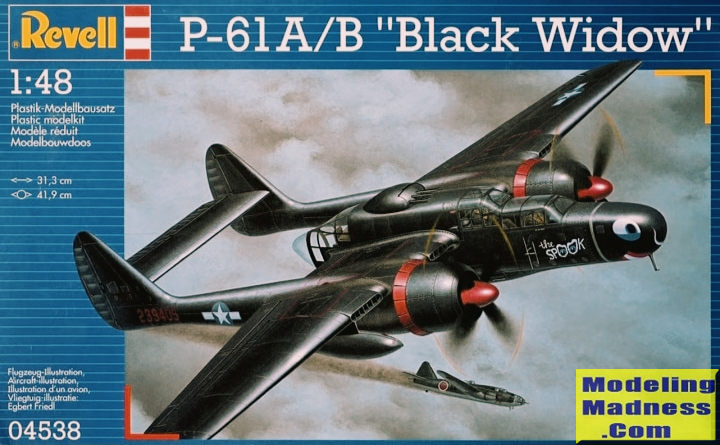
Revell 1/48 P-61 Black Widow
| KIT #: | 04538 |
| PRICE: | 16 Euros |
| DECALS: | Three options |
| REVIEWER: | Spiros Pendedekas |
| NOTES: | Monogram tooling |
| HISTORY |
The Northrop P-61 Black Widow occupies a very special place in the history of American military aviation. Born from the urgent need for an effective night fighter during the Second World War, it was the first American aircraft designed from the outset specifically for the night-fighting role, with airborne radar incorporated into the design from the beginning. The requirement emerged as radar technology was developing rapidly, offering the possibility of detecting and attacking enemy aircraft even when they could barely be seen in the darkness.
The result was an aircraft unlike anything previously produced in the United States. Northrop created a large twin-engine, twin-boom design with the crew and radar equipment housed in a central nacelle. The unusual configuration was dictated by function rather than aesthetics: the aircraft had to accommodate a large radar installation, heavy armament, substantial fuel capacity, and a crew of three. The first XP-61 made its maiden flight on May 26, 1942, while the first production P-61A was completed in October 1943.
By the time the Black Widow entered service in 1944, it represented a remarkable combination of aviation and electronics technology. Its SCR-720 radar allowed the crew to locate targets in conditions where visual interception was extremely difficult, while its heavy armament gave it considerable firepower once an enemy aircraft had been located. The radar was housed in the distinctive nose and could detect aircraft at considerable distances, depending on conditions.
The P-61 saw combat in both the European and Pacific theaters, as well as other areas of operations. Although it arrived relatively late in the war and was never produced in the numbers of more conventional American fighters, it proved to be a capable and technically successful night fighter. Its combination of radar, endurance, firepower, and a purpose-designed airframe made it one of the most interesting aircraft of the period.
The aircraft also developed a personality among the crews who flew it. Its imposing size, twin-boom configuration, radar-equipped nose, and dark finish made it look every bit as mysterious as its name suggested. One of the most famous Black Widows was “Lady in the Dark,” a P-61B of the 548th Night Fighter Squadron operating in the Pacific. The aircraft became associated with the last Allied aerial victory credited before V-J Day, adding another memorable chapter to the story of an already remarkable aircraft.
For the modeller, therefore, the Black Widow is much more than an unusual-looking twin-engine fighter. It represents an important step in the development of airborne radar and dedicated night-fighting technology, while its distinctive appearance makes it one of the most fascinating aircraft to emerge from the Second World War.
| THE KIT |
 Originally
released by Monogram in 1974 and reissued several times over the years under
both the Monogram and Revell labels, this classic 1/48 scale P-61 Black Widow
has long been regarded as one of the company's finest aircraft kits. For many
years, it was virtually the only option available to modellers wishing to build
the famous Northrop night fighter in this scale, earning an almost legendary
reputation. Even today, despite the availability of newer toolings, it continues
to be appreciated for its impressive level of detail and unmistakable Monogram
character. The original tooling has remained remarkably well preserved through
the years, although its age is immediately apparent in both the molding and
engineering.
Originally
released by Monogram in 1974 and reissued several times over the years under
both the Monogram and Revell labels, this classic 1/48 scale P-61 Black Widow
has long been regarded as one of the company's finest aircraft kits. For many
years, it was virtually the only option available to modellers wishing to build
the famous Northrop night fighter in this scale, earning an almost legendary
reputation. Even today, despite the availability of newer toolings, it continues
to be appreciated for its impressive level of detail and unmistakable Monogram
character. The original tooling has remained remarkably well preserved through
the years, although its age is immediately apparent in both the molding and
engineering.
Like many Monogram releases from the 1970s, the kit was designed to provide a rewarding building experience while offering an exceptional amount of detail for its time. The cockpit and crew stations are well appointed, while the radar compartment, gun bays, one exposed engine, optional access panels, movable propellers, and other details create a remarkably comprehensive package.
The example presented here was purchased back in 2002 from a small hobby shop in my hometown of Chalkis, Greece, for the almost unbelievable price of just 16 euros. Even at the time, it represented outstanding value for money considering the size of the model, the extensive interior detail, and the generous contents of the box. More than two decades later, that price seems almost impossible to imagine. I must admit that I have always had a soft spot for Monogram kits, and although I already owned another example of this same kit and had even started building it, I simply could not resist buying another one when I found it at such a price.
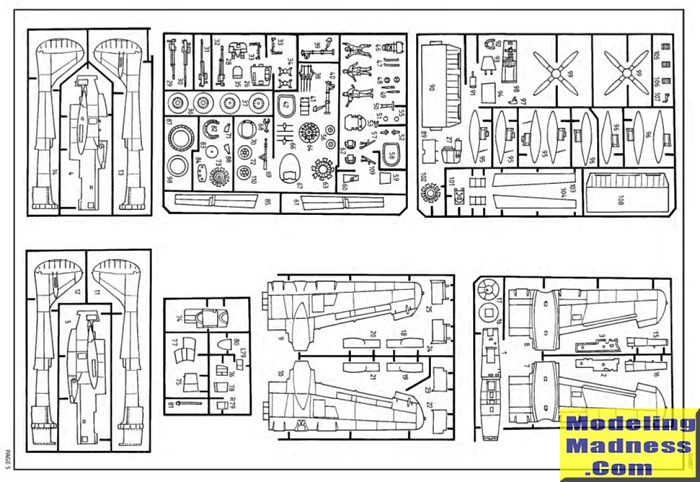
Upon opening the box, I was greeted by 118 black styrene parts, neatly arranged on six sprues. The molding is very much reminiscent of the kit's 1974 origins, with some flash present here and there that will need to be removed during parts preparation - nothing too serious. The surface detail consists, of course, of raised panel lines as was standard practice for Monogram kits of that era, and appear to be placed in the correct locations.
In terms of accuracy, the overall shapes and proportions appear very good, and the Monogram P-61 has long enjoyed a reputation for being dimensionally accurate. The distinctive lines of the real aircraft are captured well, giving the finished model an impressive presence. Considering that the tooling is now more than fifty years old, this is quite an achievement.
The crew area is one of the real highlights of the kit and is particularly impressive when we consider that this tooling dates back to 1974. It is difficult to believe that such a detailed interior was offered more than fifty years ago. The cockpit and crew stations are beautifully appointed, containing practically all the basic features found on the real aircraft. The instrument panels feature raised details, while nicely represented sidewalls add further depth and realism. With careful painting, highlighting, and a little extra work from the modeller, this area can truly shine. The interior remains one of the strongest aspects of the kit even today.
The landing gear is also nicely represented and remains perfectly acceptable even by today's standards. There is sufficient detail not only on the landing gear components themselves but also in the surrounding bays and attachment areas. Naturally, it cannot compete with the highly detailed landing gear found in some modern toolings, but it is more than adequate for a kit of this age.
The kit also features separate flaps and ailerons, which can be positioned either in the neutral or deployed position. P-61s normally had their control surfaces in the neutral position when parked, so that would be the most natural choice for a model displayed on its undercarriage. Nevertheless, Monogram gives the modeller the freedom to choose, particularly if a more dynamic display is desired.
The engines are another interesting feature. One of the highlights of the kit is the option to display one engine with its cowlings open. For this purpose, a complete engine assembly is provided, and it is quite nicely represented. The other engine, where the cowling is intended to remain closed, is provided only as a partial representation. It is, however, molded quite deeply and looks perfectly acceptable once viewed through the closed cowling. The propellers are also nicely represented.
The nose section is another attractive feature. The radar equipment is provided, albeit simplified, together with two different nose options representing the different versions covered by the kit. The nose can be displayed open, allowing the modeller to reveal the radar installation. This is particularly appropriate on a P-61, since the radar was one of the most important and distinctive pieces of equipment carried by the aircraft.
The gun installation is also quite good looking, while the various entry and access hatches are provided as separate parts and can be displayed open or closed. A small access ladder is supplied for the forward entry hatch, adding another nice touch to a parked-aircraft display. Four external fuel tanks are also included. These provide another useful option for representing the Black Widow during the long-range missions for which its considerable endurance was important.
The transparencies are very clear and free from fogging, which is especially welcome on a model with such a large and detailed interior. Unfortunately, they are probably one of the weaker aspects of the kit. The clear parts require careful cleanup, some trimming, and repeated test-fitting in order to achieve a satisfactory fit. Getting everything perfectly aligned in the closed position will not be particularly easy, so displaying some of the sections open may be the more practical and attractive option. And how do I know? Because I have already experienced it while working on the first example of this kit that I started building!
The instructions in this particular boxing are very nice, typical of Revell's early-2000s presentation. They come in the form of a 16-page, black-and-white A4 leaflet containing a photograph of the completed model, a short history of the P-61, a sprues map, a color chart, and the construction sequence. The assembly is divided into no fewer than 42 clear and concise steps, with color callouts provided wherever needed.
Three attractive USAAF schemes are provided: P-61A-1-NO, 548th Night Fighter Squadron, “Lady in the Dark,” Iwo Jima, May 1945. P-61A-5-NO, 422nd Night Fighter Squadron, “Lady Gen,” Florennes, Belgium, December 1944. P-61B-1-NO, 548th Night Fighter Squadron, “The Spook / Anonymous III,” Iwo Jima, April 1945.
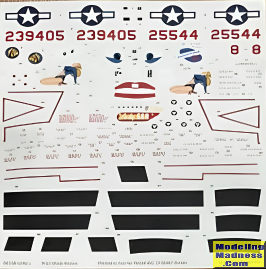 The decals
are beautifully printed by Cartograf, with sharp printing, good registration,
and convincing colors. Despite being almost twenty-five years old, they appear
to be in very usable condition. Naturally, their real quality will only be
confirmed when they are placed in water and applied to the model, but first
impressions are extremely positive.
The decals
are beautifully printed by Cartograf, with sharp printing, good registration,
and convincing colors. Despite being almost twenty-five years old, they appear
to be in very usable condition. Naturally, their real quality will only be
confirmed when they are placed in water and applied to the model, but first
impressions are extremely positive.
Construction begins with one of the kit's greatest strengths: the interior. The instructions devote no fewer than 16 steps to assembling the cockpit, crew stations, and associated equipment. At this stage, the modeller must also choose the appropriate dorsal turret arrangement for the version being built, with either the armed turret or the covered installation.
My advice here is simple: spend as much time as you want on the interior. There is so much detail packed into this part of the model that careful painting, dry-brushing, weathering, and highlighting will really pay off once the fuselage is closed. This is an area where the modeller can truly make the most of the remarkable work Monogram put into the tooling in 1974.
The nose landing gear is attached at this stage as well. It mounts to the cockpit floor, which also forms the upper wall of the nose landing gear bay. It must be installed now because fitting it later would be extremely difficult, if not impossible. This is perhaps a small disadvantage for modellers like me who are not always as delicate as they should be when handling a model during construction! Once it is installed, care will be required to avoid damaging it.
The fuselage halves are then joined, trapping the interior and nose landing gear between them. The radar assembly is constructed next and attached to the nose, followed by the appropriate nose section for the version being built. The nose can be permanently glued in place or left removable, allowing the radar to remain visible.
If the modeller chooses to display the radar with the nose open, however, another issue must be considered: the P-61 is a natural tail-sitter and requires considerable nose weight. Leaving the nose open removes one of the most convenient places for adding that weight. Additional ballast can therefore be hidden in other areas, particularly the engine nacelles and, where space permits, around the cockpit. This should be planned before closing the relevant assemblies, because once the model is together there will be very few opportunities to correct the problem.
The wings are then assembled and attached to the fuselage. At this stage, the modeller installs the separate flaps and ailerons, choosing between the neutral and deployed positions. As mentioned earlier, the normal stance of a parked P-61 would have the control surfaces neutral, but the choice is ultimately yours.
Attention then turns to the engine nacelles and the distinctive twin-boom assemblies. The engines, together with their propellers, are assembled first. One engine is provided as a complete unit for the open-cowling option, while the other is represented only partially for the closed-cowling installation. If the complete engine is not going to be displayed, the cowlings can simply be glued permanently in position.
The main landing gear is also assembled and installed at this point. It has to be fitted before the boom halves are closed around it, and I am not convinced that it could be installed successfully at a later stage. As with the nose gear, this means taking extra care during subsequent handling. For those who prefer an in-flight display, the kit also provides the option of building the landing gear retracted.
The engines, propellers, and landing gear are then trapped between the respective boom halves. The completed booms are attached to the wings, while the horizontal tailplane is captured between their rear sections. This creates the unmistakable twin-boom silhouette of the Black Widow. Careful alignment here is important, as even a small error can become quite noticeable once the two booms and tailplane are viewed from behind.
The transparencies are installed toward the later stages of construction, and this will probably be another challenging phase of the build. As mentioned earlier, the clear parts are beautifully transparent but their fit can be demanding. Good cleanup, some trimming, repeated dry-fitting, and plenty of patience will be necessary. It is certainly not an area where rushing will pay off, particularly because so much of the beautifully detailed interior remains visible through the extensive glazing.
The four external fuel tanks are then assembled and attached, followed by the remaining small external details, including the radar antennas, antenna masts, pitot tube, and other fittings. With these final parts installed, the distinctive appearance of the Black Widow finally comes together.
There is no doubt that this is a challenging build. The relatively high parts count is only part of the story; the real challenge comes from the engineering of a tooling first released in 1974. The kit has survived the passage of time remarkably well, but some areas inevitably require more care than we would expect from a modern tooling. Experienced modellers will probably find it useful to alter the assembly sequence where appropriate, particularly when it comes to adding delicate parts that might otherwise be vulnerable during handling.
| CONCLUSIONS |
Despite its age, the Monogram 1/48 P-61 Black Widow remains a truly lovely kit and a wonderful reminder of what made the company's classic releases so special. Yes, it is an old mold. The raised panel lines will inevitably be a drawback for some modellers, and the clear parts demand patience, careful preparation, and some trimming. The fit in several areas can also be challenging. But these are simply part of the character of a tooling that first appeared in 1974, and they should not overshadow what this kit gets so wonderfully right.
The overall shape has stood the test of time extremely well, and the model captures the distinctive appearance of the Black Widow beautifully. Above all, the interior is simply fantastic. Considering that this kit was designed more than fifty years ago, the amount of detail Monogram managed to pack into the cockpit, crew stations, radar compartment, gun bays, and engine installation is genuinely impressive. Add the beautifully printed Cartograf decals and the well-presented Revell instructions, and there is still an awful lot to like here.
Then there is the price. Sixteen euros for this kit was, quite frankly, beyond belief, even back in 2002. Today, when modern 1/48 aircraft kits of this size can command very serious prices—and with Revell kits themselves becoming increasingly expensive—it seems almost impossible to imagine finding a kit like this for such a sum. That bargain certainly made the purchase even sweeter, although, knowing my soft spot for Revell/Monogram kits, I suspect I would probably have bought it anyway!
This is what makes building a classic like the Monogram P-61 so charming. It does not simply fall together—you have to clean, dry-fit, think ahead, and occasionally improvise. In return, you feel that you are actually building the model rather than simply assembling it. Despite its age and shortcomings, the old Black Widow still stands proudly today. Excellent shapes, a magnificent interior, plenty of character, and that unmistakable Monogram charm make it a very satisfying kit to build. More than fifty years on, it still has plenty of life left in it—and for lovers of classic kits, that is something rather special.
Definitely a kit worth tackling.
Happy Modeling!
Spiros Pendedekas
August 2026
Copyright ModelingMadness.com. All rights reserved. No reproduction in part or in whole without express permission of the editor.
If you would like your product reviewed fairly and fairly quickly, please contact the editor or see other details in the Note to Contributors.
Back to the Main Page Back to the Review Index Page Back to the Previews Index Page